
You typed the message three times and deleted it three times. You had the job posting open in one tab and a dozen reasons not to apply in your head. You wanted to ask the question in the meeting, and you watched someone else ask it instead, and felt something between relief and disappointment.
None of that is really about the message, or the job, or the question. It’s about what might come back: No.
Fear of rejection is the anticipatory dread of being turned down, excluded, criticized, or found not strong enough, which shapes what you do before anyone has actually said no to you. It’s not a diagnosis, and it’s not a character flaw. It’s a very old part of your wiring, doing its job a little too aggressively for modern life.
This article walks through why rejection lands so hard, where that sensitivity tends to come from, how to tell it apart from a few things it often gets confused with, and what actually helps, not “just be more confident,” but a real sequence you can use the next time you catch yourself about to back out of something.
Key Takeaways:
- Fear of rejection is a near-universal, evolutionarily rooted response; not a character flaw, and not evidence that something is wrong with you.
- Social rejection activates some of the same brain regions involved in physical pain, though the two aren’t neurologically identical; the popular “it hurts exactly like a broken bone” claim overstates the research.
- It’s built from a mix of baseline evolutionary wiring, early relational experience, and reinforcing life events; rarely just one cause.
- Fear of rejection, social anxiety, rejection sensitivity, and rejection sensitive dysphoria are related but distinct; knowing which one (if any) fits you matters more than treating them as interchangeable.
- The most effective way through it is graded, repeated small exposure; not eliminating the fear, but acting alongside it until it stops making your decisions for you.
- If the fear is consistently blocking things that matter to you, or the reactions feel disproportionate and hard to explain, it’s worth talking to a professional rather than continuing to manage it alone.
Why rejection hurts so much
There’s a reason “rejection” and “hurt” show up in the same sentence so often, and it’s not just a figure of speech.
Psychologists Roy Baumeister and Mark Leary proposed that belonging to a group isn’t a nice-to-have for humans; it’s closer to a baseline need, on a par with safety or food. Their “need to belong” framework argues that humans are built to seek out and maintain relationships, and that this drive shows up early, persists across cultures, and doesn’t switch off just because modern life is safer than the environment in which it evolved.
That’s the evolutionary piece: for most of human history, being excluded from your group wasn’t an inconvenience. It could be the difference between surviving and not. A nervous system that treats social exclusion as a real threat isn’t malfunctioning; it’s doing exactly what it was built to do, in a world where the stakes have changed but the alarm system hasn’t caught up.
There’s also a neurological piece. In a well-known study, Naomi Eisenberger, Matthew Lieberman, and Kipling Williams put people in an fMRI scanner and had them play a simple ball-tossing game with what they believed were two other players. Partway through, the game was rigged so the other “players” stopped throwing to them. Being left out activated the anterior cingulate cortex and the insula regions, which are also involved in processing physical pain.
That finding is repeated often, sometimes in an oversimplified way: “rejection literally hurts like a broken bone.” That’s not quite accurate. What the research shows is real, meaningful overlap in brain activity, not that social and physical pain are neurologically identical. Later work using more detailed analysis methods has found that social and physical pain share some neural territory but also have distinct patterns. The honest version is: rejection recruits some of the same machinery your brain uses for physical pain, which is a big part of why it doesn’t feel like “just a thought”; it feels like something happening to your body.
There’s a third piece worth naming: psychologist Mark Leary’s sociometer theory. The idea is simple. Your self-esteem works a bit like a gauge, quietly checking how accepted you are by the people around you. When it dips after a rejection, that’s not you overreacting; that’s the gauge doing exactly what it’s built to do.
Put together: you’re not weak for feeling rejection intensely. You’re running old, useful hardware in a world that generates far more low-stakes rejection- an unanswered text, a passed-over idea, a match that goes quiet- than it was ever designed to handle.
Where fear of rejection come from
Fear of rejection isn’t one single cause. It’s usually some combination of the following.
- The baseline, evolutionary layer. Everyone has some amount of this. It’s not a red flag on its own; it’s the background hum of being a social animal.
- Early relational experience. Psychologists Geraldine Downey and Stephen Feldman developed the concept of rejection sensitivity: the tendency to anxiously expect rejection, notice it even when it isn’t clearly there, and react intensely when it seems to be happening. Their research and work that followed it have linked harsher, more inconsistent, or more critical experiences of rejection earlier in life, from caregivers, but also from peers, to higher rejection sensitivity in adulthood. This connects closely to attachment theory: children who experienced caregivers as unpredictably available or responsive often develop a template, carried into adulthood, where closeness feels conditional, and rejection feels like it’s always one misstep away.
Related: 23 Signs of Repressed Childhood Trauma in Adults
- Reinforcing experience over time. A pattern of harsh, public, or repeated rejections, a difficult breakup, being frozen out socially, or a string of job rejections during a hard stretch can sharpen a fear that was already there, the same way a single bad reaction can make you more careful in a specific area for a long time afterward.
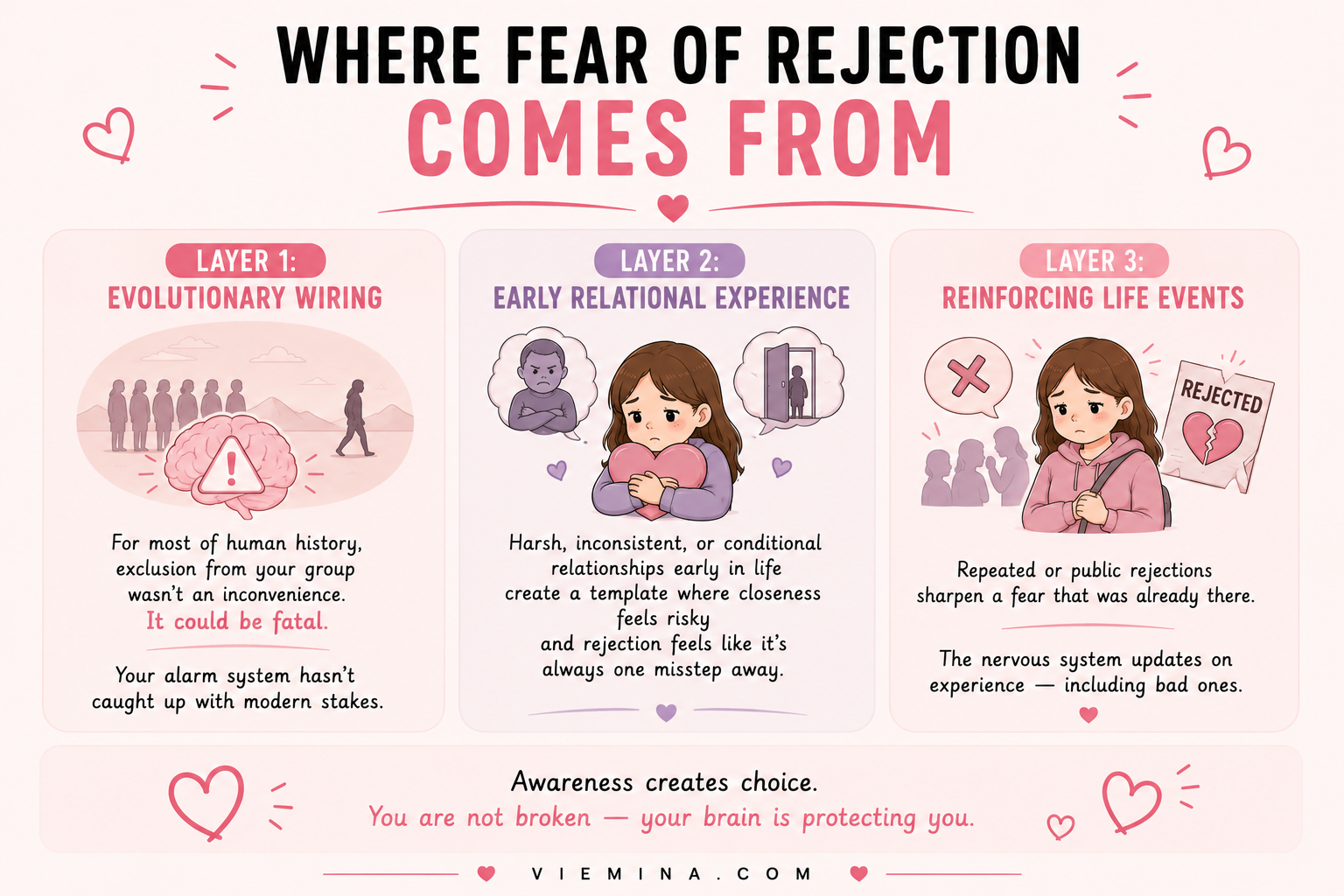
None of these mean something is “wrong with you.” Rejection sensitivity sits on a spectrum. Most people are somewhere on it. The question isn’t whether you have any fear of rejection; almost everyone does; it’s whether it’s mild background noise or something actively steering your decisions.
These four terms get used almost interchangeably online, but they’re not the same thing, and knowing which one actually describes your experience matters; both for understanding yourself and for knowing what kind of help, if any, would actually be useful.
| What it is | What it centers on | Formal diagnosis? | |
| Fear of rejection | A common, often mild-to-moderate anticipatory fear of being turned down or excluded | The outcome; being told no, left out, or judged | No; a general human experience, not a clinical category |
| Social anxiety disorder | Persistent, significant fear of social or performance situations where you might be scrutinized or embarrassed | The situation itself; being observed, judged, or embarrassed in front of others | Yes; a recognized diagnosis in the DSM-5 |
| Rejection sensitivity | A research-backed personality tendency to anxiously expect, readily perceive, and intensely react to rejection, including in ambiguous situations | A cognitive pattern; how quickly and strongly you interpret something as rejection | No; a studied psychological construct, not a diagnosis |
| Rejection sensitive dysphoria (RSD) | Sudden, overwhelming emotional pain in response to real or perceived rejection or criticism, most discussed in ADHD (and increasingly, autism) contexts | The intensity and suddenness of the emotional reaction itself | No; a widely used clinical term, but not currently in the DSM-5 |
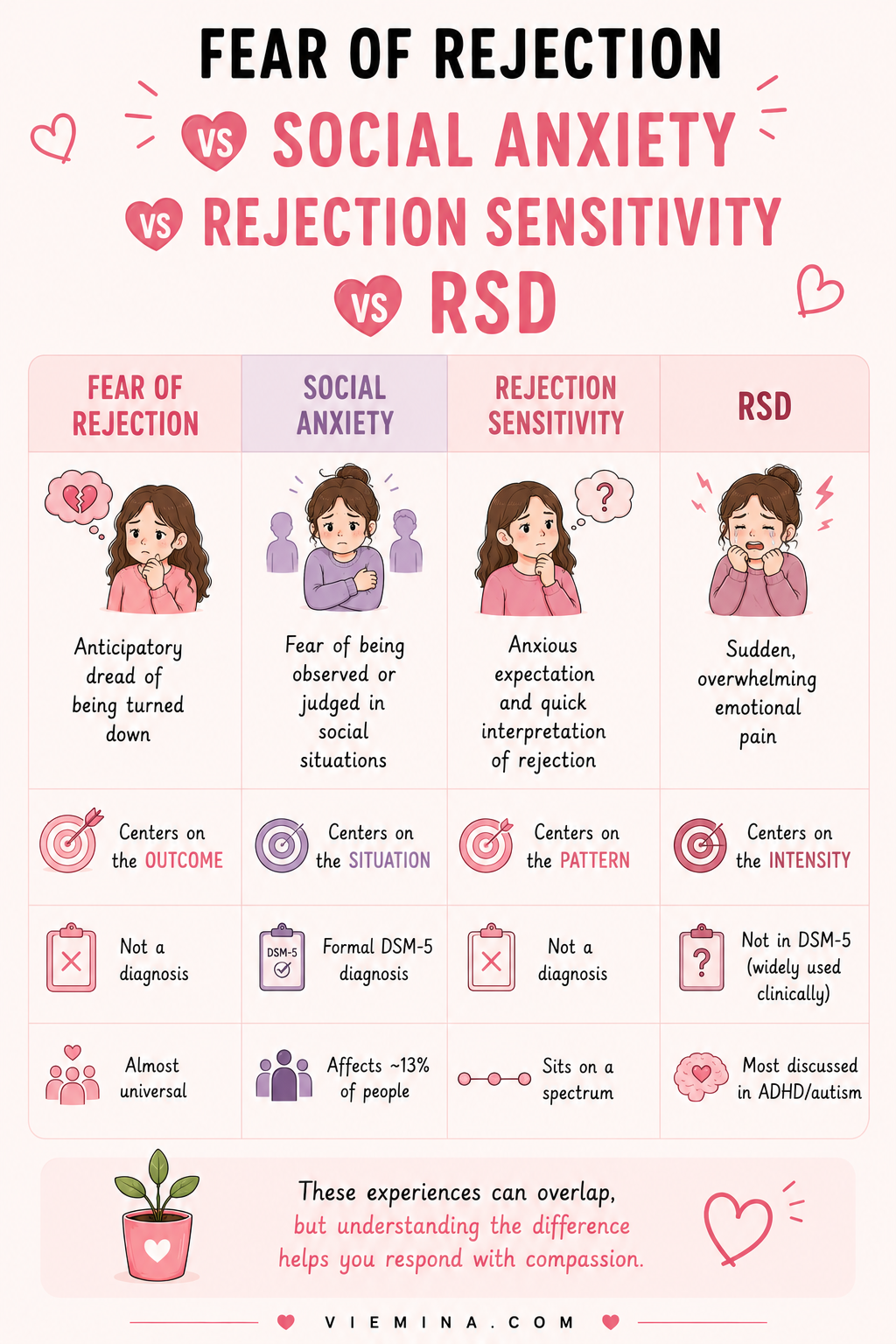
A few things are worth being precise about here. Social anxiety is centered on the situation; the fear is about being watched or judged while doing something, even without any rejection actually happening. Rejection sensitivity is centered on interpretation: how fast your mind jumps to “they’re rejecting me” from a neutral or ambiguous signal, like a slow reply or a flat tone. Rejection-sensitive dysphoria is centered on intensity; a smaller trigger produces a disproportionately overwhelming reaction, often described by people who experience it as feeling closer to physical pain than ordinary disappointment.
It’s entirely possible to have fear of rejection without having social anxiety, without meeting a rejection-sensitivity research profile, and without RSD. It’s also possible for two or three of these to overlap in the same person. None of this is meant as a self-diagnostic tool; only a doctor or therapist can assess for social anxiety disorder or ADHD, but having accurate language for what you’re noticing in yourself is genuinely useful, including when deciding whether it’s worth talking to someone.
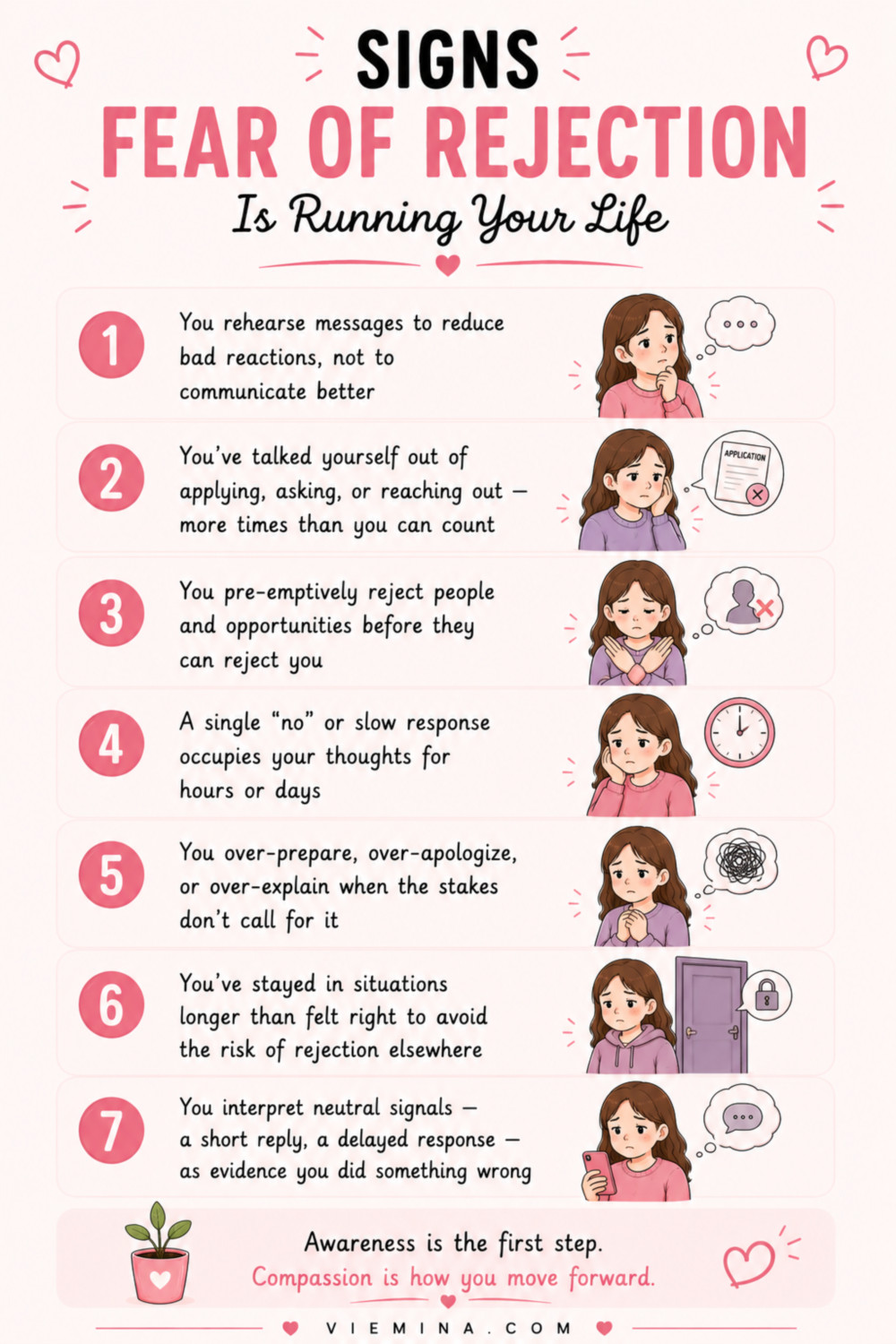
Signs that fear of rejection is running your life
Not “signs you have it”; almost everyone has some amount of it. These are signs it’s doing more than the background-hum amount of work.
- You rehearse messages, emails, or conversations extensively before sending or having them, not to communicate more clearly, but to reduce the chance of a bad reaction.
- You’ve talked yourself out of applying, asking, or reaching out first more times than you can count, and told yourself a practical-sounding reason each time.
- You notice yourself pre-emptively rejecting people, opportunities, or ideas before they can reject you; deciding “they’ll probably say no” and acting on that decision without checking.
- A single no, or even a slow or lukewarm response, can occupy your thoughts for hours or days.
- You over-prepare, over-apologize, over-explain or overanalyzing in situations where the actual stakes don’t call for it.
- You’ve stayed in a relationship, job, or friend group longer than felt right, partly because leaving meant risking rejection somewhere else.
- You interpret neutral things, such as a short reply, someone looking at their phone, or a delayed response, as evidence that you did something wrong.
If several of these are familiar, that’s not a verdict. It’s useful information about where avoidance has quietly become the default.
How to work with fear of rejection
Not “how to stop feeling it”; that’s not a realistic goal, and promising it would be dishonest. This is about acting despite it, in a way that actually gets easier with repetition.
1. Separate the event from the prediction.
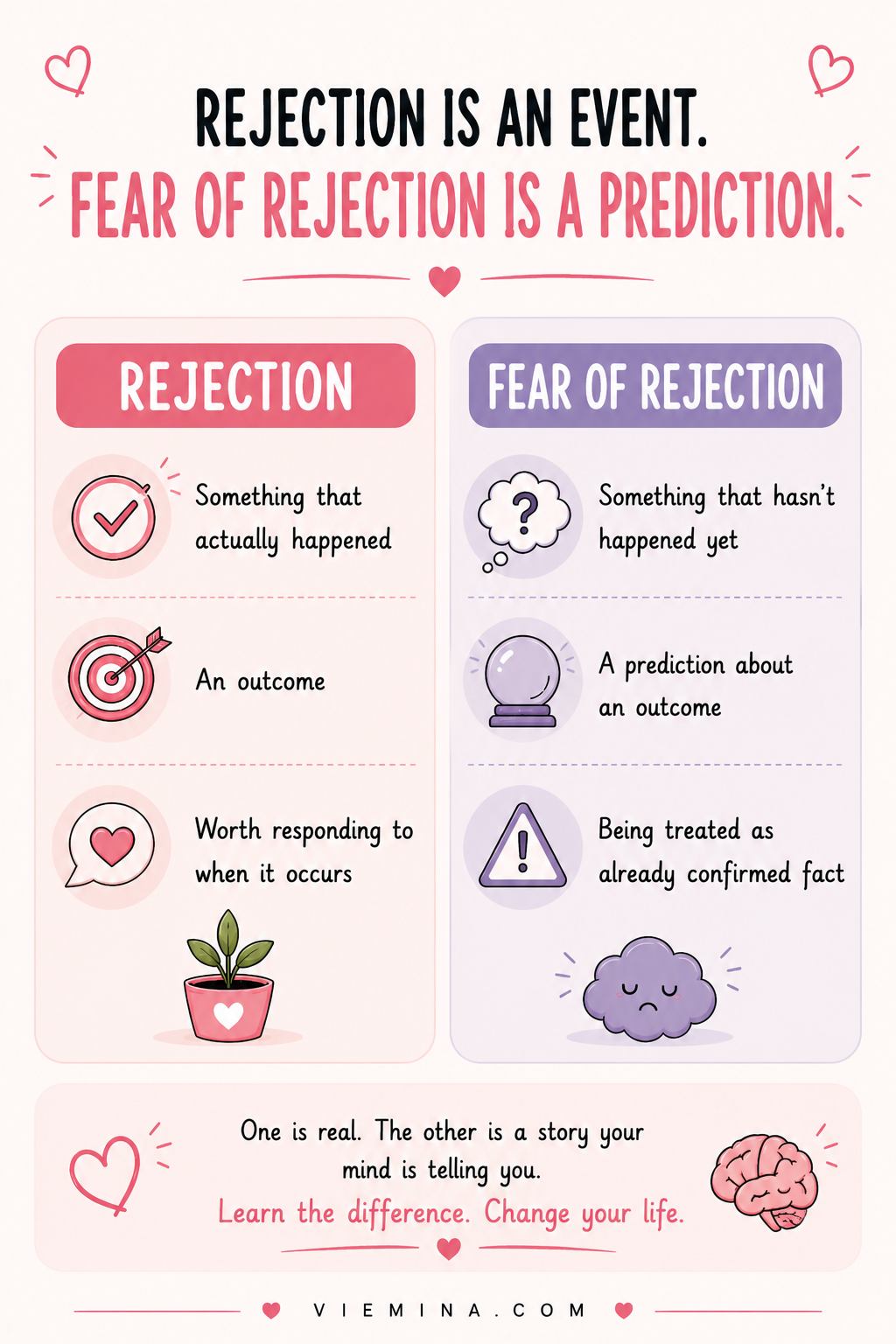
Most of what you’re reacting to hasn’t happened yet. Rejection is an event. Fear of rejection is a prediction about an event. When you catch yourself avoiding something, it’s worth asking directly: has this actually happened, or am I responding to my best guess about what will happen? That distinction alone doesn’t remove the fear, but it stops the fear from being treated as already-confirmed fact.
2. Do the “rejection math.”
Take the specific thing you’re avoiding and write down the realistic worst outcome; not the catastrophic version, the actually-likely one. Then write down what you’d say to a friend who described that exact fear to you. Most people are far more generous, accurate, and proportionate when the fear belongs to someone else. This exercise closes some of that gap.
3. Build a graded exposure ladder.
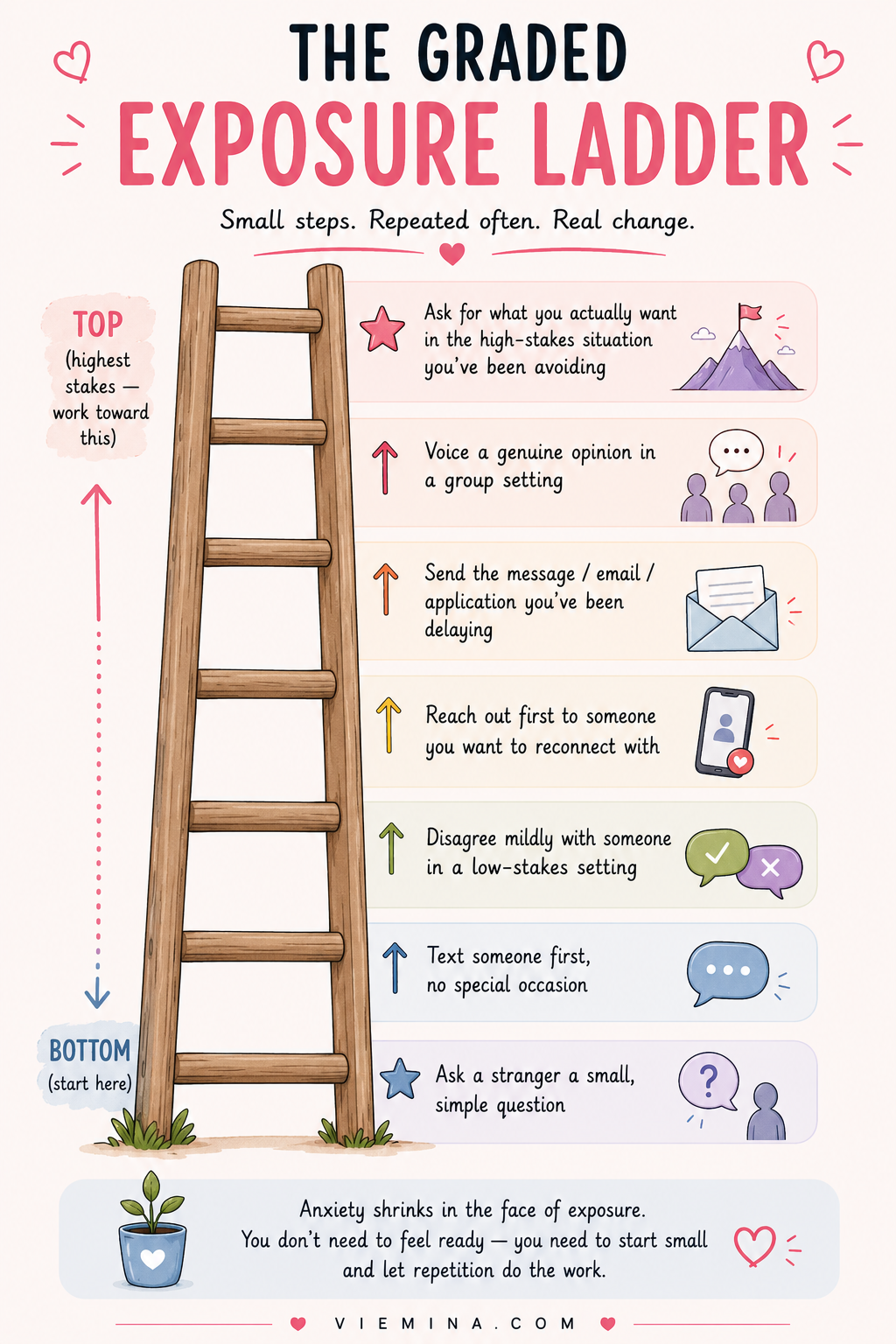
Confidence with rejection is built the same way physical endurance is: gradually, with repeated small reps, not one dramatic leap. Instead of aiming your first attempt at the highest-stakes situation you’re avoiding, build a short ladder of lower-to-higher-stakes versions of the same fear: asking a stranger for the time, texting someone first with no special occasion attached, telling a friend you’d rather do something different than what they suggested, then working up toward the specific thing you’ve been avoiding. Each successful rep, even a small one, is evidence your nervous system can update on.
4. Practice noticing the feeling without obeying it.
The physical sensation, the tight chest, the stomach drop, the urge to close the tab, is going to show up before it goes away, not after. The skill isn’t eliminating that sensation before acting. It’s learning to feel it and act anyway, on a small scale first, so it stops being a stop sign and starts being background noise you can move through.
5. Watch for pre-emptive self-rejection.
Deciding someone will say no and quietly withdrawing before they get the chance feels like protection, but it guarantees the outcome you were afraid of without giving the other person a say in it. It looks like this: you decide the person will probably say no before you’ve even sent the text asking them out, so you never send it, and then tell yourself you weren’t that interested anyway. The rejection never happened, but you got all the disappointment and none of the information. Naming this pattern out loud, even just to yourself, “I’m about to reject this before they can”, is often enough to interrupt it.
6. Let a specific rejection be specific.
When an actual rejection happens, it’s worth resisting the pull to let it become general evidence about your worth (“no one wants me,” “I always mess this up”). One outcome, in one situation, with one person, at one point in time, not a referendum. This isn’t about pretending it doesn’t hurt. It’s about keeping the size of the conclusion honest.
When it’s worth getting extra support
Most fear of rejection responds well to the kind of gradual, self-directed practice above. But it’s worth talking to a therapist or doctor if:
- The fear is consistently stopping you from things that matter to you: relationships, work opportunities, basic social contact, not just occasionally, but as a pattern.
- You notice reactions to rejection or criticism that feel disproportionate, sudden, or physically overwhelming, in a way that’s hard to explain even to yourself.
- The fear seems tied to a specific, difficult history, a period of harsh criticism, a traumatic rejection, or a pattern in an earlier relationship that hasn’t settled with time.
- You suspect a connection to ADHD, autism, social anxiety disorder, or a similar pattern, and want an actual assessment rather than a guess.
None of this means something is fundamentally wrong with you. It means this particular problem has gotten big enough that doing it alone isn’t the most efficient way through it anymore, which is true of plenty of things that aren’t emergencies.
Related: 15 Hidden Signs of Emotional Trauma in Adults & How to Heal
Related: What Are the 17 Symptoms of Complex PTSD?
Frequently Asked Questions About Fear of Rejection
No, though they can overlap. Social anxiety centers on fear of being watched, judged, or embarrassed in social or performance situations, even without any rejection occurring. Fear of rejection centers specifically on the outcome of being turned down or excluded. You can have one without the other.
Can fear of rejection be a sign of ADHD or trauma?
It can be connected to both, but it isn’t proof of either on its own. Rejection-sensitive dysphoria is widely discussed in ADHD (and increasingly autism) communities, and a history of harsh or inconsistent rejection earlier in life is a known contributor to adult rejection sensitivity. A professional assessment, not a self-check, is the only way to know if either applies to you specifically.
Why do I feel rejected even when nothing has actually happened?
This is closely related to what researchers call rejection sensitivity: a tendency to notice and interpret ambiguous signals (a slow reply, a flat tone, a change of plans) as rejection, even when there’s a more neutral explanation. It’s a pattern of interpretation, not evidence that rejection is actually occurring.
Does fear of rejection ever fully go away?
Not entirely, and that’s a realistic expectation rather than a discouraging one. The evolutionary and neurological roots of this fear aren’t going anywhere. What changes with practice is your relationship to it; the fear gets quieter, less automatically obeyed, and less able to make decisions on your behalf without your input.
Does this only affect romantic relationships?
No. It shows up just as often in friendships, family, relationships, work (asking for a raise, pitching an idea, applying for a role), and everyday social contact (starting a conversation, reaching out first). Most articles on this topic default to dating examples, but the underlying pattern is the same across every context.
How is this different from just having low self-esteem?
They’re related but not identical, and the relationship isn’t one-directional. Rejection can lower self-esteem, and lower or more fragile self-esteem can make you more sensitive to future rejection; it’s closer to a loop than a single cause pointing one way.
Conclusion
Here’s the thing worth carrying with you: the fear you’ve been fighting isn’t proof that you’re too sensitive, too much, or somehow behind everyone else who seems to move through the world more freely. It’s a very old system, doing a very old job, in a world that no longer matches what it was built for. That’s not a character flaw. That’s just being human at this particular moment in history.
You don’t need to wait until the fear disappears to start doing the things it’s been keeping you from. That was never really the deal on offer. The deal is smaller and more doable than that: feel it, and do the thing anyway, in a size you can actually manage today.
So pick one thing, the message you’ve rewritten three times, the application you’ve had open in a tab for a week, the question you swallowed in the last meeting; and do the smallest possible version of it before the day is over. Not the whole leap. Just the next honest step.
You will still feel the fear the next time, too. That’s not a sign you failed at this. It’s a sign you’re paying attention to something real. And each time you act alongside it instead of waiting for it to leave first, you’re teaching yourself, in the only way that actually sticks, that you can survive a no, and that a no was never the same thing as your worth being decided.