
Every November, the same scene repeats. Stores switch to holiday music. Feeds fill up with matching pajamas and golden-lit family dinners. And meanwhile, millions of people quietly type the same question into a search bar at 9pm: “Why do I feel so sad during the holidays?”
This year, the numbers are louder than ever. An analysis of Google search data by Thriveworks found that searches for “seasonal depression” jumped 200% between early August and late September 2026 — and peaked the first week of November, earlier than in previous years. The American Psychiatric Association’s Healthy Minds Poll (released November 2025) found that 41% of U.S. adults expect more holiday stress than the year before, up from 28% in 2024. We are not imagining it: the season that’s supposed to be “the most wonderful time of the year” has quietly become one of the hardest on mental health.
If you’ve been feeling flat, heavy, or weirdly numb since the clocks changed — nothing is wrong with you. There’s a name for what you’re feeling: the holiday blues. And there are real, practical reasons why this specific stretch of the calendar messes with your head.
This guide walks you through what the holiday blues actually are, how to tell them apart from seasonal depression, why November and December hit so hard, and most importantly, the 10 things that genuinely help.
I know this feeling too well. Every November, without fail, I catch myself wondering why I’m running on empty when my life “should” be fine. It took me years to stop blaming myself for it, and to realize that the darkest weeks of the year don’t respond to willpower. They respond to strategy. This is the guide I wish I’d had five years ago, when I thought I just needed to try harder.
What Are the Holiday Blues, Exactly?
The “holiday blues” (sometimes called holiday depression) is a temporary dip in mood tied to the holiday season itself. It’s not an official diagnosis, and that’s exactly why people dismiss it.
But the pattern is recognizable:
- A low, sad, tense, or empty mood that starts in late fall (usually November)
- Irritability over small things — crowds, noise, last-minute plans
- Fatigue that sleep doesn’t fix
- A gap between how the holidays “should” feel and how yours actually feel
- Feeling more lonely in a season about togetherness
Unlike clinical depression, the holiday blues usually ease once the season passes. But “temporary” doesn’t mean “not real”, and it doesn’t mean you have to white-knuckle your way through six weeks of it.
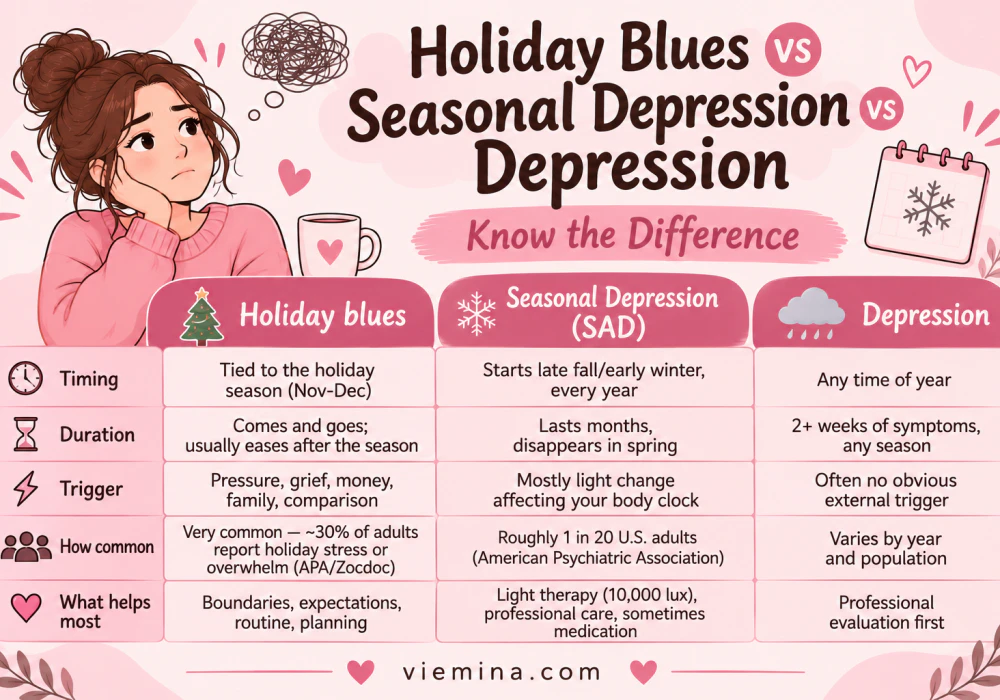
Holiday Blues vs. Seasonal Depression vs. Depression: How to Tell the Difference
These three get used interchangeably, but they’re not the same thing, and knowing which one you’re dealing with changes what helps. (We already broke down feeling blue vs depression on this blog; here’s the holiday-specific version.)
| Holiday blues | Seasonal depression (SAD) | Depression | |
|---|---|---|---|
| Timing | Tied to the holiday season (Nov-Dec) | Starts late fall/early winter, every year | Any time of year |
| Duration | Comes and goes; usually eases after the season | Lasts months, disappears in spring | 2+ weeks of symptoms, any season |
| Trigger | Pressure, grief, money, family, comparison | Mostly light change affecting your body clock | Often no obvious external trigger |
| How common | Very common — ~30% of adults report holiday stress or overwhelm (APA/Zocdoc) | Roughly 1 in 20 U.S. adults (American Psychiatric Association) | Varies by year and population |
| What helps most | Boundaries, expectations, routine, planning | Light therapy (10,000 lux), professional care, sometimes medication | Professional evaluation first |
Two things worth knowing about seasonal depression (SAD): it’s a real, diagnosable condition — a seasonal pattern of major depressive disorder, according to the NIMH — and it’s more common in women, in people living farther from the equator, and in people with a family history of depression. If your mood drops like clockwork every single winter and lasts for months, that’s worth a conversation with a professional, not just a self-care checklist.
The honest rule of thumb: the holiday blues are about the season; seasonal depression arrives with the season. One passes when the calendar does. The other doesn’t — and that difference matters.
Related: Smiling Depression: The Hidden Pain Behind a Happy Face
Why November and December Hit So Hard (5 Real Reasons)
The holiday blues aren’t a character flaw. They’re a fairly predictable response to five pressures stacking up at once.
1. The light literally changes your brain chemistry
Shorter days disrupt your circadian rhythm and lower serotonin — the same mechanism behind seasonal depression, just milder for most people. Your body is responding to the dark exactly as bodies do. You’re not “being negative”; you’re running on less light.
2. Comparison goes into overdrive
Social media was already a highlight reel. In December it becomes a curated holiday highlight reel: matching family sets, perfect tables, romantic snow moments. Your brain does what brains do — it compares your ordinary Tuesday with someone’s staged Christmas Eve. Research on social comparison has shown for years that this gap quietly drains mood, and the holidays multiply the inputs.
3. Money pressure with a deadline
In the APA poll, worrying about affording gifts (46%) and grief or missing someone (48%) were the top two sources of holiday anxiety. Financial stress doesn’t pause for tinsel, and “just spend less” isn’t advice when gift-giving feels like a social contract.
4. Family dynamics come back on duty
The holidays compress complicated relationships into small rooms and long dinners. Old roles, unsolicited comments, and boundary-testing all come back at once — often in the same week your energy is lowest. The APA poll also found that 32% of adults worry about difficult family dynamics during the holidays.
(If guilt is the tool being used on you, we have a whole guide to guilt-tripping and how to respond.)
5. Grief and loneliness feel louder
A 2014 NAMI survey found that 64% of people with mental health conditions say the holidays make their conditions worse; largely through grief, distance from family, and loneliness. Empty chairs, distance, estrangement: a season built on “togetherness” amplifies every kind of absence. In the APA poll, 31% of adults specifically worried about being lonely during the holidays.
The November Trap: Why We Put Our Mental Health on Hold
Here’s the strangest part of the whole pattern — and the one almost nobody talks about.
Zocdoc’s platform data shows that bookings for mental health providers drop 11% in November and December compared with September and October. Read that again: precisely when self-reported stress, anxiety, and low mood surge, people cancel or postpone the one thing that helps.
Dr. Christine Crawford, MD, adult and child psychiatrist and Chief Medical Officer at NAMI, calls it white-knuckling: adults write off real symptoms as “just the holiday blues” — I’m only feeling this because it’s cold and dark — and decide to hold on until January.
The psychology is sneaky: high stress feels more tolerable when it has a built-in deadline. “It’s almost Christmas anyway.” So we compress, cancel, and cope; for six to eight weeks. That’s a long time to run a nervous system on emergency mode, and it’s exactly why so many people don’t feel “back to normal” until February. (The Zocdoc data bears this out: mental health bookings jump 26% in January compared with November and December — a surge of people who realize, once the chaos clears, that they still don’t feel well.)
The fix is unglamorous: don’t pause your mental health for the season. Keep the appointments. Keep the one walk. Keep the one habit that keeps you anchored. You don’t need your full routine through the holidays, you need your minimum viable routine, protected.
I learned this one the hard way. A few years ago, I dropped everything in December; therapy, walks, the morning routine that kept me grounded, because I was “too busy” and told myself January would fix it. January came and I was worse than I’d been in months. Now, no matter how chaotic December gets, I protect two things: my morning light and my therapy appointment. Everything else is negotiable. Those two things aren’t.
10 Things That Actually Help With the Holiday Blues
None of these require a personality transplant or a perfect December. They’re small, boringly realistic moves, chosen because they target the five pressures above. (If you want a broader foundation first, start with our 62 easy self-care ideas — then come back here.)
1. Get bright light in the first hour of your day
This is the single highest-leverage change for the dark months. Either 20-30 minutes outside in natural light (a morning walk counts double), or a 10,000 lux light therapy box for about 30 minutes a day, the intervention with the strongest research support for winter low mood. Morning light tells your body clock that the day has started; without it, your whole system drifts later and heavier.
2. Protect one anchor habit — and only one
Don’t try to run your full routine through December. Pick one thing that reliably steadies you (a walk, a workout, 10 minutes of journaling, your therapy session) and treat it as an appointment. If you like structure, the 75 Soft challenge is built exactly for this — gentle rules instead of all-or-nothing discipline. The goal right now isn’t optimization; it’s keeping one thread of normalcy intact so January doesn’t start from zero.
3. Decide your money limit before December does
Since affording gifts is one of the top two holiday worries, set the number now — total gifts, one line per person, done. A written limit converts vague anxiety into a decision you’ve already made. (And yes: cheaper, handmade, or “we’re doing a low-gift year this time” are all legitimate scripts.)
4. Lower the bar on events — deliberately
Write down every December obligation, then circle the two or three that actually matter to you and give yourself explicit permission to let the rest be smaller, shorter, or skipped. Perfectionism is what turns “the perfect holiday” into a job; choosing less is not failure — it’s the difference between attending your holidays and surviving them.
Related: How to Overcome Perfectionism: What It Is and How to Stop It
5. Script your boundaries before the dinner, not during them
Boundary-setting fails mid-conversation and works pre-loaded; same principle as setting boundaries with friends, but with more gravy. Two scripts that fit in a text message:
- “We’re so looking forward to seeing everyone; we’ll come for dinner but need to head out by 9.”
- “I’d rather not discuss that today; tell me about your trip instead.” (redirect, not debate)
Arriving with your own car, a time, and one redirect phrase handles 80% of family friction.
6. Plan for the hard days specifically
The hardest moments of the season are predictable: the empty chair, the specific date, the quiet Christmas morning. Plan them on purpose. If you’re grieving; a loss, an estrangement, even a fresh breakup ; decide in advance what you’ll do that day: visit, ritual, walk, film, the person’s favorite meal. If you’re likely to be alone, put one concrete thing on the calendar (a call at a set time beats “let’s talk sometime”). Loneliness is easier to face as a plan than as an open afternoon.
7. Keep your appointments — therapy included
Given the 11% booking drop, this is the season’s most common self-sabotage — and it’s procrastination wearing a tinsel disguise: “after the holidays” feels like a plan, but it’s a trap. If you see someone, don’t pause for the holidays; if cost or schedule is the barrier, ask your provider about holiday adjustments — most expect this question every year.
8. Move your body — even 10 minutes counts
You don’t need a December transformation arc. Movement is one of the most reliable mood levers we have, and it works best in December precisely because everything else is off-rhythm. Ten minutes outside beats the zero you’ll otherwise do, and a cold-weather walk with light exposure attacks the problem twice. (If you want the ambitious version for later: the Winter Arc challenge runs Dec 1 to Feb 14.)
9. Curate your feed like it’s December medicine
You can’t opt out of comparison entirely, but you can lower the dose. Unfollow or mute the accounts that spike the “my life looks nothing like this” feeling, at least until January. Replace a few of them with accounts that feel true rather than golden. It takes ten minutes and quietly changes every scroll between now and New Year.
10. Name what you feel to one person
The holiday blues thrive in silence, because everyone around you is performing the same “I’m fine, it’s the most wonderful time!” act. Saying one honest sentence, “honestly, this season feels heavy for me this year”, to a friend, a sister, a partner does two things: it releases the pressure, and it usually discovers you weren’t the only one faking the sparkle.
When It’s More Than the Blues and Where to Get Help
Talk to a professional if any of these are true:
- The low mood lasts most of the day, nearly every day, for more than 2 weeks, especially if it persists into January when the season’s pressures are gone
- You’ve lost interest in things you normally care about
- Sleep, appetite, or concentration are significantly disrupted
- It’s affecting your ability to work, study, or maintain relationships
- You notice the same winter pattern year after year (possible seasonal depression — very treatable, and light therapy, talk therapy, and medication all have real evidence behind them)
Depression has several faces — our guide to the 8 types of depression helps you see which one might be at play, and some of them are experts at hiding behind a busy, successful season. If that’s you, read 12 signs of high-functioning anxiety hiding as success and take the question seriously.
And if things ever feel truly dark: in the US you can call or text 988 (Suicide & Crisis Lifeline, 24/7); elsewhere, your local emergency number or crisis line. Reaching out early is not overreacting — it’s the same logic as seeing a doctor before an infection spreads.
This article is informational and doesn’t replace professional advice. Mina is a blogger, not a therapist; when in doubt, always consult a qualified professional.
FAQ: Holiday Blues, Answered
-
What are the holiday blues?
A temporary dip in mood tied to the holiday season; sadness, stress, irritability, fatigue, or loneliness between roughly November and early January. It’s not an official diagnosis, but it’s extremely common: about 30% of adults report feeling stressed or overwhelmed during the season, and 41% expect more holiday stress than the previous year.
-
Why do I feel sad during the holidays when I’m “supposed” to be happy?
Because the season stacks pressures: much less daylight (which affects mood-regulating brain chemistry), financial strain, family friction, and nonstop comparison with idealized holiday images. The “should be happy” expectation adds a second layer; you now feel bad about feeling bad. Both layers are normal, and neither means something is wrong with you.
-
When do the holiday blues start, and how long do they last?
For most people they build through November, peak between mid-December and early January, and ease once the season’s pressure lifts. Search data confirms the rhythm: queries about seasonal low mood spike sharply in early-to-mid November — this year, they peaked the first week of November.
-
Is it holiday blues or seasonal depression?
Ask one question: does it lift when the season ends? Holiday blues track the calendar (stress, events, family, money) and fade in January. Seasonal depression (SAD) follows the light; it starts in late fall, lasts months, returns every winter, and affects about 1 in 20 adults. If your winters reliably feel like months of depression, see a professional; light therapy in particular is worth discussing.
-
How do you get rid of the holiday blues?
You make them smaller, not nonexistent: morning light, one protected anchor habit, a pre-set spending limit, fewer and shorter events, pre-scripted boundaries, concrete plans for grief or lonely days, kept therapy appointments, daily movement, a muted comparison feed, and one honest conversation with someone you trust. Start with light + one habit — they’re the two with the biggest return.
-
When should I talk to a professional?
If low mood lasts most of the day for more than 2 weeks, if it’s still there in January, if you can’t function normally, or if every winter follows the same heavy pattern. And book sooner rather than “after the holidays” — provider bookings drop 11% in November-December precisely because everyone postpones, while stress peaks. (They jump 26% in January; don’t be part of that wave if you don’t have to be.)
The All Sources:
- American Psychiatric Association, Healthy Minds Poll (Nov 2025) — 41% of U.S. adults anticipate more holiday stress (vs 28% in 2024); 48% grief; 46% affording gifts; 32% family dynamics; 31% loneliness. (Reported via Newsbreak, Seattle Times, Psychreg, First Therapy, Oct-Nov 2026.)
- Thriveworks, “The 10 U.S. cities hit hardest by seasonal depression — plus, what truly helps” (Nov 2, 2026) — searches peaked the week of Nov 1, 2026; +200% from early Aug to late Sept.
- Zocdoc, “White-knuckling the holidays: Why so many Americans put mental health on hold at the end of the year” (Oct 2026) — provider bookings -11% in Nov-Dec vs Sep-Oct; +26% in January vs Nov-Dec; ~30% of adults report stress or overwhelm; Dr. Christine Crawford, MD (CMO, NAMI) quoted.
- NAMI survey (2014) — 64% of people with mental illness report the holidays worsen their conditions.
- American Psychiatric Association — SAD affects about 1 in 20 U.S. adults. (psychiatry.org/patients-families/seasonal-affective-disorder)
- National Institute of Mental Health (NIMH) — Seasonal Affective Disorder (winter-pattern symptoms, risk factors).
- Thriveworks (Nov 2, 2026), citing research review (PMC6746555) — 10,000 lux light therapy, 30 minutes per day, morning, autumn to spring.