
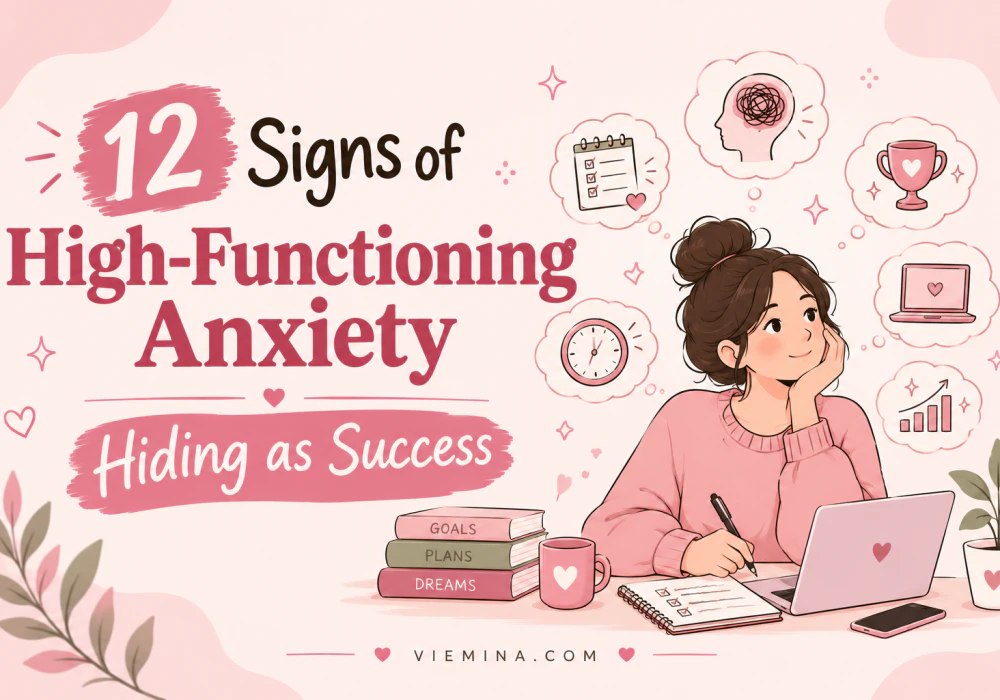
The signs of high functioning anxiety don’t look like anxiety at all. They look like reliability, drive, and success.
You’re the one people call when things fall apart. You hit every deadline, remember every birthday, and always seem to have a plan. If your life were a movie, you wouldn’t be the nervous character — you’d be the one the nervous characters lean on.
But if someone could hear the commentary track running in your head, they’d be surprised.
The racing thoughts. The mental rehearsals for conversations that will never happen. The quiet hum of dread that today might be the day everyone discovers you’re not as fine as you look.
I know that track well. For years, I thought my 2 AM rehearsal sessions were just being thorough. I thought the color-coded calendar was a personality trait. I thought the fact that I couldn’t sit still through a movie was because I was ambitious, not because I was running from something I refused to name.
Psychologists have a name for this gap between how you appear and how you feel: high-functioning anxiety. And there’s a good chance you’ve never used that phrase, because when your anxiety motivates you instead of stopping you, it doesn’t feel like a problem. It feels like a personality.
It isn’t. Here are the twelve signs, so you can finally see the pattern.
First, an Honest Note About the Term
“High-functioning anxiety” is not an official diagnosis — you won’t find it in the DSM-5. It’s a useful label for a very real experience, not a clinical category. Psychologist Dr. Adam Borland of the Cleveland Clinic describes it as anxiety that persists while a person still “seems able to effectively manage the demands of day-to-day life.”
Most people who recognize themselves in it would likely meet the criteria for generalized anxiety disorder (GAD); a condition that affects around 6.8 million American adults every year, according to the Anxiety and Depression Association of America. And fewer than 40% percent of them ever get treated. Partly because, just like you, they’re functioning. And functioning hides everything.
12 Signs of High Functioning Anxiety Hiding as Success
The label matters less than the experience. If the next twelve signs read like your own diary, that’s the point.
1. Stress Is Your Fuel
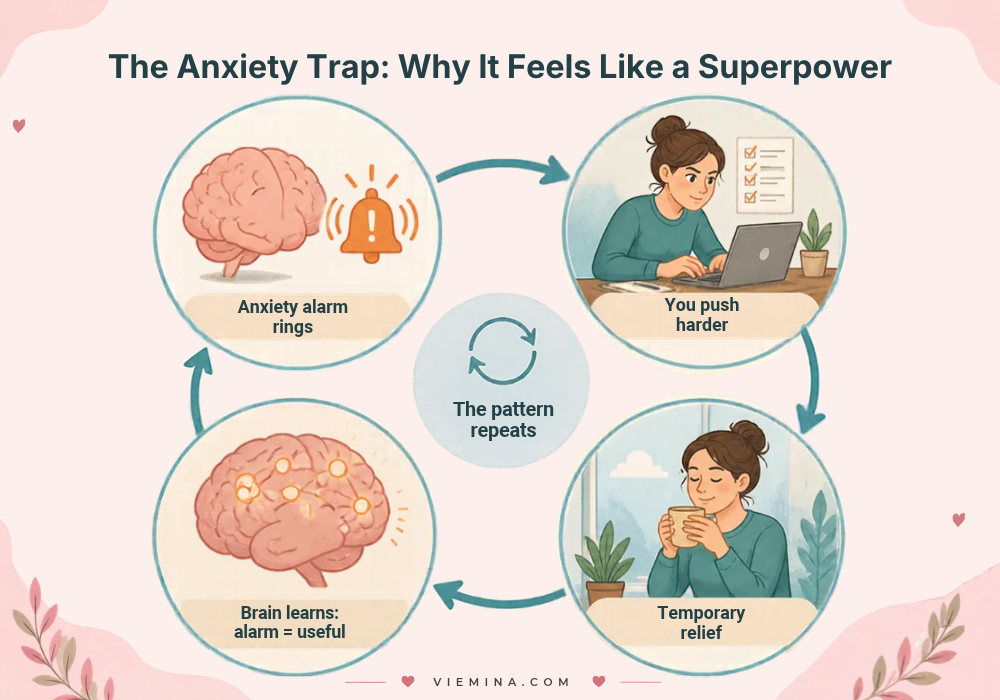
Some people freeze under pressure. You sharpen. A tight deadline makes you focused, productive, almost euphoric. Dr. Borland points out that where generalized anxiety tends to push people toward the flight response — avoiding what scares them — high-functioning anxiety runs on fight: you push yourself harder to drown out the alarm.
It works. That’s exactly the trap. The relief you feel after delivering under pressure teaches your brain that the alarm was useful. So it keeps ringing.
2. You’re the Organized One Everyone Relies On
Color-coded calendar. Backup plans for the backup plans. Friends joke that you’ve already researched the restaurant, the parking, and the weather before anyone asked.
For you, structure isn’t a hobby. It’s medicine. Managing every detail you can control is how you quiet the thoughts about everything you can’t. The calendar isn’t about productivity — it’s a shield against uncertainty. When everything is scheduled, nothing can surprise you. Except it doesn’t work, does it? The unease just moves to the next unscheduled hour.
3. “Relax” Feels Like a Foreign Language
A free evening should feel like a gift. To you, it often feels like a warning.
When there’s nothing urgent to chase, there’s space — and in your mind, space fills itself. So you add one more task, refresh the inbox one more time, start a new project. Downtime doesn’t recharge you. It itches.
“Almost everything will work again if you unplug it for a few minutes… including you.” — Anne Lamott
4. Your Mind Runs Worst-Case Scenarios at 2 A.M.
The body is horizontal. The mind is in the boardroom. You’re replaying the meeting (why did I say “sounds good”? was that cold?), drafting tomorrow’s difficult email, and calculating what happens if [the thing] goes wrong — all before the ceiling gets your full attention.
Night is when overthinking finally gets the stage, because it’s the only time of day you didn’t schedule anything over it.
For more details about overthinking read this article How to Stop Overthinking: 12 Ways That Actually Work
5. You Rehearse Conversations That Will Never Happen
This is different from being organized (Sign 2). The calendar manages your time. The rehearsal manages your fear.
You rehearse the difficult conversation, the one with your boss, your partner, the friend you’re drifting from. You draft their side too, anticipate every reaction, prepare three versions of your response. Then the conversation happens, and it’s nothing like what you rehearsed. But you can’t stop. Because being caught off-guard makes your nervous system scream, and rehearsal is how you turn the volume down.
It’s not about being ready. It’s about not trusting yourself to handle what you didn’t predict.
6. Saying “No” Feels Illegal
The request comes in. Your calendar says absolutely not. You say yes anyway. Then you resent it. Then you get angry with yourself for resenting it.
People-pleasing isn’t endless kindness — for many, it’s fear management. Dr. Borland notes that people with this pattern “tend to have difficulty with assertiveness and the ability to say ‘no.'” In the moment, disappointing someone feels more dangerous than exhausting yourself.
7. You Need Everything to Look Effortless
You’d rather pull an all-nighter than let anyone see that something was hard for you. Asking for help feels like confessing a crime. Being vulnerable isn’t neutral, it feels like handing someone evidence against you.
Psychology Today describes this as the “volcano effect”: suppressing for so long that the eventual eruption of distress surprises everyone, including you. People who seem the most together are often just the most committed to never being seen struggling.
8. You’re a Pro at Reassurance — For Everyone Else
You’re the friend who talks people off ledges. The colleague who says “it’ll be fine, and here’s why.” The one with the color-coded advice and the calming voice.
But when it’s your crisis, you tell no one, or you minimize it into a joke. You’d happily encourage a friend to see a therapist, and it would never occur to you to qualify for the same offer. Dr. Asim Shah of Baylor College of Medicine calls this the field’s uncomfortable Catch-22: the better you function, the less you qualify for help, and the easier it is to convince yourself you don’t need any.
9. Criticism From Years Ago Still Replays in HD
Your brain keeps an archive. The presentation flop in 2019. The teacher’s comment when you were 12. The friend’s offhanded remark from last March.
Everyone cringes at their memories sometimes. But if the reel plays often, and each viewing reopens the wound like it happened this morning, that’s not reflection, it’s rumination with a highlight reel.
10. Your Body Sends You Invoices
Jaw tension you catch yourself clenching. A stomach that “acts up” every busy week. Headaches that arrive with deadlines. Legs that never stop bouncing during meetings. You fall asleep exhausted but wired, and wake up feeling like you never left work.
Anxiety that never gets spoken often gets yelled; through the body. Chronic stress hormones like cortisol are linked to digestive problems, headaches, sleep disruption, and blood pressure spikes. Your calendar is organized; your symptoms are scheduled too.
11. Success Never Actually Arrives
You’ve hit goals you once dreamed about, and stayed at that altitude for about a day before your brain filed the achievement under “bare minimum” and raised the bar.
So it becomes a pattern: degree, promotion, applause, then the quiet voice: okay, but next time do it better. When nothing is ever enough — and the “nothing” always comes from inside the house — the finish line isn’t a place. It’s a mirage you keep chasing at sprint pace.
12. Nobody Would Ever Guess
This is the sign that protects all the others. Your friends call you the positive one. Your boss calls you the rock. If a stranger described you, “anxious” wouldn’t make the list.
That gap; between the outer performance and the inner weather, is the defining feature. High-functioning anxiety is generalized anxiety wearing a very convincing costume. And the costume is precisely what makes it easy to ignore for years.
The Part That Actually Matters
Reading this list and wincing isn’t a diagnosis, but it is information. Here’s what to do with it.
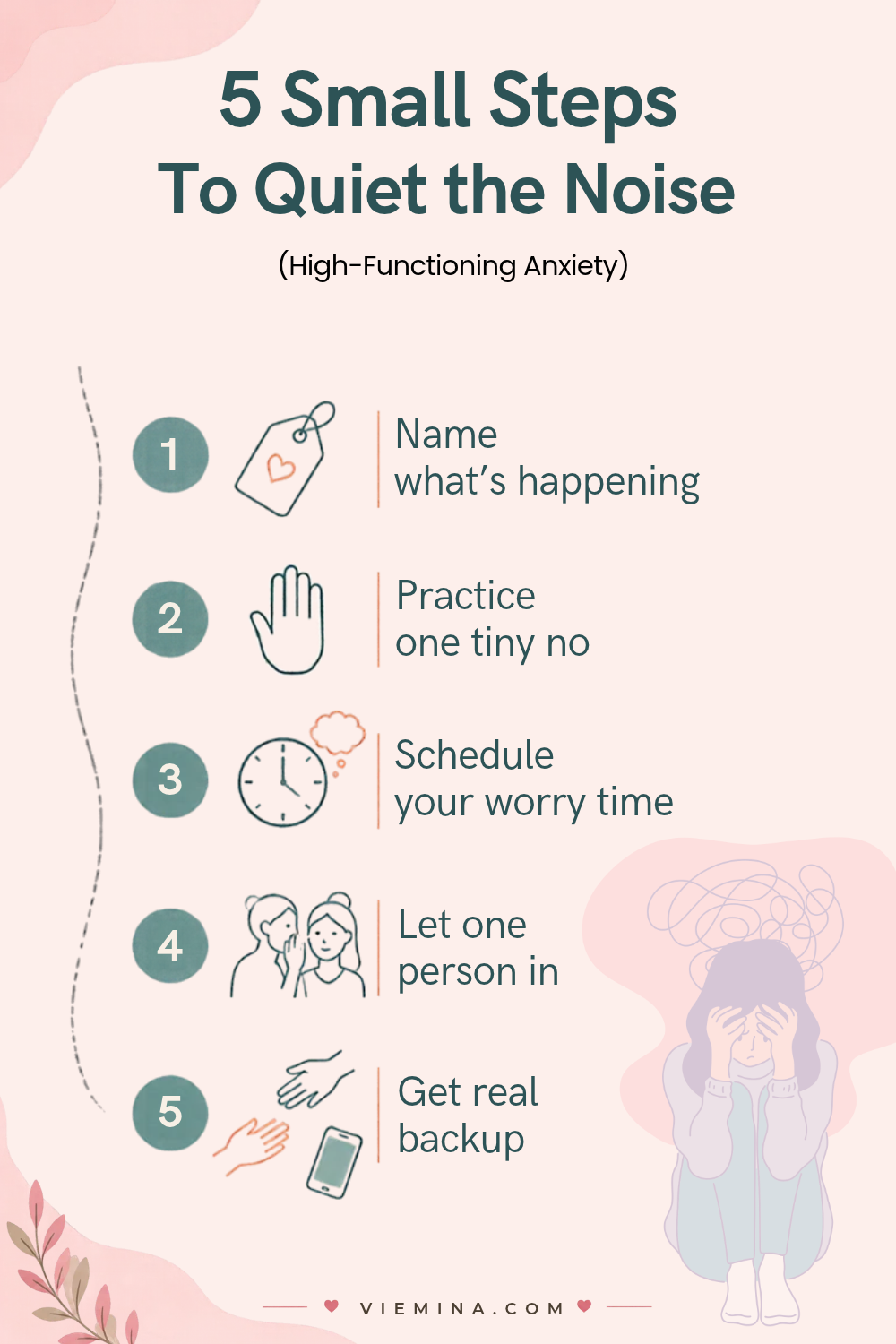
Name what’s happening
You can’t change a pattern you refuse to see. The simple act of saying “this is my anxiety talking, not a fact about my worth” reintroduces choice where there used to be autopilot. High-achievers especially tend to treat rest as a reward for total victory. Rest isn’t the prize at the end of your to-do list. It’s maintenance.
Practice one tiny “no” this week
You don’t need a personality transplant — just reps. Decline one small, low-stakes request (“I can’t take that on this week”) and observe a remarkable discovery: nobody leaves, nobody attacks, and the world keeps turning. Assertiveness is a muscle that atrophies from disuse and rebuilds from use.
Schedule your worry like a meeting
It sounds absurd, but it’s a real technique (therapists call it worry time). Give yourself 15 scheduled minutes a day to worry deliberately — on paper, outside your head. When the 2 A.M. reel starts, note it and tell your brain: you’re booked for 4 P.M. Redirecting rumination is far easier than suppressing it.
Let one person behind the curtain
The burden isn’t anxiety alone; it’s anxiety plus the full-time job of hiding it. You don’t need to confess everything to everyone. You need one honest sentence to one safe person: “Honestly, I’ve been running on empty lately.”
Get real backup if the list felt like a biography
If signs like the 2 A.M. replays, the physical symptoms, or the exhaustion have been your normal for months — that’s beyond “a stressful season,” and you deserve more than coping alone. A therapist (especially one trained in Cognitive Behavioral Therapy, the best-studied approach for generalized anxiety) is not a last resort. And if anxiety is touching your sleep, your health, or your ability to feel like a person, talk to a doctor. None of this needs a diagnosis to justify getting support — you qualify by being tired of paying the tax.
“You don’t have to control your thoughts. You just have to stop letting them control you.” — unknown
Final Thought
High-functioning anxiety convinces you that it’s the reason you succeed. That without the constant pressure, the early deadlines, the 2 A.M. rehearsals, you’d fall apart.
But look at the evidence differently: everything you’ve achieved, you achieved while carrying this. Imagine what it would be to run on a quieter engine, one that doesn’t wake you at 2 A.M. to tell you to rehearse disasters that never happen.
You are not your coping mechanism. You’re the person who built an entire life while exhausted and that person deserves to feel what “fine” actually feels like.