

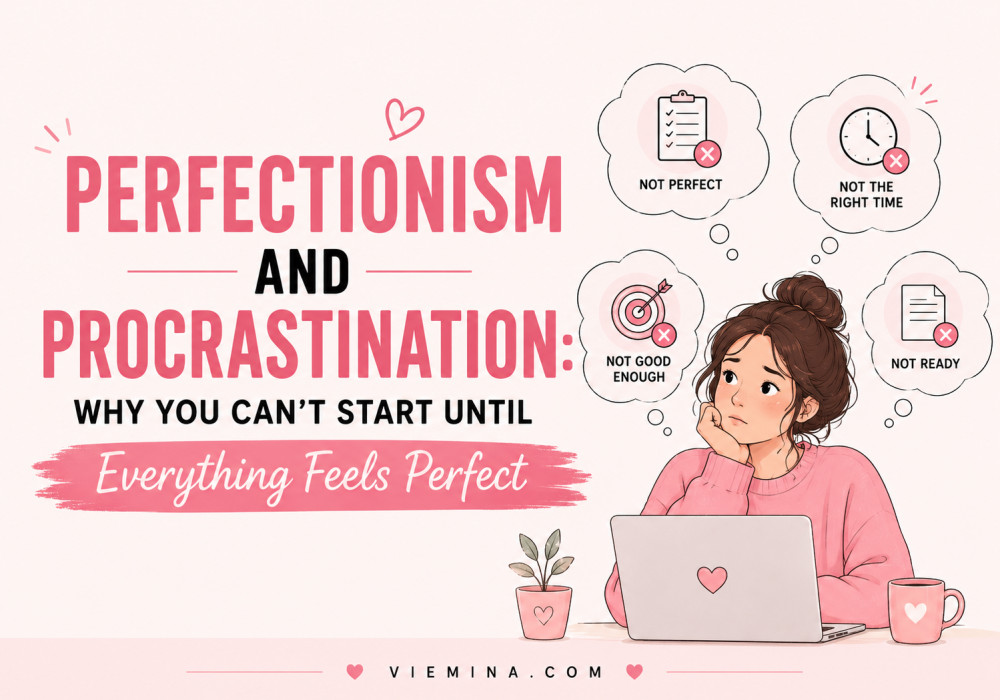
There’s a version of procrastination nobody talks about enough.
It’s not the kind where you don’t care. It’s not laziness, distraction, or forgetting. It’s the kind where you care so much that you can’t move. Where you sit with the task open in front of you, running it over in your mind, tweaking the plan, waiting for the right moment, the right mood, the right conditions, and somehow, nothing ever gets done.
Perfectionism and procrastination feed each other in a loop most people never see clearly.
You want to start. You also want it to be good, really good. And the gap between those two things freezes you completely.
The irony is brutal: the very trait you thought was making you better at things is quietly becoming the reason you finish nothing at all.
If you’ve ever spent more time planning a project than working on it, rewritten the same paragraph fifteen times without moving forward, or avoided starting something because you couldn’t picture doing it well enough, this article is for you.
We’re going to look at why perfectionism and procrastination are so deeply connected, what’s actually happening in your brain when perfection becomes the barrier, and how to start moving again without abandoning your standards.
Why do perfectionists procrastinate?
Because perfectionism sets a standard so high that starting feels genuinely risky. If your work needs to be perfect to be acceptable, then producing anything imperfect, which is what all first attempts are, feels like failure before you’ve even begun. Avoidance protects you from that feeling. The result is that the higher your standards, the harder it becomes to start, and the more tasks pile up unfinished while you wait for conditions that never quite arrive.
Perfectionism Is Not a High Standard. It’s a Fear Response.
Most perfectionists think of their perfectionism as a strength.
And in some ways, it is. Attention to detail matters. Caring about quality matters. Wanting to do things well is not a flaw.
But there’s a line, and most perfectionists crossed it a long time ago without noticing.
Healthy high standards: You want to do good work, you put in real effort, and you accept that the result will be imperfect but still valuable.
Perfectionism: You need the work to be flawless before you can feel okay about it, and that need is rooted not in standards, but in fear.
Fear of judgment: Fear of getting it wrong. Fear that a flawed output reflects a flawed person.
Perfectionism isn’t about the work. It’s about what the work means to you.
Research by Dr. Brené Brown and others consistently links perfectionism to shame, specifically, the belief that mistakes are not just things you do, but things you are. When your identity is tied to your output, producing something imperfect doesn’t just feel like underperforming. It feels like being exposed.
And the safest way to avoid exposure?
Never fully start.
Perfectionism vs High Standards: What’s the Difference?
People often confuse the two, and that confusion matters because the solutions to each are completely different.
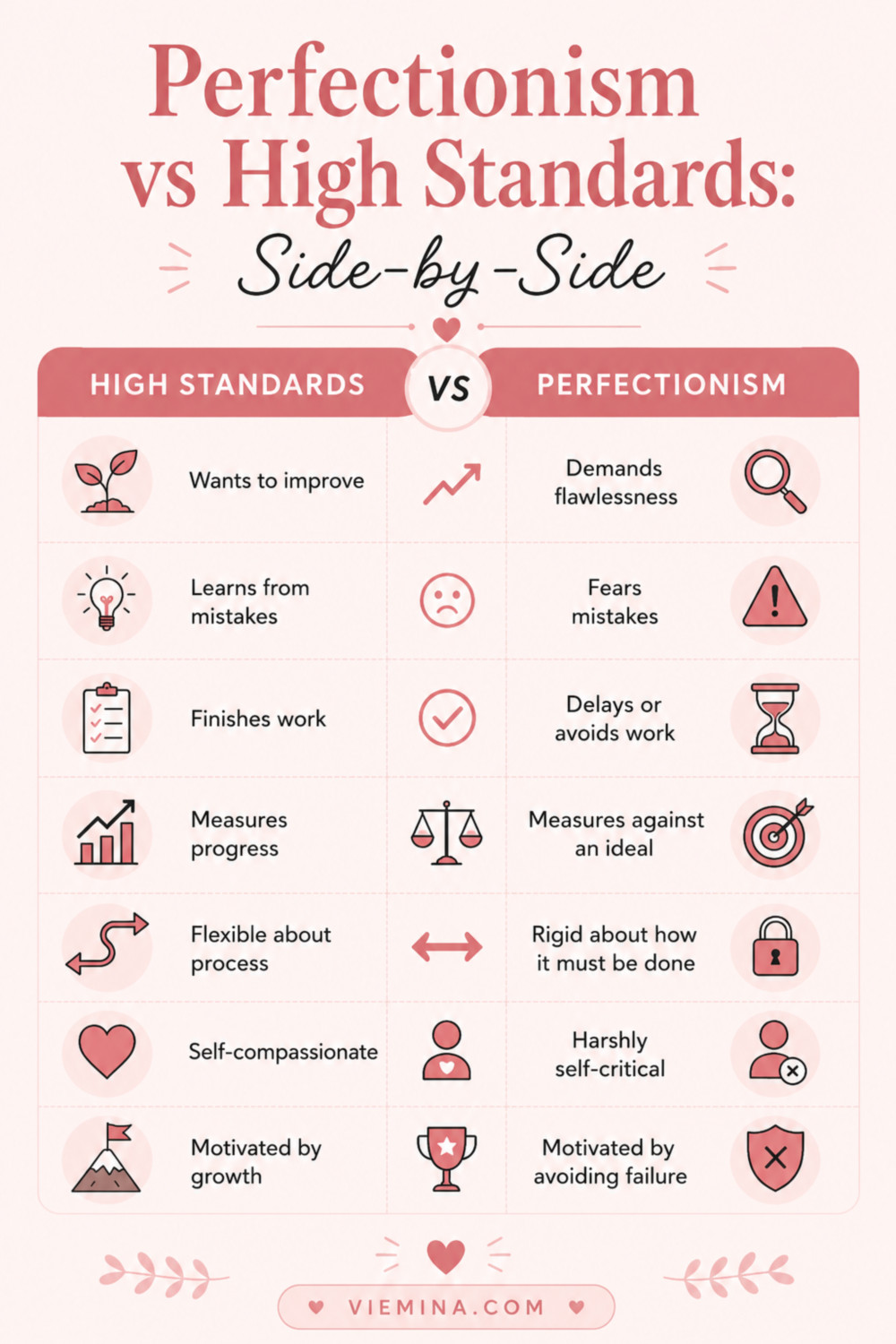
High standards push you forward. Perfectionism holds you back. They can look identical from the outside, but internally they operate in completely opposite ways.
| Wants to improve | Demands flawlessness |
| Learns from mistakes | Fears mistakes |
| Finishes work | Delays or avoids work |
| Measures progress | Measures against an ideal |
| Self-compassionate when things go wrong | Self-critical, sometimes harshly |
| Motivated by growth | Motivated by avoiding failure |
| Flexible about process | Rigid about how things must be done |
The person with high standards submits the project, reviews the feedback, and does better next time.
The perfectionist waits, revises, second-guesses, and often never submits at all or submits so late that the delay itself becomes the problem.
High standards are about the work. Perfectionism is about self-protection.
That’s the line. And once you see it, you can start asking yourself honestly: Am I holding this standard because it genuinely improves the outcome or because releasing it feels unsafe?
If the answer is the second one, you’re not dealing with high standards. You’re dealing with fear.
The goal isn’t to lower your standards. It’s to stop letting fear disguise itself as standards.
Why Perfectionism and Procrastination Are the Same Problem
On the surface, they look like opposites.
Perfectionism seems like caring too much. Procrastination seems like not caring enough. But underneath, they’re running on the same engine.
Both are driven by fear of failure.
The perfectionist delays because starting means producing something that could be judged, and judgment is threatening. The procrastinator delays because starting means risking an outcome they can’t control. In both cases, avoidance is self-protection disguised as delay.
Here’s how the loop typically runs:
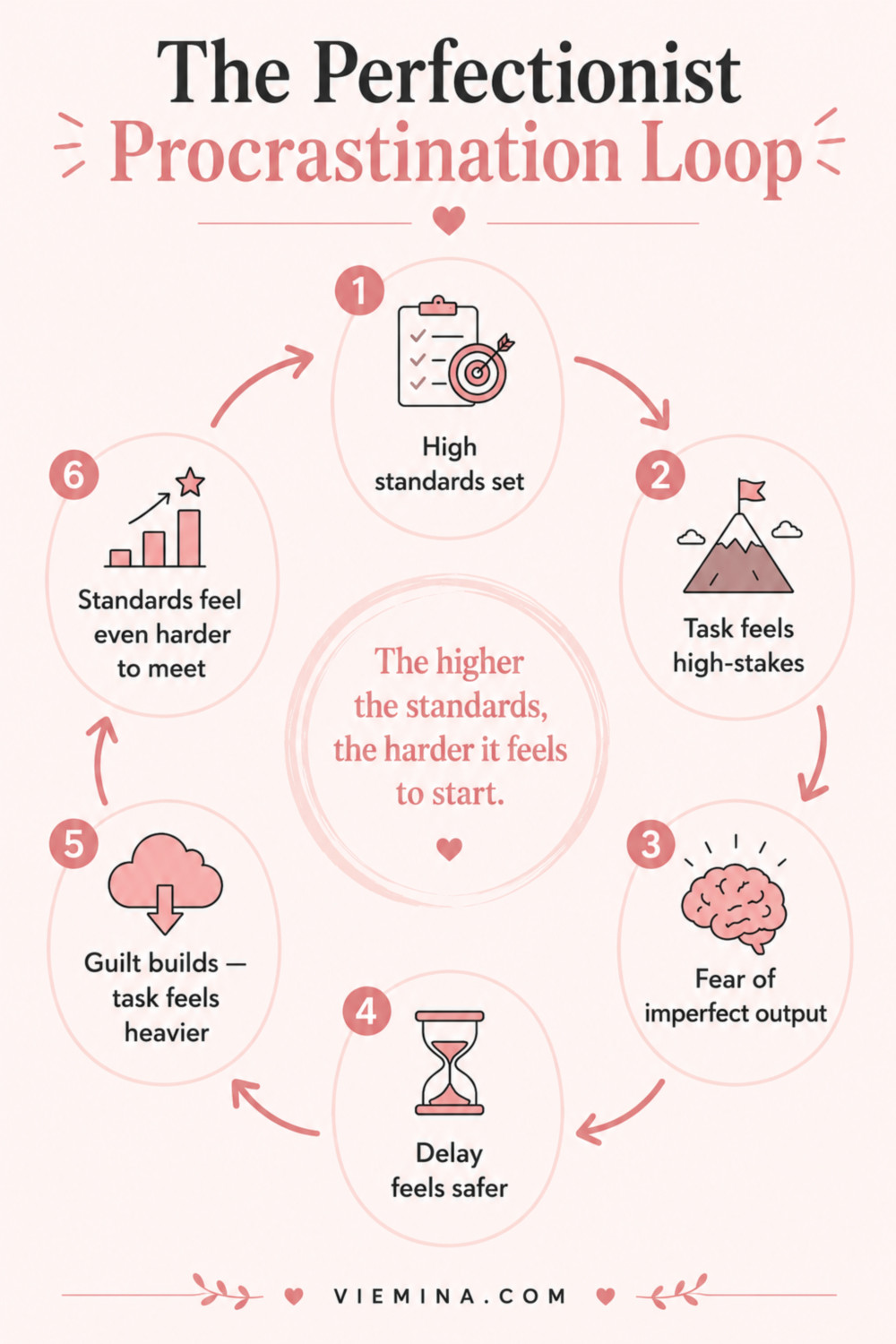
The longer this runs, the worse it gets. Because now you’re not just afraid of doing the task badly. You’re afraid of doing it badly after all this time spent not doing it. The delay itself becomes another reason the result needs to be perfect to justify the wait.
Every day you avoid it, the task gets heavier. And heavier tasks feel like they need more perfect solutions.
This is why perfectionist procrastination tends to spiral. It’s self-reinforcing. And breaking it requires understanding that the spiral exists, not just pushing harder against it.
The 4 Ways Perfectionism Kills Your Ability to Start
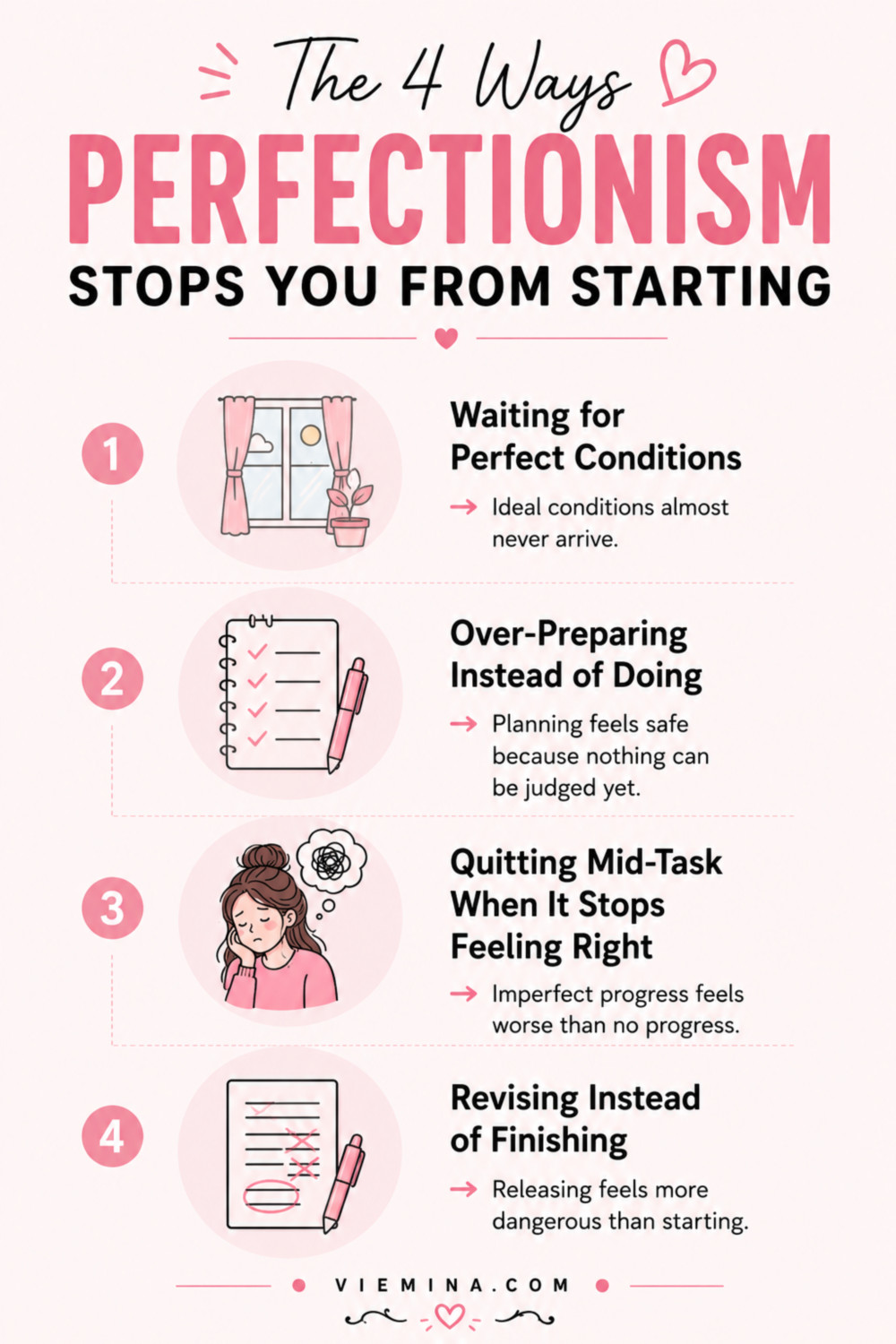
1. You’re Waiting for the Right Conditions
Perfectionists often wait for the right time, the right energy, the right amount of preparation, and the right environment. The logic feels reasonable: if I start when conditions are ideal, the work will be better.
The problem is that ideal conditions almost never arrive.
A writer waits until they have a free day with no interruptions. A student waits until they fully understand the material before writing the essay. An entrepreneur keeps refining the business plan before launching. A job seeker rewrites their CV for the tenth time before sending a single application.
None of them is lazy. All of them are stuck.
The uncomfortable truth: most great work was done in imperfect conditions by people who started anyway.
2. You’re Over-Preparing Instead of Doing
There’s a version of productivity that looks like work but isn’t.
Researching. Outlining. Collecting references. Redesigning your workspace. Buying a new notebook. Creating the perfect folder structure. Read one more article before you begin.
Over-preparation is perfectionism in disguise. It feels productive because you’re busy, and it feels safe because you haven’t produced anything that can be judged yet. It also keeps you permanently in the comfortable pre-work phase, where failure is still impossible because nothing real has been made.
If you recognize this pattern, it’s worth reading about why you procrastinate even when you want to work, because over-preparation is one of the clearest signs that emotional avoidance is driving the delay, not genuine preparation needs.
3. You Quit Mid-Task When It Stops Feeling Perfect
Perfectionism doesn’t only stop you from starting. It can kill momentum halfway through.
You’re writing something, and it doesn’t sound right, so you stop and rewrite from the top. You’re working on a project and realize it’s not going in the direction you imagined, so you scrap it. You’ve done half the work, and it already doesn’t match the vision in your head, so finishing feels pointless.
This is perfectionism as a completion blocker.
The result: a trail of half-finished projects, abandoned drafts, and good ideas that never made it to done. Not because you lacked ability, but because the version in progress didn’t match the version in your head, and imperfect progress felt worse than no progress at all.
4. You Rewrite, Revise, and Polish Instead of Finishing
Some tasks technically get done, but they just never get released.
The email gets written and reread fifteen times before sending. The article was published three weeks late because it needed one more round of edits. The project gets submitted late because it was almost right, but not quite.
This is the finishing-line version of perfectionism. The work exists, but letting it go into the world feels like the real risk because once it’s out there, it can be judged.
Perfectionism makes finishing feel more dangerous than starting.
Related: Embracing Imperfection: 9 Top Steps to Self-Acceptance
The Psychology Behind Why Perfectionists Fear “Good Enough”
To understand why this is so hard to shake, you need to understand where it comes from.
For most perfectionists, the pattern has roots that go back a long way. Conditional approval, where praise was tied to performance, and mistakes were met with criticism or withdrawal of affection, teaches a child that being good enough at things is how you stay safe and loved.
That lesson doesn’t disappear in adulthood. It gets applied to work, creativity, relationships, and self-image. The standard shifts from “get good grades” to “produce perfect work,” but the underlying logic is the same. If it’s not good enough, I’m not good enough.
This is why telling a perfectionist to “just lower their standards” almost never works. The standards aren’t just preferences. They’re attached to identity and safety.
What actually helps is separating the quality of the output from the worth of the person producing it. That separation is a skill that develops slowly, through repeated evidence that imperfect work doesn’t produce the catastrophic judgment the perfectionist brain anticipates.
Every time you finish something imperfect, and the world doesn’t end, you’re gathering that evidence.
Related: 23 Signs of Repressed Childhood Trauma in Adults
Related: 15 Hidden Signs of Emotional Trauma in Adults & How to Heal
How Perfectionism and Anxiety Overlap
Perfectionism and anxiety are deeply intertwined, and for many people, you can’t fully address one without the other.
Anxious thinking magnifies the anticipated consequences of getting something wrong. A mistake at work becomes a catastrophe. A lukewarm response to creative work becomes proof of fundamental inadequacy. An imperfect first draft becomes evidence that you’re not cut out for this.
The anxiety makes the perfectionist standard feel not just desirable but necessary, like the only thing standing between you and a very bad outcome.
This is also why perfectionist procrastination often feels physically uncomfortable. The avoidance isn’t just mental; it shows up as tension, restlessness, difficulty concentrating on anything else, and a pervasive sense of low-level dread that follows you around even when you’re doing something completely unrelated.
If this resonates, the connection between overthinking and procrastination is worth exploring because anxious perfectionism almost always involves a thought spiral that keeps the task feeling impossible long before you sit down to face it.
How to Break the Perfectionism-Procrastination Cycle
This isn’t about abandoning your standards. It’s about separating your standards from your ability to begin.
1-Separate the Draft From the Deadline
The most practical shift you can make: give yourself explicit permission to produce a bad first version.
Not a mediocre one. A genuinely bad one.
Tell yourself before you start: this draft doesn’t count. This is just getting it out of my head and onto the page. Then write it badly, messily, incompletely. You can fix it later, but only once it exists.
A writer who finishes a bad first draft has something. A writer waiting for the perfect first draft has nothing.
This works because it removes the perfectionist standard from the starting phase and relocates it where it actually belongs: the revision phase. Quality is a filter you apply after creation, not a prerequisite for it.
2-Set a “Done” Standard Instead of a “Perfect” Standard
Before you begin any task, define what done looks like. Not perfect. Not great. Just done.
For a student: “The essay is done when it answers the question, hits the word count, and has been read through once.” For a freelancer: “The proposal is done when it covers the brief, includes pricing, and has been sent.” For a creator: “The post is done when it says what I intended to say and has been published.”
When your brain knows exactly what the finish line looks like, it stops searching for an impossible standard and starts moving toward an achievable one.
Related: 12 Signs You’re Overanalyzing — And How to Finally Stop
3-Use Time Constraints to Force Completion
Perfectionism thrives on unlimited time. When there’s no deadline, there’s always room for one more revision.
Create artificial constraints. Give yourself 45 minutes to write the first draft, not as much time as you need, but enough to get something real on the page. Set a timer and stop when it goes off. Send the email after one reread, not five.
Constraints aren’t a compromise on quality. They’re a tool for completing things that would otherwise never get finished.
4-Practice “Shipping” Small Things First
If perfectionism has you frozen on a big project, start building the evidence that done is survivable by finishing small things.
Send the short email. Post the brief update. Submit the small task. Each completed and released thing is a data point your brain collects: I put something imperfect into the world, and it was fine. Over time, that accumulation of evidence weakens the fear significantly.
Reframe What “Good Enough” Actually Means
“Good enough” sounds like giving up. It isn’t.
Good enough means: this work serves its purpose. It does what it needs to do. It is ready to be seen, used, or submitted, not because it’s flawless, but because it’s complete and real.
Most of the work you admire from other people isn’t perfect either. It was just finished and released by someone who made peace with its imperfections.
Done and imperfect will always outperform perfect and imaginary.
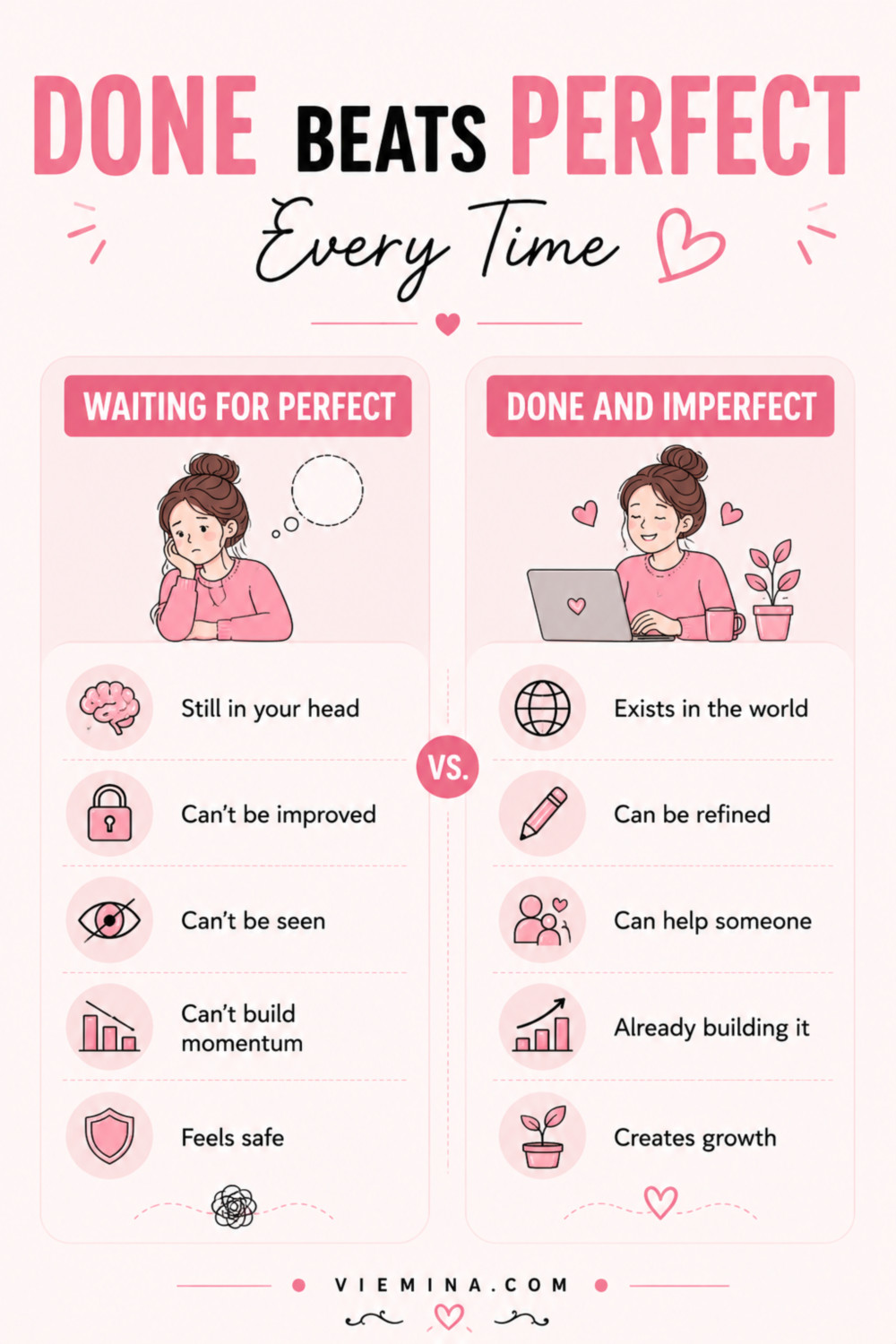
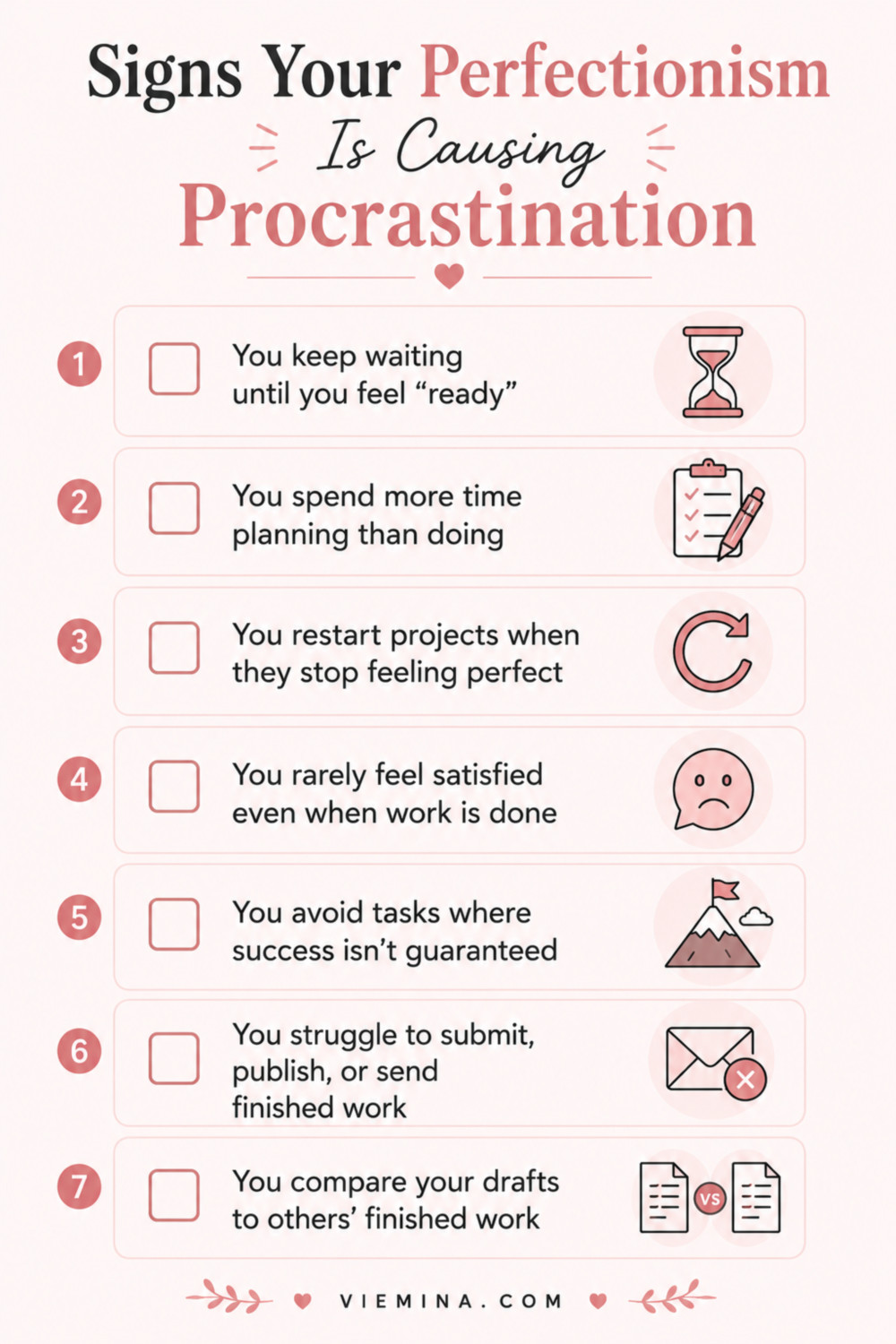
Signs Your Perfectionism Is Causing Procrastination
This is where it gets specific. Perfectionism-driven procrastination has a distinct fingerprint, and recognizing it is the first step to breaking it.
Here are the clearest signs that perfectionism is behind your delay:
- You keep waiting until you feel “ready,” and ready never quite arrives.
- You spend more time planning than doing: outlining, researching, organizing, instead of starting.
- You restart projects frequently because the current version doesn’t match the vision in your head.
- You rarely feel satisfied with finished work, even when others think it’s good.
- You avoid tasks where success isn’t guaranteed and stick to things you already know you can do well.
- You struggle to submit, publish, or send the work that is done, but releasing it feels risky.
- You compare your drafts to others’ finished work and feel like yours doesn’t measure up before it’s complete.
If three or more of these feel familiar, perfectionism isn’t just influencing your procrastination. It’s probably driving it.
The important distinction: a regular procrastinator avoids tasks they don’t want to do. A perfectionist procrastinator avoids tasks they care about most because the stakes feel highest there.
Signs You’re a Perfectionist Procrastinator (Not Just a Procrastinator)
These patterns distinguish perfectionism-driven delay from other types of procrastination:
- You spend more time planning tasks than doing them.
- You have many projects started, but very few finished
- You feel paralyzed by decisions about how to do something, not whether to do it.
- Receiving criticism feels disproportionately painful, even constructive feedback.
- You compare your work to the best existing examples before you’ve even started.
- You find it easier to help others with their work than to do your own
- You feel a vague sense of shame about unfinished things, not just inconvenience.
- You’ve been told your work is good, but you rarely feel like it was good enough.
If more than four of these apply to you, perfectionism is likely the primary driver of your procrastination, not distraction, not motivation, not time management.
Conclusion:
Perfectionism feels like it’s protecting your work. In reality, it’s protecting your ego at the cost of everything you actually want to create.
The work you’re holding back because it isn’t perfect yet? It has value right now. Imperfect, unfinished, rough value, but value. The version in your head that you’re waiting to produce is not more valuable. It’s just safer because it hasn’t been tested yet.
Every creator, writer, entrepreneur, and professional whose work you respect has a body of imperfect things behind them. Things they sent too early, published with mistakes, and wished they’d done differently. Those imperfect things are also the reason they got better, found their audience, and built their career.
You don’t get good by waiting until you’re good. You get good by starting before you are.
The gap between where you are and where you want to be closes through repetition, not through waiting. And repetition only starts when you give yourself permission to begin badly.
Start badly. Finish anyway. That’s the whole strategy.
For a complete framework on breaking through procrastination beyond perfectionism, the full guide on how to stop procrastination covers every layer of the pattern, including the practical systems that make starting consistently easier over time.
Frequently Asked Questions About Perfectionism and procrastination
-
Why do perfectionists procrastinate more than other people?
Because the standard they need to meet before starting feels impossibly high. Every first attempt is imperfect by definition, and for a perfectionist, imperfect is unacceptable. So the task never starts, or starts but never finishes. The higher the standard, the wider the gap between “where I am” and “where I need to be to begin.” That gap produces paralysis.
-
Is perfectionism a form of anxiety?
They’re closely related. Perfectionism is often driven by the same fear-based thinking that underlies anxiety, specifically, an exaggerated sense of the consequences of making a mistake or being judged. Many people with perfectionist tendencies also experience anxiety disorders, and treating the anxiety often reduces the perfectionist behavior significantly.
-
How do I stop being a perfectionist when it comes to work?
Start by separating the act of creating from the act of evaluating. Give yourself a “bad draft” phase where quality is explicitly not the goal. Set a specific “done” standard before you begin. Use time limits to force completion. And practice finishing small things regularly; each completed, imperfect thing is evidence that done is survivable.
-
Can perfectionism be a good thing?
In limited doses, yes. High standards produce better work than indifference does. The problem is when the standard becomes a barrier to starting or finishing at that point, perfectionism stops serving the work and starts serving only the fear. The goal isn’t to become someone who doesn’t care about quality. It’s to stop letting the pursuit of quality become a reason to produce nothing at all.
-
Why do I feel physically anxious when my work isn’t perfect?
Because for perfectionists, the quality of their work is tied to their sense of safety and self-worth. When something feels wrong or imperfect, it triggers a threat response, the same system that activates for actual danger. Your nervous system is reacting to imperfect work the way it might react to a real threat. This is why breathing exercises, grounding techniques, and working on separating identity from output can all help with perfectionist anxiety specifically.
-
How do I know if perfectionism is causing my procrastination?
The clearest sign: you’re not avoiding the task because you don’t care, you’re avoiding it because you care too much and can’t figure out how to do it well enough. If you think about the task frequently, feel guilty about not doing it, but still can’t start, perfectionism is almost certainly involved. Compare this to distraction-based procrastination, where the task rarely crosses your mind at all.





Thanks for this beautiful guide, it makes me understand more what’s happened with me
Ooh,I really appreciate that 🥰
Thank you so much for this beautiful comment!
Thanks for the practical article. The points were helpful for readers comparing options and planning the next step. Ref 1qgex6y.
Ooh,I really appreciate that 🥰
Thank you so much for this beautiful comment!