


Learning how to overcome perfectionism is harder than most people expect because perfectionism doesn’t feel like a problem from the inside.
It feels like caring. It feels like standards. It feels like the reason you do things well.
Until it becomes the reason you don’t do things at all.
Maybe you’ve spent hours on something that should have taken thirty minutes. Maybe you’ve abandoned a project halfway because it stopped matching the image in your head. Maybe you’ve been “preparing to start” something for months, researching, planning, outlining, while the actual work stays untouched.
That’s not diligence. That’s perfectionism doing what it does best: protecting you from the risk of being seen as anything less than exceptional.
The frustrating part is that perfectionism is self-defeating. It promises excellent results but routinely delivers paralysis, burnout, and an endless trail of unfinished things. It sets a standard so high that starting feels dangerous and finishing feels almost impossible.
This guide explains what perfectionism actually is, where it comes from, the different forms it takes, and how to genuinely overcome it, not by lowering your standards, but by separating your worth from your output.
What Is Perfectionism Really?
Perfectionism is not the same as having high standards.
That distinction matters more than most people realize because if you believe perfectionism is just caring deeply about quality, you’ll never address the part that’s actually causing the problem.
- High standards push you toward better work. They accept that the path to excellence includes imperfect attempts along the way. They allow for learning, adjustment, and growth.
- Perfectionism is different. At its core, perfectionism is a belief that your value as a person depends on your performance. When a piece of work is flawed, it doesn’t just feel like underperforming; it feels like being exposed as inadequate.
That’s why perfectionism is exhausting in a way that high standards aren’t. It’s not just about the work. It’s about what the work means to you.
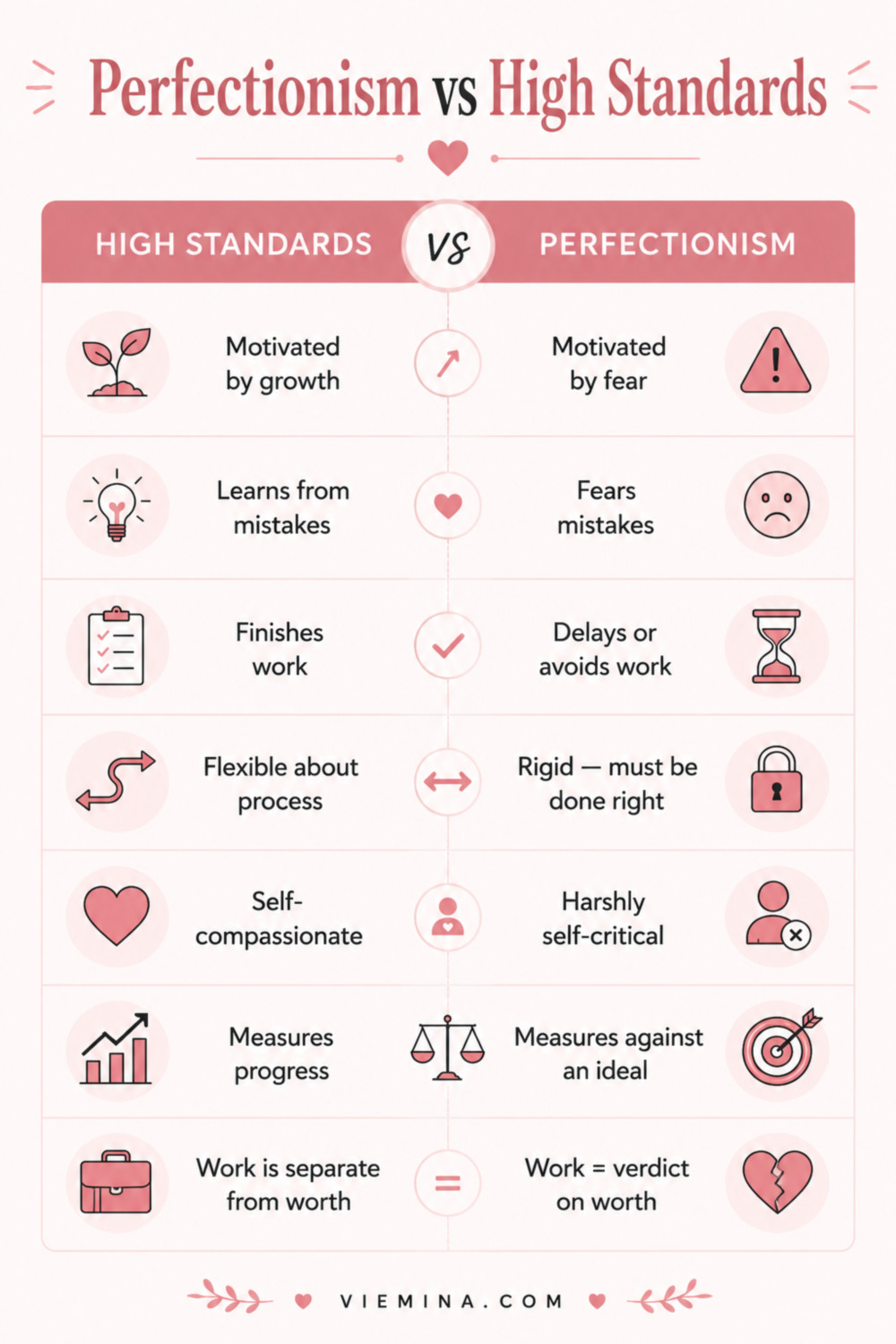
Psychologists distinguish between two main types:
- Adaptive perfectionism: high standards combined with flexibility and self-compassion. This type can drive achievement without causing excessive distress.
- Maladaptive perfectionism: high standards combined with harsh self-criticism, fear of failure, and rigid all-or-nothing thinking. This is the type that causes procrastination, anxiety, and burnout.
Most people who struggle with perfectionism are dealing with the maladaptive version, and most of what follows in this article addresses that specifically.
What Are the 5 Types of Perfectionists?
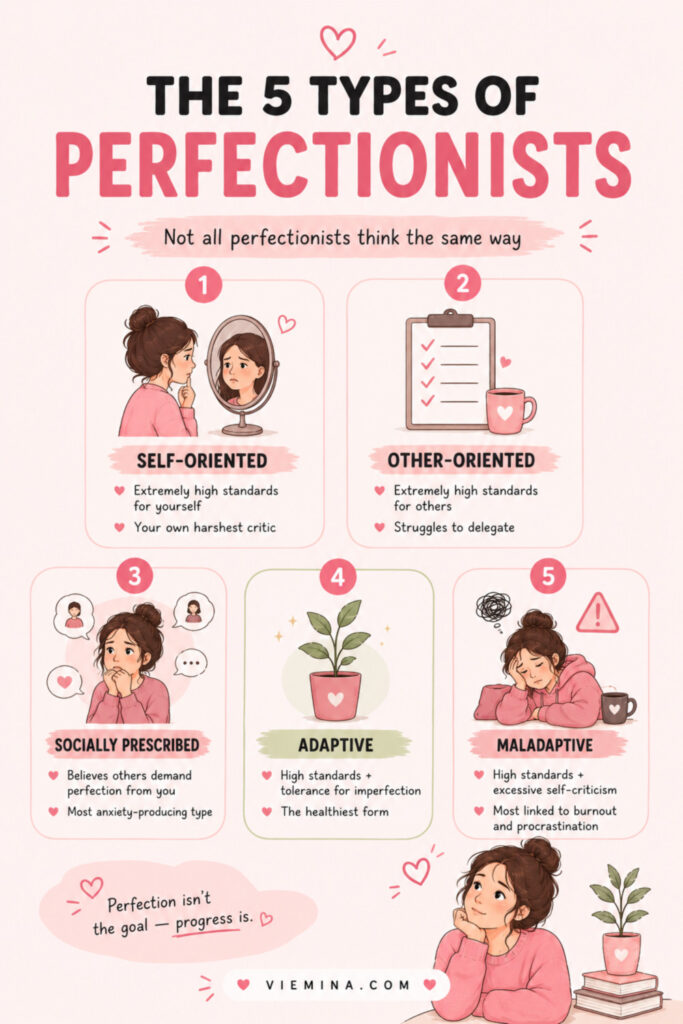
Perfectionism doesn’t look the same in everyone. Understanding which type resonates with you makes the strategies for overcoming it far more targeted and effective.
1. The Self-Oriented Perfectionist
They set extremely high standards for themselves. Internally driven, highly self-critical, and often struggles with chronic dissatisfaction even when their work is genuinely excellent. This type rarely feels finished; there’s always something that could be better.
2. The Other-Oriented Perfectionist
Holds other people to the same high standards they hold themselves. Struggles with delegating, becomes frustrated when others don’t meet their expectations, and often experiences conflict in relationships and work environments.
3. The Socially-Prescribed Perfectionist
Believes other people expect perfection from them and lives in fear of failing to meet those expectations. This type is especially prone to anxiety, people-pleasing, and a paralyzing fear of judgment. Often, the most psychologically distressed of the five types.
4. The Procrastinating Perfectionist
Can’t start until conditions are ideal. Spends excessive time planning and preparing. Delays tasks because beginning means risking imperfect output, and imperfect feels unacceptable. This type often looks like laziness from the outside but is driven by intense fear of failure internally.
If this type resonates with you, the deeper connection between perfectionism and procrastination explains exactly how this pattern develops and what maintains it.
5. The Burnout Perfectionist
Has been running on impossible standards for so long that exhaustion has set in. May have periods of high achievement followed by complete crashes. Struggles to understand why they can’t sustain the pace, because admitting that the standard is unsustainable feels like failure, too.
What Is the Root Cause of Perfectionism?
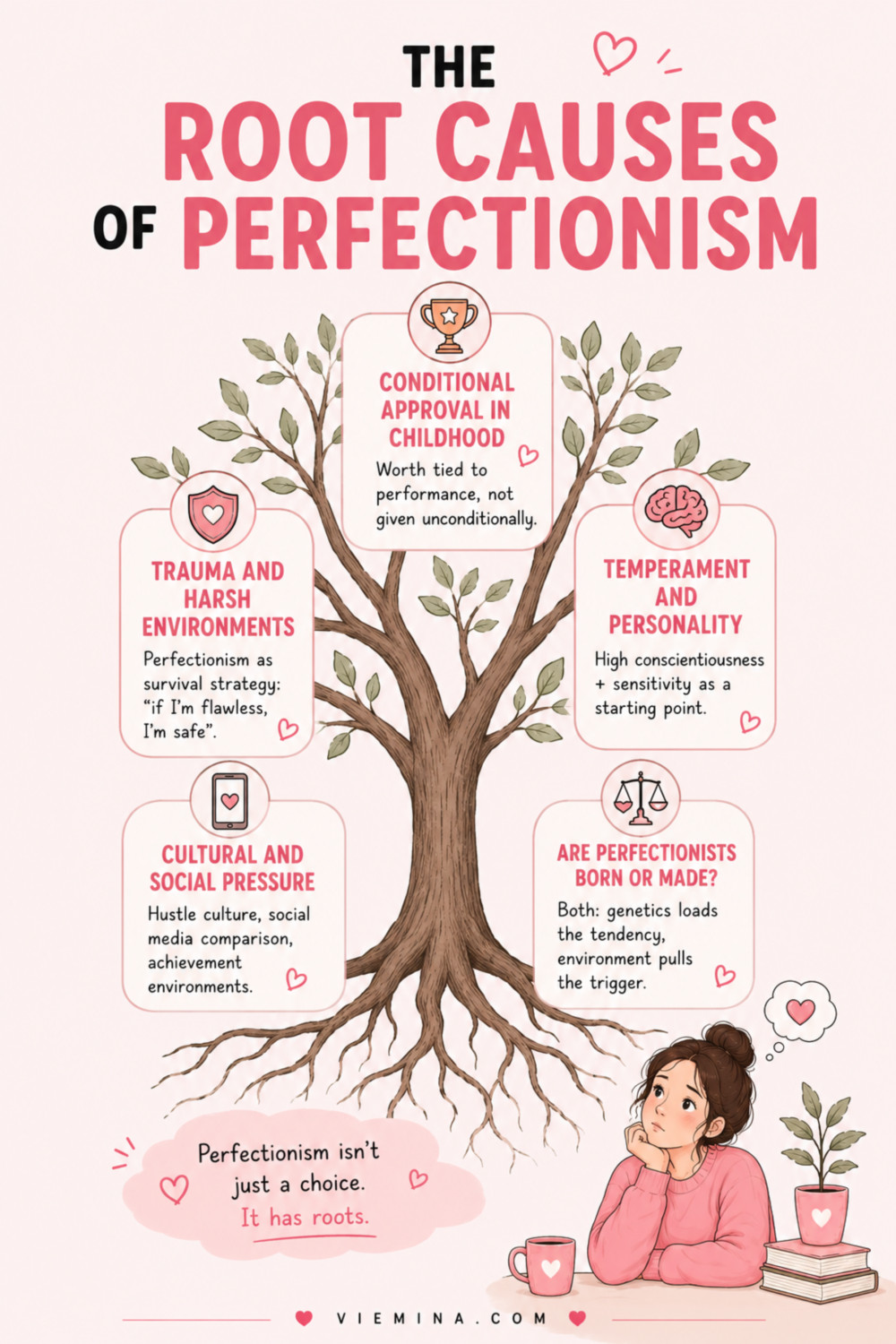
Understanding where perfectionism comes from doesn’t automatically fix it, but it does help you stop treating it as a character flaw and start treating it as a learned pattern that can be unlearned.
1-Childhood and Conditional Approval
The most common root of perfectionism is growing up in an environment where approval from parents, teachers, or caregivers is felt tied to performance. When praise came mainly for achievements and mistakes were met with criticism, withdrawal, or disappointment, a child learns: being good enough at things is how I stay safe and loved.
That lesson doesn’t disappear when you become an adult. It just gets applied to work, creativity, relationships, and self-image in increasingly sophisticated ways.
Related: 15 Hidden Signs of Emotional Trauma in Adults & How to Heal
2-Childhood Trauma
Not all perfectionism has roots in obvious trauma, but research consistently finds links between perfectionistic tendencies and early experiences of instability, unpredictability, or emotional neglect. When a child’s environment feels unsafe or uncontrollable, exercising extreme control over their own performance becomes a coping mechanism, one of the few areas where they can predict outcomes.
Are perfectionists born or made? Research suggests both contribute. Some people have temperamental traits, such as conscientiousness, sensitivity, and high cognitive ability, that make perfectionism more likely to develop. But the environment shapes whether those traits become adaptive or maladaptive. The same conscientious child raised in a low-pressure, unconditionally supportive environment will likely develop high standards without fear. In a high-pressure, conditional approval environment, those same traits become perfectionism.
Related: 23 Signs of Repressed Childhood Trauma in Adults
3-The High IQ Connection
Perfectionism is disproportionately common among people with high cognitive ability, and there are several reasons for this. Highly intelligent people can imagine more ways things could go wrong. They often set their aspirations based on comparison with the best existing work in a field rather than with realistic peer comparisons. And they may have sailed through early academic environments without effort, leaving them unprepared for the normal struggle and imperfection that comes with genuinely challenging work.
Is Perfectionism Linked to Anxiety, OCD, or ADHD?
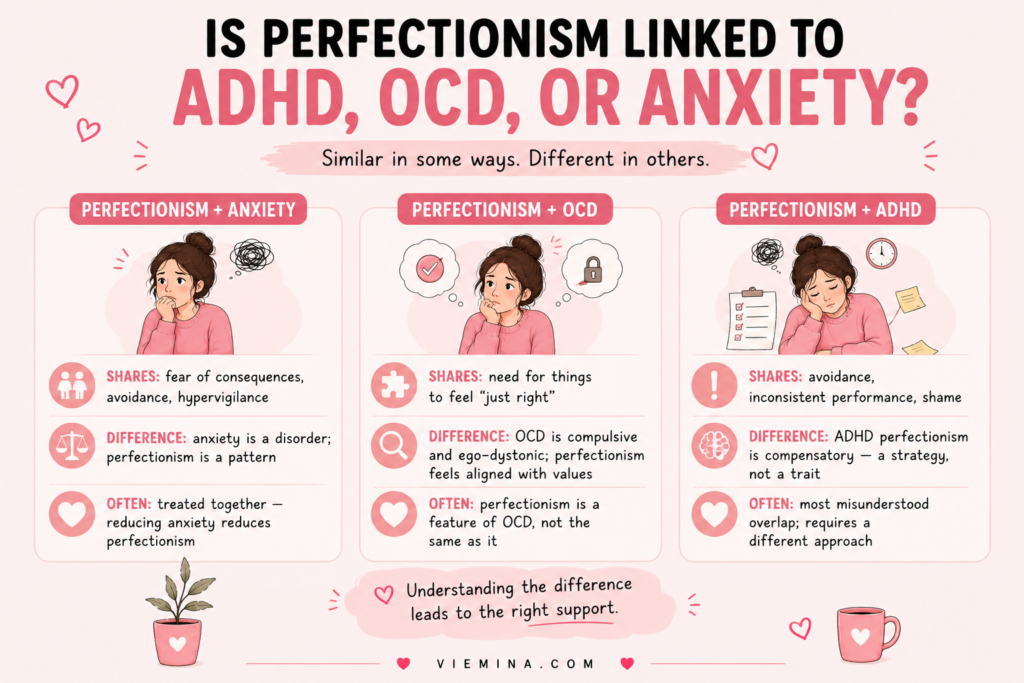
This question comes up frequently, and the answer is nuanced but important.
1-Perfectionism and Anxiety
Perfectionism and anxiety are deeply intertwined. Anxious thinking amplifies the anticipated consequences of mistakes, turning a minor error into a catastrophe, a critical comment into proof of inadequacy. The anxiety makes the perfectionist standard feel not just desirable but necessary, like the only protection against a very bad outcome.
Is perfectionism an anxiety disorder? Not exactly, perfectionism itself is not a clinical diagnosis. But it is a significant risk factor for anxiety disorders, and it commonly co-occurs with Generalized Anxiety Disorder (GAD), Social Anxiety Disorder, and OCD.
2-Is Perfectionism OCD?
Perfectionism is a core feature of OCD for many people, but not all perfectionists have OCD, and not all OCD involves perfectionism. In OCD, perfectionism typically manifests as compulsive behaviors (checking, redoing, symmetry rituals) driven by obsessive intrusive thoughts. In non-OCD perfectionism, the driver is more often fear of failure or judgment rather than intrusive thoughts.
3-Is Perfectionism a Form of ADHD?
This one surprises people, but yes, perfectionism is common in people with ADHD, particularly those with the inattentive presentation. The connection is often rooted in years of criticism and underperformance despite high intelligence, which creates intense pressure to compensate by being perfect. ADHD perfectionism often looks like starting nothing because finishing nothing feels safer than confirming fears of inadequacy.
What Are Perfectionists Afraid Of?
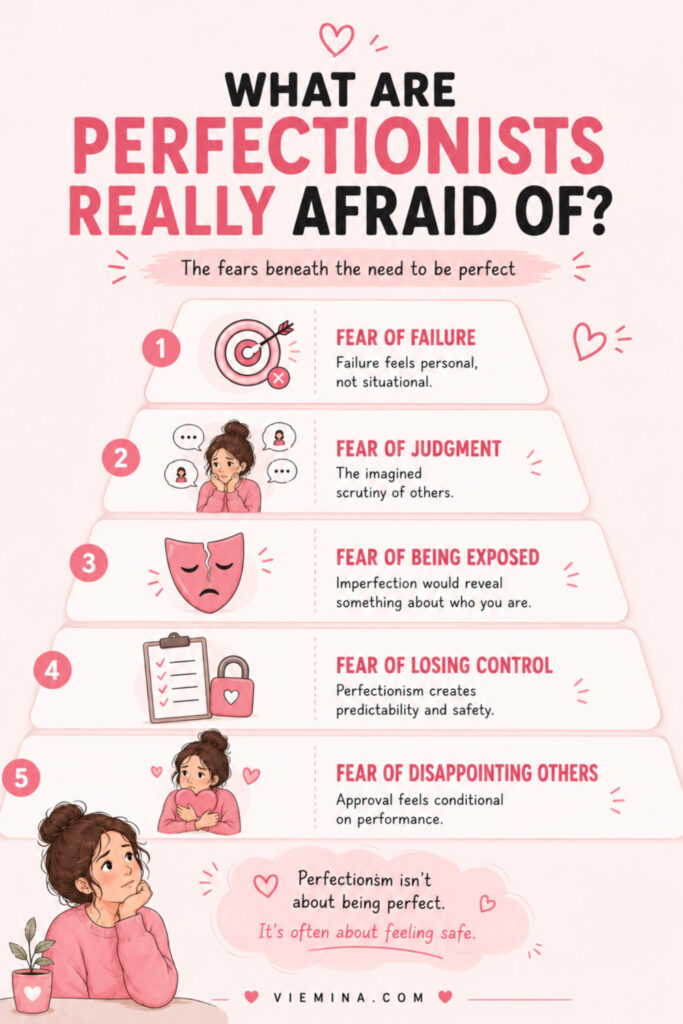
At the base of most perfectionism, beneath the standards and the rituals and the endless revisions, is a small number of specific fears:
- Fear of judgment of being seen as incompetent, mediocre, or not as capable as people think
- Fear of failure, specifically failure that confirms a feared self-image (“I’m not as smart/talented/capable as I pretended”)
- Fear of rejection, the belief that imperfect performance will cost them relationships, status, or belonging
- Fear of losing control, perfectionism as a way of managing a world that feels unpredictable
- Fear of success less common but real; the anxiety about what new expectations a success would create
Perfectionism is almost always fear wearing the costume of standards.
Recognizing which fear is at the center of yours makes the work of overcoming it more targeted and more honest.
How to Overcome Perfectionism: 10 Strategies That Actually Work
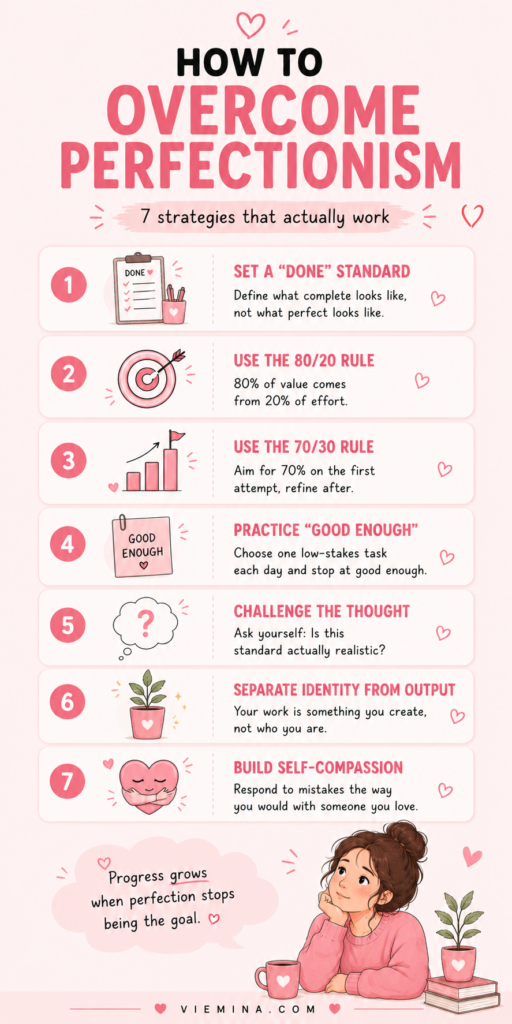
These aren’t generic tips. Each one addresses a specific psychological mechanism that keeps perfectionism in place.
1. Separate Your Identity From Your Output
This is the foundational shift and the hardest one.
As long as you believe your value depends on your performance, every imperfect result will feel threatening. The work of separating identity from output isn’t a one-time insight. It’s a repeated practice of noticing when you’ve fused the two. This draft is bad, therefore I am bad, and consciously uncoupling them.
A useful daily practice: after completing any task, ask yourself, “What did this teach me?” rather than “How well did I do?” The first question positions you as a learner. The second positions you as a subject being evaluated.
2. Use the 80/20 Rule for Perfectionism
What is the 80/20 rule for perfectionism?
The 80/20 rule (Pareto Principle) applied to perfectionism means recognizing that roughly 80% of a task’s value comes from the first 20% of effort and that the final push toward “perfect” often delivers diminishing returns that aren’t worth the cost.
In practice: identify the point at which your work is genuinely good and serves its purpose. Everything beyond that point is where perfectionism takes over from quality. Not every email needs seven drafts. Not every report needs three rounds of revisions. Learn to identify when more effort is actually improving the outcome and when it’s just managing your anxiety.
3. Define “Done” Before You Start
Before beginning any task, write down specifically what the finished version looks like. Not perfect. Not exceptional. Just done.
For a student: “This essay is done when it answers the question, meets the word count, and has been read through once.”
For a professional: “This report is done when it covers the brief, includes the key data, and has been proofread.”
When your brain has a clear, concrete finish line, it stops searching for an impossible standard and moves toward an achievable one. This is one of the most practical interventions for perfectionist procrastination specifically.
Related: How to Stop Procrastination (Even When You Feel Unmotivated)
4. Practice the 70/30 Rule
What is the 70/30 rule for perfectionism?
The 70/30 rule suggests aiming for 70% quality on everyday tasks and reserving the full push toward excellence for the 30% of work that genuinely warrants it. Not everything deserves the same level of perfectionist attention, and treating every task as equally high-stakes is both unsustainable and ineffective.
This rule helps perfectionists learn to calibrate effort appropriately, saving the deep investment for things that genuinely matter, and releasing the rest at good enough.
Related: How to Stop Overthinking: 12 Ways That Actually Work
5. Create Deliberate “Imperfection Practice.”
Perfectionism weakens through repeated exposure to repeatedly experiencing that imperfect work doesn’t produce the catastrophic outcome your brain anticipates.
Build small, regular practices of intentional imperfection:
- Send an email after one read-through instead of five.
- Post something without reading it twice.
- Submit work that you know isn’t your best and notice what actually happens.
Each experience where imperfect output is accepted, overlooked, or even praised is evidence that weakens the fear. Over time, the catastrophic prediction loses its power because you’ve gathered enough data to contradict it.
6. Challenge All-or-Nothing Thinking
Perfectionism runs on binary logic: it’s either excellent or it’s a failure. There’s no middle ground, no partial credit, no “pretty good for a first attempt.”
When you notice this thinking, name it explicitly: “I’m doing all-or-nothing thinking right now.” Then deliberately introduce gradations. A scale of 1-10 works well for this. Ask: “On a scale of 1-10, how good does this actually need to be?” Most tasks are 6s and 7s, not 10s, and recognizing that relieves enormous pressure.
Related: 12 Signs You’re Overanalyzing — And How to Finally Stop
7. Build Self-Compassion as a Skill
This sounds soft. The research behind it isn’t.
Dr. Kristin Neff’s extensive work on self-compassion consistently finds that people who treat themselves kindly after failures are more motivated to improve and try again, not less. Perfectionism tells you the opposite: that self-criticism is what keeps you from getting complacent. But the evidence shows that harsh self-criticism actually increases avoidance and reduces resilience.
Self-compassion isn’t the same as lowering your standards or making excuses. It’s responding to your own struggles the way you’d respond to a good friend going through the same thing with honesty, support, and perspective rather than cruelty.
8. Set Time Limits That Force Completion
Perfectionism thrives on unlimited time. When there’s no constraint, there’s always room for one more revision, one more consideration, one more pass.
Create artificial time boundaries: 45 minutes to write the first draft. One read-through before sending. A 20-minute decision window before committing. Constraints force completion and build the evidence that what is done is survivable, which is exactly the evidence that perfectionism doesn’t want you to gather.
9. Reframe Mistakes as Data
Every mistake contains specific information: what didn’t work, what to adjust, what to try differently. That information is only available after you’ve tried, which means attempts, including failed ones, are the mechanism through which improvement actually happens.
The perfectionist who never submits never gets feedback. The person who submits imperfect work gets data. Over time, the data-gatherer gets better. The perfectionist stays stuck in preparation.
The only way to improve is to produce things that can be improved. That requires finishing them first.
10. Seek the Right Kind of Support
- What is the best therapy for perfectionism? Cognitive Behavioral Therapy (CBT) is the most researched approach for perfectionism, targeting the distorted thinking patterns, all-or-nothing thinking, catastrophizing, and over-generalization that maintain it. Acceptance and Commitment Therapy (ACT) is also highly effective, helping people develop psychological flexibility and reduce the experiential avoidance that perfectionism creates.
- Is there medication for perfectionism? Perfectionism itself is not treated with medication. But when perfectionism co-occurs with anxiety, OCD, or depression, which it frequently does, medication for those conditions can reduce the intensity of perfectionist symptoms significantly. A psychiatrist or psychologist is the right person to assess whether this applies to you.
How to Accept That You’re Not Perfect
1-How do I accept that I’m not perfect?
Acceptance doesn’t mean indifference. It means building a realistic relationship with your own humanity, acknowledging that imperfection is not an aberration but the baseline condition of every person who has ever done anything worth doing.
2-A few practices that build this over time:
Look at the work of people you admire, all of it, not just the highlights. Most successful people have a significant body of imperfect, failed, or embarrassing work behind them. That work is rarely shown in retrospectives, but it existed. The finished thing you admire was built on a foundation of earlier imperfect attempts.
3-Notice how you respond to imperfection in people you love:
When someone you care about makes a mistake or produces something flawed, do you love them less? Probably not. The standard you hold yourself to that you don’t hold others to is worth examining.
4-Track progress, not perfection:
Keep a simple log of things you completed, not things you completed perfectly. Over time, the list of completed things becomes more motivating than the imaginary list of perfect things ever could be.
Conclusion
Overcoming perfectionism isn’t about caring less. It’s about directing your care more wisely.
The standards that feel like they’re protecting your work are often protecting your ego instead, and the cost of that protection is enormous. Unfinished projects. Avoided opportunities. Work that never gets seen because it was never quite ready. A life spent preparing to start.
Done is not the enemy of good. Perfectionism is.
Every imperfect thing you finish is more valuable than the perfect thing that stays in your head. Every attempt that doesn’t go the way you planned teaches you something the planned version never could. Every time you send the email, submit the work, or publish the post, despite the discomfort, you’re weakening the fear just a little.
That’s how it changes. Not through a single insight, but through the accumulated evidence of attempts survived.
Start badly. Finish anyway. Do it again.
And if you’re working on breaking procrastination across the board, not just where perfectionism is the driver, the complete guide on Why Do I Procrastinate Even When I Want to Work? covers every strategy in one place.
Frequently asked questions
-
Is there a way to stop being a perfectionist?
Perfectionism rarely disappears entirely, but it becomes significantly more manageable. The goal isn’t to stop caring about quality. It’s to stop treating quality as a condition of your self-worth. With consistent practice of the strategies above, particularly separating identity from output, using time constraints, and practicing intentional imperfection, most people find that perfectionism goes from a daily obstacle to an occasional pattern they can recognize and redirect.
-
What is the root cause of perfectionism?
Most perfectionism is rooted in the early belief that approval and love are conditional on performance, typically learned in childhood through environments where praise was tied to achievement and mistakes were responded to harshly. Perfectionism develops as a way of staying safe: if I’m always excellent, I can never be rejected or criticized. The adult version of this pattern maintains itself because the fear underneath it was never directly addressed.
-
Is perfectionism linked to high IQ?
Research does find higher rates of perfectionism among people with higher cognitive ability, though the relationship is complex. Highly intelligent people can more vividly imagine potential failure scenarios, tend to compare themselves against the highest standards in their field, and may have had early experiences where things came easily, leaving them without practice tolerating struggle and imperfection.
-
What childhood trauma causes perfectionism?
Perfectionism can develop in response to various adverse childhood experiences: emotionally unavailable or highly critical parents, environments where love felt conditional on achievement, chaotic or unpredictable home situations where control over performance became a coping mechanism, and early experiences of bullying or social rejection. Not all perfectionism involves obvious trauma, but it almost always involves some experience of feeling that being good enough wasn’t enough.
-
Is perfectionism a form of ADHD?
Not exactly, but perfectionism is common in people with ADHD, especially those who have spent years being criticized for disorganization, missed deadlines, or inconsistent performance. The perfectionism in ADHD often functions as an overcompensation: an attempt to prove capability by being flawless, because anything less confirms the feared self-image. ADHD perfectionism often manifests as avoidance, never starting because starting means risking another disappointing result.
-
Can perfectionism cause depression and anxiety?
Yes; and significantly so. Maladaptive perfectionism is one of the strongest psychological predictors of both anxiety and depression. The relentless self-criticism, chronic dissatisfaction, difficulty completing tasks, and fear of judgment that characterize perfectionism create precisely the conditions in which anxiety and depression develop and persist. Research consistently finds that reducing perfectionistic thinking has measurable positive effects on both conditions.