
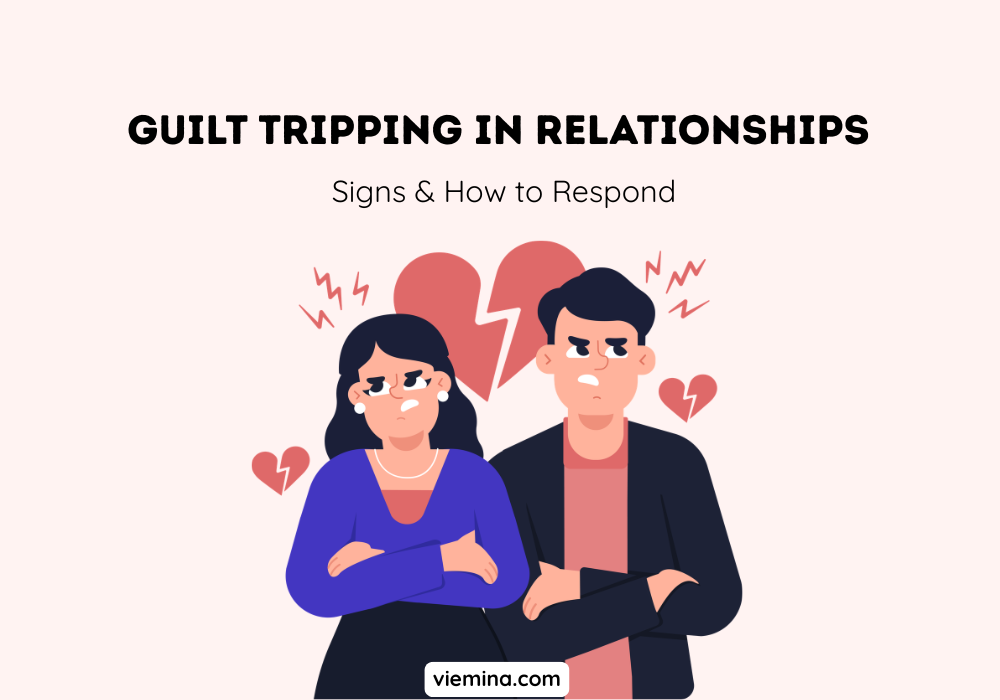
Guilt tripping in relationships is one of the most common forms of emotional manipulation and one of the hardest to recognize when you’re inside it.
You said no to something, something reasonable, something that was entirely your right to decline. And now you’re sitting with a knot in your stomach, replaying the conversation, wondering if you were selfish.
You weren’t. But someone made sure you’d feel like you were.
That’s guilt tripping. And if it’s a regular feature of one of your close relationships, it’s worth understanding exactly what it is, why it works so well, and what you can do about it.
This article covers everything you need to know about guilt tripping in relationships.
What Is Guilt Tripping in a Relationship?
Guilt tripping is a manipulation tactic where someone makes you feel responsible for their emotions, their disappointment, or their problems, to influence your behavior. The goal is not to communicate genuine hurt but to use the appearance of hurt as leverage.
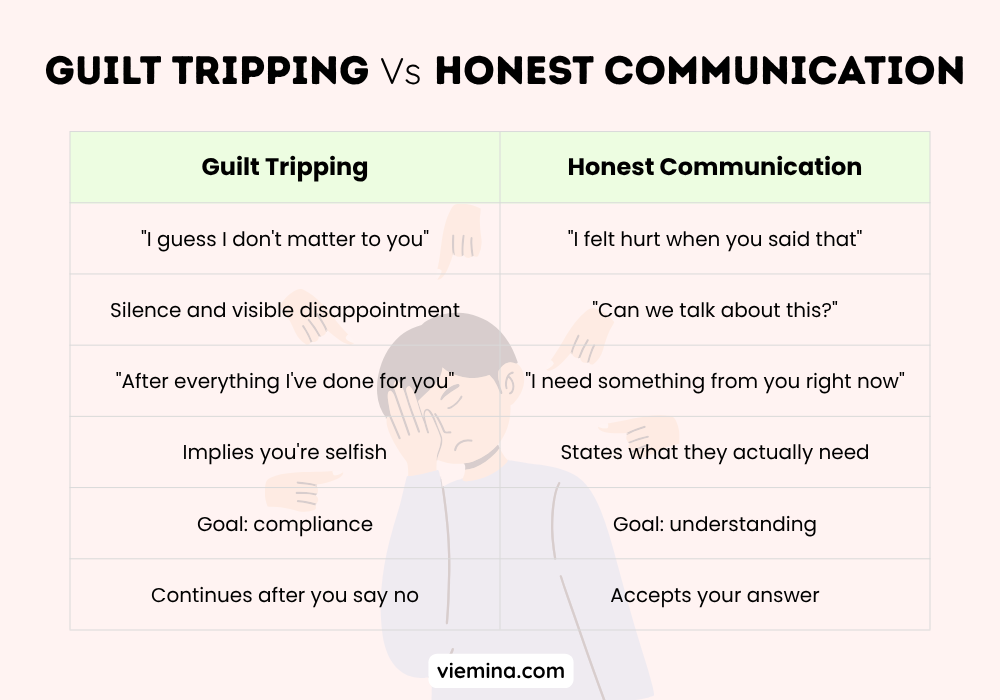
It’s different from honest emotional expression. When someone says, “I felt hurt when you canceled on me” because they genuinely felt hurt and want to be understood, that’s communication. When someone says, “I guess I just don’t matter to you” to pressure you into doing something you’ve already decided against, that’s guilt tripping.
The distinction is in the intent and the pattern. Genuine hurt seeks understanding. A guilt trip seeks compliance.
Guilt tripping is most likely to occur and is most successful in relationships that are closest to us. Because we are most emotionally vulnerable with the people closest to us, we don’t want them to feel bad, and so we comply. This is how guilt operates as such a strong motivator in our close relationships.
Is Guilt Tripping a Form of Manipulation?
Yes, clearly and unambiguously.
Guilt tripping is a psychological tactic that bypasses your rational decision-making and targets your emotions instead. Rather than making a direct request and accepting whatever answer you give, a guilt tripper engineers an emotional environment where saying no becomes unbearable. The manipulation lies in that engineering.
Some people guilt-trip consciously, as a deliberate strategy to maintain control. Others do it without recognizing what they’re doing, having absorbed it from families or relationships where guilt was the primary currency of influence. Both are manipulations. The intent matters less than the effect.
Related: 18 Signs of Manipulation in a Relationship
Is Guilt Tripping a Form of Emotional Abuse?
It depends on frequency, severity, and intent.
A single guilt trip, especially an unconscious one, is not emotional abuse. People communicate imperfectly, particularly in moments of genuine frustration or hurt. That’s human.
But a sustained pattern of guilt tripping, where one person consistently uses emotional manipulation to control another’s behavior, override their limits, and ensure compliance, is a form of emotional abuse. The toxic nature of guilt-tripping lies in its ability to distort the natural give-and-take of healthy interactions, replacing it with a cycle of manipulation and resentment.
It becomes cause for serious concern when:
- It’s a consistent pattern across many interactions and topics.
- It’s paired with other controlling behaviors, criticism, isolation, and gaslighting.
- Your limits are never respected, only worn down.
- You feel chronically anxious around this person.
- You’ve changed who you are and how you behave to manage their emotional reactions.
When these signs are present together, particularly in romantic relationships, the situation is worth naming clearly and either addressing with professional support or reconsidering the relationship’s place in your life.
People who come from narcissistic or controlling relationships often find that guilt has been used against them so consistently that they struggle to trust their judgment. If that sounds familiar, the problem isn’t your decision-making. It’s the conditioning.
Related: 15 Signs You’re in a Relationship with a Narcissist,Not Love
Is Guilt Tripping a Form of Control?
Yes, and this is the part that often goes unacknowledged.
Guilt is one of the most effective tools of behavioral control available because it works from the inside. Unlike direct coercion, “do this, or there will be consequences,” guilt tripping makes you control yourself. You comply not because you’re forced to but because the guilt has become unbearable enough that doing what they want feels like the only way to relieve it.
This is particularly effective in empathetic people, people-pleasers, or those who grew up in environments where guilt was regularly used to manage behavior.
The most controlling versions of guilt tripping don’t look like obvious pressure. They look like a sigh. A withdrawal. A loaded silence. A “Don’t worry about me.” The control is exercised through emotional atmosphere rather than direct demand, which is precisely what makes it so hard to name and resist.
Related: 20 Signs of a Controlling Relationship — And How to Leave
Related: 15 Signs of a Controlling Friend — And When to Walk Away
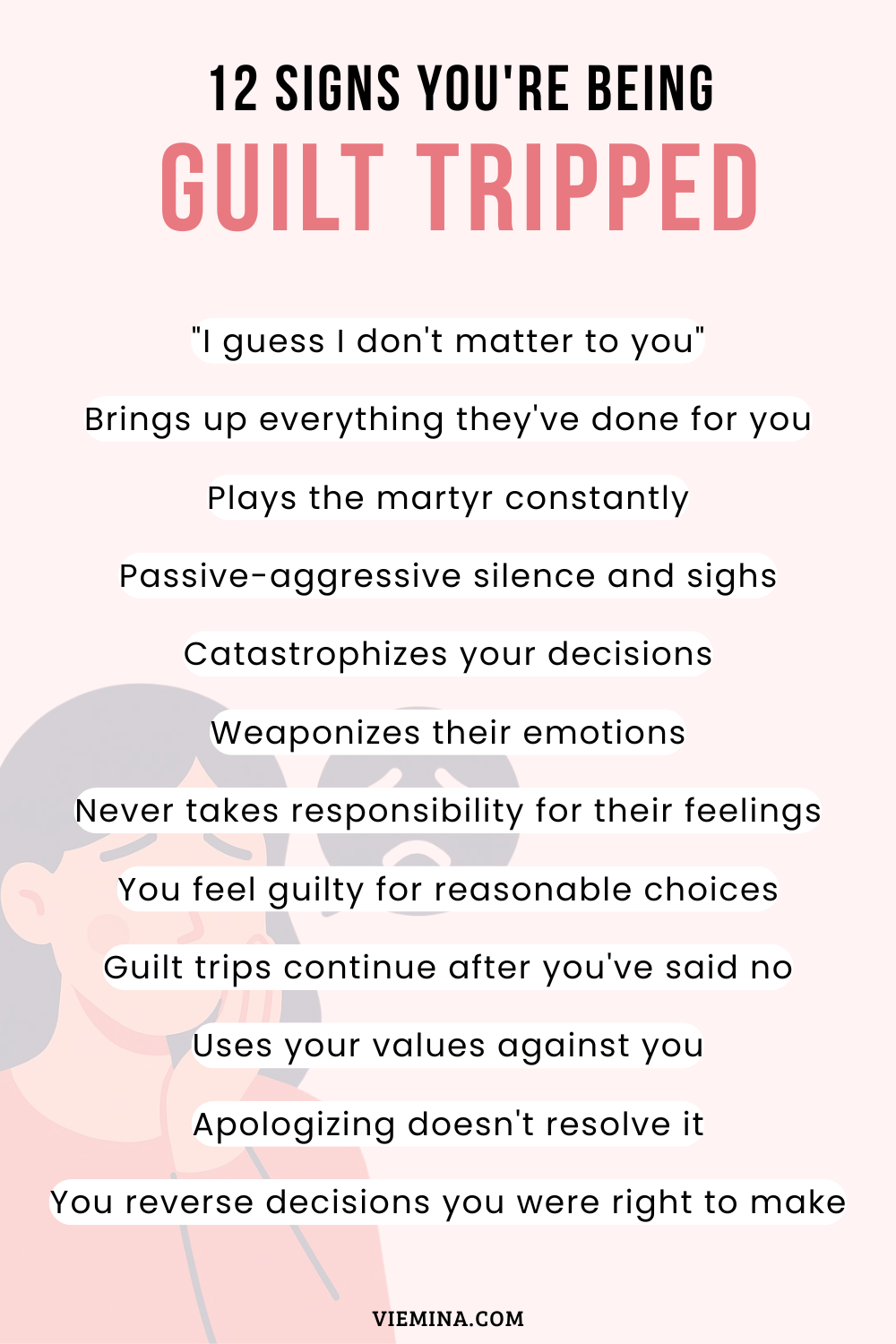
12 Signs of Guilt Tripping in Relationships
1. They make statements designed to make you feel selfish for having needs
Classic examples: “I guess I just don’t matter to you.” “No, it’s fine, I’ll just figure it out on my own.” “I thought we were a team.”
None of these is a direct request. All of them are engineered to make you feel that your needs, your boundaries, or your choices are evidence of selfishness or a lack of care. The goal is to make saying no feel so costly emotionally that you don’t say it.
Related: How to Set Boundaries With Friends (And Why It’s Hard)
2. They remind you of everything they’ve done for you
Favors, sacrifices, and history get brought up not as genuine expressions of care but as debts to be called in. “After everything I’ve done for you” is the signature phrase, but it can be subtler. “I always make time for you” when you’ve said you’re busy. “Remember when I was there for you during X?” when you’ve declined something unrelated.
Leading remarks meant to appeal to your emotions, such as “Remember when I did X thing for you?” or “Don’t I do things for you all the time?” are a classic sign of guilt tripping in action.
3. They play the martyr
The martyr guilt trip involves the other person positioning themselves as a helpless victim of your choices, even choices that have nothing to do with them. “I’ll be fine, alone, as usual.” “It’s okay. I’ll just cancel the thing I had planned.” The suffering is performed for your benefit, with the clear implication that you could relieve it if you chose to.
Related: Victim Mentality: Signs, Causes, and 12 Strategies
4. They use passive-aggressive guilt trips
A passive-aggressive guilt trip is one where the manipulation is delivered indirectly, through tone, body language, or implication rather than explicit statement. The sigh. The tight smile. The “no, really, it’s fine” that makes clear it isn’t fine. The sudden coldness that appears after you’ve made a decision they didn’t like.
What makes passive-aggressive guilt trips particularly insidious is that they give the guilt tripper plausible deniability. If you address it, they can claim you’re imagining things, which sometimes tips directly into gaslighting.
Related: 12 Manipulative Apology Examples: How To Spot Fake Sorries
5. They catastrophize your decisions
Your choice to spend an evening alone becomes evidence that you don’t value the relationship. Saying no to one request becomes proof that you’re not a good partner, friend, or child. The guilt trip works by inflating the significance of your decision to a scale it doesn’t warrant, making a small, reasonable choice feel like a moral failing.
Related: 23 Signs of Repressed Childhood Trauma in Adults
Related: 15 Signs of Fake Friends — And How to Deal With Them
6. They weaponize their emotions
There’s a difference between expressing emotions honestly and using emotions as a weapon. Genuine emotional expression: “I felt hurt when that happened, and I’d like to talk about it.” Weaponized emotions: deliberately crying, becoming visibly distressed, or expressing suffering in a way specifically calibrated to produce guilt and change your behavior.
The key difference is that genuine expression moves toward resolution, weaponized emotion moves toward compliance.
7. They never take responsibility for their feelings
A guilt tripper consistently externalizes responsibility for their emotional state. They’re not responsible for their feelings; you are. If they’re upset, it’s because of something you did. If they’re disappointed, it’s your fault for letting them down. Their emotions are always presented as caused by you, which means you can always be made to feel responsible for alleviating them.
8. You feel guilty for things that are completely reasonable
This is one of the clearest personal indicators. When you find yourself feeling guilty for saying no, for choosing to spend time alone, for making a completely legitimate decision, and the guilt feels disproportionate to any reasonable assessment of the situation, that’s a signal worth examining.
When you’re being guilt-tripped, you might start feeling like you’re not good enough. You may notice that you feel anxious every time you interact with that person.
9. They guilt-trip you after you’ve already said no
Setting a limit doesn’t end the conversation. After you’ve said no, the guilt trip continues, more sighs, more “I guess I understand,” more performance of disappointment, until you either change your answer or feel so bad that the original limit feels like it wasn’t worth setting.
This is one of the most important signs because it reveals the function of the guilt trip clearly: it isn’t an expression of genuine hurt. It’s a continuation of an attempt to change your behavior.
10. They use your values and vulnerabilities against you
A skilled guilt tripper learns what you care most about, being a good partner, being reliable, being caring, and frames your decisions as violations of those values. If you care about being a good friend, they suggest that your decision proves you’re not one. If you value loyalty, they imply your choice is disloyal.
This is manipulation at its most targeted: using your own good qualities as the lever.
Related: 21 Signs of Manipulative Parents You Should Know
Related: 18 Signs of a Manipulative Mother
11. Apologizing doesn’t end it
You apologize, sincerely, genuinely, and the guilt trip continues. The apology is accepted in a way that still manages to communicate ongoing hurt and disappointment. There’s no actual resolution, just a temporary pause before the next guilt trip. This pattern suggests the guilt tripping isn’t really about the original issue at all.
12. You change decisions you were right to make
The clearest indicator that you’ve been successfully guilt-tripped is this: you agreed to something you didn’t want to do, or reversed a decision that was right for you, specifically because the emotional pressure became unbearable, not because you genuinely changed your mind.
After the fact, you may feel resentment toward the other person and toward yourself. That resentment is information.
Guilt Trip Examples in Relationships
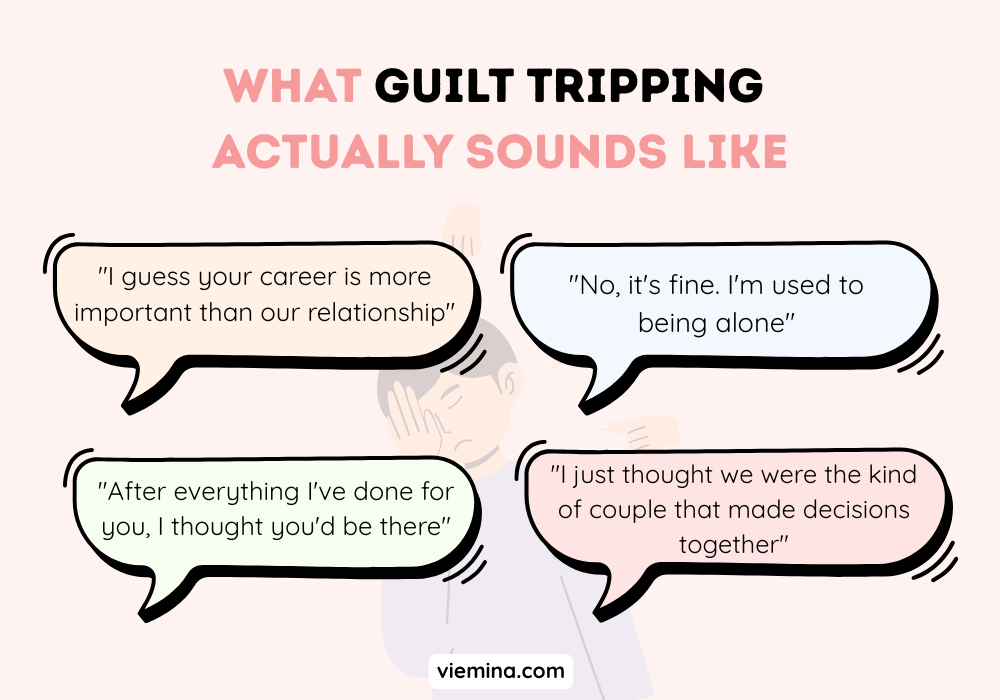
Understanding guilt tripping is easier with concrete examples of how it actually sounds:
From a partner:
You’ve worked a long week and want to spend Saturday alone recharging. Your partner says, “I just thought we could spend some time together for once. But that’s okay. I know you need your space. I’ll find something to do.”
From a parent:
You can’t make it to a family event due to work. Your parent says, “No, of course, your career is important. We’ll just tell everyone you couldn’t come. They’ll understand. We’re used to it.”
From a friend:
You decline an invitation because you need to rest. Your friend says, “I’ve been going through a really hard time, and I really needed you there. But it’s fine. I’ll figure it out.”
Passive-aggressive version:
You make a plan without consulting them. They say nothing at the time, but become noticeably quiet and withdrawn for the rest of the evening. When you ask what’s wrong, they say, “Nothing. I just thought we were the kind of couple that made decisions together. But I might be wrong about that.”
In every case, the structure is the same: your reasonable action is reframed as evidence of inadequacy, and the emotional discomfort you feel is the mechanism of control.
What Kind of Person Guilt Trips?
Guilt tripping isn’t exclusive to any one personality type, but certain patterns show up repeatedly.
People with poor communication skills
For some people, guilt tripping is a default communication strategy because they were never taught to express needs directly. They learned, in the families or relationships where they grew up, that expressing hurt was safer and more effective than making direct requests. This doesn’t make it acceptable, but it does make it addressable if the person is willing to develop different skills.
People with narcissistic traits
Guilt tripping is a core tool in the narcissistic manipulation toolkit. A manipulator suggests to the conscientious victim that they do not care enough, using guilt trips as a special kind of intimidation tactic. For people with narcissistic tendencies, guilt tripping isn’t incidental; it’s a deliberate control strategy, used alongside gaslighting, criticism, and emotional withdrawal to keep others compliant and their needs met.
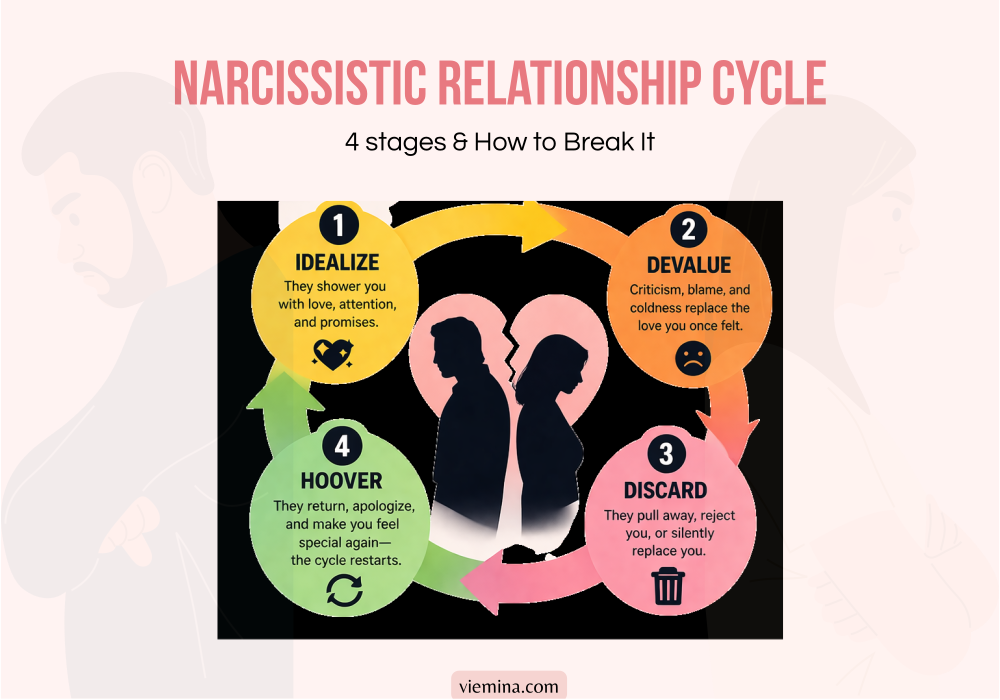
Related: Narcissistic Relationship Cycle: 4 stages & How to Break It
People who fear abandonment
Beneath many guilt trips is a genuine fear of being left, rejected, or abandoned. The guilt trip is an attempt to control the other person’s behavior to manage that fear. This doesn’t justify the behavior, but it explains why the most intense guilt tripping often emerges when the other person tries to establish independence or distance.
People who grew up in homes where guilt was the primary emotional currency. As adults, they reproduce the relational patterns they learned, not always consciously, but reliably.
Why Guilt Tripping Works: The Psychology
Understanding why you comply, even when part of you recognizes the manipulation, is important and not a sign of weakness.
1-Empathy is exploited:
The more empathetic you are, the more you feel other people’s emotional states as real and significant. A guilt tripper’s performed disappointment triggers a genuine empathetic response in you. Your brain doesn’t automatically distinguish between genuine hurt and manufactured hurt; it just registers that someone you care about is distressed, and it wants to relieve that distress.
2-Social conditioning:
Many people, particularly women, are socialized to prioritize others’ emotional comfort over their needs. The guilt trip activates that conditioning directly: saying no feels selfish because you’ve been taught that being responsive to others’ emotional states is what good people do.
3-The relief is immediate:
Complying with the guilt trip makes the discomfort stop immediately. Holding your boundary while enduring the emotional pressure requires tolerating sustained discomfort with a delayed payoff. Neurologically, immediate relief will always be more powerful than delayed reward, which is why the short-term logic of giving in is so compelling even when the long-term logic argues against it.
Related: 7 Stages of Trauma Bonding: How to Break the Cycle & Heal
How to Respond to Guilt Tripping With Specific Scripts
Step 1: Name what’s happening internally first
Before you respond, recognize what’s happening. “This is a guilt trip. I’m feeling pressure to change my answer because of the emotional atmosphere being created, not because I’ve genuinely reconsidered.”
This internal naming breaks the automatic compliance response. You don’t have to say this out loud; just recognizing it creates enough distance to respond intentionally rather than reactively.
Step 2: Acknowledge without agreeing
Validate the emotion without accepting the frame. This sounds like:
“I can see you’re disappointed.”
“I hear that you’re frustrated.”
“I understand this isn’t what you were hoping for.”
You are not saying they’re right to be disappointed. You’re not accepting responsibility for their emotional state. You’re simply acknowledging that they have feelings, which is true, while not allowing those feelings to become the mechanism that changes your decision.
Step 3: Hold your position clearly
State your position calmly, once, without extensive justification. Over-explaining gives the guilt tripper material to work with. Each reason you offer is another angle they can challenge or dismiss.
“I’ve made my decision, and I’m not going to change it.”
“I understand you feel that way. My answer is still no.”
“I can hear that you’re upset. That doesn’t change what I’ve decided.”
Step 4: Don’t engage with the guilt trip directly
Engaging with the guilt trip, defending yourself against the implicit accusation, proving you’re not selfish, and explaining why you’re not a bad partner/friend/child, is exactly what the guilt tripper wants. It accepts the premise that you owe them a defense.
If they say, “I guess I just don’t matter to you,” the response is not to explain all the ways they matter to you. The response is: “I can tell you’re hurt. That’s not what I want. And I’m still not going to change my answer.”
The One Phrase to Shut Down a Manipulator
This is the most-searched question on this topic, and the answer is simpler than most people expect.
The phrase is “I understand you feel that way, and my answer is still no.”
Here’s why it works:
It acknowledges the emotional content without accepting it as valid grounds for changing your decision. It doesn’t argue, defend, explain, or justify. It doesn’t get drawn into the guilt trip’s logic. It simply confirms that your decision is made, that you’ve heard their feelings, and that those two things can coexist.
Repeating this phrase, calmly, and consistently, without escalation, is sometimes called the “broken record” technique in assertiveness training. The guilt trip depends on you engaging with it. When you don’t engage, when you simply restate your position without taking the bait, the manipulation has nothing to work with.
How to Outsmart a Guilt Tripper
“Outsmarting” a guilt tripper isn’t about winning an argument; it’s about removing yourself from the emotional game they’re trying to run.
1-Prepare for escalation
Guilt trippers often escalate when the initial attempt doesn’t work. The first sigh becomes a loaded comment. The loaded comment becomes emotional withdrawal. Knowing this pattern in advance means you won’t be destabilized by it. Each escalation is simply the manipulation, trying harder, not evidence that you’re doing something wrong.
2-Delay your response if you need to
You don’t have to respond in the moment. But the sooner after the conversation it happens, the better. Taking time to respond removes the immediate emotional pressure and gives you the chance to respond deliberately rather than reactively.
3-Notice the pattern, not just the incident
Guilt trippers tend to escalate if the initial attempt doesn’t work. Knowing this in advance means you won’t be caught off guard when the first sigh is followed by a loaded comment and then a withdrawal of warmth. The pattern is predictable.
4-Reduce the reward
The guilt trip works because it produces a response from you, even an engaged defensive response, which gives the guilt tripper what they need. When you respond calmly, briefly, and without apparent distress, you remove the emotional reward the behavior is designed to produce.
Guilt Tripping vs. Gaslighting—The Key Difference
These two tactics often appear together, and it’s worth understanding how they’re different.
Guilt tripping manipulates your behavior by making you feel responsible for someone else’s emotional state. The goal is compliance.
Gaslighting manipulates your perception of reality by making you doubt what you know to be true. The goal is self-doubt.
Sometimes, people use them together. If you say, “I don’t like it when you make me feel guilty for not visiting,” a person might respond, “You’re imagining things; I never guilt-trip you. You’re too sensitive.” First, they guilt-tripped you, and then they gaslighted you by denying that it happened.
When both are present together, guilt tripping to produce compliance and gaslighting to prevent you from naming it, the combination is particularly harmful and characteristic of more serious emotional abuse patterns.
Conclusion
Guilt tripping works because it targets something real: your empathy, your care for others, your desire to be a good person. The manipulation lies in using those qualities against you.
You are allowed to make decisions that others don’t like. You are allowed to say no. You are allowed to have needs that sometimes conflict with other people’s preferences. None of those things makes you selfish, uncaring, or a bad partner, friend, or child.
A relationship where someone consistently tries to make you feel otherwise, where your limits are regularly met with performed disappointment, loaded silences, or reminders of what they’ve sacrificed for you, is a relationship that deserves serious examination.
Your emotional responses belong to you. So do your decisions.
Frequently Asked Questions
What is guilt tripping in a relationship?
Guilt tripping in a relationship is when one person uses guilt as a tactic to influence or control the other person’s behavior, making them feel responsible for their emotional state, reminding them of past favors, or implying that their decisions prove they don’t care enough. It’s different from honest emotional expression because the goal isn’t to communicate genuine hurt and seek understanding; it’s to produce compliance. Guilt tripping is a form of emotional manipulation that appears in romantic relationships, friendships, and family dynamics, and tends to be most effective with people who are empathetic or have been socialized to prioritize others’ emotional comfort.
Is guilt tripping a form of manipulation?
Yes. Guilt tripping is a psychological tactic that bypasses rational decision-making and targets emotions to influence behavior. Rather than making a direct request and accepting the answer, a guilt tripper engineers an emotional environment where saying no becomes so uncomfortable that compliance feels like the only way to relieve the pressure. Whether done consciously or not, this is manipulation; it uses emotional pressure rather than honest communication to change someone’s behavior.
Is guilt tripping emotional abuse?
A single guilt trip is not emotional abuse. However, a sustained pattern of guilt tripping, where one person consistently uses emotional manipulation to override another person’s limits, makes them feel responsible for things that aren’t their responsibility, and ensures behavioral compliance, is a form of emotional abuse. When guilt tripping is chronic and paired with other controlling behaviors like gaslighting, criticism, or emotional withdrawal, it constitutes coercive control.
What is the best response to a guilt trip?
The most effective response to a guilt trip is to acknowledge the other person’s emotion without allowing it to change your decision. A specific phrase that works: “I understand you feel that way, and my answer is still no.” This validates their emotional experience without accepting it as grounds for changing your decision. Avoid over-explaining or defending yourself, as engaging with the guilt trip’s logic gives it more power. State your position calmly, once, and hold it.
Is guilt-tripping a red flag?
A single guilt trip isn’t necessarily a red flag, particularly if it seems to come from poor communication skills rather than deliberate manipulation. However, a pattern of guilt tripping is a significant red flag, particularly when you consistently feel guilty for exercising reasonable limits, your decisions are regularly met with performed disappointment or withdrawal, you find yourself changing decisions you were right to make because the emotional pressure became too great, or the guilt tripping appears alongside other controlling or manipulative behaviors.
What kind of person guilt-trips?
Guilt tripping appears across a range of people but is particularly associated with those who have poor direct communication skills, learned guilt-based communication in childhood, have narcissistic traits, or struggle with a significant fear of abandonment. For people with narcissistic tendencies, guilt tripping is often a deliberate control strategy used to maintain power in relationships. For others, it’s an unconscious pattern absorbed from families where emotional manipulation was the primary way needs were communicated. Both are forms of manipulation, regardless of whether the intent is deliberate.
How do you respond to a narcissist’s guilt trip?
Responding to a narcissistic guilt trip requires a different approach than responding to one that comes from poor communication skills. A narcissist using guilt tripping as a control strategy will escalate if the initial attempt doesn’t produce the desired compliance. The most effective response is to keep your response brief and non-emotional, avoid defending yourself or explaining your reasoning extensively, state your position once and clearly, and disengage from continued attempts to engage you with the emotional content. With a narcissist, extended engagement with the guilt trip, even to defend yourself, is interpreted as an opening. The goal is to remove the reward that the behavior is designed to produce.
What is a passive-aggressive guilt trip?
A passive-aggressive guilt trip is one delivered indirectly, through tone, body language, or implication rather than explicit statement. The sigh, the tight smile, the loaded “it’s fine,” the sudden withdrawal of warmth or attention after you’ve made a decision they didn’t like. What distinguishes passive-aggressive guilt trips is that they give the guilt tripper plausible deniability. If you address the behavior, they can claim you’re imagining things or being too sensitive, which sometimes tips into gaslighting. Passive-aggressive guilt trips are often harder to name and address precisely because nothing overt has been said.