

Most people don’t realize they’re in an unhealthy relationship right away.
It doesn’t usually start with obvious warning signs. It starts with small things, a comment that stings a little too long, a moment where you feel like you can’t say something honestly, a pattern of walking on eggshells that becomes so familiar you stop noticing it.
By the time something feels clearly wrong, it’s often been wrong for a while.
That’s what makes unhealthy relationships so difficult to recognize from the inside. You adapt. You explain things away. You tell yourself that every relationship has rough patches. And sometimes the person you’re with is someone you genuinely love, which makes it even harder to see the signs clearly.
This article lays out the signs of an unhealthy relationship without softening them. Not just the obvious ones, but the subtle patterns that are easy to dismiss until you see them written down and recognize your own life in them.
Understanding what you’re dealing with is always the first step, and sometimes it’s the hardest one.
What are the signs of an unhealthy relationship?
An unhealthy relationship is one where one or both partners experience consistent patterns of disrespect, control, emotional harm, or fear. Key signs include: feeling like you can’t express yourself freely, walking on eggshells around your partner, being controlled or monitored, experiencing manipulation or emotional abuse, feeling isolated from people you care about, and regularly feeling worse about yourself as a result of the relationship. Unhealthy relationships exist on a spectrum from emotionally draining to genuinely dangerous, and not all of them involve physical harm.
What Makes a Relationship Unhealthy?
A relationship doesn’t have to be physically abusive to be unhealthy.
That’s the most important thing to understand before reading the signs below. Many people stay in genuinely harmful situations for years because there’s no bruise to point to, just a slow erosion of confidence, freedom, and self-worth that’s much harder to name.
Psychologists generally define an unhealthy relationship as one where the dynamic between two people is characterized by persistent patterns of harm, emotional, psychological, or physical. The harm doesn’t have to be intentional to be real. Some partners are controlling without knowing it. Some are emotionally abusive in ways they’d genuinely deny. The impact on the person receiving it is what matters.
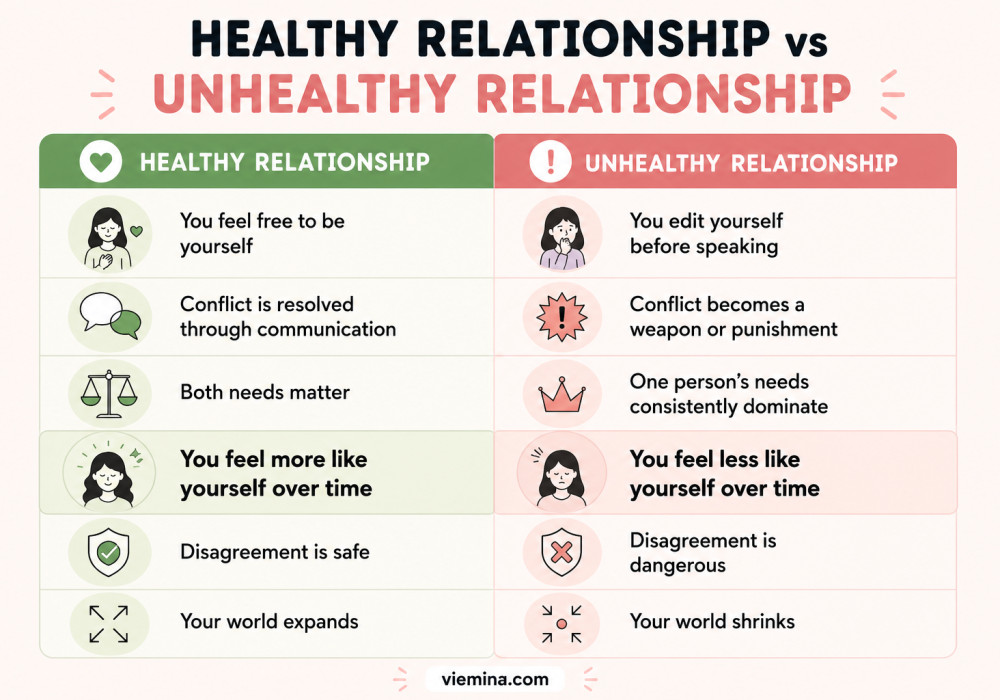
Healthy relationships aren’t perfect. But they’re safe.
In a healthy relationship, both people feel free to be themselves, express their needs, disagree without fear, and feel fundamentally respected even during conflict. When those things are consistently absent, the relationship is unhealthy regardless of how much love exists alongside it.
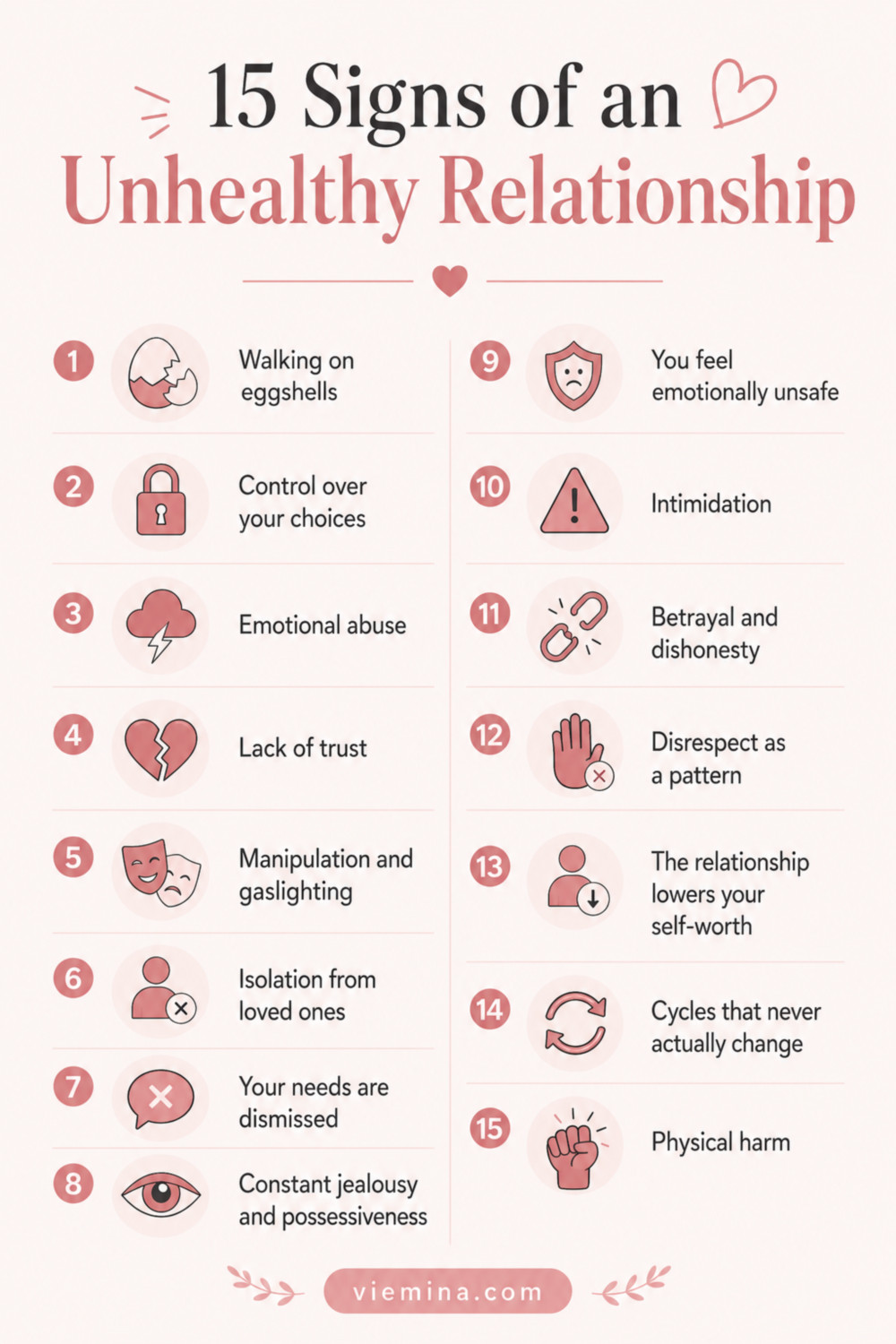
15 Signs of an Unhealthy Relationship
1. You Walk on Eggshells
You think carefully before you speak. You avoid certain topics entirely. You monitor your tone, your expressions, your timing, because you’ve learned that saying the wrong thing leads somewhere you don’t want to go.
This constant internal editing is one of the most telling signs of an unhealthy dynamic.
Walking on eggshells means you’ve traded authenticity for safety. And any relationship where you can’t be yourself without consequence is already in dangerous territory.
2. Control Over Your Choices
Control doesn’t always look like someone dictating your every move. It often starts subtly.
Comments about who you spend time with. Preferences about what you wear. “Suggestions” about your decisions that carry an unspoken weight, agree, or deal with the fallout.
Over time, these accumulate into a pattern where one person’s preferences override the other’s autonomy. A controlling partner may frame this as caring, protectiveness, or simply having strong opinions. But when your independent choices consistently become a source of conflict, that’s control, not love.
Signs your partner may be controlling:
- They question you extensively about who you were with and what you did.
- They disapprove of your friendships or family relationships.
- They make decisions for you without consulting you.
- They react badly when you do things without them.
- They use guilt or anger to redirect your behavior.
For a deeper look at this pattern, the article on signs of a controlling relationship covers how control escalates over time and what it looks like at each stage.
3. Emotional Abuse
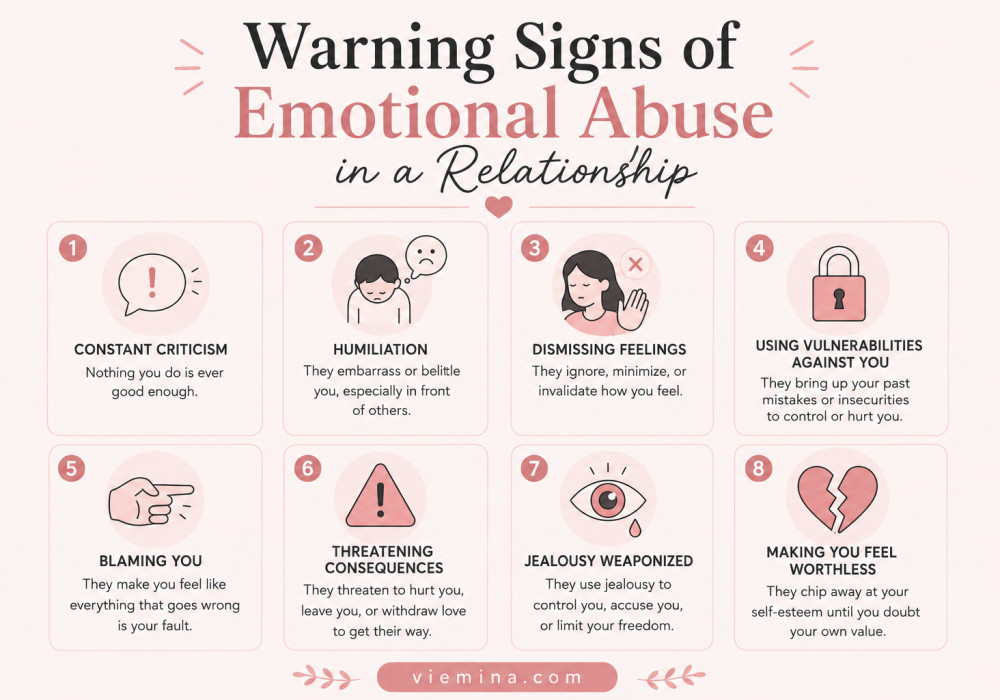
Emotional abuse is one of the most commonly overlooked forms of relationship harm, partly because it leaves no visible marks, and partly because it tends to happen gradually.
It can look like:
- Constant criticism that targets who you are, not just what you did
- Humiliation in private or in front of others
- Dismissing your feelings as an overreaction
- Using your vulnerabilities against you
- Blaming you for their behavior (“you made me act this way”)
- Threatening consequences when you don’t comply
The defining feature of emotional abuse is that it consistently makes you feel smaller, less capable, and less valuable.
Over time, emotional abuse distorts your perception of yourself. You start to believe the narrative the abusive partner creates, that you’re too sensitive, too difficult, not good enough. That distorted self-image is often what keeps people stuck long after they’ve recognized something is wrong.
4. Lack of Trust
Trust is not the same as having no secrets. It’s the foundation that allows both people to feel secure, to know that their partner is honest with them, faithful to their commitments, and acting with their well-being in mind.
When trust is absent, a relationship becomes exhausting in a very specific way.
You analyze messages. You question explanations. You feel a baseline anxiety that never fully goes away. Whether the trust issue stems from actual dishonesty or from a partner who provokes insecurity deliberately, the result is the same: a relationship that drains rather than sustains you.
5. Manipulation
Manipulation is an influence that bypasses your ability to make free, informed choices. It’s what’s happening when someone is steering your behavior through indirect pressure rather than honest communication.
Common manipulation tactics in relationships include:
- Guilt-tripping: making you feel responsible for their emotions to change your behavior
- Gaslighting: making you question your memory, perception, or sanity
- Silent treatment: withdrawing affection or communication as punishment
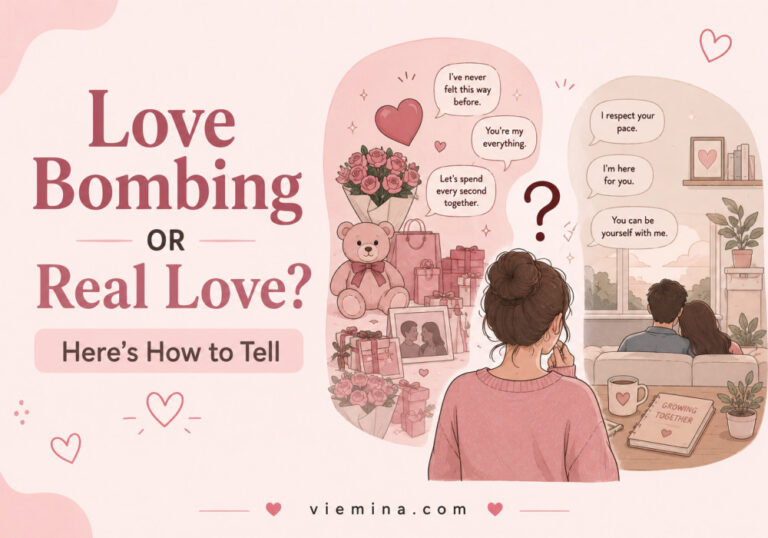
- Love bombing and withdrawal: alternating intense affection with coldness to keep you off-balance
- Victim playing: framing every confrontation so that they are the one who was wronged.
Manipulation is particularly hard to identify from the inside because it works by making you doubt yourself rather than your partner.
If you find yourself regularly confused, apologizing for things you’re not sure you did wrong, or feeling like your emotions are being used against you, manipulation is likely present. The article on manipulative apologies covers one of its most common forms in detail.
Related: 18 Signs of Manipulation in a Relationship
6. Isolation From People You Love
Healthy relationships expand your world. Unhealthy ones shrink it.
Isolation rarely happens all at once. It starts with small friction, a partner who’s moody when you see certain friends, who needs you to stay home, who makes subtle comments about the people in your life, until those relationships start to fade.
Over time, you find yourself with fewer close connections, which makes you more dependent on your partner and less likely to leave.
Isolation is a control tactic. And the more isolated you become, the harder it is to see the relationship clearly.
If you’ve noticed you spend significantly less time with friends and family since this relationship began, and that pulling back wasn’t your choice, that’s a serious warning sign.
7. Your Needs Are Consistently Dismissed
In any relationship, needs won’t always be perfectly met. Life is imperfect, communication is imperfect, and compromise is a normal part of being with someone.
But there’s a difference between needs sometimes going unmet and needs being consistently dismissed, minimized, or mocked.
When you express a need, and your partner responds with defensiveness, eye-rolling, accusations that you’re too demanding, or simply ignores it, and this happens regularly, it’s a sign that the relationship isn’t functioning as a mutual partnership.
A relationship where only one person’s needs matter is not a relationship. It’s a dynamic.
8. Constant Jealousy and Possessiveness
Some jealousy is human. It becomes a problem when it manifests as possessiveness, when a partner uses their jealousy to justify monitoring, controlling, or punishing you.
Possessiveness can look like:
- Checking your phone without permission
- Demanding to know your location at all times
- Accusing you of flirting or cheating without evidence
- Getting angry when you talk to certain people
- Reacting badly to your independence or success
Possessiveness is often framed as love or protectiveness. It isn’t. It’s an attempt to manage a partner’s anxiety through control, and it consistently erodes the freedom and trust that healthy relationships require.
9. You Feel Emotionally Unsafe
Emotional safety means you can be honest about your feelings, your needs, your fears, your mistakes, without fear of punishment, ridicule, or exploitation.
When it’s absent, you’re not really in an intimate relationship. You’re in a performance.
You say what’s acceptable, not what’s true. You hide the parts of yourself that might be judged. You manage your partner’s emotional reactions rather than authentically expressing your own.
If you can’t be honest with your partner, you’re not really with them. You’re managing them.
This is one of the most corrosive signs of an unhealthy relationship because it erodes the very thing that makes relationships valuable, a genuine connection.
10. Intimidation
Intimidation in a relationship doesn’t have to involve explicit threats. It can be a tone of voice, a particular look, a sudden shift in energy that you’ve learned means something bad is coming.
Over time, your nervous system learns the cues. You become hypervigilant, monitoring your partner’s mood, adjusting your behavior preemptively, always braced for a reaction.
Living in a state of low-level fear inside your relationship is not normal. It is not a rough patch. It is a serious sign.
11. Betrayal and Dishonesty
A relationship requires a baseline of honesty to function. That doesn’t mean every small thing needs to be disclosed; privacy is healthy. But systematic dishonesty, broken promises, and betrayals of trust fundamentally damage the foundation of a relationship.
Betrayal in a relationship can include:
- Repeated lying about significant things
- Sharing private information about you with others
- Infidelity or dishonesty about commitment
- Making promises that are consistently broken
Isolated incidents can be worked through with honesty and effort. Repeated patterns are a different matter, and pretending otherwise doesn’t protect the relationship. It just delays a harder reckoning.
Related: Understanding Complicated Relationships: 15 Signs & 8 Causes
12. Disrespect as a Pattern
Respect isn’t just about big moments. It lives in the small, daily interactions, how your partner speaks to you when they’re frustrated, whether they take your opinions seriously, whether they treat your time and feelings as mattering.
Disrespect that appears as a pattern, eye-rolls, dismissive comments, sarcasm used to belittle, interrupting you constantly, and talking over your needs, is more damaging than people give it credit for.
You don’t have to tolerate disrespect in exchange for love. Those two things are not a package deal.
13. The Relationship Consistently Makes You Feel Worse About Yourself
This is one of the clearest diagnostic questions you can ask: Has this relationship made me more or less myself?
Healthy relationships, even difficult ones, generally leave you feeling more capable, more supported, and more like yourself over time.
Unhealthy relationships do the opposite. You feel less confident. Less like your old self. You’ve adopted your partner’s critical view of you, and it’s taken up residence inside your own head.
If you look back at who you were before this relationship and feel a significant loss, that feeling is information worth taking seriously.
Related: 7 Stages of Trauma Bonding: How to Break the Cycle & Heal
14. Cycles That Never Actually Change
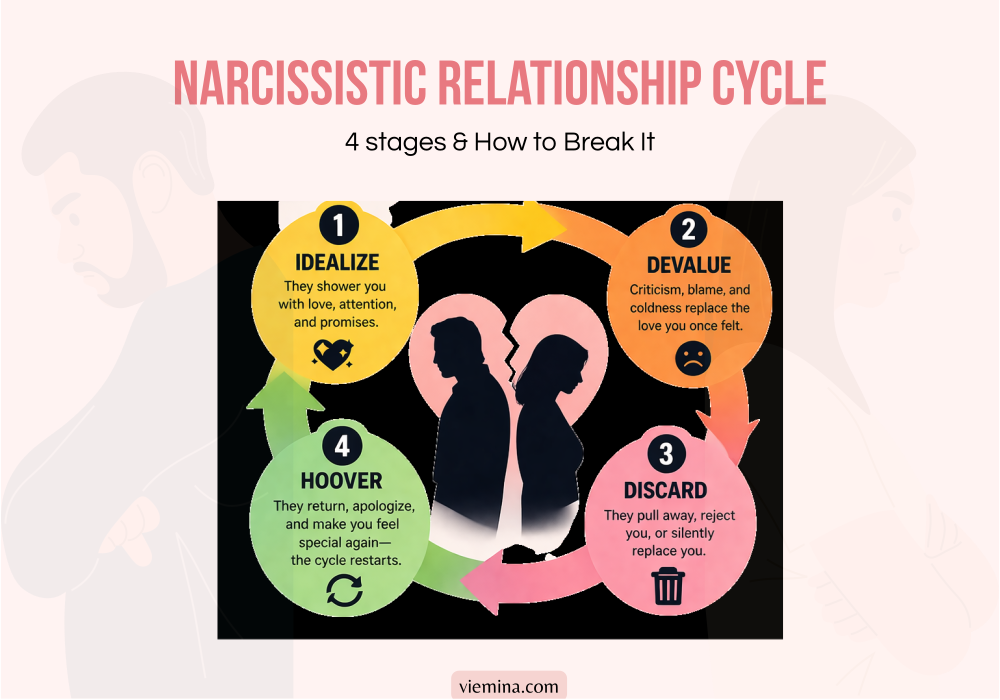
Every unhealthy relationship has a cycle. Tension builds. An incident happens. There’s remorse, apologies, a period of calm, and reconnection. Then tension builds again.
The critical word is cycle. Not change.
Promises to change, without sustained behavioral change, are part of the cycle, not evidence that the cycle is ending. If you’ve been through the same pattern multiple times and find yourself back at the beginning again, the pattern itself is the problem.
Related: Narcissistic Relationship Cycle: 4 stages & How to Break It
15. Physical Harm
Physical harm is the clearest line and the most dangerous.
Any form of physical force, intimidation through physical size or presence, or unwanted physical contact is abuse. Full stop. There is no provocation that justifies it, no stress that excuses it, and no level of love that makes it acceptable.
If physical harm has occurred, safety is the priority above everything else. Resources and support exist, and leaving safely matters more than leaving quickly.
Why Unhealthy Relationships Are Hard to Leave
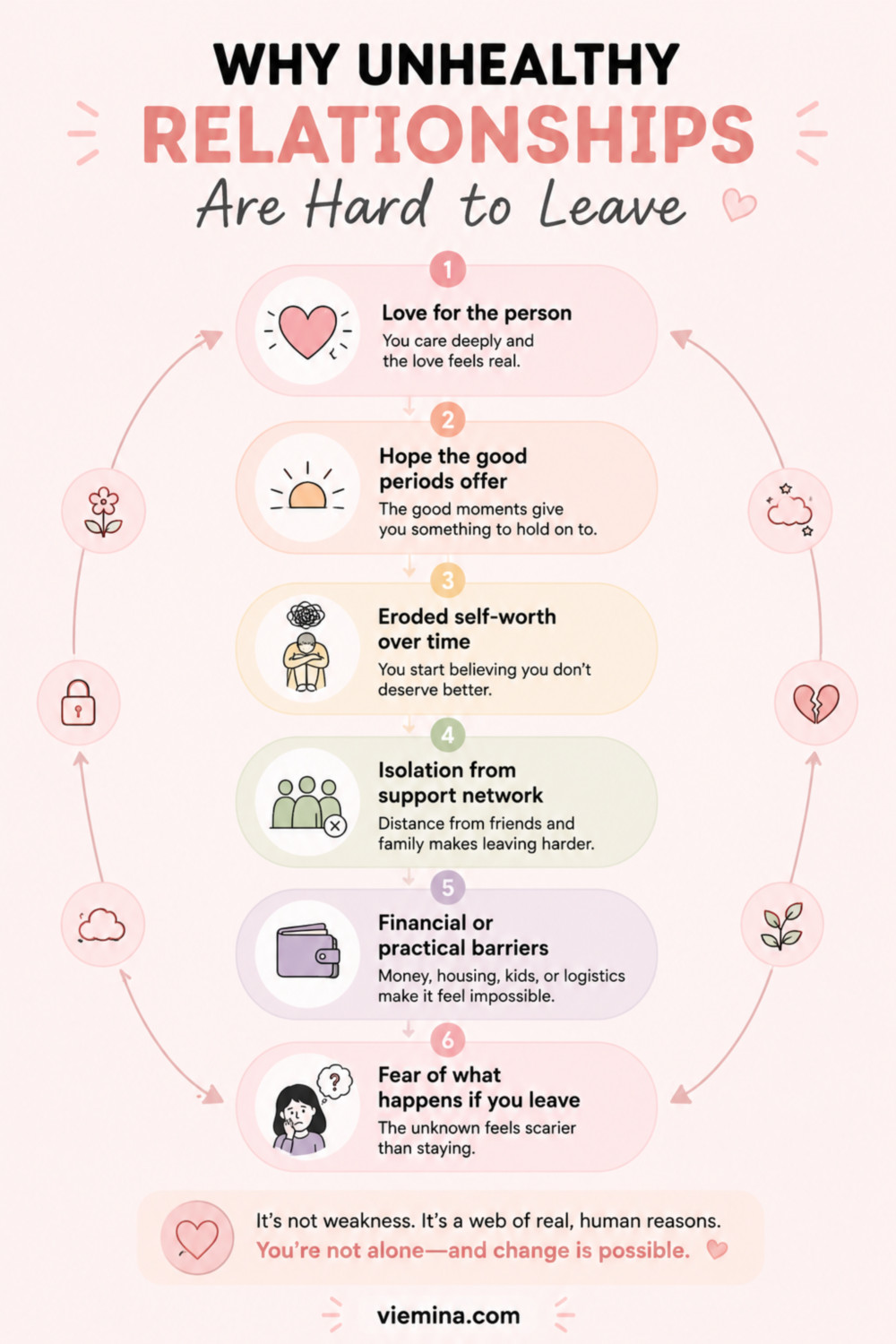
Recognizing the signs is one thing. Leaving is another. And the gap between the two is real, complex, and deserves to be acknowledged.
You might stay because:
- You love the person, even while the relationship is harming you.
- The good periods are genuinely good, and they give you hope.
- Your self-worth has been eroded to the point where you don’t feel you deserve better.
- You’ve been isolated from the support network that would help you leave.
- Financial or practical circumstances make leaving feel impossible.
- You fear what happens if you try to leave.
None of these reasons makes you weak. They’re the predictable results of being in a psychologically harmful dynamic for an extended period.
The difficulty of leaving is not a sign that the relationship is actually okay. It’s often a sign of how deeply unhealthy it is.
Unhealthy vs. Toxic vs. Abusive: Understanding the Spectrum
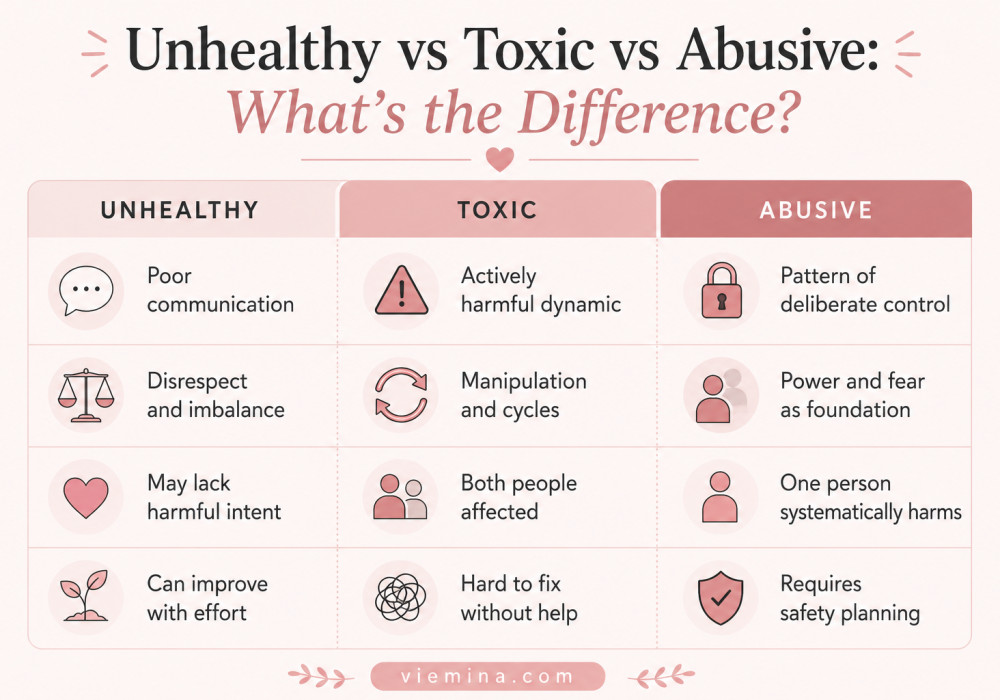
These three terms are often used interchangeably, but they describe different points on a spectrum.
- Unhealthy relationships have persistent patterns of poor communication, disrespect, emotional unavailability, or imbalance. They cause harm but may not involve deliberate intent to control or abuse.
- Toxic relationships involve dynamics that are actively poisonous to one or both people’s well-being, manipulation, cycles of conflict and repair, and persistent negativity that outweighs positive connection.
- Abusive relationships involve a pattern of deliberate control, intimidation, or harm, emotional, psychological, financial, or physical. Abuse is about power and control, and it tends to escalate over time.
A relationship can move along this spectrum. Many relationships that start as merely unhealthy become toxic and eventually abusive. Recognizing where yours sits and watching whether it’s moving in a particular direction matters.
For those wondering whether specific behaviors cross the line into narcissistic abuse, the article on signs you’re in a relationship with a narcissist covers the pattern in detail.
Frequently Asked Questions About Unhealthy Relationship
-
What are the most common signs of an unhealthy relationship?
The most consistently recognized signs include: walking on eggshells around your partner, feeling controlled or monitored, experiencing emotional abuse or manipulation, being isolated from friends and family, having your needs regularly dismissed, feeling emotionally unsafe, and noticing that the relationship consistently lowers your self-worth. Not all of these need to be present; even two or three recurring patterns are enough to indicate a seriously unhealthy dynamic.
-
Can an unhealthy relationship become healthy again?
In some cases, yes, if both people recognize the problem, are genuinely willing to change, and do the work (often with professional support like couples therapy). But this requires honest acknowledgment of what’s happening, not just promises during the reconciliation phase of a cycle. When only one partner is working on the relationship, or when patterns of abuse are present, change is unlikely without significant external intervention.
-
What is the difference between an unhealthy relationship and an abusive one?
All abusive relationships are unhealthy, but not all unhealthy relationships are abusive. Abuse specifically involves a pattern of deliberate control and harm, emotional, psychological, physical, financial, or sexual. Unhealthy relationships may involve poor communication, emotional immaturity, or mutual dysfunction that causes harm without deliberate intent. The distinction matters practically: abusive relationships carry physical and psychological safety risks that require a different level of response.
-
How do unhealthy relationships affect mental health?
The psychological impact of unhealthy relationships is well-documented and significant. Prolonged exposure to emotional abuse, manipulation, and controlling behavior is associated with anxiety, depression, lowered self-esteem, post-traumatic stress, difficulty trusting others, and a distorted self-image. Many people carry the psychological effects of unhealthy relationships long after the relationship ends, which is one of the clearest indicators of how genuinely harmful they are.
-
How do I know if I’m overreacting to relationship problems?
This question is itself worth examining, because it’s exactly the kind of self-doubt that unhealthy relationship dynamics tend to produce. A useful test: would you be concerned if a close friend described these same experiences to you? If the answer is yes, you’re not overreacting. Another useful question: have you been told repeatedly that you’re too sensitive, that you’re imagining things, or that your reactions are the problem? If so, that pattern of dismissal is itself a warning sign worth taking seriously.
-
What should I do if I recognize these signs in my relationship?
Start by giving yourself permission to trust what you’re seeing. Then, if it’s safe to do so, reach out to someone you trust, a friend, family member, or therapist, and talk about what you’ve been experiencing. You don’t have to have a plan to leave before you’re allowed to acknowledge that something is wrong. For support specific to abuse, organizations like the National Domestic Violence Hotline (1-800-799-7233) offer confidential guidance regardless of where you are in the process.
Conclusion
Recognizing the signs of an unhealthy relationship isn’t about condemning the person you’re with or yourself for staying. It’s about seeing clearly, and clarity is the only thing that makes real choices possible.
You cannot make a free decision from inside a fog.
If something in this article landed for you, that recognition matters. You don’t have to act on it immediately. You don’t have to have a plan. But you’re allowed to acknowledge what you’re experiencing, and you’re allowed to want something better.
Healthy relationships exist. They don’t feel like constant management, constant fear, or constant self-erasure. They feel like a place where you can breathe.
You deserve to breathe.




Thanks for fantastic information I was looking for this info for my mission.