


There’s a specific kind of pain that comes from a toxic family.
It’s not like other pain. It’s tangled with love, history, and the deep human need to belong. You can’t simply walk away from it the way you might walk away from a bad friendship. These are the people who shaped who you are, the relationships your earliest sense of safety was built on. When those relationships are harmful, the hurt goes somewhere far deeper than most people know how to name.
You might feel guilty for calling it toxic. You might have spent years explaining their behavior, minimizing what happened, or telling yourself that all families are like this.
Most aren’t.
A toxic family environment is one where the consistent patterns of behavior, criticism, control, manipulation, emotional unavailability, favoritism, or abuse cause measurable harm to the people inside it. The harm is real; it’s psychological, and it often lasts long after you’ve left the house.
This article covers what actually defines a toxic family (beyond the word “toxic”), the roles these families tend to assign, the signs that are hardest to see from the inside, what the research says about long-term effects on mental health, and what genuinely helps, whether you’re still in daily contact or trying to heal from years of distance.
But before diving deep into the full guide , let’s take a quick answer first
What is a toxic family?
A toxic family is one in which the consistent relational patterns cause emotional, psychological, or physical harm to one or more members. This includes families characterized by emotional abuse, chronic criticism, manipulation, control, neglect, favoritism, scapegoating, or enmeshment. What distinguishes a toxic family from a difficult or imperfect one is the persistence of harmful patterns, the absence of genuine accountability, and the psychological impact on those inside it. Toxic family dynamics are associated with anxiety, depression, low self-esteem, attachment difficulties, and a range of adverse long-term health outcomes.
What Makes a Family Toxic? The Psychology Behind It
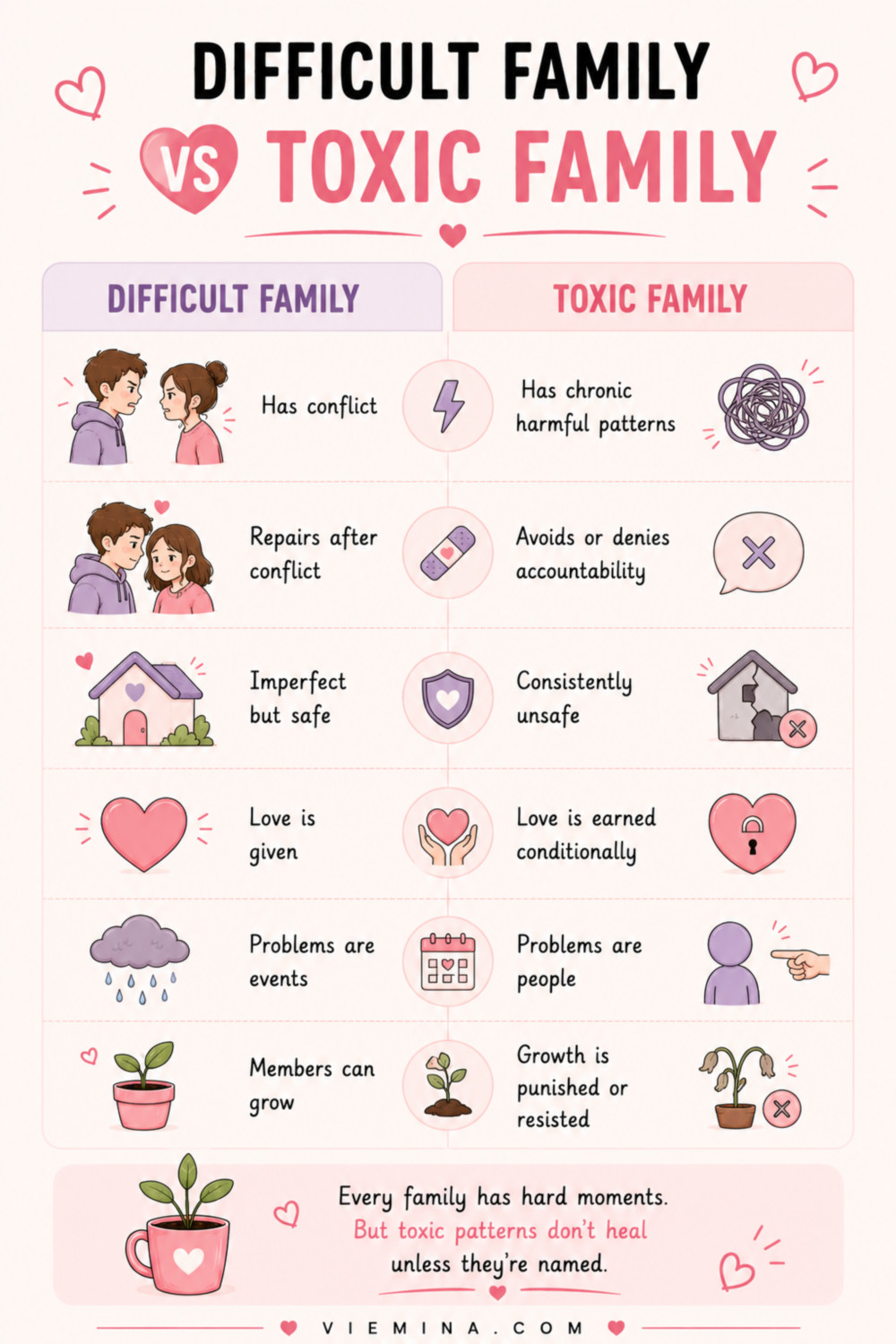
All families have conflict. All parents make mistakes. The difference between a difficult family and a toxic one is not occasional dysfunction; it’s the sustained pattern of harm and the absence of repair.
Psychologists use the term “toxic family environment” to describe family systems in which unhealthy relational patterns are chronic, persistent, and damaging to the psychological development and well-being of family members.
A 2025 study published in the Journal of Family Psychology introduced a validated Family Toxicity Scale to measure toxic family environments, finding significant connections between toxic family scores, Adverse Childhood Experiences (ACEs) scores, and mental illness diagnoses in adulthood. This is among the first formal clinical measures of what many therapists have long observed: toxic family environments have measurable, lasting consequences.
The most important distinction to understand:
- Difficult families have conflict, stress, imperfect communication, and seasons of dysfunction. But they also have genuine repair, apologies, accountability, moments of warmth and connection that are real rather than performed.
- Toxic families have chronic harmful patterns without meaningful accountability. The damage accumulates without resolution. The problem is never addressed, and often anyone who names it becomes the problem.
In a toxic family, the truth is more threatening than the behavior causing harm.
Why Toxic Families Are Hard to Recognize From the Inside
One of the most important things to understand about toxic family dynamics is why they’re so difficult to identify when you’re inside them.
- You have no reference point. Whatever your family looked like growing up is your baseline for normal. If you grew up in an environment where criticism was constant, conditional love was the standard, or emotional volatility was routine, that’s just what families are, until you encounter something different.
- Loyalty runs deep. Love and harm are not mutually exclusive. You can love someone who hurts you. You may want to protect a parent who neglected you. This emotional complexity is not a weakness; it’s a natural consequence of deep attachment. The same bond that makes family relationships meaningful makes them harder to evaluate clearly.
- The harm is often invisible. Physical abuse leaves visible marks. Emotional neglect, gaslighting, chronic criticism, and the quiet withdrawal of love leave none, which makes them easier to dismiss and harder to document, even to yourself.
- You’ve been told it’s your fault. One of the defining features of toxic family systems is that the person who names the dysfunction is typically blamed for it. If you’ve been told you’re too sensitive, that you’re imagining things, or that you’re the reason the family has problems, that narrative is worth examining carefully.
The Roles Toxic Families Assign
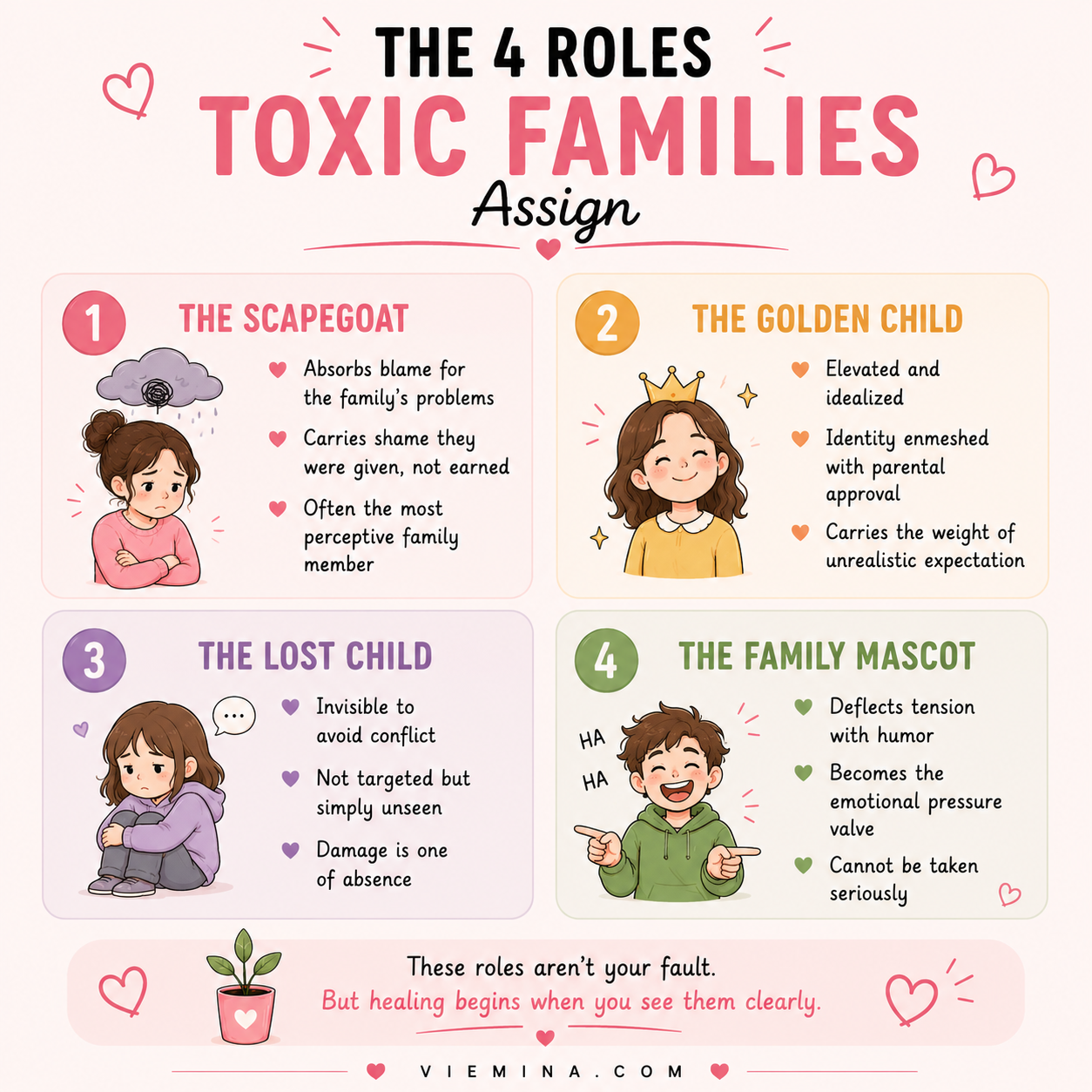
Family systems theory helps explain one of the most recognizable features of toxic families: the assignment of fixed roles to each member. These roles aren’t chosen; they’re imposed by the family system’s need to maintain its equilibrium, usually in service of a controlling or narcissistic central figure.
1-The Scapegoat
The scapegoat is the family member who absorbs blame for the family’s problems. They are criticized, excluded, compared unfavorably to siblings, and made to feel responsible for conflict they didn’t create.
As psychologist Melanie Klein documented, scapegoated children carry the family’s “bad” projections, the shame, failure, and inadequacy that the dominant parent cannot tolerate in themselves. The scapegoat is frequently the most psychologically perceptive member of the family, the one who sees what’s actually happening, and is systematically undermined for that clarity.
2-The Golden Child
The golden child is elevated, idealized, and used to reflect the narcissistic parent’s sense of specialness. This role comes with its own damage: the golden child’s identity becomes enmeshed with parental approval, making authentic selfhood difficult, and the pressure of expectation can be crushing.
3-The Lost Child
The lost child withdraws. They make themselves invisible to avoid conflict and attention. They are often overlooked and underloved; not targeted, but simply not seen. The damage here is one of absence rather than attack.
4-The Family Mascot
The mascot uses humor and lightness to deflect tension. They become the family’s emotional pressure valve, keeping things from escalating by never taking anything seriously. The cost is an inability to take themselves seriously or to process their own pain.
Understanding which role you occupied explains a great deal about the patterns you carry into adulthood, in relationships, in how you respond to conflict, and in the beliefs you hold about your own worth.
Related: 23 Signs of Repressed Childhood Trauma in Adults
Related: 15 Hidden Signs of Emotional Trauma in Adults & How to Heal
12 Signs of a Toxic Family
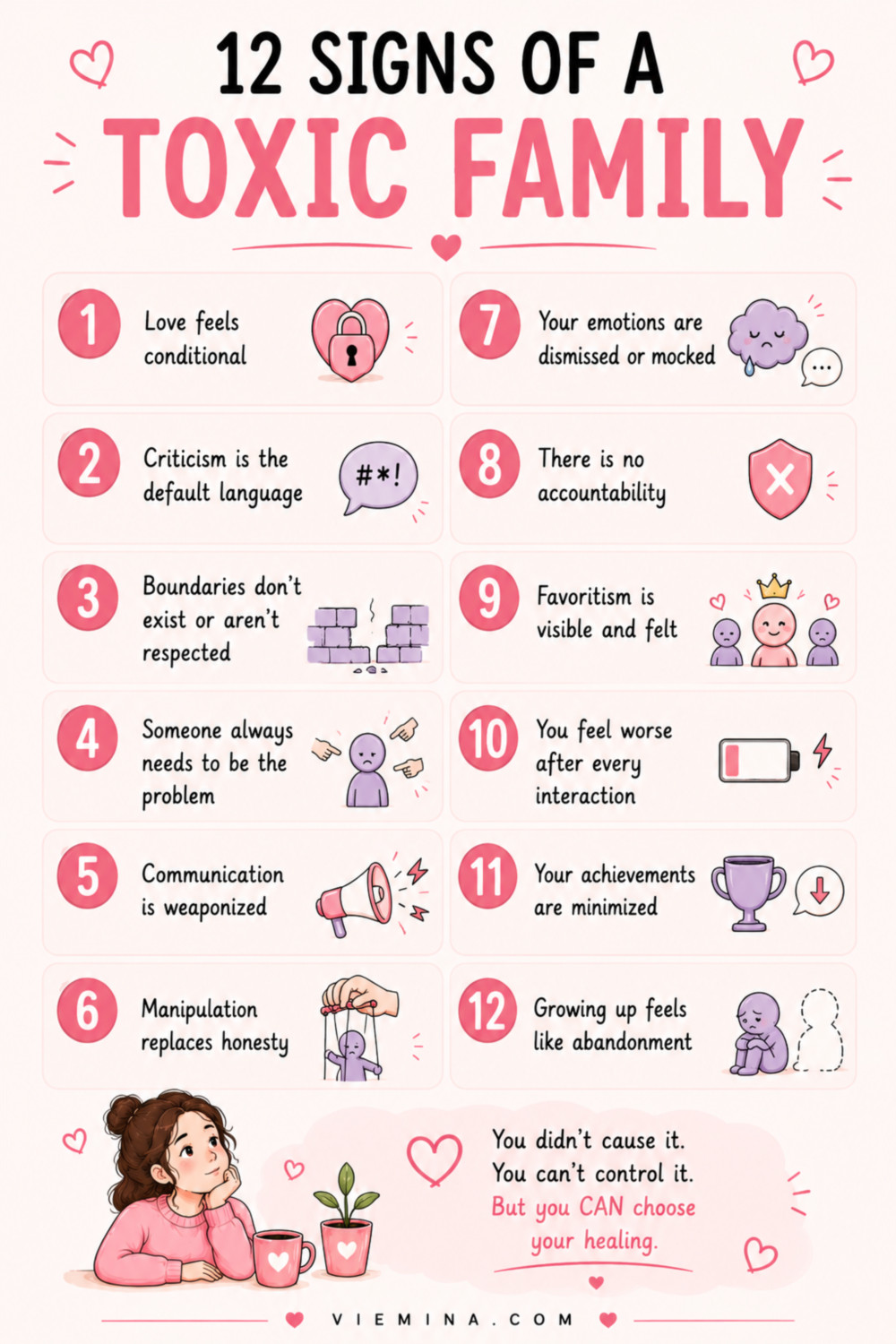
1. Love Feels Conditional
In healthy families, love is a given. In toxic ones, it functions as a currency, extended when you comply, withheld when you don’t. You learned early that being yourself was risky. That certain parts of you were acceptable, and others needed to be hidden.
This conditioning is one of the deepest sources of adult anxiety for people from toxic families.
Related: Trauma Bond vs Love: How to Tell the Difference
2. Criticism Is the Default Language
Not constructive feedback. Not an honest concern. Constant criticism that targets who you are rather than specific behaviors, your appearance, your choices, your personality, and your potential. Delivered casually, relentlessly, and without space for you to respond.
Over time, this criticism moves inside. You begin delivering it to yourself.
3. Boundaries Don’t Exist or Aren’t Respected
Toxic families treat individual boundaries as threats. Your privacy is invaded, your decisions are overridden, your need for autonomy is read as rejection or disloyalty. In enmeshed families, having a life that doesn’t center the family can feel like a betrayal and is treated as one.
Related: How to Set Boundaries With Friends (And Why It’s Hard)
4. Someone Always Needs to Be the Problem
In functional families, problems are events. In toxic ones, problems are people. When something goes wrong, there is always a designated cause, and it’s usually the same person. If that person has consistently been you, that’s scapegoating. If it shifts based on who the dominant figure needs to blame that week, that’s a different but equally damaging pattern.
5. Communication Is Weaponized
Toxic communication patterns include: silent treatment as punishment, bringing up past mistakes in unrelated arguments, twisting words, denying things were said, and turning emotional conversations into attacks on the person who raised them. Healthy conflict resolution, where both people feel heard, is absent or rare.
6. Manipulation Is Used Instead of Honesty
Guilt-tripping, emotional blackmail, playing the victim, and triangulating family members against each other are all manipulation strategies that replace direct, honest communication. The goal is compliance rather than genuine connection.
For a deeper look at how this pattern operates, the article on 21 Signs of Manipulative Parents You Should Know covers the specific tactics in detail.
7. Your Emotions Are Dismissed or Mocked
“You’re too sensitive.” “You always overreact.” “I was just joking.” These responses to emotional expression teach a clear lesson: your inner experience is not valid, your feelings are a problem, and you should manage your emotions alone or not at all. This is emotional invalidation, and it’s a form of emotional neglect.
Related: 18 Signs of a Manipulative Mother
8. There Is No Accountability
In functional families, people apologize genuinely, take responsibility for their behavior, and repair harm when it occurs. In toxic families, accountability is absent. Wrongdoing is denied, minimized, or immediately redirected into an accusation about someone else. The person who was harmed often ends up apologizing.
Related: 12 Manipulative Apology Examples: How To Spot Fake Sorries
9. Favoritism Is Visible and Felt
Some children are elevated. Others are consistently overlooked, criticized, or blamed. The favoritism may never be named, but everyone feels it, and it shapes each child’s sense of worth in ways that follow them far into adulthood.
10. You Feel Worse About Yourself After Interactions
A consistent pattern: you feel smaller, more anxious, more self-critical, or emotionally depleted after contact. This isn’t a coincidence. It’s a reliable indicator that the relationship is net negative for your wellbeing.
11. Your Achievements Are Minimized
Healthy families celebrate. Toxic ones compete, minimize, or ignore. A parent who responds to your success with a criticism, a comparison, or a redirect to their own needs is not incapable of noticing; they’re choosing not to.
12. Leaving or Growing Feels Like Abandonment
In enmeshed, toxic families, your independence is not celebrated. Moving away, building your own life, or establishing your own identity can trigger intense guilt, emotional withdrawal, or punishment. The family system is organized around keeping its members close and compliant, not around helping them thrive.
The Long-Term Effects of a Toxic Family on Mental Health
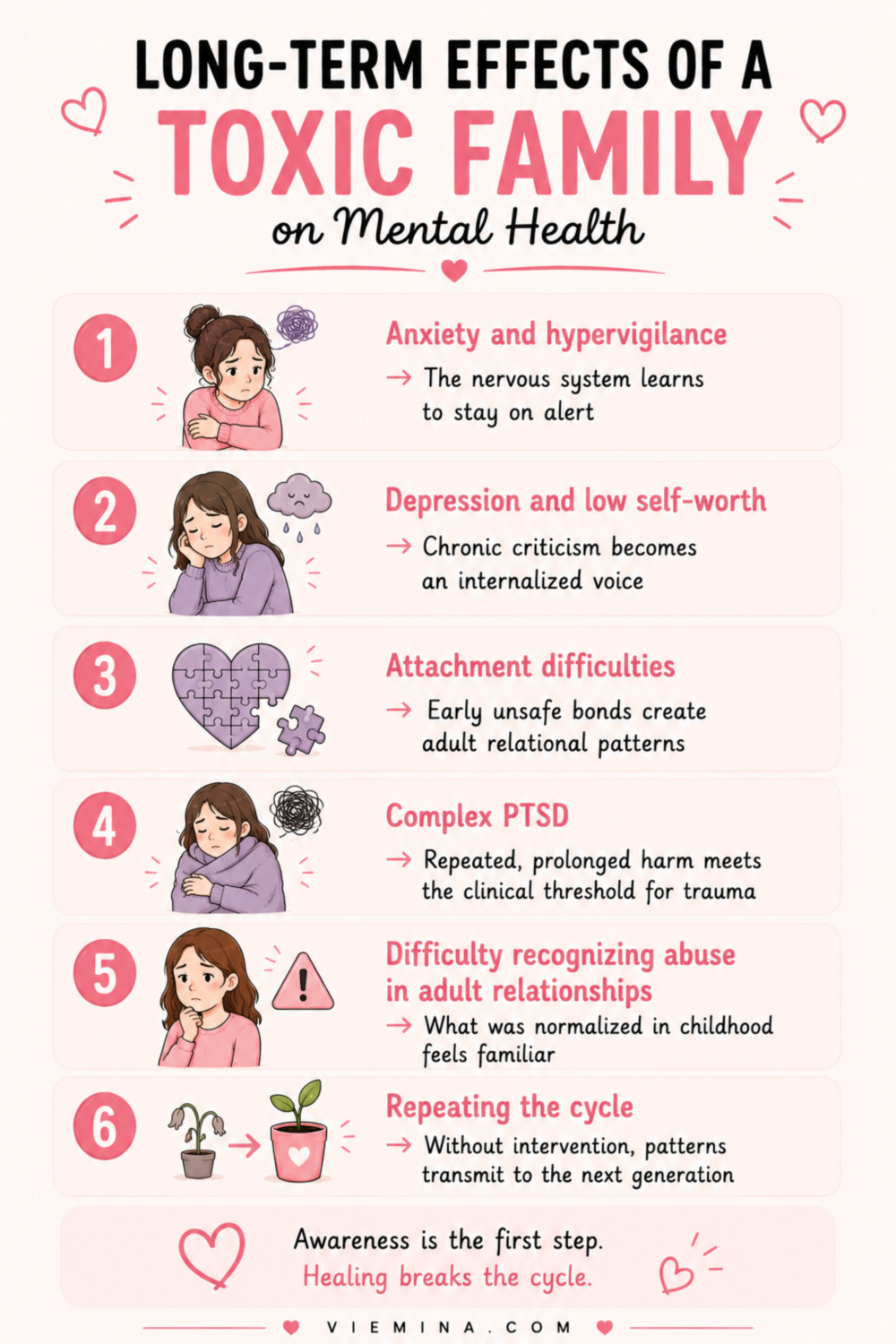
The psychological effects of growing up in a toxic family environment are well-documented and significant.
The most important research base here is the CDC-Kaiser Permanente Adverse Childhood Experiences (ACEs) Study, one of the largest investigations of childhood abuse, neglect, and household challenges ever conducted. The study found that ACEs are linked to chronic health problems, mental illness, and substance misuse in adulthood.
61% of U.S. adults report experiencing at least one ACE. One in six reports four or more. And the effects are cumulative; the more ACEs, the higher the risk for serious health outcomes.
The specific mental health effects most consistently associated with toxic family environments include:
- Anxiety and hypervigilance. Growing up in an unpredictable environment teaches the nervous system to stay on alert. For many adults from toxic families, this hypervigilance doesn’t switch off; it becomes a baseline state that shows up as anxiety, difficulty relaxing, and a constant scanning for threat in relationships.
- Depression and low self-worth. Chronic criticism, emotional neglect, and conditional love consistently produce depressive symptoms and a deeply internalized sense of inadequacy. The inner critic in many adults from toxic families is not their own voice; it’s a borrowed one.
- Attachment difficulties. Attachment theory, developed by John Bowlby and significantly advanced by Mary Ainsworth, PhD, at UC Berkeley, establishes that our earliest experiences with caregivers create internal working models for all subsequent relationships. When those early relationships were unpredictable, emotionally unsafe, or harmful, the result is often disorganized attachment in adulthood, difficulty trusting, difficulty being close, or oscillating between the two.
- PTSD and complex trauma. Growing up in a chronically unsafe family environment meets the clinical threshold for trauma for many people. Complex PTSD, which arises from repeated, prolonged trauma rather than a single event, is increasingly recognized as the appropriate framework for many adults who grew up in toxic or abusive family systems.
- Difficulty recognizing abuse in adult relationships. What was normalized in childhood can feel familiar in adulthood, even when it’s harmful. Adults from toxic families are at higher risk for entering and remaining in abusive or unhealthy relationships, in part because the dynamics feel like home.
How to Cope When You’re Still in Contact
Not everyone can or wants to cut off family contact. Many people remain in contact for practical, financial, cultural, or personal reasons, and coping strategies that assume immediate separation aren’t useful for most people.
1-Understand That You Cannot Change Them
The most energy-preserving realization you can arrive at: you cannot make a toxic family member change. You cannot explain well enough, love enough, perform well enough, or be patient enough to produce a different person. The hope that the right conversation will finally make them understand is one of the costliest things toxic family members take from you; that perpetual hope keeps you in cycles that don’t resolve.
What you can change is how you respond, what you allow, and what you protect.
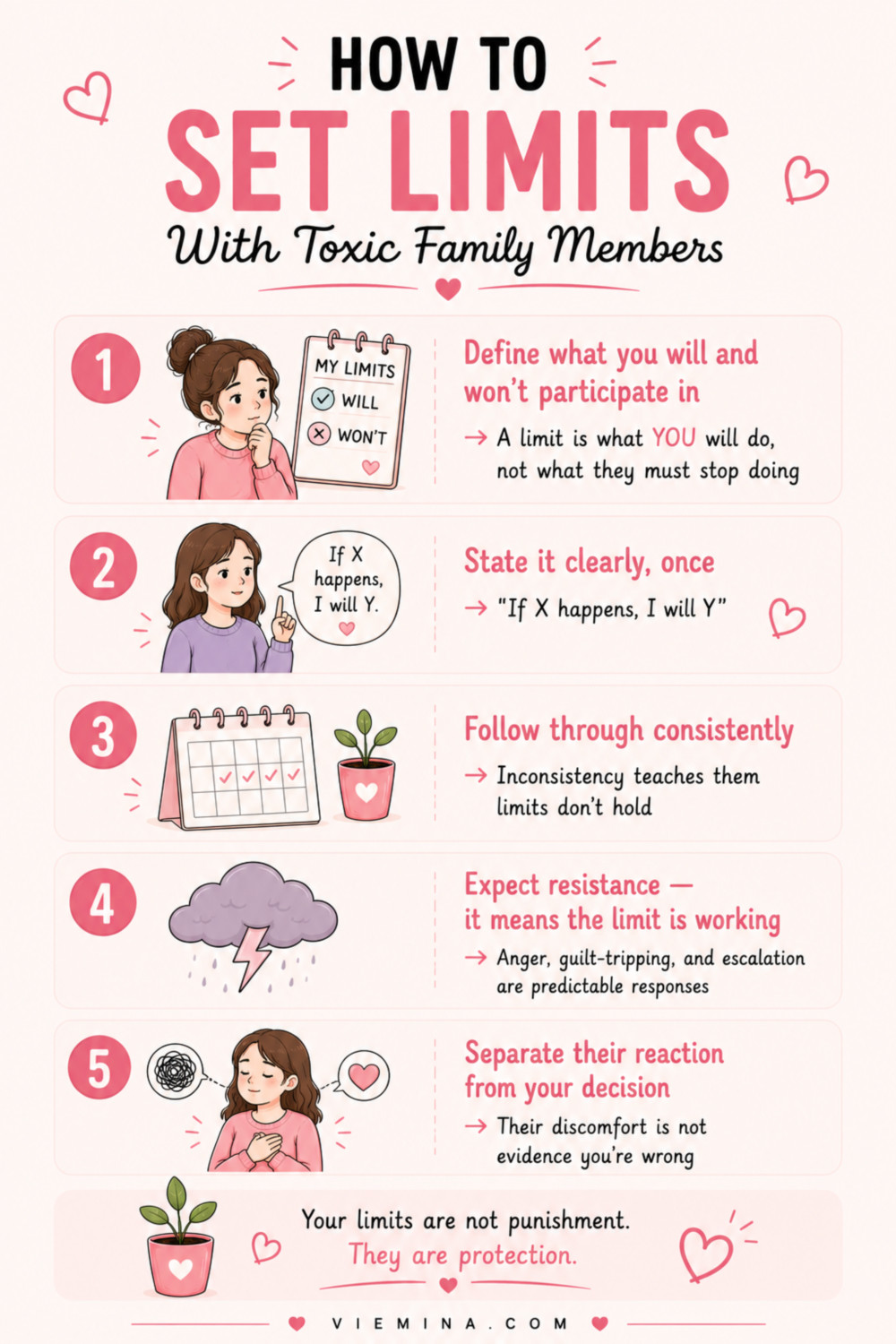
2-Establish Boundaries That Protect Your Mental Health
Boundaries with toxic family members are not about controlling their behavior. They’re about defining what you will and won’t participate in.
A boundary is: “If you criticize my parenting in front of my children, I will end the visit.”
Not a boundary: “Please don’t criticize my parenting.”
The distinction matters because the first one you can enforce. The second depends on their willingness to comply, which, in a toxic family, is rarely reliable.
Expect resistance. Toxic family members dislike boundaries because limits make control harder. Anger, guilt-tripping, accusations of selfishness, and escalation are common responses. That resistance is not evidence that the boundary is wrong. It’s evidence that it’s working.
Related: Guilt Tripping in Relationships: Signs & How to Respond
Related: 20 Signs of a Controlling Relationship — And How to Leave
Toxic family members often use personal information against you, later in arguments, as leverage, to undermine confidence, or to share with other family members as part of triangulation. The practical response is to share less. Not everything that happens in your life needs to be disclosed to people who have demonstrated they won’t use it well.
Related: What Is Trauma Dumping & Why It Can Be So Toxic
4-Manage Your Exposure
Reducing contact, even without a formal “break,” changes the dynamic. Fewer calls, shorter visits, and less availability are all things you control. You don’t owe your family unlimited access to your time and emotional energy.
5-Build a Support System Outside the Family
Isolation is one of the most damaging effects of toxic family dynamics. Many people lose friendships and outside relationships over years of family chaos. Rebuilding those connections, through friends, therapy, support groups, or community, creates the reference point for healthy relationship dynamics and the support needed to navigate the family with more resilience.
When to Consider Limiting or Ending Contact
This is one of the most personal and difficult decisions anyone from a toxic family faces. There is no universal right answer, and any article that tells you definitively to cut off your family or not to is overstepping.
What can be said clearly:
Consider limiting or ending contact when:
- Contact consistently produces significant psychological harm: anxiety, depression, PTSD symptoms, self-harm.
- The relationship involves any form of abuse: emotional, physical, financial, or sexual.
- Your health, your children’s safety, or your closest relationships are being damaged by the contact.
- Every attempt at repair is used against you, resulting in more harm than the original issue.
- The cost of maintaining contact has become unsustainable.
What family estrangement actually looks like: Research on family estrangement, the deliberate distancing from a family member, finds it is far more common than popularly acknowledged, and that the most frequently cited reasons are abuse, neglect, and the perpetuation of toxic patterns. It is not, as it is sometimes framed, an impulsive or selfish act. For most people, it is a decision arrived at after years of trying other approaches.
Grief is part of this, regardless of the decision. People don’t grieve only the relationships they lose; they grieve the relationships they wished they had and the family they deserved to be born into.
Healing From a Toxic Family
Healing from a toxic family is not a single event. It’s a long process that involves rebuilding what was dismantled: the sense of self-worth, the capacity for trust, the belief that relationships can be safe.
1-Therapy as the Foundation
For most people, healing from a toxic family environment is best supported by a therapist, specifically one trained in trauma, attachment, or family systems. Approaches with strong evidence bases for this kind of work include:
- EMDR (Eye Movement Desensitization and Reprocessing) is specifically designed for trauma processing and is widely used for complex trauma and childhood adverse experiences.
- CBT (Cognitive Behavioral Therapy) is effective for addressing the distorted belief systems toxic families produce, including the internalized criticism and core beliefs about unworthiness.
- ACT (Acceptance and Commitment Therapy) is helpful for developing psychological flexibility and the ability to act according to your own values rather than the family’s conditioning.
- Family Systems Therapy useful for understanding the roles and dynamics and beginning to separate your own identity from the one assigned to you.
2-Grieving the Family You Deserved
One of the most underacknowledged parts of healing from a toxic family is grief, not just for what happened, but for what never happened. The supportive parent. The safe home. The childhood where your needs were genuinely met. This grief is real, and it deserves space, ideally with the support of a therapist who understands trauma.
Related: 7 Stages of Trauma Bonding: How to Break the Cycle & Heal
3-Rebuilding Identity Outside the Family Narrative
Toxic families assign identities. The scapegoat carries the shame they were given, not earned. The golden child carries worth tied entirely to performance. The lost child carries invisibility. The first act of healing is naming the role and beginning to separate your authentic identity from the one the family system required you to play.
This is slow work. It involves building evidence, through your own behavior, your own relationships, your own choices, that you are not what the family said you were.
4-Understanding the Cycle Without Excusing It
Understanding why your family members behave the way they do, the trauma they carried, and the environments they grew up in can reduce the personalization of what happened. Their behavior was not a verdict on your worth. It was the output of people operating from their own unresolved damage.
Understanding this does not mean excusing it. Both things can be true at once.
In conclusion
Calling your family toxic doesn’t mean you don’t love them. It doesn’t mean you’re ungrateful, disloyal, or dramatic. It means you’ve started to see clearly, and that clarity, however painful it arrives, is the beginning of something.
You did not deserve the things that happened in a harmful family environment. The shame, the criticism, the conditional love, the invisible labor of managing someone else’s emotional volatility- none of that was something you earned or caused.
What was done to you is not who you are.
Healing is possible. Not as a return to who you were before; you can’t unknow what you know, but as the building of a life and a sense of self that belongs to you. Not to the family system. Not to the role you were assigned. To you.
If you are in crisis or experiencing abuse, the National Domestic Violence Hotline is available 24/7 at 1-800-799-7233 or at https://www.thehotline.org.
FAQs About Toxic Families
Can a toxic family change?
Sometimes, but only with genuine willingness and sustained effort from the family members causing harm. Change requires acknowledgment of the problem, accountability for specific behavior, and consistent behavioral change over time. It is not produced by someone naming the problem, nor by the person being harmed simply enduring more of it. In practice, meaningful change in toxic family dynamics is uncommon without professional intervention such as family therapy.
Is it normal to love a toxic family member?
Yes, and the coexistence of love and harm is one of the most confusing aspects of toxic family dynamics. Attachment bonds form early and run deep, independent of whether the relationship is healthy. Loving someone who hurts you is not a weakness. It is a normal response to a complicated reality.
What is the difference between a toxic family and a dysfunctional one?
These terms overlap considerably. All toxic families are dysfunctional, but not all dysfunctional families are toxic. Dysfunction describes a family that doesn’t operate healthily, with poor communication, inconsistent support, or significant stress. Toxicity implies a level of persistent harm, emotional abuse, manipulation, chronic criticism, and scapegoating that goes beyond dysfunction into active damage.
Why do I feel guilty for setting limits with my family?
Because you were taught to. Guilt in response to self-protection is not a signal that you’re doing something wrong; it’s a conditioned response to a family system that treated your autonomy as a threat. The guilt tends to be loudest when the limits are most necessary. It typically decreases over time as you accumulate evidence that protecting yourself is both possible and survivable.
How do I stop the patterns I learned in a toxic family from affecting my own relationships?
Recognizing the patterns is the essential first step. Many of the relational strategies that helped you survive a toxic family- hypervigilance, people-pleasing, emotional withdrawal, difficulty with conflict- become liabilities in healthy adult relationships. Therapy that addresses the attachment and trauma roots of these patterns is the most reliable path to changing them. Building relationships with people who demonstrate consistent safety also provides the corrective experience the nervous system needs.
Is cutting off a toxic family member the right choice?
This is deeply personal and cannot be answered universally. It may be the right choice when contact is causing significant, ongoing harm and when other approaches have been exhausted. It may not be the right choice for everyone, and it comes with its own grief and complexity. The question worth asking is not “is this person toxic?” but “is maintaining this relationship sustainable at a cost I can actually afford?”


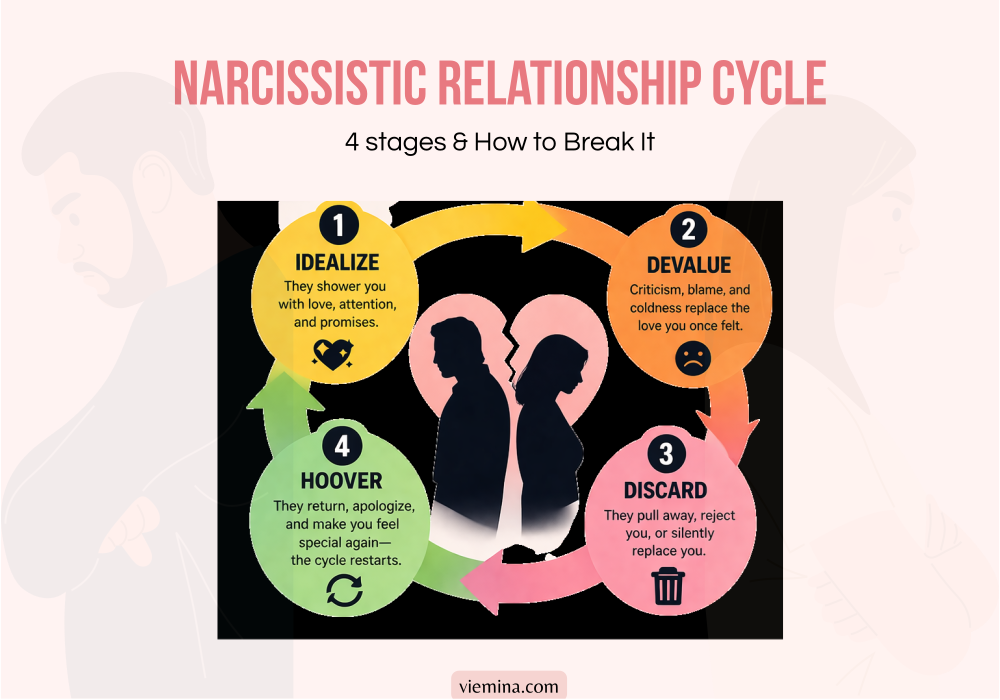




It’s tough when you’re stuck in a toxic environment, but we all go through it at some point. Having a few simple tips to deal with it can really help make things a bit easier