
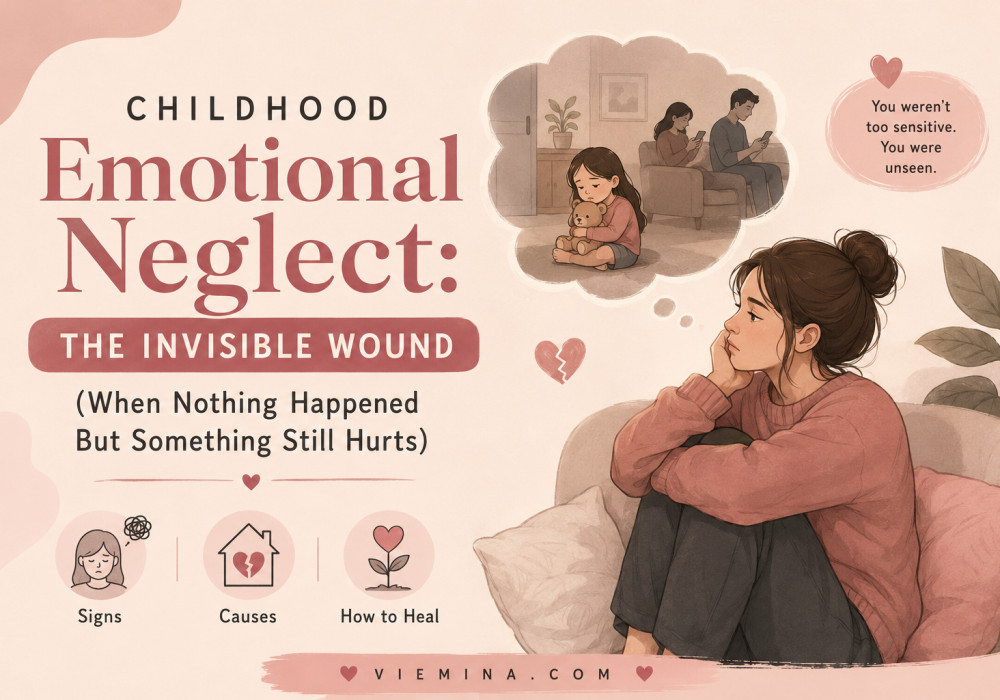
You can probably describe your childhood in a sentence. Stable house. Parents who stayed together, or didn’t, but showed up. Food on the table, help with homework, maybe even a few good memories from summer vacations. By most measures, it was fine.
So why does something feel unfinished?
Maybe it’s the way you flinch internally when someone asks how you’re feeling, and you genuinely don’t know. Maybe it’s how hard it is to ask for help, even from people who’d gladly give it. Maybe it’s a low hum of emptiness that shows up on ordinary Tuesdays, for no reason you can point to.
If part of you is already arguing with this article- my parents did their best, I shouldn’t complain, plenty of people had it worse- that reaction is worth noticing rather than obeying. Guilt shows up almost automatically when people start to examine this topic, and it’s rarely a sign you’re wrong to look closer. It’s usually a sign of exactly how deeply “don’t make a fuss about your feelings” got learned in the first place.
This isn’t about finding something to blame your parents for. It’s about a specific, well-documented experience called childhood emotional neglect, and understanding it tends to explain more about adult life than almost anything else people search for.
What Childhood Emotional Neglect Actually Is
Childhood emotional neglect (CEN) is what happens when a child’s feelings are consistently overlooked; not because anyone meant harm, but because no one was paying attention to them. Jonice Webb, the psychologist who coined the term, describes it simply: it’s a parent’s failure to respond enough to a child’s emotional needs.
That word “failure” is doing a lot of work, and it points in the opposite direction of what you’d expect. Emotional neglect isn’t something a parent did. It’s something they didn’t do. No one hit you, humiliated you, or screamed at you. Nothing happened. And that’s exactly what makes it so hard to spot and so easy to dismiss in yourself.
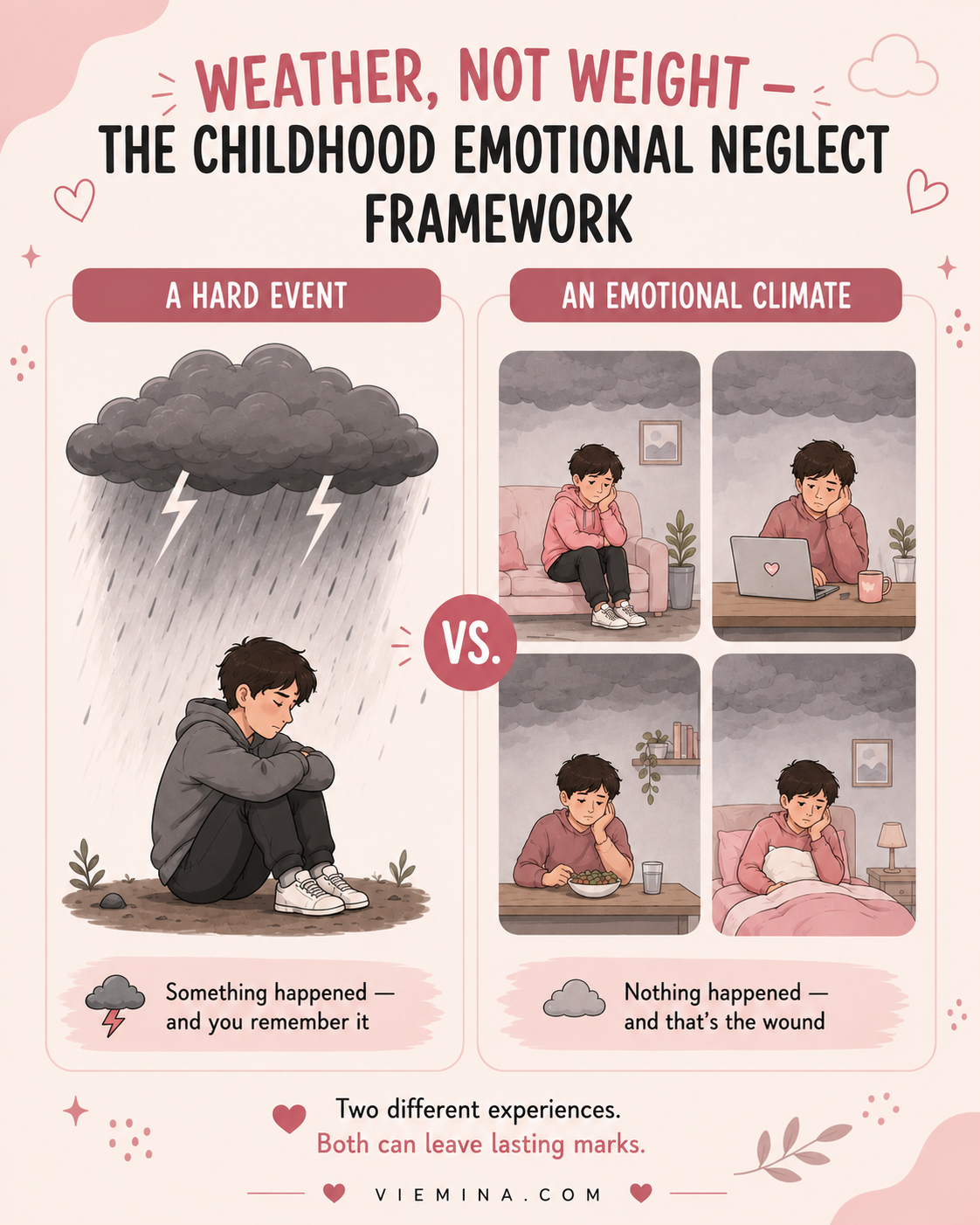
Here’s a way to picture it: think of your childhood less as a single event and more as a climate. One argument, one harsh comment, one bad day, those are weather. They pass. But if the emotional climate of your home was consistently mild indifference, not stormy, not cruel, just quietly unresponsive, you don’t remember a single incident, because there wasn’t one. You just adapted to the climate, the way anyone adapts to the weather they grow up in, without ever questioning whether it was the right temperature for a child to grow up in at all.
That’s the core difficulty with CEN: it’s not the weight of something heavy that happened to you. It’s the weather you grew up in, and weather is nearly impossible to notice while you’re standing in it.
A note on the evidence, for the skeptical reader: two different things are true at once here. The broader phenomenon, caregivers failing to respond to a child’s emotional needs and the adult outcomes associated with it, is studied under the peer-reviewed umbrella of childhood psychological maltreatment, and organizations including the World Health Organization recognize child neglect as a serious public health concern with documented developmental effects.

The specific term “childhood emotional neglect,” its 12-parent-types framework, and its self-assessment questionnaire, however, are the clinical work of one psychologist, Dr. Jonice Webb; useful, widely used by therapists, but not independently peer-reviewed in the way a research finding would be. This article draws on both and says clearly which is which as it goes.
Emotional Neglect vs. Emotional Abuse
This is the distinction almost every article on this topic gets muddy, and it matters more than any other single idea here, because getting it wrong either makes you dismiss a real experience (“nothing bad happened, so I have no right to feel this way”) or makes you misdiagnose a genuinely loving childhood as something darker than it was.
| Emotional Abuse | Emotional Neglect | |
| Nature | An action | An absence of action |
| What happens | Criticism, humiliation, manipulation, threats | Feelings go unnoticed, unasked-about, or unaddressed |
| How it’s usually remembered | Specific, memorable incidents | Vague, hard to recall “nothing in particular” |
| Parental intent | Often deliberate or reactive harm | Frequently unintentional |
| How it feels to name | “I know something bad happened” | “I’m not sure I’m allowed to call this anything” |
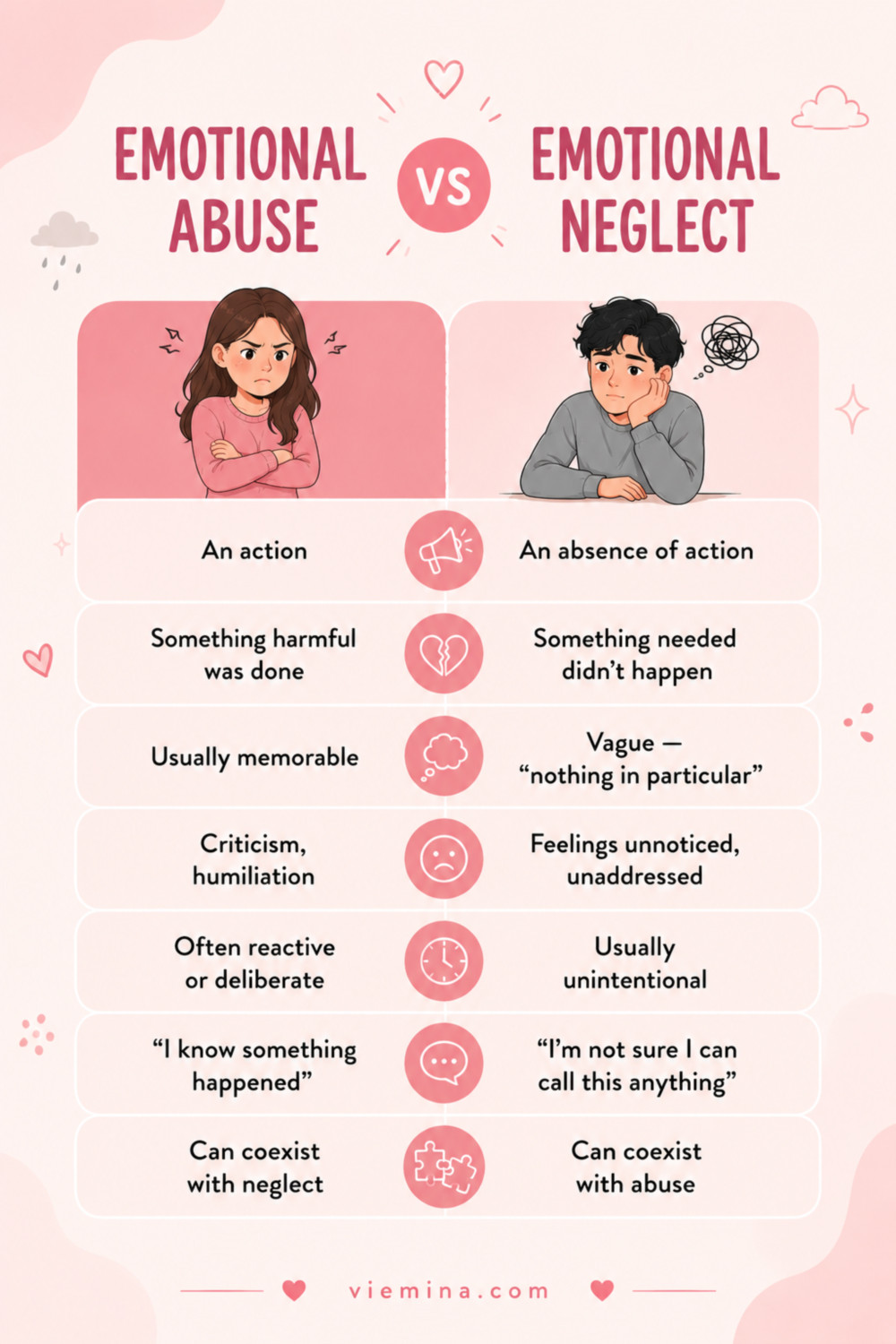
Both can leave real marks. Both can coexist in the same household. But they are not the same wound, and they don’t call for the same kind of understanding.
A short scenario helps. Two kids strike out in their last at-bat of a close baseball game. The first kid’s father meets him at the dugout and says, “I can’t believe you struck out. I left work for this.” That’s emotional abuse, a direct, harmful act.
The second kid’s father was supposed to be there but got pulled into a work call and missed the ending. He shows up afterward, distracted, asks how the game went, and moves on before really listening to the answer. Nothing cruel happened. But the son’s disappointment was never actually seen. That’s emotional neglect.
Years later, both of these kids may struggle to trust their own feelings. But only one of them has an obvious reason to point to, which is part of why people-pleasing and codependent patterns often trace back to neglect just as often as to more visible forms of harm.
Signs of Childhood Emotional Neglect in Adults
These signs cluster into three areas. You likely won’t recognize all of them; most people see themselves in a handful.
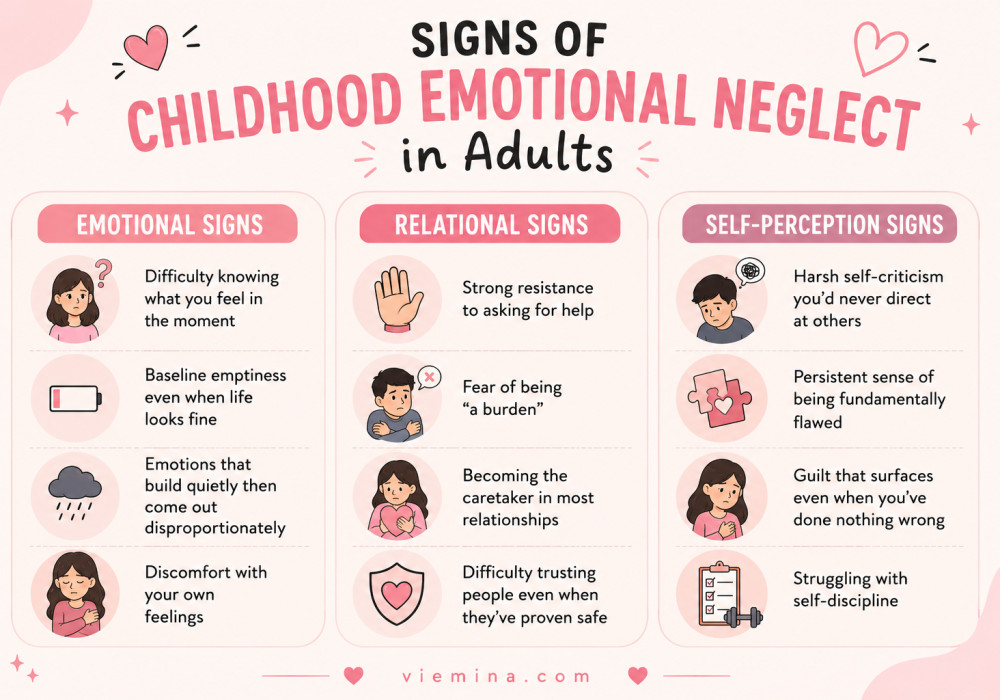
Emotional signs
- Difficulty identifying what you’re feeling in the moment (you know something is “off,” but not what); sometimes called alexithymia
- A baseline sense of emptiness or numbness, even when life looks fine on paper
- Emotions that build quietly and then come out disproportionately; irritation that turns into snapping, tiredness that turns into burnout
- Discomfort with your own emotions, as if they’re inconvenient or excessive
Relational signs
- Hyper-independence: a strong resistance to asking for help, even when you need it
- A fear of being “a burden,” which shows up as apologizing for having needs at all
- Becoming the caretaker in most relationships, prioritizing everyone else’s feelings before your own
- Difficulty trusting that people will actually show up for you, even when they’ve proven they will
Related: Signs of an Unhealthy Relationship: 15 Warning Signs to Know
Self-perception signs
- Harsh self-criticism, often more severe than you’d ever direct at someone else.
- A quiet, persistent sense of being fundamentally flawed or “too much”
- Guilt or shame that surfaces even when you’ve done nothing wrong
- Struggling with structure or self-discipline, if consequences and follow-through weren’t consistently modeled growing up
If several of these feel uncomfortably familiar, that discomfort is information, not proof of anything, but a reasonable place to keep looking. Research on childhood psychological maltreatment more broadly, reviewed through sources indexed on NIH’s PubMed, links these kinds of early experiences to higher rates of adult anxiety and depression, though as with most research in this area, that’s an association, not a guarantee for any one individual.
Where It Comes From: The Generational Blind Spot
Here’s the part that tends to surprise people the most: many clinicians who specialize in Childhood Emotional Neglect, including Jonice Webb, observe that emotionally neglectful parents were frequently emotionally neglected themselves.
This isn’t an excuse; it’s context, and context changes how you’re able to hold this. A parent who was never taught to name their own feelings, or was raised to see emotional needs as inconvenient, often can’t teach their child something they never learned themselves. It’s not necessarily that they didn’t love you. It’s that an entire category of parenting- noticing feelings, naming them, responding to them- was never modeled for them in the first place.
This is what makes emotional neglect generational rather than purely personal. It travels through families quietly, unnoticed, until someone in the line decides to look at it directly. You can be doing that right now, just by reading this.
The both/and truth. This context matters for one more reason: it lets you hold two things at once, rather than picking a side. Your parents may have genuinely loved you and failed to give you something you needed. Neither one cancels out the other; you’re not required to choose between gratitude and grief.
Related: Toxic Family: 12 Signs, Effects, and How to Heal
What It Looks Like in Childhood
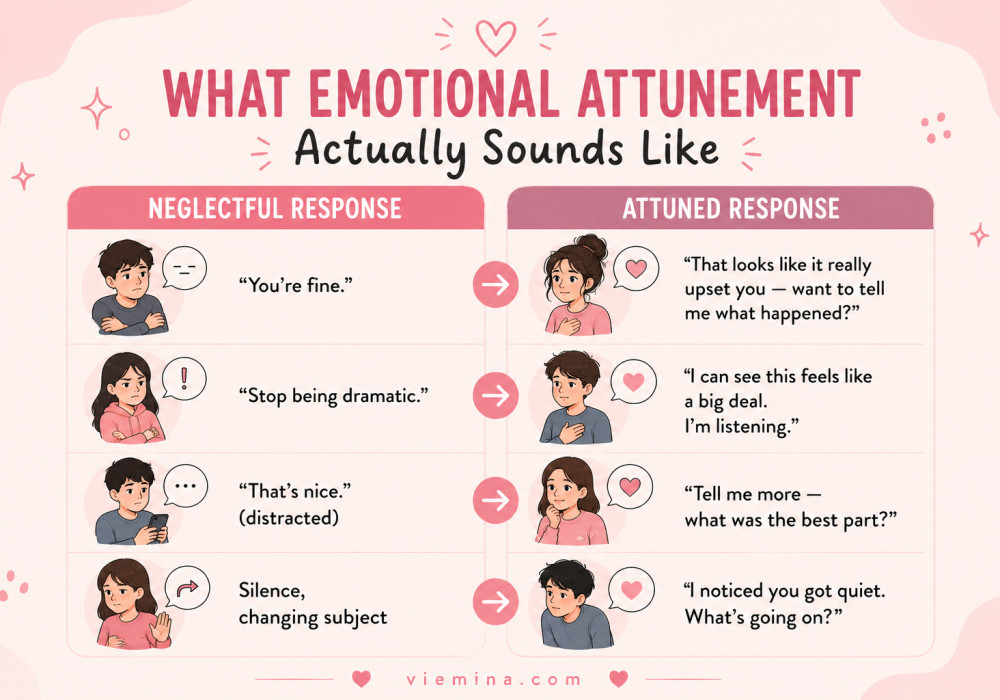
Emotional neglect rarely looks dramatic in the moment. It usually looks like:
- A child crying, and a parent saying “you’re fine” instead of asking what’s wrong.
- A child excited about something small, and getting a distracted “that’s nice” instead of genuine interest
- A child scared or anxious, and being told to “stop being dramatic” or simply left alone with it
- A household where practical needs (meals, rides, homework help) were consistently met, but emotional check-ins never happened.
- A parent who was present physically but consistently distracted, overwhelmed, or emotionally unavailable
What attuned responses sound like instead:
None of these attuned responses require perfect parenting. They just require noticing, which is precisely the thing that didn’t happen.
Related: 15 Hidden Signs of Emotional Trauma in Adults & How to Heal
It Doesn’t Always Look the Same
The examples so far describe a fairly typical pattern, but Childhood Emotional Neglect doesn’t always show up in a tidy, whole-household way. A few variations worth naming, because each one tends to leave people doubting whether their experience “counts”:
- One attuned parent, one who wasn’t. If you had even one adult who reliably noticed your feelings, you may have grown up with real strengths alongside real gaps, and that mix can be more confusing to sort out than a fully neglectful home, precisely because you have proof that attunement was possible, right there in the house.
- High-achieving or “successful” families. Homes with real resources, high expectations, and visible accomplishment can still be emotionally under-responsive; sometimes because performance became the currency that got attention, while feelings that didn’t relate to achievement went unaddressed. From the outside, and often from the inside too, these families look like the opposite of neglect.
- Blended and adopted families. Emotional attunement can vary significantly between biological and step-parents, or across different caregivers a child moved between, meaning childhood emotional neglect can be present in one relationship within a household and genuinely absent in another.
- Siblings, different experiences. Two children raised by the same parents don’t necessarily have the same emotional experience. Birth order, temperament, and how much a particular child’s personality happened to be “legible” to their parents can all mean one sibling felt seen and another didn’t, in the exact same house.
None of these variations makes an experience less real or more real than the more typical pattern described earlier. They’re here because “did this really count as neglect” is one of the most common places people get stuck; and the answer is usually: if the feeling of being unseen is real and recurring, it counts, regardless of how tidily it maps onto a textbook example.
What This Doesn’t Mean (Read This Before the Reflection Exercise)
Before you go further, two things are worth sitting with.
First, recognizing some of these signs doesn’t mean every current struggle in your life traces back to your childhood. Adult depression, anxiety, and relationship difficulties have many possible sources: genetics, current stress, and other life experiences. CEN can be a meaningful piece of the picture without being the whole picture. Treating it as a single, total explanation for everything that’s hard right now tends to lead to a dead end rather than real clarity.
Second, this isn’t a tool for winning an argument. It’s genuinely common, once people learn this framework, to want to use it to prove something to a parent, sibling, or partner: “see, this is what you did to me.” That instinct makes sense, but it tends to turn a private, useful process of self-understanding into a confrontation that rarely goes the way people hope.
One more note before you begin: the exercise below is a reflection tool, not a diagnostic test. It’s designed to help you notice patterns in your own memory, not to produce a clinical verdict about your childhood or your parents.
Reflection: The Emotional Attunement Ledger
Most Childhood Emotional Neglect checklists ask you to check boxes next to symptoms. This exercise asks something different: it asks you to look at specific moments, not general traits.
Try this. Pick three or four memories from childhood where you clearly remember having a strong feeling: excitement, fear, disappointment, embarrassment. For each one, write down:
- What happened
- What you were feeling
- What response did you get from the adults around you (or what you don’t remember getting; that absence is data too)
A worked example, to show you what this looks like:
What happened: I didn’t make the school play I really wanted to be in.
What I felt: Embarrassed and quietly devastated.
What response I got: My mom asked, “Did you get the part?” I said no, and she said “okay, well, dinner’s almost ready” and moved on to setting the table.
Notice that nothing in that memory is dramatic. No one was unkind. But the feeling never got a place to land and that’s the pattern worth paying attention to across your own memories, not any single moment on its own.
You’re not doing this to build a case against anyone. You’re doing it because “emotional neglect” is an abstract phrase, and specific memories are where you’ll actually feel the shape of what you’re working with.
How It Shows Up in Relationships and in Your Own Parenting
In relationships, emotional neglect tends to show up as a strange contradiction: you crave closeness, but closeness makes you uneasy. You might go quiet during conflict instead of engaging, not because you don’t care, but because you were never shown what it looks like for a hard conversation to end safely. You might also over-function; smoothing things over, reading the room constantly, managing everyone’s feelings but your own; because that was the only role that felt safe or useful as a kid.
If you’re a parent yourself, this section is probably the one you clicked for, even if you didn’t admit it. Here’s a gentler way to check in with yourself than a guilt-inducing checklist:
The Two-Question Parenting Check
- This week, when my child was upset, did I get curious about what they were feeling, or did I move quickly to fix, dismiss, or distract?
- Is there one small moment I could go back to and say, “I didn’t handle that the way I wanted to; can we talk about it?”
The fact that you’re asking these questions at all already separates you from the pattern you’re worried about repeating. Emotional neglect thrives on nobody noticing. You’re noticing.
Related: 21 Signs of Manipulative Parents You Should Know
Related: 18 Signs of a Manipulative Mother
Is This the Same as an Attachment Issue or Trauma?
Related, but not identical, and worth untangling if you’re the kind of reader who wants more precision than a single label offers.
| Childhood Emotional Neglect | Insecure Attachment | Complex Trauma | |
| What it describes | A pattern of caregiver unresponsiveness to feelings | Relational patterns (anxious, avoidant) formed in response to inconsistent caregiving | Prolonged exposure to distressing or unsafe experiences |
| Presence of active harm | Not required | Not required | Usually involved |
| Can occur without the others? | Yes | Yes; has other contributing causes too | Yes, from other sources |
| Typical overlap with CEN | — | Common; CEN is one contributing factor among several | Less direct; CEN alone doesn’t necessarily meet this threshold |
None of these labels are competitions for who had it “worse.” They’re tools for understanding your specific experience more precisely, which tends to make healing more targeted and less generic.
“If the complex trauma column feels more accurate to your experience than the CEN column, the article on signs of repressed childhood trauma covers what that pattern looks like in adulthood in more detail.”
How Healing Actually Works
Most “how to heal” advice reads like a to-do list you complete once. Emotional neglect doesn’t work that way, because the thing that’s underdeveloped- your relationship with your own feelings- isn’t a task; it’s a skill. Skills are built through repetition, not a single insight. That also means the honest answer to “does this ever fully go away?” is: the underlying childhood experience doesn’t change, but your relationship to it can shift enormously; most people describe it less as “curing” something and more as building a skill that gets steadily more automatic over time.
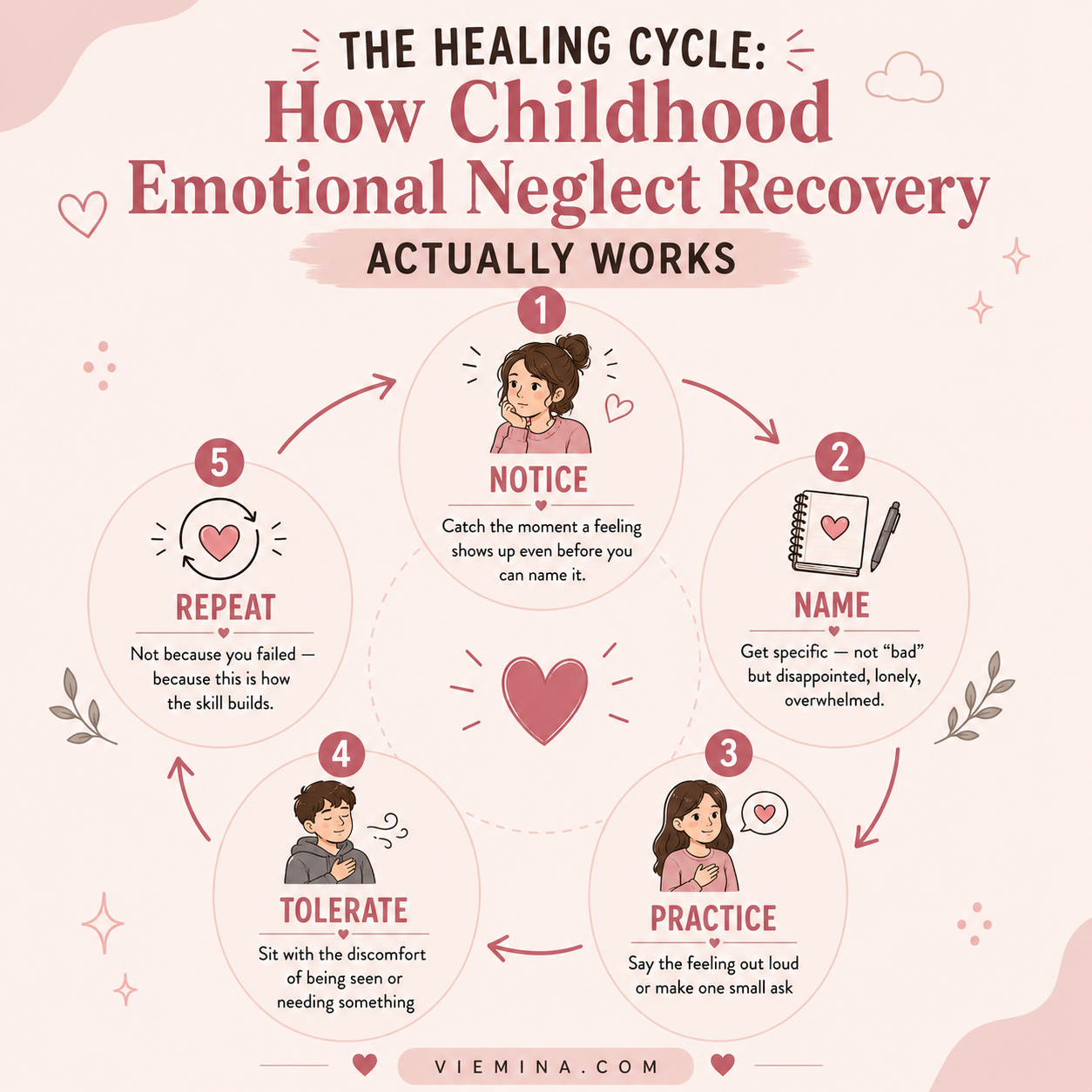
A more honest way to think about the process is as a cycle you’ll move through many times, not a staircase you climb once:
Notice → Name → Practice → Tolerate → Repeat
- Notice: Catch the moment a feeling shows up, even if you can’t name it yet. “Something just shifted in me” is a valid starting point.
- Name: Get more specific. Not “bad,” but disappointed, embarrassed, overwhelmed, lonely. A feelings-word list can genuinely help here; this is a vocabulary most people were never taught.
- Practice: Say the feeling out loud to someone, or ask for something small. “I’m actually pretty stressed today” is a legitimate practice rep.
- Tolerate: Sit with the discomfort that comes after being seen or asking for something. This part is usually the hardest and the most necessary.
- Repeat: Not because you failed the first time, but because this is how the skill actually gets built.
This work is genuinely possible without therapy, especially at the noticing-and-naming stage. And to be clear: healing doesn’t require confronting your parents, and it doesn’t require deciding your childhood was “bad.” Plenty of people do this work fully without ever raising it with their parents at all. This is your process, not a case you have to make to anyone else.
When Professional Support Helps
There’s no strict threshold here, but a few signals are worth taking seriously:
- The emptiness or numbness feels constant rather than occasional.
- This is significantly affecting your relationships, work, or parenting.
- You’re also dealing with symptoms of depression or anxiety.
- You’ve tried noticing and naming your emotions on your own and keep hitting the same wall, cycle after cycle.
A therapist familiar with attachment-based or schema-focused approaches can be particularly useful here, since much of this work involves relearning things at a relational level- something that’s genuinely easier to practice with another person than alone. This isn’t a sign the self-directed work “failed.” Some parts of this are simply easier to build with a second person in the room.
Conclusion
If you came into this article quietly convinced your childhood was “fine, but,” you’re not wrong on either count. It’s entirely possible that your parents loved you and that something important still went unmet. Those two things have coexisted in more households than most people realize.
The relief in naming childhood emotional neglect isn’t that it explains everything about you; it’s smaller and more useful than that. It just means you’re not broken, malfunctioning, or too sensitive. You adapted, sensibly, to a childhood climate that didn’t teach you what to do with your feelings. That adaptation made sense then. It doesn’t have to be permanent now.
You don’t need a confrontation, a diagnosis, or a perfect childhood memory to start. You need one moment today where you notice what you’re actually feeling, and let that be enough of a beginning.
Frequently Asked Questions about Childhood Emotional Neglect
Is childhood emotional neglect a real diagnosis?
No. It’s a widely used clinical and psychological concept rather than a formal diagnosis, though its effects are studied under broader, peer-reviewed research on childhood psychological maltreatment.
Can I have been emotionally neglected even if my parents loved me and I had a good childhood?
Yes, this is the central point of the concept. Emotional neglect is about a failure to respond to emotional needs, not about the presence or absence of love, money, or stability.
Is emotional neglect the same as emotional abuse?
No. Neglect is an absence; something that didn’t happen. Abuse is a presence; something harmful that did. They can occur together, but they’re distinct experiences with different emotional aftermaths.
How is this different from just being naturally independent?
Independence born from Childhood Emotional Neglect usually comes with discomfort or shame about needing others, not a simple preference. If asking for help feels dangerous or embarrassing rather than just unnecessary, that’s worth paying attention to.
Is there a childhood emotional neglect quiz I can take?
The Emotional Attunement Ledger in this article is designed to serve that purpose in a more grounded way through specific memories rather than a generic checklist. It’s intended as a reflection tool, not a diagnostic quiz, since no self-assessment for childhood emotional neglect has been clinically validated as a diagnostic instrument.
Can you heal from childhood emotional neglect without therapy?
Yes, meaningful progress is possible through self-directed practice: noticing and naming emotions, practicing small asks for support. Therapy tends to help most when patterns are significantly affecting daily life or relationships, or when self-directed practice keeps hitting the same wall.
Do I have to confront my parents to heal?
No. Confrontation is optional, not required. Many people heal fully without ever raising it with their parents.
How do I know if I’m emotionally neglecting my own children?
The fact that you’re asking is itself meaningfully different from the unawareness that usually defines the pattern. Noticing and repairing small moments matters more than achieving perfect attunement.
Is emotional neglect linked to anxiety or depression later in life?
Research on childhood psychological maltreatment, including neglect, shows an association with adult depression, anxiety, and related outcomes; though this is a correlation, not a guaranteed cause-and-effect path for every individual.