

Most toxic friendships don’t start that way.
They start with warmth, shared humor, and the feeling that you’ve finally found someone who gets you. The shift happens so gradually that by the time you notice something is wrong, you’ve already spent months explaining it away.
That’s what makes them so hard to leave. Not just the history, but the confusion. You can clearly see the good moments. The bad ones are harder to name.
If you’ve been feeling consistently drained, dismissed, or vaguely worse about yourself after spending time with a friend, this article is for you.
What Makes a Friendship Toxic?
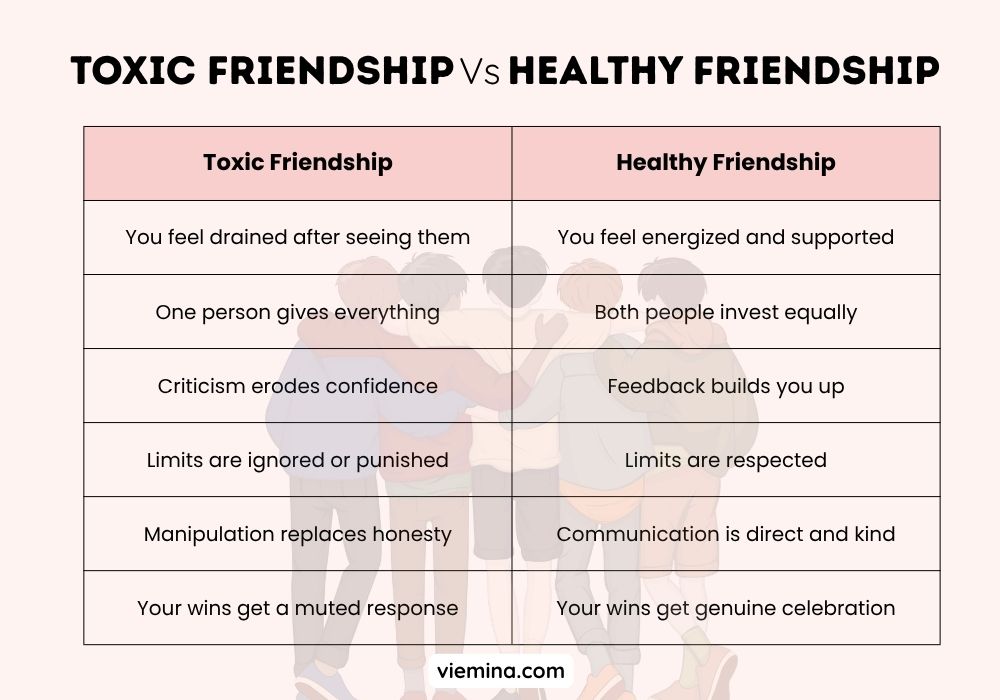
A toxic friendship is one that consistently harms your emotional well-being rather than supporting it. Unlike healthy friendships, which involve mutual care, honest communication, and the freedom to be yourself, toxic friendships are characterized by patterns of manipulation, one-sidedness, criticism, or control that leave you feeling depleted rather than supported.
The keyword is pattern. Everyone has bad days. Good friendships survive conflict, distance, and difficult periods. What makes a friendship toxic isn’t any single incident; it’s the recurring dynamic that consistently leaves one person feeling worse for having the other in their life.
Research published in the Journal of Health and Social Behavior found that people with high levels of negative social interactions were 22% more likely to experience severe depression. The quality of your close relationships isn’t a peripheral concern; it directly affects your mental and physical health.
Related: How I Lost Myself in a Controlling Friendship and What I Know Now
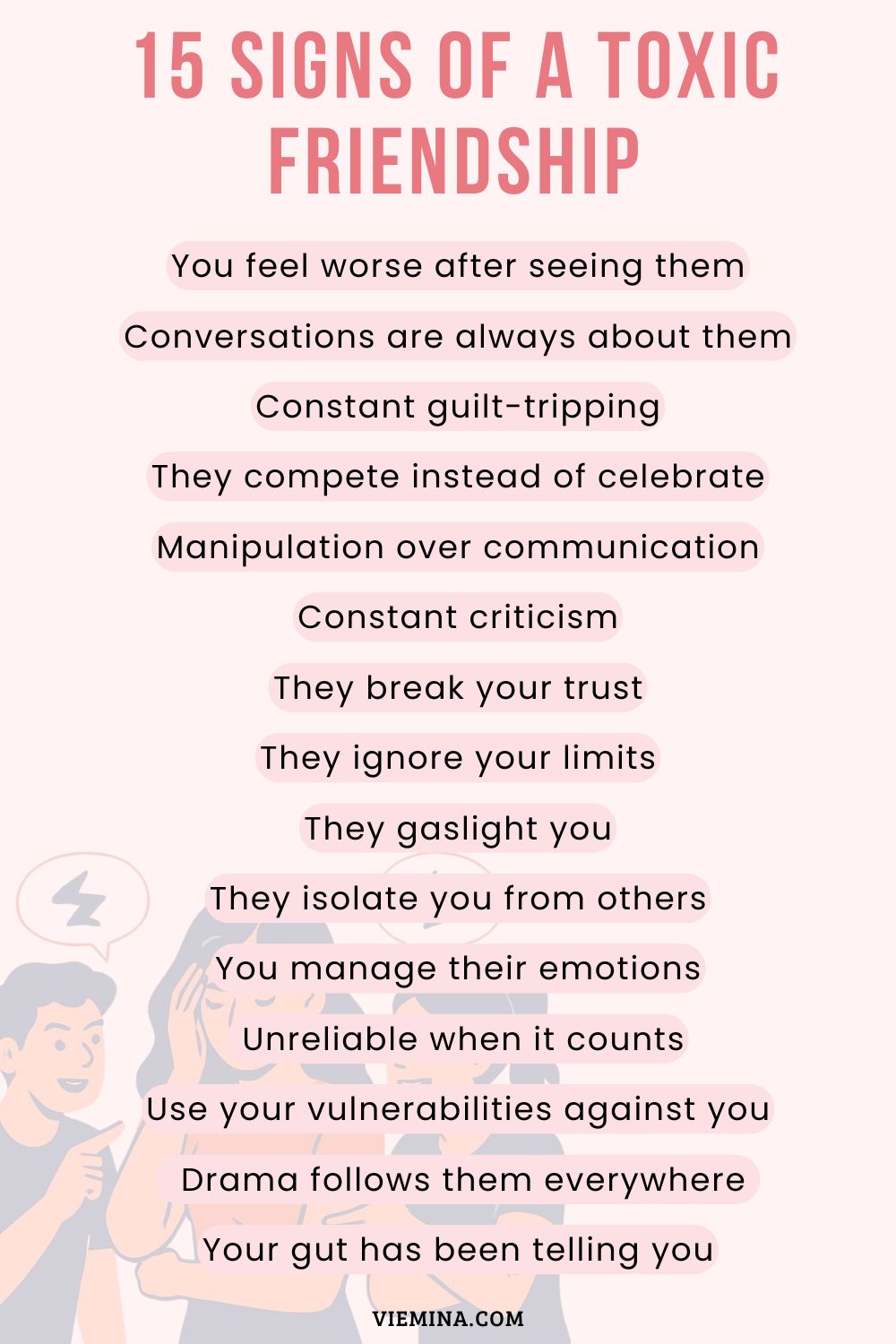
15 Signs of a Toxic Friendship
1. You consistently feel worse after spending time with them
This is the simplest and most reliable indicator available to you. How do you actually feel after being around this person?
Not whether the time was entertaining or the conversation was interesting. How do you feel about yourself? If your consistent experience, across multiple interactions, over a significant period, is flatness, depletion, or a slight lowering of your mood and self-worth, that pattern is telling you something important.
As therapist Suzanne Degges-White, author of Toxic Friendships, puts it, the clearest sign of a toxic friendship is realizing that a particular friend consistently leaves you feeling worse after spending time together.
2. The friendship is almost entirely about them
You listen to their problems. You remember the details, the job situation, the family conflict, and the thing they were anxious about, and you follow up. They rarely do the same for you.
When you do share something, the conversation pivots back to them within minutes. Your experiences are briefly acknowledged rather than genuinely explored. As psychiatrist Dr. Sarah Quaratella describes it, “You become a vessel for a friend’s trauma dumping, but they can’t remember your dog’s name.”
A friendship that functions as a one-way emotional service is not a friendship in any meaningful sense.
Related: What Is Trauma Dumping & Why It Can Be So Toxic
3. They guilt-trip you constantly
A toxic friend has an advanced facility with guilt. They make you feel responsible for their emotional state, their disappointments, and their problems, often without saying so directly.
“After everything I’ve done for you” signals that your debt has been called in. Silence and coldness after you’ve done something they didn’t like communicates disapproval without saying a word. The guilt isn’t a side effect of genuine hurt; it’s a tool used to keep you compliant and apologetic.
Over time, you find yourself anticipating their reactions and adjusting your behavior preemptively to avoid the guilt that follows.
Related: 15 Signs You’re in a Relationship with a Narcissist,Not Love
4. They’re happy when things are going badly for you, less so when they’re going well
This is one of the most painful signs and one of the clearest. A real friend is genuinely glad when something good happens to you. A toxic friend struggles to hide their discomfort.
Your good news gets a muted response, a subject change, or a subtle reframe that takes the shine off it. Your struggles get their fullest attention. If you find yourself hesitating to share good news with a friend because you know it won’t land well, pay attention to what that hesitation is telling you.
Research on friendship quality consistently shows that how someone responds to your positive news is actually a stronger predictor of friendship quality than how they respond to your bad news.
Related: 15 Signs of Fake Friends — And How to Deal With Them
5. They manipulate rather than communicate
Toxic friends are often guilty of emotional hijacking, doing things that escalate emotions rapidly, creating pressure to address something immediately, or expressing a scarcity mindset: wanting your friendship to be more important than any other friendships in your life.
This might look like a sudden crisis that requires your immediate attention. It might seem like ultimatums dressed as vulnerability. It might look like the withdrawal of warmth until you comply with what they want. The common thread is that the emotional temperature of the friendship is being managed by them, and you’re left reacting rather than choosing.
Related: 20 Hidden Signs Of a Manipulative Friend You Never Knew
6. They constantly criticize you
Real friends offer honest feedback when it matters. A toxic friend makes criticism a regular feature of the friendship, your appearance, your choices, your relationships, and your ambitions.
The criticism often comes wrapped in concern: “I’m just being honest” or “I’m saying this because I care.” But the effect is a gradual erosion of your confidence, a growing sense that you consistently fall short, and an increasing tendency to seek their approval before trusting your own judgment.
You find that your accomplishments and goals are frequently dismissed as unimportant. Sharing that you received a promotion at work is met with something that manages to diminish rather than celebrate it.
Related: 12 Manipulative Apology Examples: How To Spot Fake Sorries
7. They violate your trust
You told them something in confidence. You were specific about wanting it to stay between you. Later, you find out it didn’t.
When you raise it, the response is defensive, minimizing, or somehow turns into a conversation about their feelings rather than the breach of trust. A pattern of confidences being shared, even small ones, tells you that what you give this person is not being held with care.
Trust, once broken this way, rarely fully recovers. And a friendship without trust isn’t a friendship; it’s a performance.
8. They push and ignore your limits
As therapist Brooke Sprowl explains, “It really takes a toll on your self-trust, because you’re being told that if you set boundaries, you’re being selfish, or if you’re not giving in to all of their needs, you’re letting them down.”
A toxic friend treats your limits as obstacles to negotiate rather than information to respect. They push past what you’ve said you’re comfortable with, make you feel guilty for having any limits at all, or simply ignore them and wait to see if you’ll enforce them.
Over time, you stop naming limits because experience has taught you they won’t be honored.
9. They gaslight you about their behavior
You raise a concern, something they said that hurt, a pattern you’ve noticed, or a commitment they didn’t keep, and the conversation ends without the concern being addressed.
Instead: “That’s not what happened.” “You’re being too sensitive.” “I can’t believe you’d think that about me.” You leave the conversation having apologized for bringing it up, the original issue still unresolved, and your confidence in your own perception slightly more eroded than before.
This pattern, where your read of events is consistently questioned, is a form of gaslighting. Done repeatedly, it makes you stop trusting your own instincts.
10. They isolate you from other people
This can be explicit, direct criticism of your other friends, hostility toward your relationship, or subtle. A toxic friend may simply ask so much of your time and emotional energy that other relationships naturally atrophy. They may react with coldness or hurt when you spend time with others, making your social independence feel like a betrayal.
They can end up isolating you from other connections, leaving you focused solely on what’s actually a toxic friendship. The isolation isn’t usually an intentional strategy, but the effect is the same. Your world contracts around them.
11. You feel responsible for their emotional well-being
There’s a meaningful difference between caring about how a friend is doing and feeling responsible for managing their emotional state. A toxic friendship often blurs this line.
You find yourself monitoring their mood, adjusting your behavior to prevent them from becoming upset, and feeling vaguely anxious when you haven’t checked in. Their emotional stability feels like your job, and when they’re not okay, some part of you feels like you’ve failed.
This dynamic is exhausting, and it’s fundamentally unfair. You are not responsible for another adult’s emotional regulation.
12. They’re unreliable when it actually counts
Canceled plans, forgotten commitments, and promises made and quietly abandoned. Everyone has periods of poor follow-through. What distinguishes a toxic friend is the pattern—the unreliability is consistent, the apologies are brief and habitual, and there’s no visible effort to improve.
Your time, your needs, and your expectations are not treated as worth protecting. When you’re the one in need of support, a difficult situation, a hard week, or a moment where you actually need someone, they’re unavailable.
You opened up about something vulnerable—an insecurity, a fear, or a past experience, in a moment of trust. Later, in conflict or in company, that information surfaces in a way that feels deliberate.
Used as leverage in an argument. Brought up in front of others. Referenced in a way that makes you feel exposed rather than held. A genuine friend keeps what you share with care. A toxic friend files it.
14. Drama follows them everywhere
Conflict with colleagues, falling-outs with other friends, ongoing family crises, new grievances with people who were previously fine, if your friend exists in a permanent state of social chaos, it’s worth noticing.
Not because hard times aren’t real; they are. But when every relationship in someone’s life is turbulent, and yours is the only peaceful corner of their world, the common element is worth considering.
15. Your gut has been telling you something for a long time
This is the sign most people acknowledge last, but it’s usually the one that came first.
The quiet, persistent unease. The things you tell yourself to explain away. The hesitation before plans, the relief when they cancel, the internal commentary you’ve been managing for longer than you’ve been willing to admit.
Your instincts about people are more reliable than the toxic friendships train you to believe. If something has felt wrong for a long time, that feeling is worth taking seriously.
How Toxic Friendships Affect You
The effects of a toxic friendship extend well beyond the interactions themselves.
- On your self-trust. Consistent criticism, gaslighting, and having your limits disrespected gradually erode your confidence in your own judgment. You start second-guessing yourself in contexts that have nothing to do with the friendship.
- On your other relationships. A toxic friendship can slowly begin to poison other close relationships. Once you start to doubt yourself, you might see yourself as a poor friend, wondering if everyone views you as flawed or unsupportive, and begin avoiding people as a result.
- On your mental health. Chronic exposure to a one-sided, critical, or manipulative friendship is a genuine source of psychological stress. The research linking negative social interactions to depression is not incidental; it reflects a real and significant relationship between friendship quality and mental well-being.
- For people with a history of controlling relationships. This deserves its acknowledgment. If you’ve previously been in a controlling or narcissistic relationship, romantic or otherwise, you may be more vulnerable to toxic friendships than you realize. The patterns feel familiar. The tolerance for one-sidedness has already been established. The instinct to make yourself smaller in the interest of keeping the peace is already practiced.
Recognizing this isn’t self-blame. It’s self-awareness, and it’s protective.
Related: 20 Signs of a Controlling Relationship — And How to Leave
How to End a Toxic Friendship
Option 1: The gradual fade
Not every friendship requires a formal ending. Gradually reducing your availability, declining plans, and redirecting your energy elsewhere is a legitimate approach, particularly when the friendship is less central, when confrontation feels unsafe, or when you simply don’t want the drama that a direct conversation might produce.
Match their energy. Stop initiating. Be less available. Often, the friendship quietly dissolves without conflict.
Option 2: The direct conversation
If this is a significant friendship, one with real shared history, and you want to either repair it or close it with clarity, a direct conversation is worth having.
Choose a calm, private moment. Focus on your own experience rather than their behavior. Be specific about what isn’t working:
“I’ve felt for a while that our friendship has become one-sided; I’m putting in most of the effort, and I’m often left feeling worse after we spend time together. I care about you, but I need to step back.”
Prepare for the possibility that they respond with hurt, anger, or denial. Your friend may respond with anger or sadness, especially if they’re used to having you fulfill their needs without complaint. If this happens, it doesn’t mean you’re doing something wrong.
Their reaction is not a measure of whether your decision is right.
Related: 7 Stages of Trauma Bonding: How to Break the Cycle & Heal
Option 3: Clean severance
In cases where the friendship has become significantly harmful, where there’s been persistent gaslighting, boundary violations, or a controlling dynamic, a clean break is typically the healthiest option.
This means ending contact clearly and completely. Block them on platforms where you’d be tempted to check in. Resist the urge to search for evidence they’ve changed. Give yourself the space to grieve properly, which you can’t do if contact is still happening.
Related: How to Set Boundaries With Friends (And Why It’s Hard)
The Grief Is Real, and So Is the Relief
Ending a friendship even a toxic one — involves genuine loss. The grief is for what you hoped the friendship was, for the time invested, and for the version of the person you knew at the beginning.
That grief is legitimate and deserves to be acknowledged. It doesn’t mean you made the wrong choice.
What most people describe on the other side of ending a toxic friendship is a relief they didn’t expect, the gradual return of a self they hadn’t realized they’d been suppressing. Opinions they stopped voicing. Energy they didn’t know was being consumed. A quieter internal life that turns out to feel significantly better.
You deserve friendships that don’t cost you that much.
Related: How to Get Over a Breakup: 15 Steps to Heal and Move On
Frequently Asked Questions About Toxic Friends
What are the signs of a toxic friendship?
The clearest signs of a toxic friendship include consistently feeling worse about yourself after spending time together, a persistent imbalance where one person gives far more than they receive, manipulation through guilt and emotional pressure, boundary violations that are repeated after being addressed. Critique that erodes rather than supports. Gaslighting makes you doubt your own perceptions. The most important indicator is not any single incident but a sustained pattern, the consistent effect the friendship has on your sense of self and your well-being over time.
How do toxic friendships affect mental health?
Research published in the Journal of Health and Social Behavior found that people experiencing high levels of negative social interactions were 22% more likely to experience severe depression. Toxic friendships create chronic low-level stress, erode self-trust through gaslighting and criticism, and can contribute to anxiety, lowered self-esteem, and difficulty trusting others in subsequent relationships. The effects often extend beyond the friendship itself — affecting how you see yourself in other relationships and contexts.
How do you end a toxic friendship?
Ending a toxic friendship can be done through a gradual fade, reducing contact and investment without a formal conversation, or through a direct conversation that names what isn’t working and states your intention to step back. In more harmful situations, a clean break with no contact is typically the healthiest option. The approach depends on the severity of the dynamic and what feels safest. In all cases, their reaction to your decision is not a measure of whether your decision is right.
Can a toxic friendship change?
Change is possible if the toxic friend recognizes the problematic patterns and actively commits to addressing them, not just temporarily after a confrontation, but sustainably over time. This is rare, particularly in friendships with significant power imbalances or controlling dynamics. The clearest test is behavioral consistency over a significant period, not promises made in the immediate aftermath of conflict.
Why is it so hard to leave a toxic friendship?
Toxic friendships are hard to leave for several reasons: shared history and genuine good moments create a complicated grief; the gradual nature of toxicity makes it hard to identify a clear turning point; guilt, often cultivated by the toxic friend’s behavior, makes leaving feel like a betrayal; and for people with a history of controlling or one-sided relationships, the dynamic can feel uncomfortably familiar in a way that keeps them in it longer than they otherwise would. None of these reasons makes staying the right choice; they just explain why it’s genuinely difficult.
What’s the difference between a difficult friendship and a toxic one?
A difficult friendship involves conflict, imperfection, and periods of imbalance, but both people care, both people try, and you generally still feel respected and valued. A toxic friendship is characterized by a persistent pattern, of one person consistently causing harm to the other through manipulation, criticism, control, or one-sidedness with no genuine effort to change. The clearest test: does this friendship, overall and over time, make you feel more like yourself or less?





Great post, thanks🫰
Glad you like it 💖.