
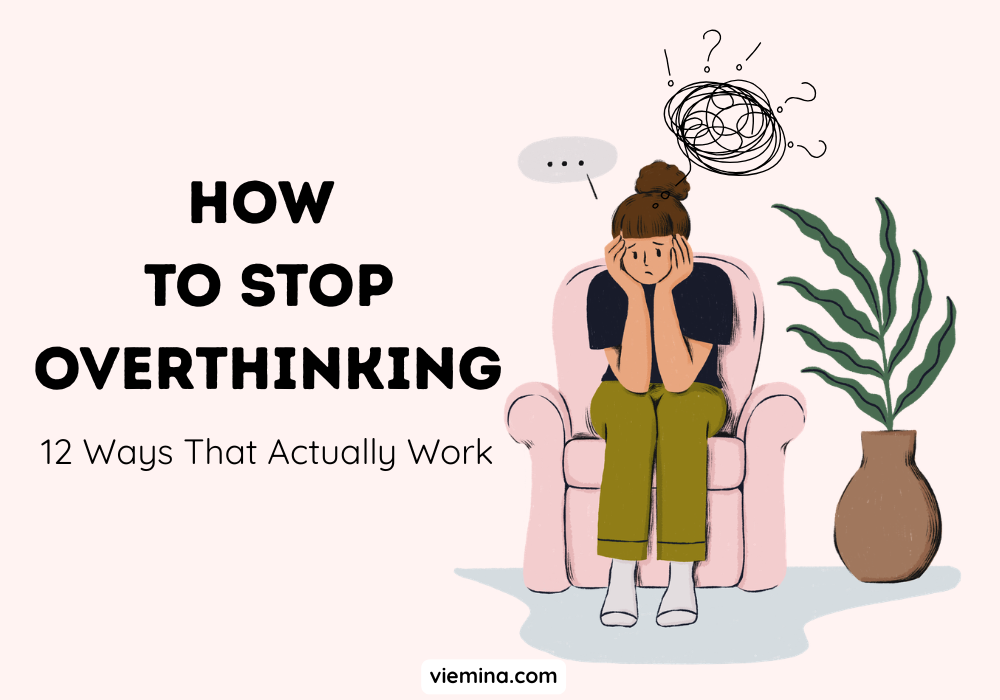
There’s a specific kind of exhaustion that comes from not knowing how to stop overthinking.
You replay a conversation from three days ago. You mentally rehearse what you’ll say before you say it. You wake up at 2 am running through scenarios that haven’t happened yet — and probably won’t. You know none of this is helping. You can’t stop anyway.
If this sounds familiar, you’re not alone. Overthinking is one of the most common psychological struggles people experience, and one of the hardest to shake — not because the solutions are complicated, but because the habit itself makes it difficult to take any action at all.
This article breaks down what overthinking actually is, why it happens, and twelve evidence-backed strategies that genuinely help — not just in theory, but in the moments when your mind won’t quiet down.
What Overthinking Actually Is
Overthinking is the habit of getting stuck in repetitive, unproductive thought loops — replaying the past, worrying about the future, and mentally rehearsing scenarios that drain your energy without leading anywhere useful.
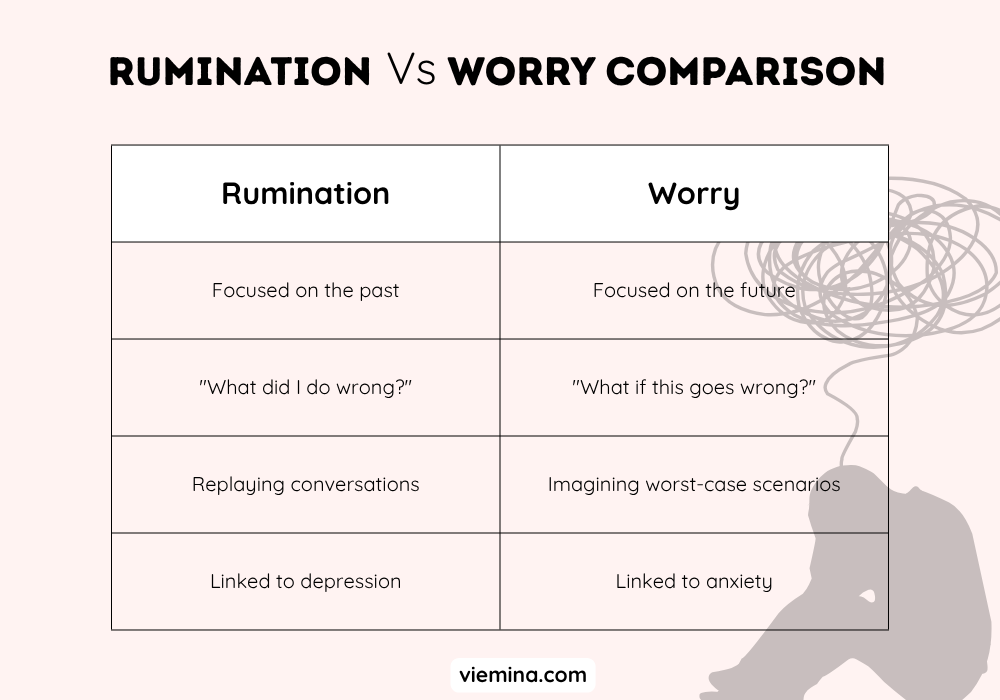
Psychologists distinguish between two main types:
- Rumination — dwelling on past events, mistakes, or painful experiences, trying to analyze what went wrong or what you should have done differently.
- Worry — focusing on future events, imagining worst-case scenarios, and trying to prepare for every possible outcome mentally.
Both feel like they’re helping. They’re not. Research consistently shows that prolonged overthinking doesn’t solve problems — it amplifies anxiety, distorts perspective, and keeps you stuck.
It’s also worth knowing that overthinking is often a symptom of something deeper. Chronic overthinkers frequently have underlying anxiety, depression, or a history of experiences — particularly in relationships — that trained their nervous system to stay on alert. Understanding the root cause matters because it changes how you approach the solution.
Why You Overthink — The Real Reasons
Before you can stop overthinking, it helps to understand why it’s happening.
- Your nervous system learned to stay alert. If you grew up in an unpredictable environment, or if you’ve been in relationships where things could turn bad without warning, your brain adapted by staying vigilant. Overthinking is often the mind’s attempt to prevent being caught off guard. It feels protective even when it isn’t.
Related: 23 Signs of Repressed Childhood Trauma in Adults
- Uncertainty is uncomfortable. The brain dislikes not knowing. When a situation is unclear — a relationship conflict, an unanswered message, a difficult decision — it often prompts scenarios and analyses in an attempt to resolve the discomfort. The problem is that analysis rarely produces certainty, so the loop continues.
Related: 20 Signs of a Controlling Relationship — And How to Leave
- Perfectionism. If you believe that the right answer exists and you just haven’t found it yet, you’ll keep searching. Overthinkers often have a high intolerance for making the “wrong” decision, which means they stay in their heads long past the point of usefulness.
Related: Embracing Imperfection: 9 Top Steps to Self-Acceptance
- Low self-trust. When you don’t fully trust your own judgment — often a result of past experiences where your instincts were overridden or dismissed — you seek certainty through thinking rather than through feeling. You keep analyzing because you don’t feel safe just deciding.
Related: Low Self-Esteem: 10 Effective Ways to Improve Self-Worth
How to Stop Overthinking ( 12 Ways That Actually Work)
1. Recognize when you’ve crossed from thinking into overthinking
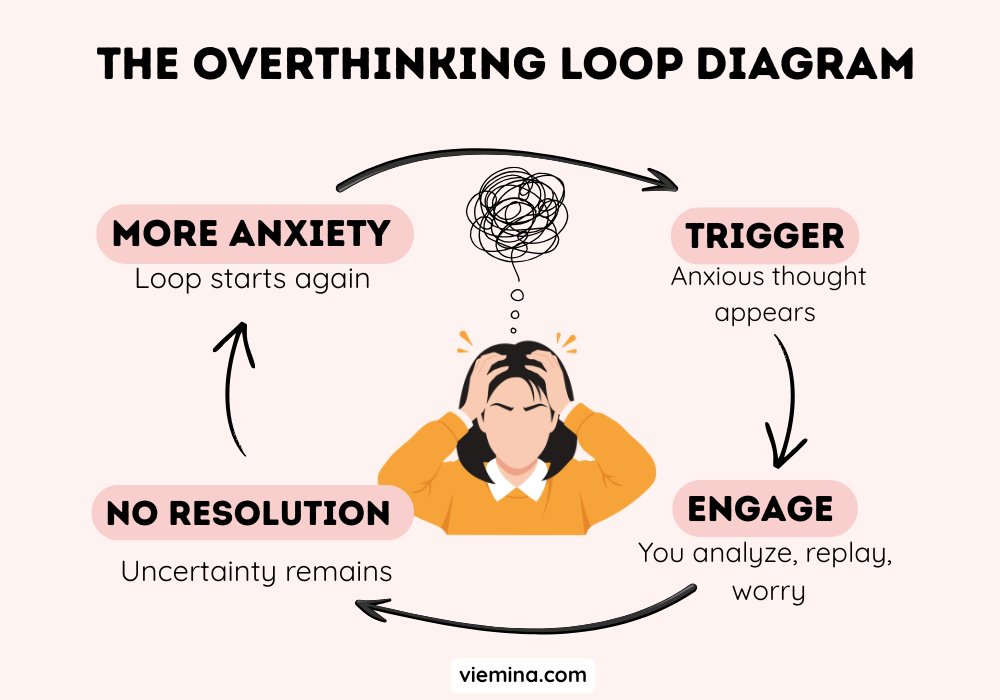
The most important skill is awareness. Productive thinking leads somewhere — to a decision, a plan, or a new perspective. Overthinking loops. It revisits the same ground, generates the same anxiety, and produces no forward movement.
Ask yourself: “Is this thought helping me take an action or make a decision?” If the honest answer is no — if you’re just replaying, worrying, or catastrophizing — that’s the signal to interrupt the pattern.
You can’t change what you haven’t noticed.
2. Scheduled worry time
This sounds counterintuitive, but it is one of the most well-researched tools for reducing overthinking. Rather than trying to suppress anxious thoughts — which tends to make them stronger — set aside a specific 20-minute window each day as designated worry time.
When an anxious thought appears outside that window, you don’t fight it. You note it and remind yourself you’ll give it proper attention during your scheduled time. This gradually breaks the habit of worry bleeding into every part of your day.
When worry time arrives, many people find the thoughts feel less urgent than they did in the moment. Some feel barely worth attending to at all.
3. Name the thought pattern
Overthinking comes in predictable flavors. Learning to name them takes away some of their power.
Common patterns include:
- Catastrophizing — assuming the worst possible outcome is likely
- Mind reading — assuming you know what others are thinking
- All-or-nothing thinking — seeing situations in extremes with no middle ground
- Fortune telling — predicting the future as if you know what will happen
- Rumination — replaying past events repeatedly without resolution
When you can say “I’m catastrophizing right now” rather than experiencing the thought as fact, you create distance from it. The thought is something you’re having — not something you are.
4. Challenge the thought directly
Cognitive Behavioral Therapy (CBT) is one of the most evidence-based approaches to managing overthinking, and its core technique is thought challenging. When you find yourself caught in a loop, ask:
- Is this thought factually true, or is it an assumption?
- What evidence supports it? What evidence contradicts it?
- What would I say to a friend who had this thought?
- What’s the most realistic outcome, not just the worst one?
This isn’t about forcing positive thinking. It’s about accurate thinking — getting a clearer picture of what’s actually likely, rather than what your anxious mind is presenting as inevitable.
5. Get out of your head and into your body
Overthinking is a cognitive experience that intensifies when you stay still and mentally. Physical movement interrupts the pattern at a neurological level — it shifts the nervous system out of the stress response and into a different mode.
This doesn’t require a gym session. A 10-minute walk, stretching, washing dishes with full attention to the sensations, or even cold water on your face, can interrupt a thought spiral. The goal is to give your brain a concrete, present-moment experience that competes with the abstract loop.
Exercise specifically reduces cortisol and increases dopamine and serotonin — the neurochemical shift that makes it easier to think more clearly afterward is real, not just motivational advice.
6. Practice the “5-4-3-2-1” grounding technique
When overthinking is acute — when the loop is fast and hard to interrupt — grounding techniques bring you back to the present moment by engaging the senses.
Notice: 5 things you can see, 4 things you can physically feel, 3 things you can hear, 2 things you can smell, 1 thing you can taste.
This is effective because it engages the same cognitive resources that overthinking uses. You can’t simultaneously ruminate and attend carefully to sensory experience. It doesn’t resolve whatever you were worrying about — but it breaks the spiral so you can approach it more clearly afterward.
7. Write it down — and then close the notebook
Journaling can be therapeutic, or it can become another form of rumination, depending on how you use it. The most effective approach for overthinkers is a brain dump — writing down every thought without editing or analyzing — and then deliberately closing the notebook and moving on.
The act of externalizing the thought removes it from the loop. You’re no longer holding it in working memory, trying not to forget it or resolve it. It’s captured. You can return to it if you choose. Often, you find, on returning to it, that it felt more urgent than it actually is.
Avoid journaling that becomes an extensive re-analysis of the same events. The goal is release, not further examination.
8. Distinguish between what you can and cannot control
Much of what overthinkers worry about falls into one of two categories: genuinely actionable things and things that aren’t. The brain doesn’t naturally make this distinction — it treats uncertainty about outcomes it can’t control the same way it treats problems it could solve if only it thought harder.
A simple exercise: take whatever you’re overthinking and ask, “Is there a concrete action I can take about this right now?” If yes, take it, even a small step. If not, the thinking isn’t solving the problem. It’s just creating the feeling of doing something while avoiding the discomfort of uncertainty.
Accepting uncertainty is a skill that can be built. It starts with repeatedly noticing that most of the things you can’t control tend to resolve themselves, and that the time spent worrying about them doesn’t improve the outcome.
9. Examine the belief underneath the thought
Overthinking is rarely just about the surface concern. Under most persistent thought loops, there’s a core belief — about yourself, about other people, or about how the world works.
Common ones include: “If I make a mistake, people will think less of me.” “If I’m not in control, something bad will happen.” “I need to figure everything out before I can move forward.”
These beliefs are often formed in early experiences and reinforced by later ones. They feel like facts because they’ve been operating for so long. But they’re interpretations — and interpretations can be examined and updated.
Therapy, particularly CBT or schema therapy, is the most effective way to work on core beliefs. But awareness is the first step. When you notice yourself in a loop, it’s worth asking: “What am I afraid this means about me?”
Related: 21 Signs of Manipulative Parents You Should Know
10. Build self-trust through small commitments
A significant driver of overthinking is low confidence in your own judgment. When you don’t trust yourself to make good decisions or handle difficult outcomes, the mind compensates by endlessly analyzing in search of certainty that won’t come from thinking.
Self-trust is rebuilt through action — specifically, through making small decisions and following through, then observing that you handled whatever came next. Over time, this builds the internal evidence that you are capable of navigating uncertainty.
Start deliberately small. Decide without revisiting it. Notice that the outcome was manageable. Repeat.
11. Limit reassurance-seeking
Overthinkers frequently seek reassurance from others — checking whether something is okay, asking for opinions on decisions they’ve already made, rereading messages looking for evidence of the other person’s emotional state.
Reassurance provides short-term relief but reinforces the underlying belief that you cannot tolerate uncertainty without external confirmation. Each time you seek it, you strengthen the habit of outsourcing your judgment.
This doesn’t mean talking to people you trust. It means noticing the difference between genuine connection and reassurance-seeking — and gradually reducing the latter.
12. Work on what’s underneath
If overthinking is persistent, severe, or has been a feature of your life for a long time, the twelve strategies above will help — but they’re most effective when paired with an understanding of the deeper roots.
Chronic overthinking is frequently connected to anxiety disorders, depression, past trauma, or patterns formed in early relationships. It’s also very common in people who’ve been in controlling or emotionally unpredictable relationships — environments that trained the nervous system to scan constantly for threat.
A therapist who understands anxiety, CBT, or trauma-focused approaches can help you understand not just how to manage overthinking but why it developed — which is the most durable route to lasting change.
Related: 7 Stages of Trauma Bonding: How to Break the Cycle & Heal
When Overthinking Becomes Something More
It’s normal to go through periods of more intense worry during stressful life events. But if overthinking is consistently interfering with your daily functioning, your relationships, your sleep, or your ability to make decisions, it may be more than a habit.
Generalized Anxiety Disorder (GAD), OCD, depression, and PTSD can all involve significant components of overthinking. If you recognize yourself in that description, speaking to a mental health professional is worth taking seriously — not as a last resort, but as a practical step toward feeling better.
Conclusion
Overthinking feels productive because it feels like doing something. But thought loops that don’t lead to action or resolution aren’t problem-solving — they’re anxiety in disguise.
The path out isn’t to think less. It’s to think differently — to develop the awareness to catch the loop early, the tools to interrupt it, and eventually the self-trust to tolerate uncertainty without needing to resolve it mentally first.
That’s a skill. It takes practice. And it starts with noticing, just once today, that you’ve crossed from thinking into overthinking — and choosing to do something different.
Frequently Asked Questions
What causes overthinking?
Overthinking is most commonly caused by underlying anxiety, depression, or a history of unpredictable experiences — particularly in relationships — that trained the nervous system to stay on alert. Perfectionism and low self-trust also contribute significantly. In some cases, overthinking is a symptom of Generalized Anxiety Disorder (GAD) or other mental health conditions that benefit from professional support.
How do I stop overthinking at night?
Nighttime overthinking is so common because fewer distractions are competing for cognitive attention. The most evidence-backed approaches include a consistent bedtime routine, scheduled worry time earlier in the day so thoughts feel less unresolved by night, journaling before bed to externalize thoughts, and progressive muscle relaxation or breathing exercises to shift the nervous system out of the stress response. Avoiding screens and stimulating content in the hour before sleep also significantly reduces nighttime thought activation.
Is overthinking a mental illness?
Overthinking itself is not a mental illness, but it is frequently a symptom of one. Anxiety disorders, depression, OCD, and PTSD all involve components of repetitive, unwanted thought. If your overthinking is persistent and interfering with daily life, speaking to a mental health professional is a worthwhile step.
Can overthinking be cured?
Overthinking can be significantly reduced and managed, though “cured” may not be the most helpful frame. What most people achieve through consistent effort and sometimes therapeutic support is not the elimination of overthinking but a fundamentally different relationship with it — the ability to notice it, interrupt it, and return to the present more quickly. Over time, this becomes more automatic and requires less effort.
Why do I overthink in relationships?
Overthinking in relationships is particularly common in people who have experienced inconsistent, unpredictable, or emotionally harmful relationships in the past — including childhood experiences. The nervous system learns to scan for threat and interpret ambiguity as danger. It can also develop after being in a relationship where your perceptions were frequently dismissed or contradicted (gaslighting). The anxiety feels like it’s about the current relationship, but often has roots in older patterns.
What’s the difference between overthinking and problem-solving?
Problem-solving leads somewhere — to a decision, a plan, or a new perspective. Overthinking loops. It revisits the same ground repeatedly, generates anxiety, and produces no forward movement or resolution. The clearest test is whether the thinking is changing anything. If you’ve had the same thought cycle three or more times without reaching any new conclusion, you’ve moved from problem-solving into overthinking.