

Figuring out how to stay on track is harder than most advice makes it sound, and if you’re reading this, you’ve probably already fallen off at least once. Maybe more than once with this exact goal.
That’s not a confession. It’s just what happens to almost everyone who’s ever tried to change something about their life. Motivation doesn’t arrive once and stay; it comes in waves, and most advice about “staying on track” is quietly written for the crest of the wave, not the trough. It tells you what to do when you’re already motivated. It has much less to say about the Tuesday morning when you genuinely don’t want to, and yesterday you already skipped, and some part of you is wondering if you’re just not the kind of person who follows through.
You are. The problem usually isn’t your character. It’s that most systems for staying on track assume motivation will stay constant, and then quietly blame you when it doesn’t.
This article is built around a different question than most “stay on track” advice asks. Instead of “how do I never slip,” it asks “why did I actually slip, and what do I do about it right now”; because that’s almost always the real question by the time someone searches for this.
Why It’s Hard to Stay on Track: The Real Causes
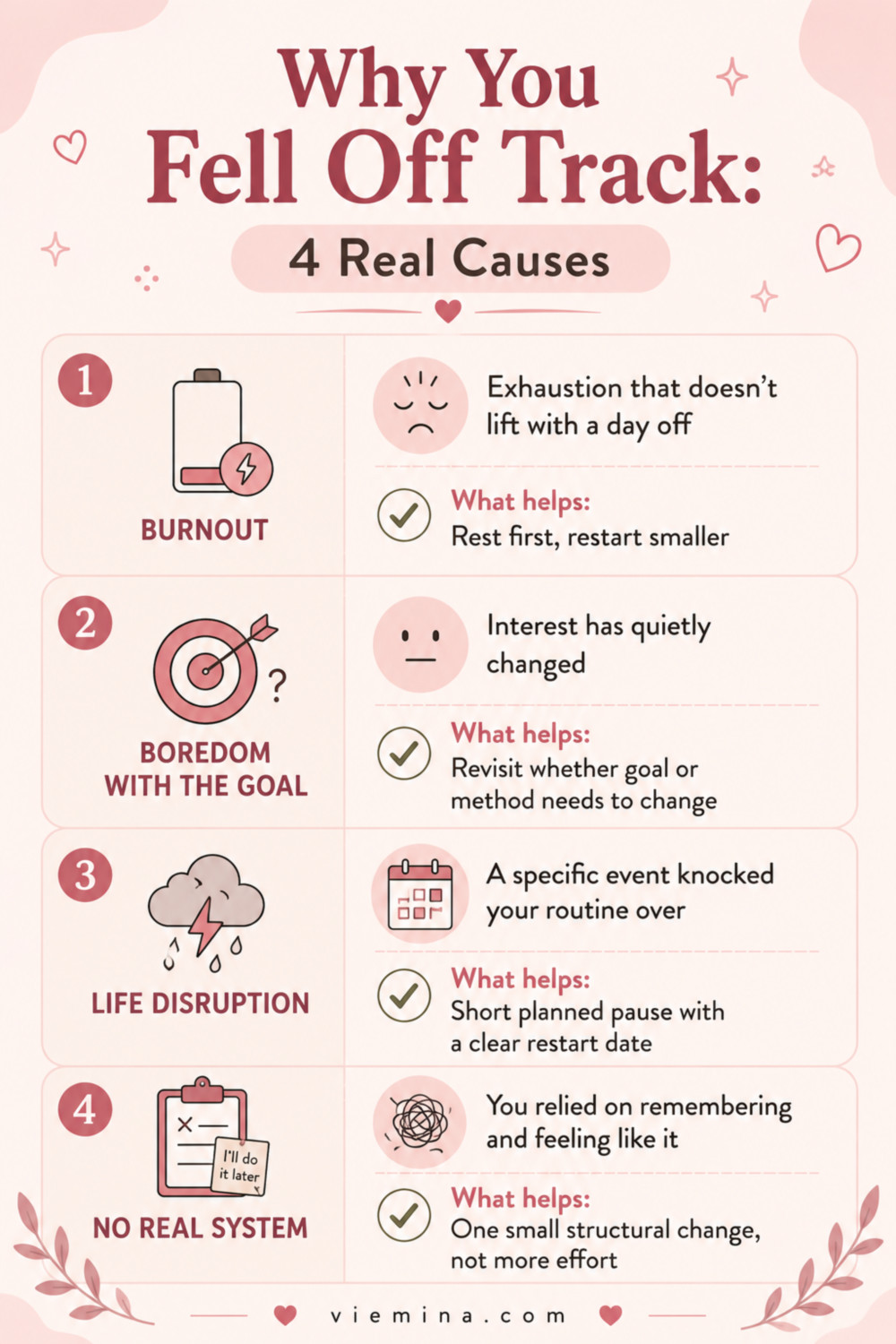
Before any advice on how to stay on track is useful, it helps to know which problem you’re actually solving, because “stay on track” advice tends to assume one cause and quietly apply it to all of them.
| Cause | What it usually looks like | What actually helps |
| Burnout | Exhaustion that doesn’t lift with a day off; dread instead of resistance | Rest first, restart smaller; pushing harder here usually backfires |
| Boredom with the goal | The plan hasn’t changed, but your interest quietly has | Revisit whether the goal or the method needs to change, not just your effort |
| Life disruption | A specific event knocked your routine over: travel, illness, a hard week | A short, planned pause with a clear restart date, not an open-ended one |
| No real system | You relied on remembering and feeling like it, and some days you just didn’t | Build one small structural change (see Section 6) rather than trying harder next time |
Most people assume they’re dealing with a discipline problem by default. Often they’re actually dealing with one of the other three, and no amount of willpower advice fixes a system problem or a burnout problem.
Related: How to Avoid Burnout: 15 Effective Ways to Restore Balance
Motivation Is a Wave, Not a Switch
Most “stay on track” content quietly assumes motivation should stay switched on once you find it. In practice, motivation behaves more like a wave; it rises when a goal feels fresh or urgent, and it naturally recedes once the novelty wears off or life gets in the way, regardless of how much you actually want the outcome.
This matters because the wave model changes what a dip means. If motivation is supposed to be a constant switch, then a dip means something is wrong with you. If motivation is a wave, a dip is just the wave doing what waves do; and the real question isn’t “why did my motivation disappear,” it’s “did my system depend on the wave staying high, or did it account for the dip?”
Related: Why Do I Procrastinate Even When I Want to Work?
Related: How to Stop Procrastination (Even When You Feel Unmotivated)
The Never Miss Twice Rule
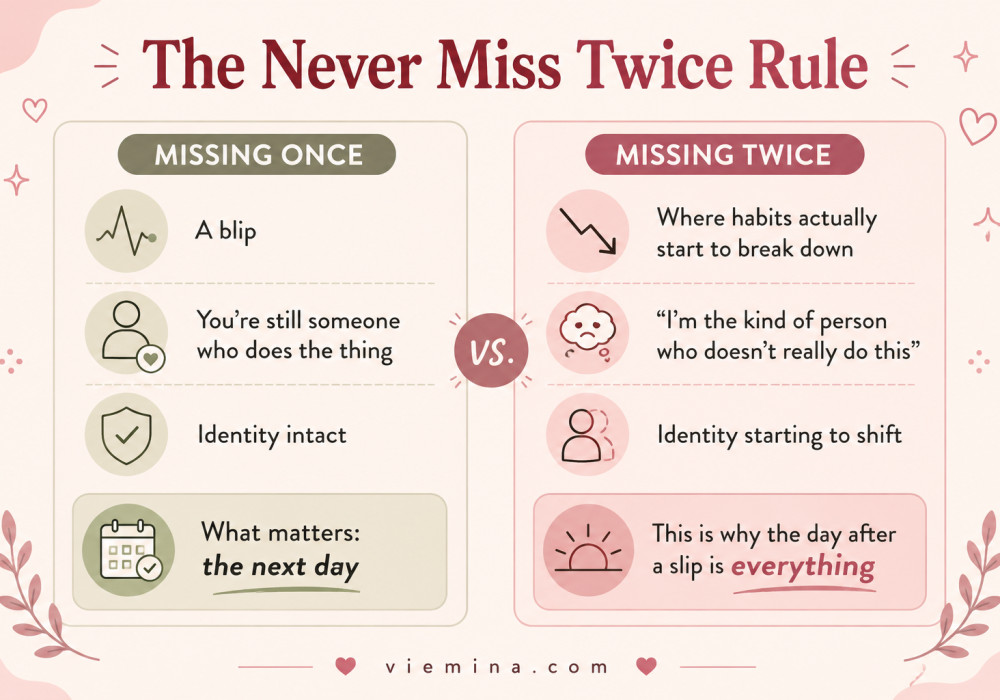
Here’s the single rule worth remembering if you take nothing else from this article: one missed day is a blip. Two missed days in a row is where a habit actually starts to come apart.
The first missed day rarely does real damage on its own; you’re still, structurally, someone who does the thing, who happened to skip once. The second missed day is different. It’s the point where “I skipped” starts to quietly become “I’m the kind of person who doesn’t really do this,” and that shift in identity is what actually derails people, far more than the missed day itself.
This is why the rule isn’t “never miss a day”; that standard is unrealistic and sets almost everyone up to fail. It’s “never let a miss become two.” Practically, that means the day after a slip matters more than any other day in the entire process.
Understanding this single rule changes how you think about how to stay on track; it moves the focus away from perfect consistency and onto what you do the day after an imperfect one.
Related: Perfectionism and Procrastination: The Hidden Link
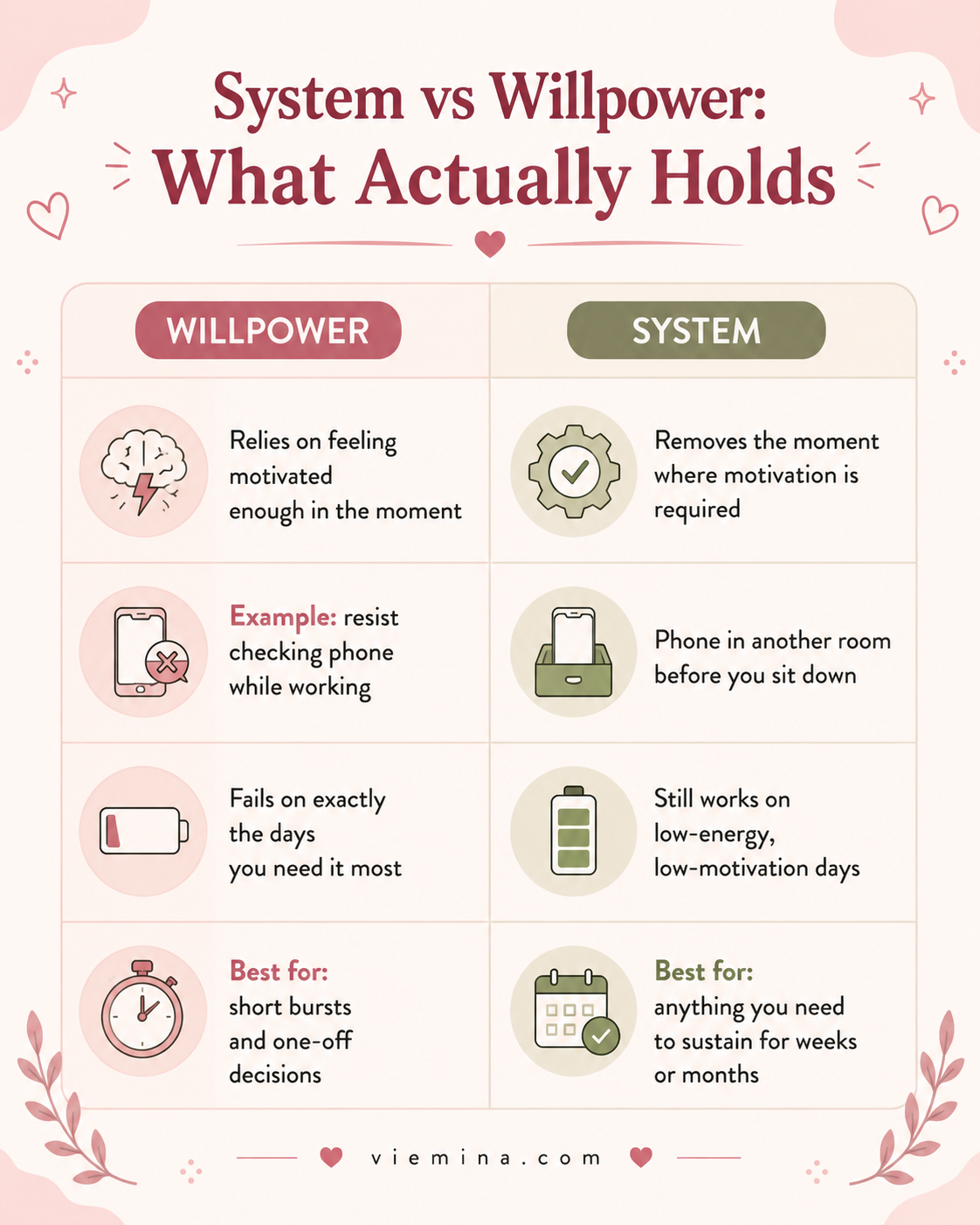
System vs Willpower: What Actually Holds
| Willpower-Dependent Approach | System-Dependent Approach | |
| What it relies on | Feeling motivated enough, in the moment, to choose the harder option | Removing the moment where a hard choice is even required |
| Example | “I’ll just resist checking my phone while I work” | Phone physically in another room before you sit down to work |
| What happens on a low-motivation day | Often fails, because willpower is precisely the thing that’s lowest on those days | Still works, because it doesn’t depend on how you feel that day |
| Where it’s actually useful | Short bursts, one-off decisions | Anything you need to sustain for weeks or months |
Willpower isn’t useless; it’s just an unreliable long-term foundation, because it’s lowest exactly when you need it most (tired, stressed, busy). A system doesn’t ask you to be disciplined in the moment; it’s built so the disciplined choice is already the easy one.
If the Problem Is the Goal Itself
This is worth asking honestly: sometimes the reason you keep falling off track isn’t a systems problem or a motivation dip. It’s that the goal you’re chasing doesn’t actually fit you anymore, or never quite did.
A useful, non-judgmental way to check: if you imagine having already achieved this goal, does the image genuinely appeal to you, or does it mostly feel like relief that you’d finally be allowed to stop? Relief-at-stopping usually points to a goal you adopted because you felt you should, not one you actually want. That’s not a discipline failure; it’s information, and it’s worth taking seriously rather than pushing through with more willpower aimed at the wrong target.
This doesn’t mean abandoning every goal that gets hard. Most worthwhile goals get hard at some point. The distinction is between “this is hard because it matters” and “this is hard because it was never really mine.”
Related: How to Set Goals and Achieve Them (Complete Guide)
How to Stay on Track: 4 System Changes That Work
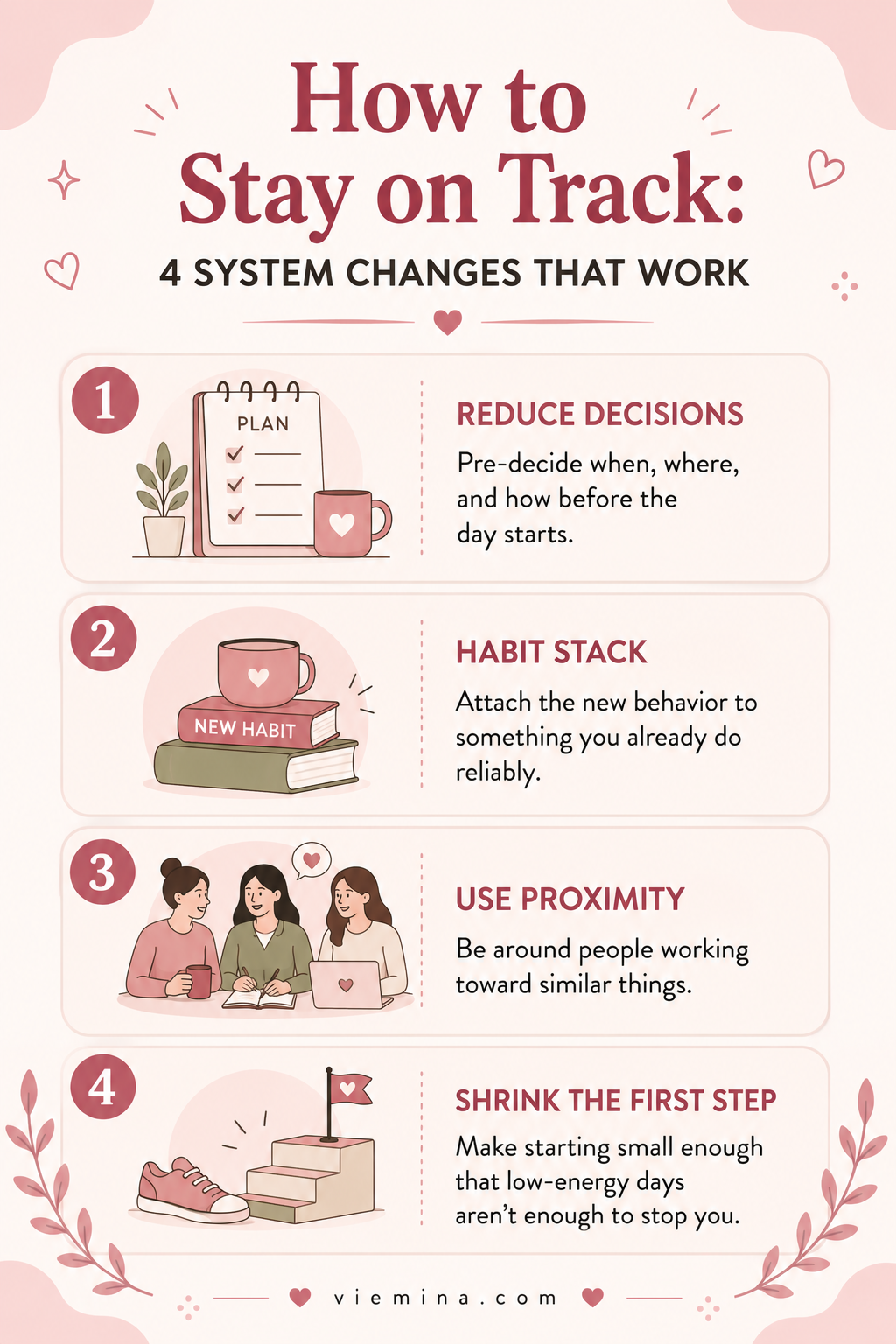
A few structural changes tend to matter more than any amount of trying harder:
1-Reduce the number of decisions between you and the action. If starting requires several small decisions (when, where, what first), each one is a chance to talk yourself out of it. Pre-deciding removes those exit points.
2-Attach the new habit to an existing one. Doing the new thing right after something you already do reliably borrows that existing routine’s momentum, rather than asking the new habit to stand entirely on its own.
3-Use proximity deliberately. Being around people who are actively working toward similar things- a friend, an online group, a mentor- makes staying on track feel like the default rather than something you have to manufacture alone through sheer will.
4-Make the first step smaller than feels necessary. A goal that requires real energy to start is one you’ll skip on exactly the days you have the least energy; which, by the wave model in Section 2, is a predictable, recurring event, not a rare one.
Related: 11 Real Signs It’s Time to Change Your Life,Not Just a Break
What to Do the Day After You Slip

This is the single highest-leverage moment in the entire process: the moment that determines whether you actually stay on track long-term; it’s the day after you slip, not the day you set the goal.
- Do the smallest possible version of the thing today. Not the full version; the smallest version that still counts. Five minutes instead of thirty. One page instead of a chapter. The goal isn’t progress today; it’s keeping the miss from becoming two.
- Skip the self-audit for now. There will be time later to figure out what happened. Today’s job is just showing up in some small form; analyzing the lapse in the moment usually turns into rumination, not insight.
- Don’t renegotiate the whole plan today. The day after a slip is a bad day to decide whether the entire goal or system needs to change; that decision is better made with a clear head, not from inside the discomfort of having just missed a day.
Related: 12 Signs You’re Overanalyzing And How to Finally Stop
Related: How to Stop Overthinking: 12 Ways That Actually Work
Common Mistakes When Getting Back on Track
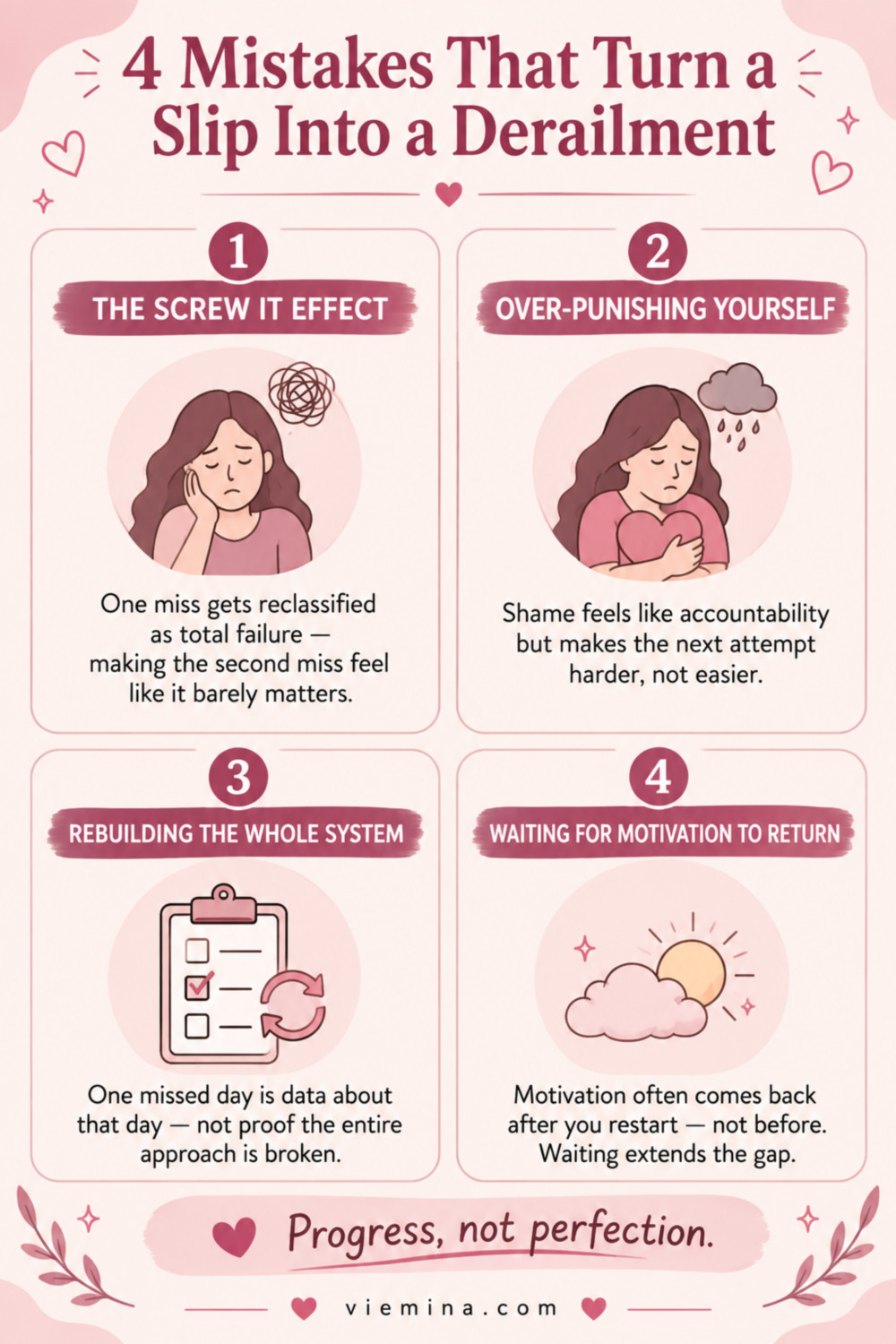
- The “screw it” effect. One missed day gets mentally reclassified as a failure, which makes the second missed day feel like it barely matters anymore, since the streak is “already ruined.” This is the single most common way a small, meaningless lapse turns into an actual derailment, and it’s precisely what the Never Miss Twice rule (Section 3) exists to interrupt.
- Over-punishing yourself for a normal dip. Treating an ordinary motivation dip as evidence of a character flaw tends to make the next attempt harder, not easier; shame is a poor long-term motivator, even though it can feel like accountability in the moment.
- Rebuilding the entire system after one slip. A single missed day is data about that day, not proof the whole approach is broken. Overhauling everything after one lapse often does more damage than the lapse itself, by adding the cost of starting over on top of the original miss.
- Waiting for motivation to come back before restarting. Motivation often returns after you’ve already started again, not before; waiting for the feeling to show up first tends to extend the gap rather than shorten it.
Reflection: What Did the Slip Actually Look Like?
Instead of a general “learn from your setbacks” instruction, try something more specific. Think of the most recent day you fell off track and answer three questions:
- What was actually happening that day; were you tired, bored, busy, or was there simply no clear plan for when or how to do the thing?
- Which of the four causes in Section 1 does that day match most closely?
- What’s the smallest possible adjustment,not an overhaul- that would make that specific situation easier to handle next time?
This turns an abstract instruction into something concrete enough to actually use, and it tends to reveal which of the four causes from Section 1 you’re really dealing with, rather than defaulting to “I just need more discipline” by habit.
Conclusion
If you’ve fallen off track before ; probably more than once; that’s not a verdict on your character. It’s what happens to almost everyone who’s ever pursued something that mattered to them for longer than a few weeks. Motivation was never going to stay constantly high, and the goal now isn’t to force it to. It’s to build something that still works on the days it isn’t.
You don’t need a perfect comeback today. You need one small version of the thing, done today, so a single missed day stays exactly that; a missed day, not the start of a pattern. That’s the whole rule. Everything else in this article is just what makes following it a little easier.
Frequently Asked Question About How To Stay on Track
How do I get back on track after missing several days in a row?
Start with the smallest possible version of the habit today rather than trying to make up for lost time all at once. Trying to fully compensate for several missed days in a single session tends to backfire and increase the odds of quitting again.
Does missing one day really matter?
Not as much as people assume; one missed day rarely causes real damage on its own. What matters more is what happens the day after: a second consecutive miss is where the pattern actually starts to break down.
Is losing motivation a sign I chose the wrong goal?
Not necessarily; motivation naturally rises and falls for everyone, regardless of how right the goal is. It’s worth paying attention to, though, if the dip comes with genuine relief at the idea of quitting rather than just short-term reluctance to do the work.
Why do I keep falling off track with the same goal specifically?
It’s worth identifying which of the four common causes; burnout, boredom with the goal, a life disruption, or no real system; best matches your situation, since a repeated pattern with one specific goal often points to the same unaddressed cause each time.
What’s the difference between a helpful system and just willpower?
A system removes the moment where you’d need willpower in the first place; for example, physically removing a distraction rather than relying on resisting it. Willpower works for short bursts; systems hold up over weeks and months.
Should I punish myself for falling off track to stay accountable?
No; self-punishment tends to make the next attempt harder, not easier. Treating a lapse as information rather than a character failure is both more accurate and more effective at helping you actually continue.