

You stand in front of a menu for ten minutes and still can’t choose. You delay a reply to an important email for days. You’ve been thinking about a decision for so long that the window for it has passed—and part of you feels relieved.
If this sounds like you, you’re not just indecisive. You may have something called decidophobia—a genuine, documented fear of making decisions that goes far beyond the ordinary anxiety most people feel when faced with difficult choices.
Understanding it is the first step toward changing it.
What Is Decidophobia?
Decidophobia is an intense, irrational fear of making decisions—including minor everyday ones like what to eat or what to wear, not just major life choices.
The term was coined by philosopher Walter Kaufmann in his 1973 book Without Guilt and Justice: From Decidophobia to Autonomy, where he described it as “the dread of making fateful decisions.” In modern psychology, it is classified as a specific phobia—a type of anxiety disorder characterized by a disproportionate fear of a specific situation or object that poses no real objective danger.
What distinguishes decidophobia from ordinary indecision is the level of distress involved and the way it disrupts daily functioning. Someone who takes time to think through an important choice is being thoughtful. Someone with decidophobia experiences genuine anxiety, sometimes panic, at the prospect of any decision and goes to significant lengths to avoid having to make them.
Signs and Symptoms of Decidophobia
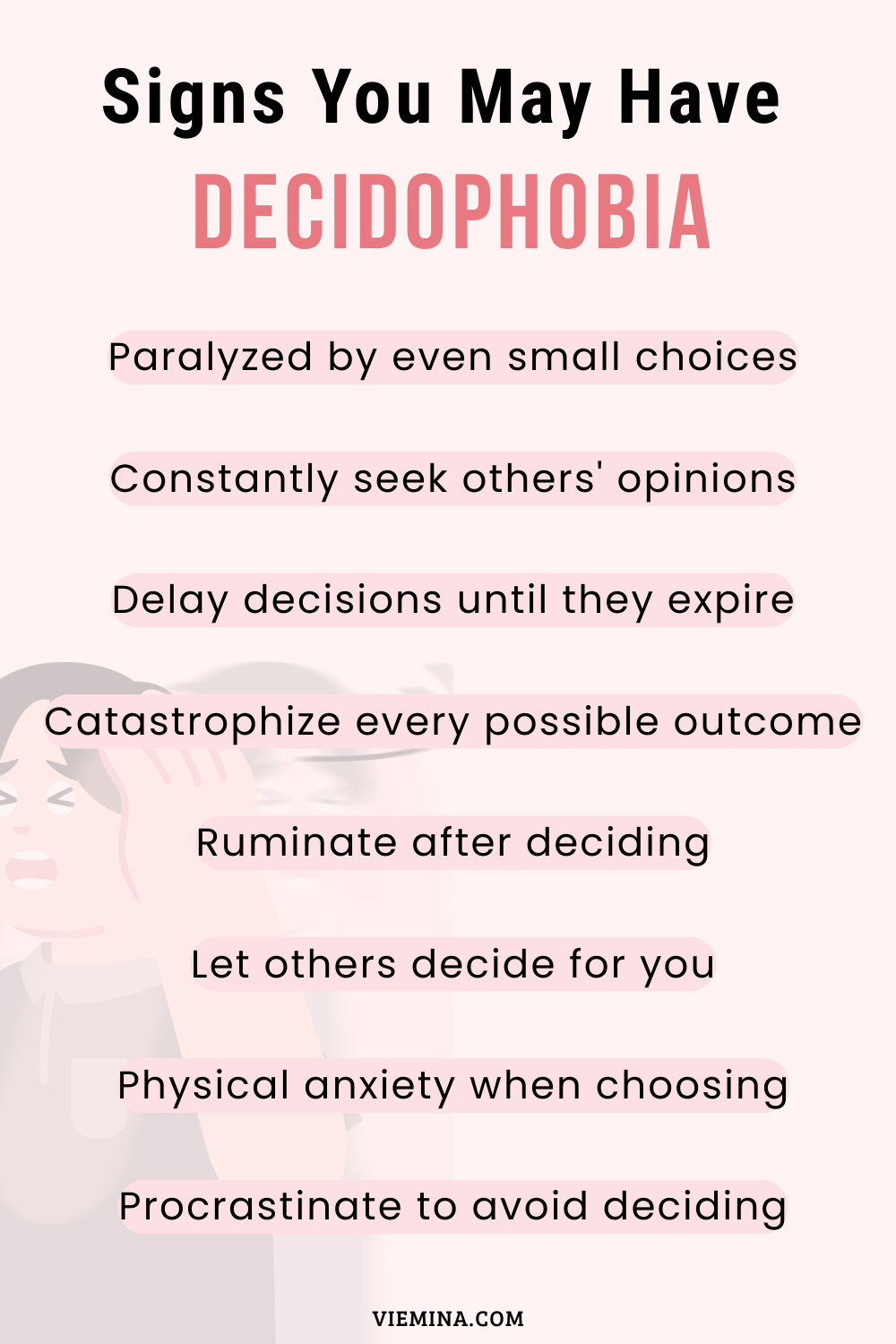
Decidophobia can show up differently in different people, but the most common signs include:
1-Paralysis in front of choices
Even simple decisions—what to order, which route to take, what to reply to a message—produce disproportionate stress. You find yourself frozen, unable to commit, going back and forth without resolution.
2-Chronic avoidance
You delay decisions for as long as possible, hoping circumstances will change, someone else will decide, or the choice will become irrelevant on its own. Deadlines pass. Opportunities close. The avoidance provides short-term relief and long-term cost.
3-Seeking constant reassurance
You check with others — friends, family, anyone available — before making even small decisions to validate the choice. This isn’t gathering information. It’s outsourcing the responsibility of deciding because the possibility of being wrong feels intolerable.
4-Reliance on others to decide for you
In more significant cases, you may find yourself consistently deferring to whoever is nearby — a partner, a parent, a friend — allowing them to make choices that affect your own life. This can gradually erode your sense of autonomy and attract people who are comfortable making decisions on your behalf, which is not always in your best interest.
5-Physical anxiety symptoms
When faced with a significant decision, the body responds as if to a threat. Racing heart, shallow breathing, nausea, sweating, trembling, or tightness in the chest are all physical manifestations of the anxiety that accompanies severe decidophobia.
6-Catastrophizing outcomes
Every option feels loaded with potential for disaster. Minor decisions take on exaggerated weight. The worst-case scenario occupies your attention far more than any realistic assessment of what’s likely to happen.
7-Procrastination as a coping mechanism
Not all procrastination is laziness. For people with decidophobia, delaying a decision is a way of managing the anxiety attached to it. The delay provides temporary relief — but often results in the decision being made by default, in worse circumstances, or not at all.
8-Persistent rumination after deciding
Deciding doesn’t end the anxiety. After making a choice, you continue to review it—questioning whether you chose correctly, imagining how the other option might have gone, and replaying the decision until the next one arrives. The relief of having decided is brief if it comes at all.
Causes of Decidophobia
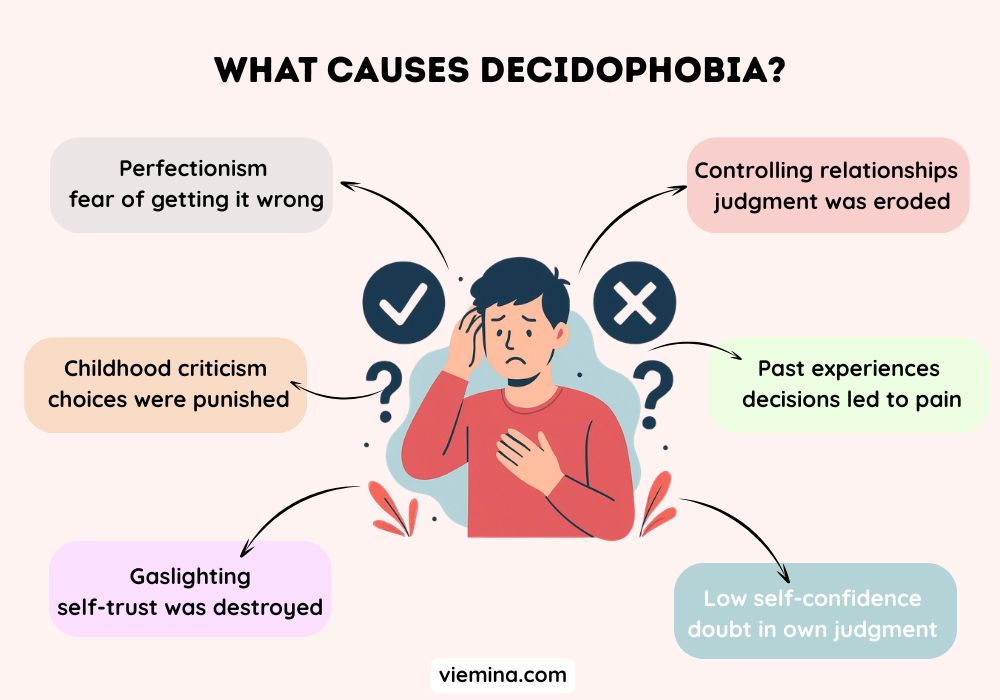
Understanding where decidophobia comes from matters because the cause often shapes the most effective approach to addressing it.
1-Perfectionism
Perfectionists set an implicit standard that the correct choice exists and must be found. Any decision carries the risk of being the wrong one—and being wrong, for a perfectionist, carries a high psychological cost. The result is analysis paralysis: the endless review of options without the ability to commit, because committing means accepting the possibility of imperfection.
Related: Atelophobia : Signs, Causes, and 10 Ways to Overcome
2-Past experiences of negative consequences
If a decision led to a significant, painful outcome—a relationship ending, a job lost, a serious mistake—the mind can generalize that experience into a broader fear of deciding. The association between choosing and suffering becomes powerful enough to create avoidance.
Related: 18 Signs of a Manipulative Mother
Related: 21 Signs of Manipulative Parents You Should Know
3-Childhood environments
Children who grew up in homes where their choices were consistently criticized, overridden, or punished learn that making independent decisions is risky. The message absorbed — consciously or not — is that their judgment cannot be trusted, and that deferring to others is safer than choosing for themselves. This pattern can persist well into adulthood.
Related: 23 Signs of Repressed Childhood Trauma in Adults
4-Controlling relationships
This is one of the most underrecognized causes of decidophobia and one that receives almost no attention in mainstream discussions of the topic.
People who have been in controlling or emotionally abusive relationships where their decisions were routinely criticized, dismissed, or overridden frequently develop profound anxiety around making independent choices. When someone has spent months or years having their judgment questioned, their decisions second-guessed, and their choices met with punishment or contempt, the nervous system learns a very clear lesson: deciding for yourself is dangerous.
This is not a character flaw or a weakness. It is a logical adaptation to an environment where independent decision-making was consistently unsafe. But the adaptation outlasts the environment—and long after the relationship has ended, the anxiety remains.
Related: 15 Signs of a Controlling Friend — And When to Walk Away
Related: 7 Stages of Trauma Bonding: How to Break the Cycle & Heal
5-Gaslighting and self-doubt
Closely related to the above: people who have experienced gaslighting — the systematic erosion of their trust in their own perceptions and judgment — often struggle enormously with decision-making. If you’ve been repeatedly told that your read of situations is wrong, that your instincts are unreliable, that your conclusions are irrational — you lose the internal compass that most people use to navigate choices. Without that compass, every decision feels like guessing in the dark.
Related: 15 Signs You’re in a Relationship with a Narcissist,Not Love
6-Low self-confidence
People who doubt their own capabilities, intelligence, or judgment naturally struggle to trust their decisions. The fear isn’t really about the choice itself — it’s about the perceived inadequacy of the person making it.
Relaed: Low Self Esteem: 10 Effective Ways to Improve Self-Worth
7-Fear of responsibility
Making a decision means owning the outcome. For people who find that weight difficult to carry — often those with anxiety, perfectionism, or a history of being blamed for things — the prospect of being responsible for a choice and its consequences is itself a source of significant distress.
How to Overcome Decidophobia
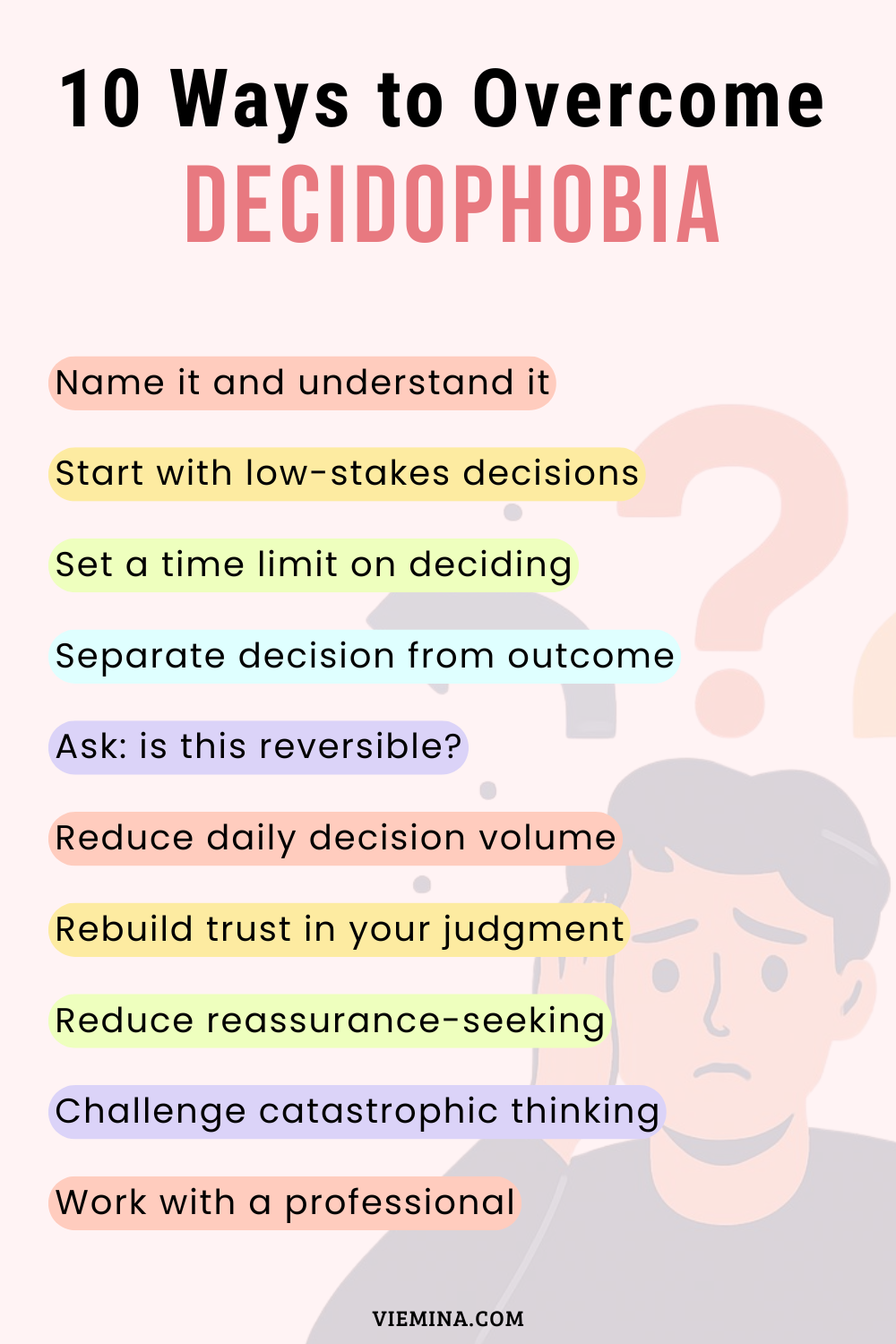
1. Name it and understand it
The first step is recognizing what’s actually happening. Decidophobia is not a personality flaw, a character weakness, or evidence of stupidity. It is a documented psychological response, a fear that developed for reasons, and that can be changed with the right approach.
Having accurate language matters. “I have a fear of making decisions” is a different relationship to the experience than “I’m just really indecisive.” One is a pattern you can work with. The other is an identity you’re stuck with.
2. Start with genuinely low-stakes decisions
The way you build confidence in decision-making is the same way you build confidence in anything: through repeated experience of making decisions and surviving the outcome—including imperfect ones.
Start with decisions that genuinely don’t matter much. Choose a restaurant without consulting anyone. Pick a film without reading every review. Reply to a message without drafting three versions first. Make the decision and observe that you’re fine. Do this consistently.
The goal isn’t to make perfect decisions. The goal is to accumulate evidence that you can decide and handle whatever comes next.
3. Set a time limit
One of the mechanisms that perpetuates decidophobia is unlimited review time. If you can always spend more time thinking about a decision, the anxiety will always find more to examine. Cutting off that time creates a healthy pressure that forces a decision.
For low-stakes choices, give yourself two minutes. For medium stakes: one day. For significant decisions, set a specific date by which you will decide, and hold it.
4. Separate the decision from the outcome
A large part of decidophobia comes from holding yourself responsible not just for the decision but for its outcome—including outcomes you couldn’t have predicted. This is an unfair standard that nobody can meet.
A good decision is one made with the information available at the time. Decisions don’t become bad just because circumstances change, because something unexpected happens, or because another option would have been better in hindsight. Evaluating your decisions based on the information you had—not on how things turned out—is both fairer and more accurate.
5. Reduce the number of daily decisions
Decision fatigue is real. The more choices you make throughout a day, the more depleted your decision-making resources become. Simplifying routine decisions—what to eat, what to wear, how to structure your morning—frees up cognitive and emotional capacity for the decisions that actually matter.
Create systems and routines that remove unnecessary choice from your day. This isn’t avoidance — it’s resource management.
6. Distinguish between reversible and irreversible decisions
Most decisions are more reversible than they feel in the moment. You can change your mind, change direction, try something different. The catastrophic irreversibility that decidophobia tends to assign to choices is usually exaggerated.
Before making a decision, ask yourself honestly: if this turns out to be wrong, can I correct it? In most cases, the answer is yes, which changes the stakes considerably.
7. Write decisions down before acting on them
One of the most practical tools for rebuilding decision-making confidence is externalizing the process—getting it out of your head and onto paper before anxiety distorts it.
When facing a decision, write down three things: what you actually want, what you’re afraid of, and what you would tell a close friend in the same situation. The third question is particularly revealing. Most people give far better advice to others than they give themselves—because they’re not filtering it through fear.
Writing also creates a record. Over time, reviewing past decisions shows you that your judgment is more reliable than decidophobia tells you it is. That evidence—concrete, documented, yours—is what gradually rebuilds self-trust more effectively than any affirmation.
8. Challenge catastrophic thinking
When a decision feels unbearable, examine what you’re actually afraid of. What’s the worst realistic outcome? Not the worst imaginable — the worst realistic. How likely is that outcome actually? How bad would it actually be?
Cognitive Behavioral Therapy (CBT) specifically addresses this kind of thinking — teaching you to examine the evidence for your catastrophic predictions and develop more accurate assessments of risk.
9. Reduce reassurance-seeking
Every time you seek reassurance from someone else before making a decision, you reinforce the belief that you cannot trust your own judgment. The short-term relief comes at the long-term cost of increasing your dependency on external validation.
Practice making small decisions without checking with anyone first. Notice that the outcome is manageable. Gradually extend this to larger decisions.
Related: 12 Signs You’re Overanalyzing — And How to Finally Stop
10. Work with a professional
For significant or long-standing decidophobia particularly when it’s connected to anxiety, past trauma, or a history of controlling relationships — professional support is worth considering seriously.
CBT is one of the most evidence-based approaches for specific phobias and anxiety disorders. Exposure therapy, which involves gradually practicing decision-making in a supported environment, has also shown significant effectiveness. A therapist who understands anxiety and its roots can help you work not just on the surface behavior but on the underlying beliefs driving it.
Decidophobia After a Controlling Relationship
If your difficulty making decisions developed or significantly worsened during or after a relationship where your choices were controlled, criticized, or consistently overridden, this section is specifically for you.
What you’re experiencing is not a coincidence. Controlling relationships systematically undermine the decision-maker’s confidence in their own judgment. When every choice you made was questioned, second-guessed, or met with disapproval, your nervous system adapted by treating independent decision-making as a threat. That was a rational adaptation to an irrational situation.
Recovery from this specific version of decidophobia requires more than decision-making practice. It requires rebuilding the self-trust that was deliberately eroded — understanding that your perceptions are valid, your instincts are reliable, and your judgment is yours to trust again.
This takes time and often benefits from professional support. But it is entirely possible, and recognizing the source of the fear is the first meaningful step.
Related: 20 Signs of a Controlling Relationship — And How to Leave
Conclusion
Decidophobia isn’t about being weak or indecisive. It’s about a nervous system that learned, for good reasons, in real circumstances, that making choices was dangerous.
That lesson made sense once. It doesn’t have to run your life forever.
Every small decision you make and survive is evidence against the fear. Every time you choose something, even imperfectly, even with anxiety, you’re proving to yourself that you can. That evidence accumulates. The fear gets quieter. Your own voice gets louder.
If the fear runs deep enough that these strategies aren’t moving the needle, especially if it grew inside a relationship that made you doubt yourself, talking to a therapist isn’t a last resort. It’s just the most direct route to getting your judgment back.
You trusted yourself once. You can again.
Frequently Asked Questions
What is decidophobia?
Decidophobia is an intense, irrational fear of making decisions—including minor everyday ones, not only major life choices. It is classified as a specific phobia under anxiety disorders. The term was coined by philosopher Walter Kaufmann in 1973. People with decidophobia experience significant anxiety or distress when faced with choices and often go to considerable lengths to avoid having to decide, including relying heavily on others, procrastinating, or allowing decisions to be made by default.
What causes decidophobia?
Decidophobia can develop through several routes, including perfectionism, past experiences of decisions leading to painful outcomes, childhood environments where independent choices were criticized or punished, low self-confidence, and fear of responsibility. One of the least discussed causes is a history of controlling or emotionally abusive relationships—where a person’s decisions were systematically overridden or criticized until independent decision-making became associated with danger. Gaslighting specifically, which erodes trust in one’s own perceptions, is a significant contributor to decision-making anxiety.
What are the symptoms of decidophobia?
Common symptoms include paralysis in front of choices, chronic avoidance of decisions, constant reassurance-seeking, relying on others to decide, physical anxiety symptoms like racing heart or nausea when facing choices, and catastrophizing about potential outcomes. Procrastination as a way of managing anxiety and persistent rumination after a decision has been made. In severe cases, decidophobia can cause panic attacks when faced with the need to choose.
How is decidophobia different from ordinary indecision?
Ordinary indecision involves thoughtful consideration before committing to a choice. Decidophobia involves disproportionate anxiety, sometimes panic, at the prospect of deciding; avoidance behaviors that disrupt daily functioning; and a level of distress that goes well beyond what the stakes of the decision warrant. The key distinction is not how long someone takes to decide but how much distress the process causes and how significantly it affects their life.
Can decidophobia be overcome?
Yes. Decidophobia responds well to therapeutic approaches, including cognitive behavioral therapy (CBT) and exposure therapy, both of which are evidence-based treatments for specific phobias and anxiety disorders. Self-help strategies—including building self-trust through small decisions, setting time limits, reducing reassurance-seeking, and separating decisions from their outcomes—can also be significantly effective, particularly for milder cases. For decidophobia connected to trauma or controlling relationships, working with a therapist who understands these dynamics is particularly valuable.
Yes. Decidophobia is classified as a specific phobia under anxiety disorders. It frequently co-occurs with generalized anxiety disorder, OCD, and depression. The fear of making the wrong decision is fundamentally an anxiety response—a threat evaluation system that has become hypersensitive to the possibility of negative outcomes. Treatments that address anxiety generally also help with decidophobia.





Very good written article. It will be beneficial to anybody who employess it, as well as yours truly :). Keep doing what you are doing – for sure i will check out more posts.
Thank you ❤️
Very good written article thank you ^^
Glad you like it 💖.