

Finishing the 75 Soft Challenge in 2024 taught me that I could keep a promise to myself — but it also left me with a question I couldn’t shake: what happens when the challenge ends and the darkest months of the year are still ahead? That’s exactly when most people (me included) slide back. The Winter Arc was my answer to that gap: instead of stopping at day 75, I framed the whole season as one continuous arc, December 1st through February 14th, and used the same 75 Soft rules to hold the structure together when motivation was at its lowest. I’m writing this guide because the Winter Arc is the version of 75 Soft that actually fits real life in winter — not the highlight-reel version, but the grey, tired, December-couch version that most of us actually live in.
Every October, something strange happens on Pinterest, TikTok, and gyms around the world. Searches for “winter arc” start climbing. By December 1st, thousands of people quietly begin a 76-day experiment on themselves: the Winter Arc — usually run in its gentlest and most popular form, 75 Soft.
The end date is deliberate. February 14th. While everyone else makes abandoned New Year’s resolutions, you’ll be roughly two months into the strongest version of yourself you’ve ever built.
This guide gives you the complete 75 Soft Winter Arc rules, why they work, and how to survive the two weeks where 90% of people quit.
What Is the Winter Arc? (And Why It Starts December 1st)
The Winter Arc is a self-improvement challenge where you commit to a set of habits across the darkest, hardest months of the year; roughly October through February. The name comes from the idea of a superhero “training arc”: while your life looks ordinary from the outside, the real transformation is happening in private.
It grew loudly in 2023-2024 on TikTok (the “winter arc” hashtag took off as a stricter alternative to waiting for January 1st), and has since matured on Pinterest into checklist culture: rule lists, habit trackers, vision boards.
The most sustainable way to run it is the 75 Soft framework — a milder cousin of the famous (and famously brutal) 75 Hard challenge. Where 75 Hard demands two workouts a day and no flexibility at all, 75 Soft as a challenge real humans can actually finish. (75 Hard itself was created in 2019 by entrepreneur Andy Frisella; 75 Soft then emerged organically on social media as people modified it to fit real life.)
The original 75 Soft rules are four:
- Eat well overall, and drink alcohol only on social occasions
- Train once a day (workout OR active recovery like walking) — every day
- Drink about 3 liters (100 oz) of water daily
- Read 10 pages of any book, every day
That’s it. Four rules. The magic is not in the severity — it’s in the streak.
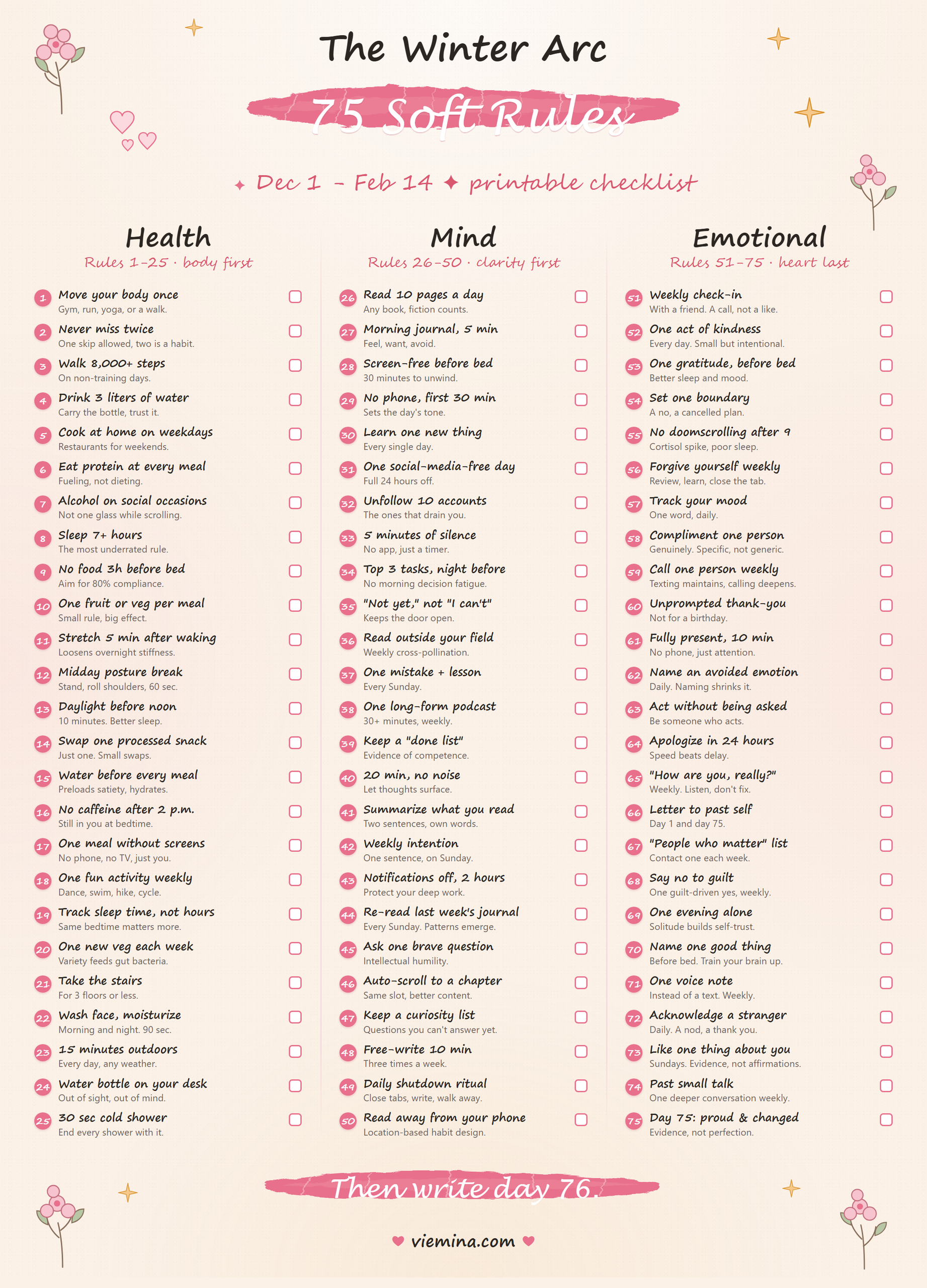
The Winter Arc 75 Soft Rules (Full Checklist)
Here is the extended version doing the rounds on Pinterest — the four original rules, plus the additions that most people keep because they make the arc feel like a life rather than a punishment. Copy it, screenshot it, print it; but read the “why” under each block first, because understanding the logic is what keeps you going on day 40.
🏃 Health Rules (1–25)
- Move your body once a day: gym, run, yoga, home workout, or a 30-minute walk all count. Consistency over intensity.
- Never miss twice: missed a day? The rule breaks the moment you miss the next one. This single rule separates finishers from quitters.
- Walk 8,000+ steps on non-training days: keeps your body in motion without requiring a workout.
- Drink 3 liters of water daily: carry the bottle; don’t trust memory.
- Cook at home on weekdays: restaurant food is allowed on weekends and social occasions.
- Eat protein at every meal: it’s the difference between dieting and fueling.
- Limit alcohol to social occasions only: not “one glass while scrolling.”
- Sleep 7+ hours: non-negotiable sleep is the most underrated discipline rule on this list.
- No eating 3 hours before bed: aim for 80% compliance; life happens.
- One fruit or vegetable every meal: small rule, huge compounding effect.
- Stretch for 5 minutes after waking: loosens overnight stiffness and signals your body that the day has started.
- Take a midday posture break: stand up, roll your shoulders, look at something farther than your screen. 60 seconds.
- Get 10 minutes of daylight before noon: natural light in the morning regulates your circadian rhythm, which improves sleep that night.
- Replace one processed snack with a whole-food option: not all snacks, just one. Sustainability lives in small swaps.
- Drink a glass of water before every meal: preloads satiety signals and ensures hydration even on busy days.
- Limit caffeine after 2 p.m: caffeine has a half-life of 5–6 hours. An afternoon coffee is still in your system at bedtime.
- Eat one meal without screens: no phone, no laptop, no TV. Just you and your food. Rebuilds mindful eating awareness.
- Do one physical activity you genuinely enjoy each week: dance, swim, hike, cycle. If movement is only duty, you’ll quit.
- Track your sleep time, not just your sleep hours: going to bed at the same time matters more than total hours for rhythm stability.
- Add one new vegetable to your rotation each week: dietary variety feeds gut bacteria diversity, which affects mood and energy.
- Take the stairs when it’s 3 floors or fewer: the smallest daily movement decisions compound over 75 days.
- Wash your face and moisturize every morning and evening: skincare is self-care made tangible; it takes 90 seconds.
- Spend 15 minutes outdoors every day, regardless of weather: fresh air and daylight are non-negotiable mood regulators in winter.
- Keep a water bottle visible on your desk: out of sight means out of mind. The bottle is your only reliable cue.
- End every shower with 30 seconds of cold water: optional but powerful. Cold exposure improves circulation, mood, and resilience tolerance over time. (ask your doctor before)
📖 Mind Rules (26–50)
- Read 10 pages a day: any book. Fiction counts. Audiobooks don’t (the point is deep single-task focus).
- Journal 5 minutes in the morning: three lines minimum: what you feel, what you want, what you’re avoiding.
- 30 minutes of screen-free time before bed: your brain needs a runway to sleep, not a hard landing.
- No phone for the first 30 minutes of your day: the first 30 minutes set the tone for the next 16 hours.
- Learn one new thing daily: a word, a concept, one page of a skill. 75 days = 75 new things.
- One social-media-free day per week: full 24 hours. The withdrawal is real on day one and gone by week three.
- Unfollow 10 accounts that make you feel worse: do this on day 1. It changes your entire feed, and your winter.
- Practice 5 minutes of silence or breathing daily: not meditation with an app. Just silence. A timer and nothing.
- Write tomorrow’s top 3 tasks tonight: planning ahead removes the morning decision fatigue that derails most days.
- Say “not yet” instead of “I can’t”: tiny language shift, real psychology: it keeps the door open without surrendering.
- Read one article outside your field each week: intellectual cross-pollination sparks creativity and breaks mental ruts.
- Write down one mistake and one lesson each Sunday: weekly review turns failures into data instead of identity.
- Listen to one long-form podcast episode per week: 30+ minutes of depth counters the attention fragmentation of short-form content.
- Keep a “done list” alongside your to-do list: seeing what you accomplished builds evidence of competence, which fuels motivation.
- Spend 20 minutes in a space with no background noise: no music, no podcast, no TV. Let your own thoughts surface.
- Write a two-sentence summary of what you read today: comprehension compounds when you articulate it in your own words.
- Define your weekly intention on Sunday evening: one sentence: what matters most this week. Everything else is secondary.
- Turn off notifications for 2 focused hours daily: protect your deepest work block from the attention economy.
- Re-read your morning journal entries from the previous week every Sunday: patterns emerge over days that are invisible in the moment.
- Ask one question you’re embarrassed to ask each week: intellectual humility accelerates learning and kills impostor syndrome.
- Replace one auto-scroll session with a book chapter: the slot is already in your day; you’re swapping the content, not adding time.
- Keep a “curiosity list” — questions you don’t have answers to yet: revisit it monthly. Some will become projects.
- Write for 10 minutes without stopping three times a week: free-writing clears mental clutter and surfaces ideas your conscious mind misses.
- Set a daily “shutdown ritual” — close tabs, write tomorrow’s first task, walk away: creates a clean boundary between work and rest.
- Read your book in a different physical spot than your phone: location-based habit design reduces the pull to check your screen mid-page.
🧠 Emotional & Relationship Rules (51–75)
- One genuine check-in per week with a friend or family member: a call, not a like.
- One act of kindness per day: doesn’t have to be big. Has to be intentional (You can read this article about How To Develop an Endearing Personality: 18 Steps to Shine)
- Write down one thing you’re grateful for before bed: gratitude journaling has measurable effects on sleep quality and mood.
- Set one boundary per week: a “no,” a cancelled plan, a difficult conversation. (If it turns into a guilt trip, read how to respond to guilt tripping first.)
- No doomscrolling news after 9 p.m: evening news consumption spikes cortisol and degrades sleep quality.
- Forgive yourself weekly: every Sunday, review your slip-ups, learn one lesson, close the tab. Guilt is not fuel; it’s friction.
- Track your mood daily in one word: awareness comes before change. You can’t fix what you can’t name.
- Compliment one person genuinely each day: specific, not generic. “Your analysis in that meeting was sharp” beats “you’re great.”
- Call (not text) one person you’ve been meaning to reach out to; weekly. Texting maintains; calling deepens.
- Write a thank-you message to someone who helped you recently: not a birthday, not a holiday. Unprompted gratitude lands hardest.
- Spend 10 minutes fully present with another person: no phone, no background task. Just attention. It’s rarer than you think.
- Name one emotion you’re avoiding each day: avoidance feeds on silence. Naming it shrinks it.
- Do something for someone without being asked: notice a need and fill it. This builds the identity of someone who acts, not someone who waits.
- Apologize within 24 hours when you know you were wrong: speed of apology is a relationship superpower. Delay breeds resentment.
- Ask “how are you, really?” once a week: and listen to the answer without fixing it. Most people just want to be heard.
- Write a letter to your past self on day 1 and day 75: you’ll be surprised how much distance 75 days creates.
- Keep a “people who matter” list and contact one person on it weekly: relationships decay without maintenance. This is the maintenance.
- Practice saying “no” to one thing each week that you’d normally say “yes” to out of guilt: boundary muscle grows through reps.
- Spend one evening per week completely alone: not working, not scrolling. Alone with your thoughts, a book, or a walk. Solitude builds self-trust.
- Notice and name one positive thing about your day before bed: trains your brain to scan for the good, not just the threats.
- Send one voice note to a friend instead of texting: tone carries warmth that text strips out. One per week.
- Acknowledge one stranger daily: eye contact, a nod, a “thank you.” Micro-connections improve baseline mood measurably.
- Write down one thing you like about yourself each Sunday: self-esteem isn’t built by affirmations; it’s built by evidence you collect.
- Let one conversation go deeper than small talk each week: ask a follow-up question that makes the other person pause before answering.
- On day 75, write down what you’re proud of and what you’d change: the arc isn’t about perfection. It’s about evidence that you can keep a promise to yourself when no one is watching. That evidence is the real reward.
(If the “be kind to yourself” rules are the ones you always skip, start here: 62 easy self-care ideas for busy people — pick two, not twelve.)
Save the checklist for December 1st 👇
Why the Winter Arc challenge Works When New Year’s Resolutions Don’t
1. You start before the crowds. Motivation is cheap in January and expensive everywhere else. Starting on December 1st means you’ve already built a 30-day habit before January 1st arrives; when everyone else is merely “deciding.”
2. The difficulty is the trainer. Willpower built in dark, cold, tired conditions transfers everywhere. A habit that survives February survives anything.
3. Soft rules beat hard rules on completion. Research on habit formation (notably the work of Dr. Phillippa Lally at University College London) found that new habits take on average 66 days to become automatic; and that missing a single day does not harm long-term progress. That’s almost exactly the 75-day arc, and it’s why “never miss twice” is scientifically sounder than “never miss at all.”
4. There’s a finish line with a date. Challenges with fixed endpoints get dramatically higher completion rates than vague goals like “get healthier in 2027.”
The Two Weeks Where 90% Quit (Days 8–21)
Every challenge has a graveyard, and for the Winter Arc it’s the second and third week. The novelty is gone, results are invisible, and December’s chaos (holidays, travel, family) attacks your streak.
Here’s the survival protocol:
Day 8–10: The Blank Wall. You feel nothing. That’s normal; dopamine from novelty is gone and the results haven’t arrived. Rule: you don’t need motivation to do a 10-page read. You need 10 pages. Shrink the action until it’s impossible to refuse; the same mechanism that beats chronic procrastination, just applied to a challenge instead of a to-do list.
Day 14: The Identity Test. Ask: “What would the person I’m becoming do today?” — then do that. This trick (identity-based habits, popularized by James Clear in Atomic Habits) works because it removes the negotiation stage entirely. If you tend to hold yourself to impossible standards, pair this rule with our guide to perfectionism and procrastination — 75 Soft punishes perfectionists hardest in week two.
Day 18–21: The First Visible Results. Sleep improves, then energy, then clothes fit differently, then someone comments. Most people peek right before the window opens. If you can see days 1–21 through, your probability of finishing gets radically higher.
One warning for high achievers: if you recognise yourself as someone who looks like they’re thriving while secretly running on empty, read our breakdown of 12 signs of high-functioning anxiety before you add a single extra rule to this list. A winter arc should add energy to your life, not hide the fact that you’re exhausted.
Winter Arc vs. 75 Hard vs. 75 Soft: Which One Should You Pick?
| Winter Arc | 75 Hard | 75 Soft | |
| Duration | Oct 1 or Dec 1 → Feb 14 | 75 days | 75 days |
| Workouts | 1×/day (active recovery counts) | 2×45 min, one outdoors | 1×/day, flexible |
| Diet | 80/20, home-cooked on weekdays | No deviations, diet of your choice | Eat well, social flexibility |
| Reading | 10 pages/day | 10 pages/day (nonfiction) | 10 pages/day (any book) |
| If you slip | Soft variant: never miss twice | Restart from Day 1 | Choose: Day 1 restart or never miss twice |
| Best for | Beginners & busy people | Already highly disciplined | 90% of people |
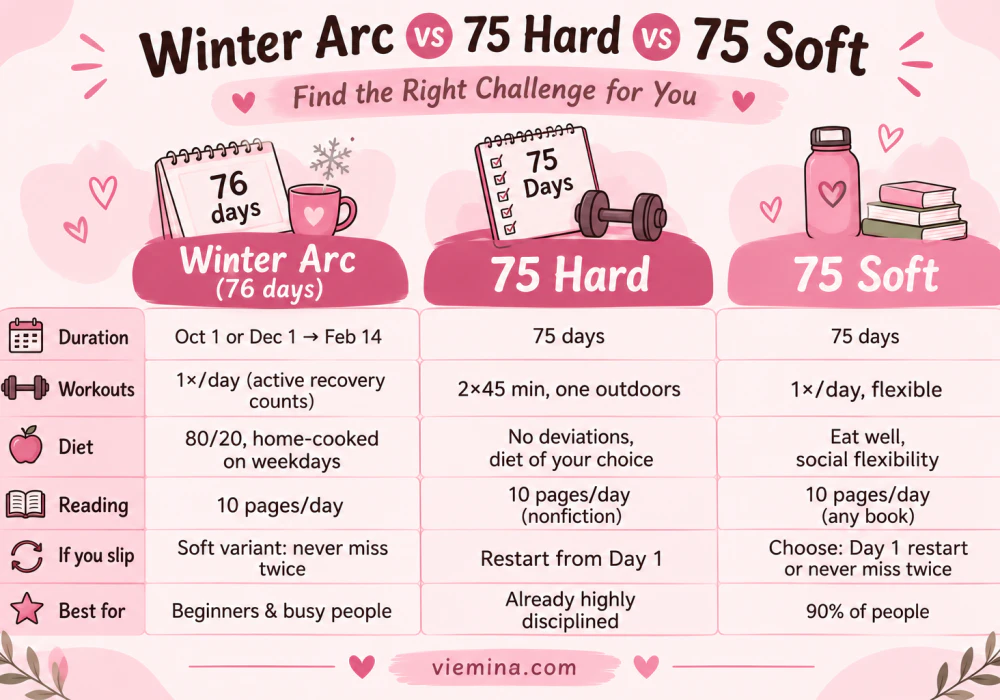
Honest answer: if you’ve never finished a 30-day challenge, do 75 Soft. 75 Hard breaks people who stack it on top of exams, jobs, and kids; and a broken streak in December is how the whole winter gets lost.
How to Start (December 1st Prep Checklist)
The people who succeed don’t start on December 1st — they prepare in November:
- [ ] Print or save your rules (one page, visible: fridge, mirror, desk)
- [ ] Buy the water bottle you’ll actually carry (1L, marked, ugly is fine)
- [ ] Pick your book and put it on your pillow tonight
- [ ] Choose your training slot — same time every day; put it in your calendar like a meeting with your future self
- [ ] Do the unfollow purge (rule #17) before day 1
- [ ] Tell one person your start date (accountability without announcement)
- [ ] Decide your “never miss twice” clause in writing
- [ ] Remove one friction: gym clothes laid out, phone charges outside the bedroom, journal on the nightstand
Frequently Asked Questions About Winter Arc
Is 75 Soft the same as the Winter Arc?
No. The Winter Arc is the season (roughly Oct–Feb); 75 Soft is the most popular set of rules to run during it. You can also run 75 Hard or your own custom rules inside a winter arc.
When should I start the Winter Arc?
Two main starts: October 1st (the full arc, ending around December 15th) and December 1st (the most popular on Pinterest, ending February 14th — Valentine’s Day, when everyone notices).
Can I do 75 Soft without a gym?
Yes. Rule 1 counts walking, home workouts, yoga, and running. Equipment is optional; consistency isn’t.
What if I miss a day?
Strict version: restart from day 1. Soft version (recommended): the never miss twice rule. One missed day doesn’t hurt habit formation — research on habit automaticity confirms a single lapse has no measurable long-term effect.
Can I drink coffee on 75 Soft?
Yes. There are no caffeine rules. Just do the water.
Is the Winter Arc healthy?
The 75 Soft variant, yes — it’s flexibility plus consistency. If you have a medical condition, adapt the rules with your doctor. The challenge should add energy to your life, not subtract it.
Final Word: The Arc Is Private
Nobody claps when you choose the water bottle. Nobody notices day 33. That’s exactly the point; a winter arc is built in the dark on purpose.
By February 14th, you won’t need a before/after photo. You’ll have something better: the quiet evidence that you keep promises to yourself when no one is watching.
Start December 1st. Miss nothing twice. See you on the other side of winter.