

If you’ve ever asked yourself, “Why do I procrastinate even when I want to work?” you’re not dealing with laziness; you’re dealing with something much more specific. You sit down. The task is open in front of you. You want to do it. And yet, nothing happens.
You open a new tab. You check your phone. You reorganize something that didn’t need reorganizing. You make a coffee you don’t need, scroll for five minutes that turn into thirty, and somewhere underneath all of it, there’s this quiet, exhausting voice asking: what is wrong with me?
Here’s what that voice gets wrong: nothing is wrong with you.
If procrastination were just laziness, it wouldn’t hurt this much. Lazy people don’t sit there genuinely wanting to work, watching themselves not do it, accumulating guilt with every wasted hour. That specific suffering, wanting to act and being unable to, is something else entirely.
It’s also far more common than most productivity content admits.
The standard advice says: make a to-do list, set a timer, just start. Sometimes that works. But if you’ve tried all of it and still find yourself frozen, it’s because those tools treat the symptom while leaving the root cause untouched.
This article is about the root cause.
Why your brain resists tasks even when your intentions are completely genuine. Why motivation is not actually the problem. And what you can do today, and in a way that actually holds over time.
Why Do I Procrastinate Even When I Want to Work?(It’s Not Laziness)
The question of why do I procrastinate even when I want to work comes up so often because the answer isn’t obvious. It’s not about wanting it badly enough; it’s about what your brain does with the emotion the task triggers.
Procrastination is not about not wanting to do the task. It’s about your brain trying to avoid the emotions that task triggers, fear of failure, anxiety about doing it wrong, overwhelm at not knowing where to start, or a vague dread of being judged.
Avoidance provides immediate emotional relief. Your brain learns to repeat whatever brings relief.
The desire to work and the inability to start can both be completely real at the same time. And neither one makes you lazy.
Related: Embracing Imperfection: 9 Top Steps to Self-Acceptance
Related: 8 Japanese Techniques To Overcome Laziness
Procrastination Is Not a Motivation Problem. It’s an Emotion Problem.
Most people assume they can’t start because they don’t want it enough.
So they try to manufacture motivation, watch an inspiring video, read a quote, or set a bigger goal. And it works for about an hour before they’re back exactly where they started.
That’s because motivation was never the problem.
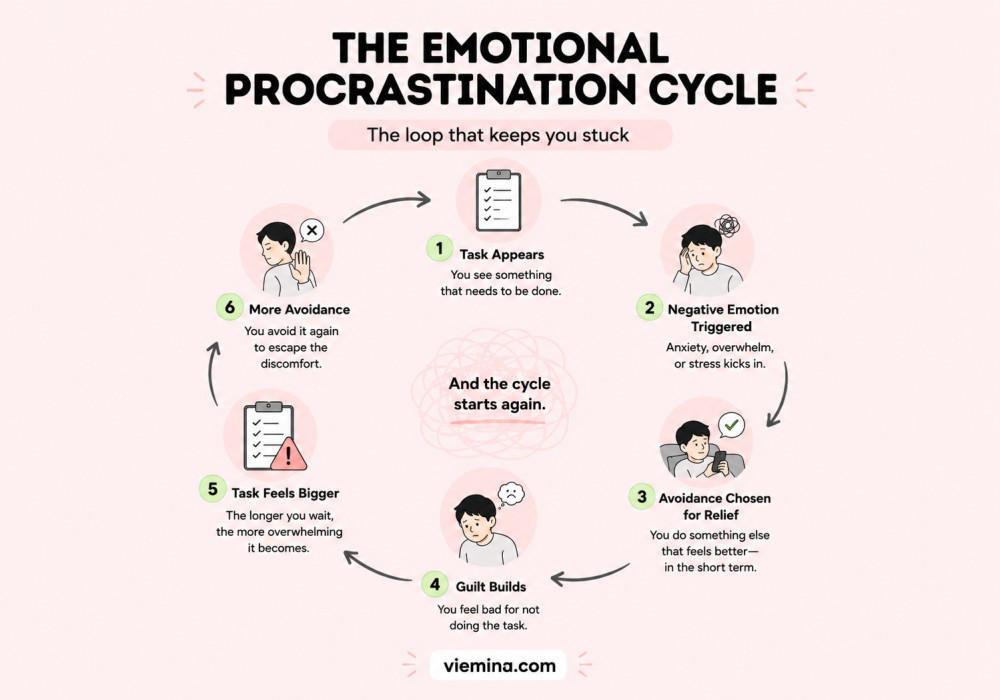
Research from Dr. Fuschia Sirois at Durham University frames procrastination as a failure of emotional regulation, not time management or drive. When a task triggers a negative emotional state, anxiety, self-doubt, boredom, or confusion, your brain’s instinct is to escape that state as quickly as possible.
Avoidance is that escape. It works instantly.
The discomfort lifts the moment you put the task down and open Instagram instead. Your brain registers relief and files avoidance away as the solution to this feeling.
Your brain is not trying to ruin your life. It’s trying to protect you from discomfort.
The problem is that the task is still there. Now with an extra layer of guilt on top. Which makes the emotional weight even heavier next time you try to face it.
This is the cycle. Not a character flaw, a learned pattern your brain has quietly optimized because it’s very good at doing things that make you feel better right now, even at the cost of what you actually want.
Understanding this doesn’t instantly solve it. But it means you finally stop blaming the wrong thing, and that’s where real change begins.
Signs Your Procrastination Is Actually Emotional Avoidance
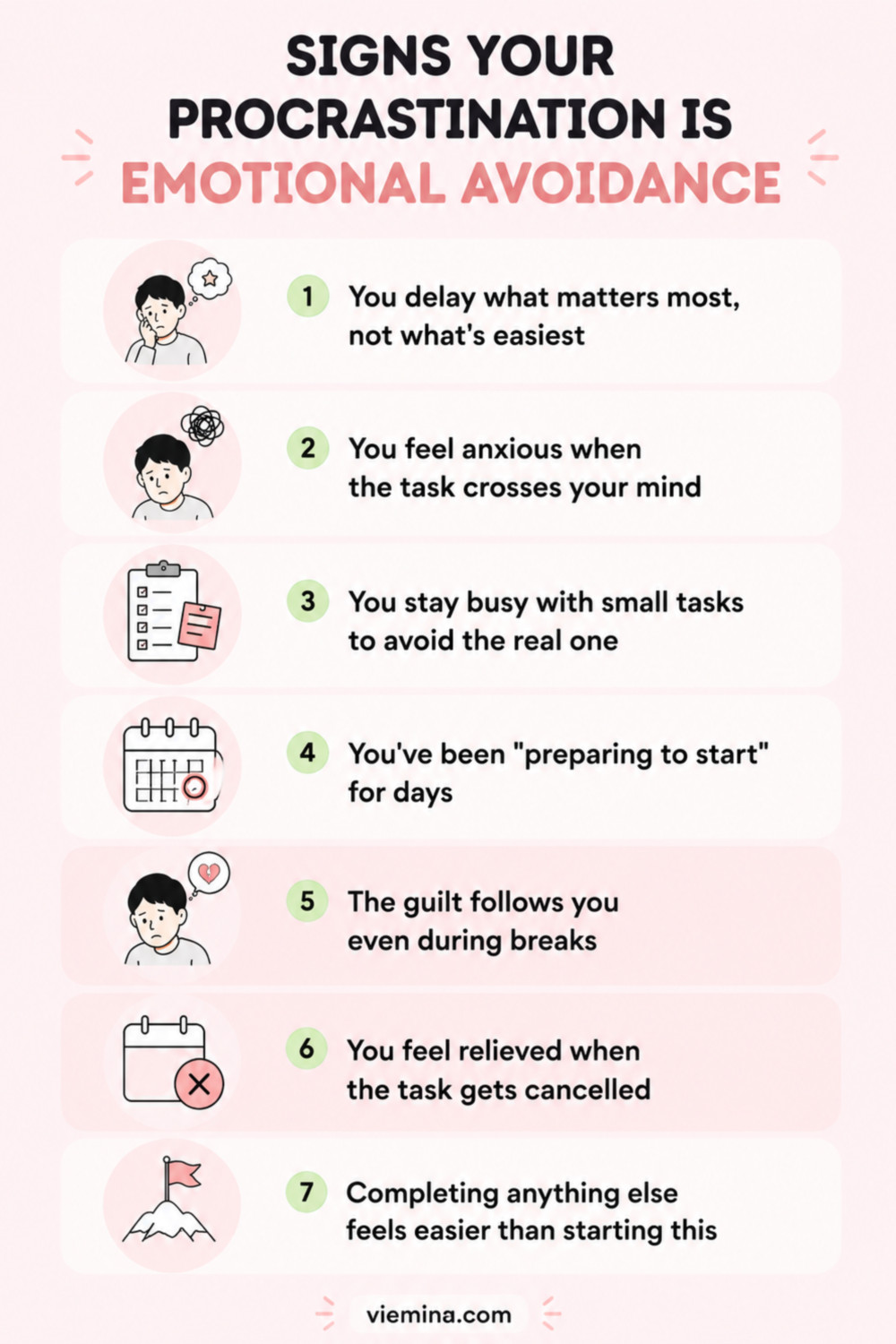
Not all procrastination looks the same. This specific kind, where you want to work but can’t, usually has emotional roots rather than practical ones.
Here are the signs it’s emotional avoidance and not just poor planning:
- You delay the tasks that matter most, not the ones you don’t care about
- You feel anxious or irritable when the avoided task crosses your mind.
- You stay “busy” with low-priority tasks to feel productive without facing the real ones.
- You’ve been “getting ready to start” for days: researching, planning, organizing, without actually beginning.
- The guilt follows you even when you’re doing something enjoyable.
- Completing other tasks feels easier, but the one task never seems to get touched.
- You feel relieved when something cancels the task; then, immediately guilty about the relief.
If that list feels uncomfortably familiar, your procrastination has an emotional driver underneath it.
This matters because behavioral fixes, such as timers, to-do lists, and habit apps, won’t touch the emotional root. You need a different approach alongside them.
Fear of Failure Makes Starting Feel Dangerous
Here’s the paradox most people never say out loud:
The tasks you procrastinate on most are usually the ones you care about most.
The job application that keeps getting postponed. The business idea you’ve been “planning” for two years. The creative project that lives in your head rent-free. These aren’t things you’re indifferent to. These are things that matter.
And that’s exactly why they’re so hard to start.
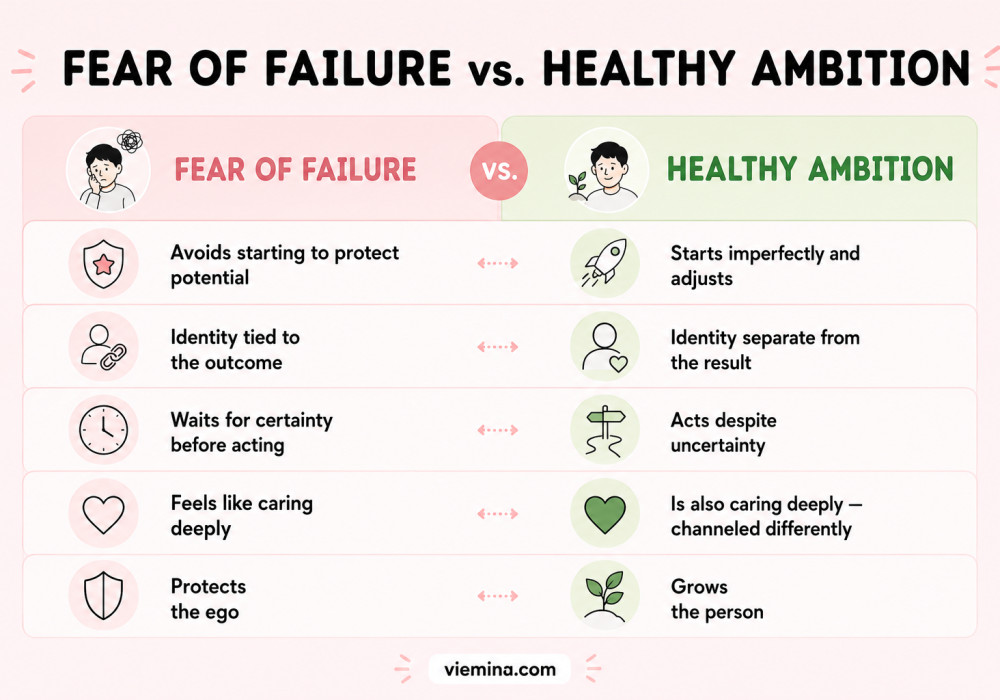
When something matters, doing it badly feels like a real threat; not just to the task, but to your sense of self. A student who never submits the essay can always tell themselves they would have done well if they’d tried. A freelancer who never pitches to the client keeps the possibility of success alive.
Avoidance feels safer than failure.
If you never fully start, you never fully fail. The potential stays intact. The ego stays protected.
This is why ambitious, high-performing people often procrastinate more than average. The higher your standards, the more threatening the gap between those standards and an imperfect first attempt feels.
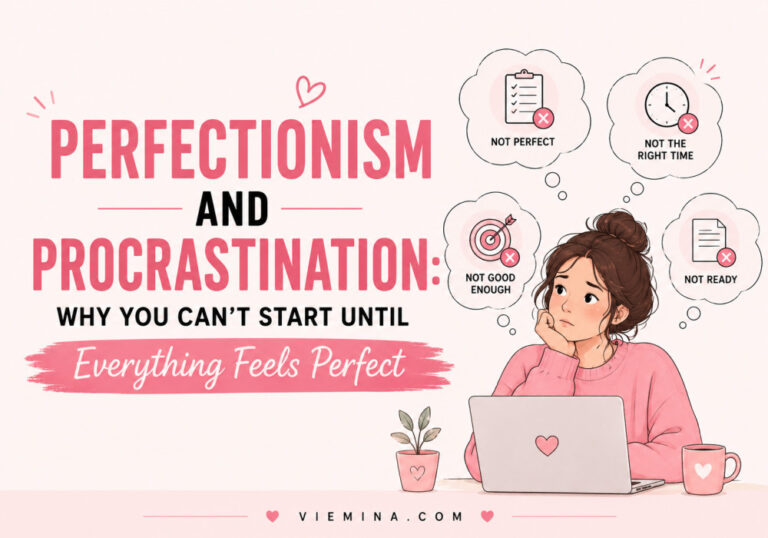
Perfectionism and procrastination are almost always the same fear wearing different clothes.
The fix isn’t to care less. It’s too slow to decouple your identity from the outcome. The task is a task. It is not a verdict on your worth.
Related: Perfectionism and Procrastination: The Hidden Link
Related: Why Do I Feel Like a Failure? 20 Causes That Might Shock You
Overthinking Creates Paralysis Before You Even Begin
Sometimes the barrier isn’t fear of a bad outcome. It’s the cognitive weight of not knowing how to begin.
A remote worker stares at a project brief for twenty minutes, thinking: Where do I start? What structure should I use? What if I pick the wrong approach? By the time they’ve thought it through, they’re more confused than when they started, and the task feels bigger than before.
A student sits with an essay prompt, paralyzed by which angle to take. An entrepreneur wants to launch something, but keeps researching because the plan never feels complete enough. A creator has the idea, but can’t begin until every element is decided.
This is overthinking as a procrastination trigger.
It’s especially common in people who are thorough, detail-oriented, and conscientious, the same qualities that make you good at what you do, can make starting feel impossible when there’s ambiguity involved.
Decision fatigue compounds it. If you’ve been making decisions all day, at work, in conversations, about small logistics, your capacity to make one more decision (how to approach this task) is genuinely depleted. The brain defaults to the path of least resistance.
That path is usually not working.
You don’t need to think your way to a perfect plan. You need one concrete action you can take in the next five minutes.
Related: How to Stop Overthinking: 12 Ways That Actually Work
Related: 12 Signs You’re Overanalyzing — And How to Finally Stop
Your Brain Is Chasing Comfort, and Your Phone Is Winning
Here’s something worth understanding before you blame yourself for being distracted:
Your phone was built by teams of engineers whose entire job was to make it more compelling than whatever else you were going to do.
Variable rewards. Infinite scroll. Notification timing. These aren’t accidents; they’re deliberate psychological mechanisms designed to capture and hold attention. You are not fighting weak willpower. You are fighting a product optimized to win this exact battle.
You’re not weak for losing. The competition is unfair.
The core problem is dopamine. Difficult work delivers a slow, delayed reward; the satisfaction of finishing something, which might arrive hours or days later. Your phone delivers a small dopamine hit every few seconds. Given the choice between slow and delayed versus fast and immediate, your brain will choose fast almost every time, unless you remove the option.
Think about a writer sitting down to work with their phone face-up on the desk. Every buzz is a small pull away from a task that demands sustained focus. Or a student studying with social media open in another tab, checking it “just once” every few minutes. The work takes three times as long and feels three times as draining.
This is why the environment matters more than willpower.
Putting your phone in another room isn’t a productivity hack. It’s removing the competition entirely.
You can’t resist what isn’t there. Stop trying to. Remove it instead.
The same logic extends to your browser. Every unnecessary tab open is an invitation to drift. A cluttered desk signals chaos to your brain. The physical context you work in either supports focus or actively works against it.
Why Motivation Isn’t What You Think It Is
The most damaging myth in productivity culture:
Motivated people just feel like working.
Somewhere out there, the story goes, there are people who wake up energized, sit down eagerly, and move through their tasks with natural enthusiasm. If you’re not experiencing that, something must be missing in you.
That’s not how motivation works for anyone.
Motivation is not a personality trait. It’s a neurochemical state that shifts based on sleep, stress, hormones, recent behavior, and environment. Waiting for it to arrive before you act is like waiting for the weather to be perfect before leaving the house.
It might happen. It probably won’t. And either way, you’re still sitting inside.
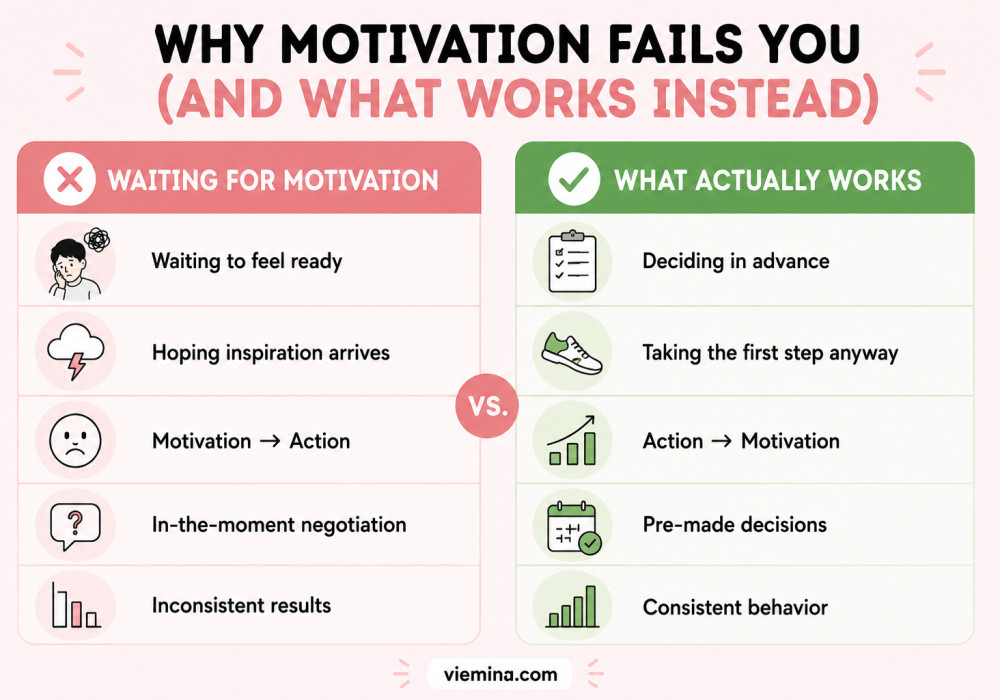
What actually works is far less glamorous: a decision made in advance.
If you’ve already decided that a specific task happens at 9am on Tuesday, you don’t need to feel motivated on Tuesday morning. The decision was already made. You just follow it.
This is what discipline actually is: not a personality quality you either have or lack, but a system of pre-made decisions that removes in-the-moment negotiation. Because in-the-moment negotiation almost always loses to short-term comfort.
The other critical piece: motivation follows action. It does not precede it.
The engagement, the momentum, the sense of interest in your work; these typically arrive after you’ve started, not before. Your brain needs evidence of progress to get on board.
An entrepreneur who waits to “feel ready” to send the pitch never sends it. The one who sends it at 9am every Wednesday, regardless of how they feel; that’s who eventually gets the result.
Give your brain evidence by starting, even badly, even briefly. The feeling usually follows within minutes.
Related: What Is Toxic Productivity? 13 Signs You’ve Crossed the Line
How to Finally Start When Your Brain Won’t Cooperate
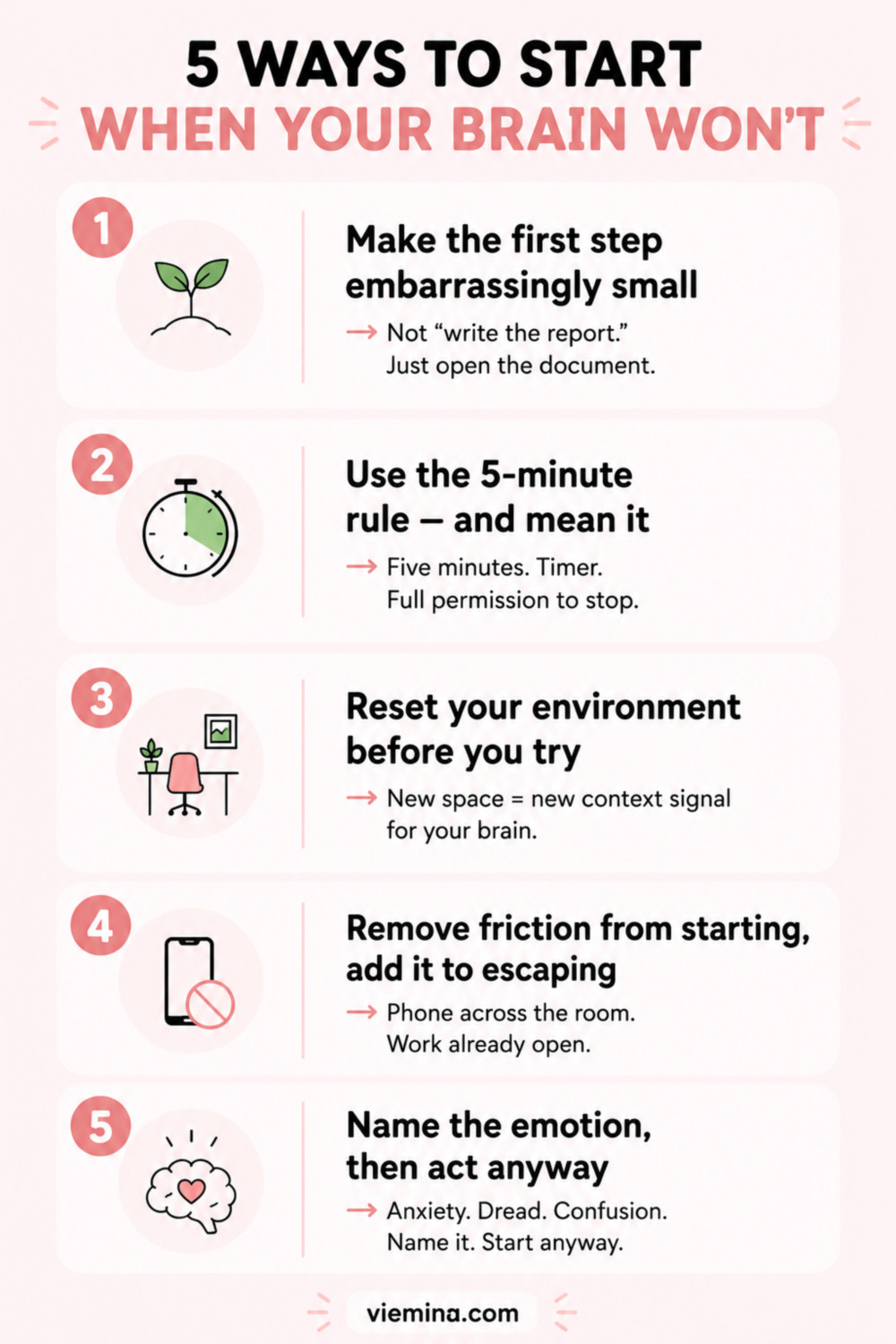
These aren’t generic tips. Each one directly targets a specific psychological barrier covered above.
1-Make the First Step Embarrassingly Small
The resistance is never to the whole task. It’s to the enormity of it as you’re imagining it.
The solution: make the entry point so small that resistance has nothing to grab onto.
Not “write the report”; instead, open the document and type one sentence, any sentence.
Not “go to the gym”; instead, put on your gym shoes and stand up.
Not “apply for the job”; instead, open the company website.
The micro-step’s goal isn’t to accomplish anything significant. It’s to transition from not doing to doing. That transition is where all the friction lives. Once you’re in motion, continuing is far easier than starting was.
Related: How to Overcome Perfectionism: What It Is and How to Stop It
2-Use the 5-Minute Rule — But Mean It
Set a timer for five minutes. Commit only to working until it goes off. When it does, you can stop, completely, with zero guilt.
This works because your brain’s resistance is largely a response to the perceived duration and difficulty of the whole thing. Five minutes is non-threatening. It doesn’t count as the full risk.
Most of the time, by the time the timer goes off, you’re already in it.
The key: genuinely give yourself permission to stop at five minutes. If it feels like a trick, your brain won’t cooperate. If it’s a real offer, the resistance softens enough to begin.
3-Reset Your Environment Before You Try to Work
If you’ve been lying on the couch scrolling for an hour and then try to “switch to work mode” in the same spot, you’re fighting your own context cues.
Your brain has associated that space with rest and passive consumption. Trying to focus there requires overriding that association with willpower, which is expensive and unreliable.
Move instead. Go to a different room, a coffee shop, a library. If that’s not possible: clear your desk completely, close every browser tab you don’t need, and put your phone physically out of reach. Give your brain a new context signal that says: something different is happening now.
It sounds almost too simple. It works more than people expect.
4-Add Friction to Distractions, Remove Friction From Starting
Make it easier to begin than to escape.
Keep your work open and visible before you sit down. Have your materials ready. Know exactly what the first action is before you start, not the whole plan, just the first move.
Then add friction to your usual escapes. Log out of social media so it requires a login to re-enter. Enable an app blocker during your focus window. Put the phone across the room instead of within reach.
The goal isn’t punishment. It’s creating a small pause between the urge to avoid and the action of avoiding, long enough for the rational part of your brain to intervene.
5-Name the Feeling Before You Fight It
When you catch yourself avoiding, stop and identify the specific emotion underneath.
Is it anxiety? Boredom? Confusion? Low-grade dread? Resentment toward the task?
Just naming it matters. Neuroscientist Matthew Lieberman’s research on affect labeling found that putting a word to an emotional state measurably reduces activity in the brain’s threat response. You’re not journaling for the sake of it; you’re literally changing how your nervous system processes the feeling.
Once you’ve named it, you can choose to act anyway. Not because the discomfort is gone, but because you’ve stopped pretending it isn’t there.
Frequently Asked Questions
-
Why do I procrastinate even when I genuinely care about the task?
Because caring raises the stakes, and higher stakes mean more risk. When a task is tied to your identity, your goals, or someone’s opinion that matters to you, the fear of doing it badly becomes a genuine psychological threat. A student who cares deeply about their dissertation will often procrastinate more than one who doesn’t care much. Avoidance protects the ego by keeping the potential intact. The deeper you care, the stronger the pull to avoid.
-
Is procrastination a coping mechanism?
Yes, and understanding this changes everything. Procrastination developed as a way to cope with emotional discomfort. When a task triggers anxiety, self-doubt, or overwhelm, avoidance provides instant relief. The brain reinforces this pattern because it works in the short term. This is why willpower alone rarely fixes chronic procrastination: you’re fighting a coping mechanism, not a bad habit.
-
Can overthinking cause procrastination?
Absolutely. Overthinking creates decision paralysis; you can’t find the “right” starting point, so you don’t start at all. It’s especially common in perfectionists and anxious thinkers who need certainty before acting. The loop looks like this: the task feels ambiguous, your mind searches for the perfect approach, the search never ends, the task never begins. The fix is shrinking the decision, not expanding the thinking.
-
Why do smart people procrastinate more?
Often, because they can imagine more ways things could go wrong. Higher cognitive ability means a more vivid mental simulation of failure, criticism, and imperfect outcomes. Smart people are also more likely to be perfectionists, and perfectionism, as covered above, is one of the strongest drivers of avoidance. Intelligence doesn’t protect you from procrastination. In some cases, it amplifies it.
-
Why do I procrastinate more when I’m stressed?
Because stress depletes the prefrontal cortex, the part of your brain responsible for planning, decision-making, and impulse control. When you’re stressed, your brain is already running on limited resources. Starting a difficult task requires exactly the kind of executive function that stress impairs. This is why procrastination tends to spiral during busy or emotionally difficult periods: the times when you most need to work are the times your brain is least equipped to start.
-
How do I stop procrastinating when I feel completely overwhelmed?
Start smaller than feels reasonable. When overwhelm is the driver, the task isn’t too hard; it’s too big and too vague. Break it into the smallest possible unit: not “do the project” but “open the file.” Not “clean the apartment” but “put five things away.” Overwhelm shrinks when the task shrinks.
-
How do I stop procrastinating on something I’ve avoided for a long time?
The longer you’ve avoided something, the more psychologically loaded it becomes. Every avoidance adds another layer of guilt and resistance. The most effective approach: shrink the task to its absolute smallest form, give yourself explicit permission to do it badly, and use the 5-minute rule. The goal of the first session isn’t to make progress; it’s to break the avoidance pattern. Once you’ve touched the task once, it becomes dramatically easier to touch it again.
Conclusion
If you’ve been asking yourself why you keep procrastinating even when you want to work, you now have the real answer.
It was never about laziness. It was never about not caring enough. It was about a brain doing exactly what brains do, seeking immediate comfort, protecting you from perceived risk, and resisting the uncertain.
That’s not a flaw. It’s a starting point.
The path forward isn’t about forcing harder or shaming yourself into action. It’s about working with your brain’s actual wiring instead of against it. Smaller entry points. Pre-made decisions. Environments designed for focus. Naming the emotion rather than escaping it.
None of this produces a perfect system overnight. But every time you start anyway, even imperfectly, even for five minutes, even when the resistance is real, you’re teaching your brain something new. That discomfort doesn’t have to win. That beginning is survivable.
That’s how the pattern changes. Not all at once. One small start at a time.
Want the full strategy for beating procrastination long-term? Read the complete guide: How to Stop Procrastination (Even When You Feel Unmotivated)






Great article
thanks
Thank you so much for this beautiful comment!