
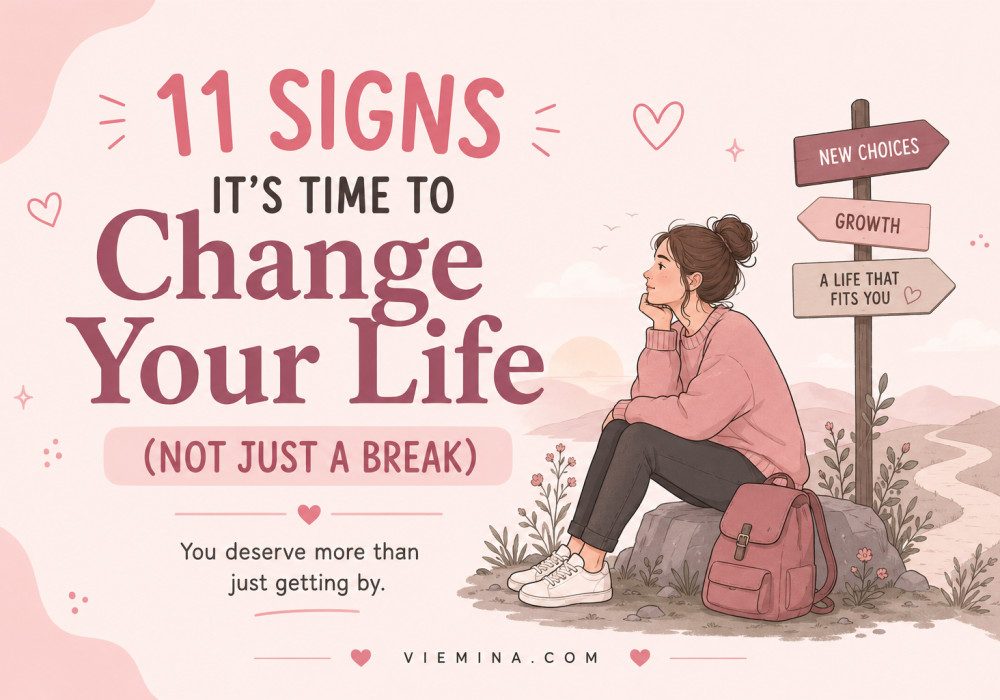
The signs it’s time to change your life rarely arrive as one dramatic moment. For me, it was quieter and slower than that.
It was noticing how many days ended with nothing to point to, one after another, until that became the pattern instead of the exception. It was catching up with friends I’d studied with years ago and watching them move forward; new roles, new milestones, visible momentum; while I was still standing in roughly the same place I’d been standing in for a long time. On paper, nothing had gone wrong. But somewhere in all those days quietly finishing empty-handed, I realized “nothing’s wrong” wasn’t the same as “this is working.”
You’re not lazy, and you’re not ungrateful for recognizing that. That’s usually the first thing worth saying, because most people arrive at an article like this already half-convinced they’re making too big a deal out of nothing.
Maybe your life looks fine from the outside. Maybe it even is fine, by most measures. And yet there’s a low, persistent hum underneath it; boredom that a new hobby doesn’t fix, a Sunday-night dread that starts earlier every week, a sense that you’re going through motions that used to mean something.
The hard part isn’t noticing that something feels off. It’s figuring out whether that feeling is a real signal telling you something needs to change, or a temporary weather pattern that will pass once this stressful month, this hard project, or this rough patch is over. Confusing the two in either direction causes real problems: overhauling your life during a passing slump, or staying in something genuinely wrong because you’ve convinced yourself it’s “just a phase.”
This article won’t tell you to blow up your life. It’s here to help you tell the difference, recognize the signs that actually matter, and figure out what to do once you do.
Rough Patch or Real Signal? How to Tell the Difference
Before the list of signs, this distinction matters more than any single item on it.
| Temporary Rough Patch | Real Signal | |
| Duration | Days to a few weeks, tied to a specific event | Weeks to months, with no clear single trigger |
| Responds to rest or a break | Usually lifts noticeably after time off or the stressful event passes | Barely shifts, or returns quickly once the break ends |
| Tied to one area of life | Often; a hard project, a specific conflict, a busy season | Tends to spread; work, relationships, and how you feel about yourself all start to feel affected |
| What it feels like underneath | Tired, but still recognizably yourself | A quiet sense that you’re avoiding something, or that you’ve drifted from who you meant to be |
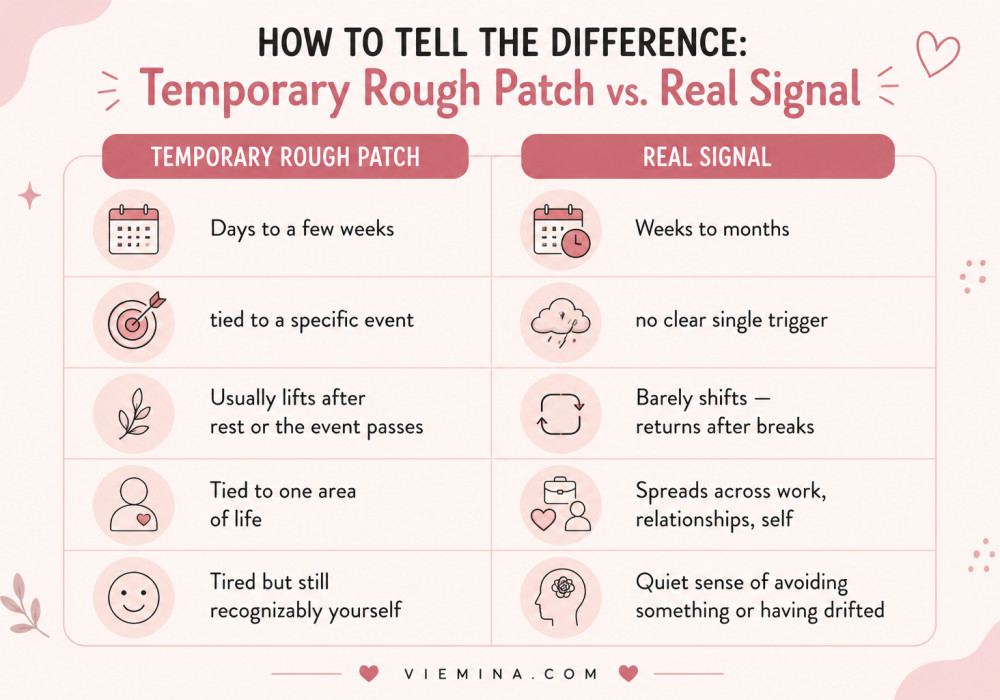
Neither column is “worse” than the other, and you don’t need a perfect score in the Real Signal column to take your feelings seriously. This table is a starting compass, not a verdict; the goal is just to slow down before assuming either “I’m fine, I’m just tired” or “everything needs to change” is automatically true.
Coming back to this table after reading the full list of signs is the most reliable way to know whether what you’re experiencing fits the signs it’s time to change your life pattern; or whether rest and time are the more honest answer.”
Could This Be Depression Instead?
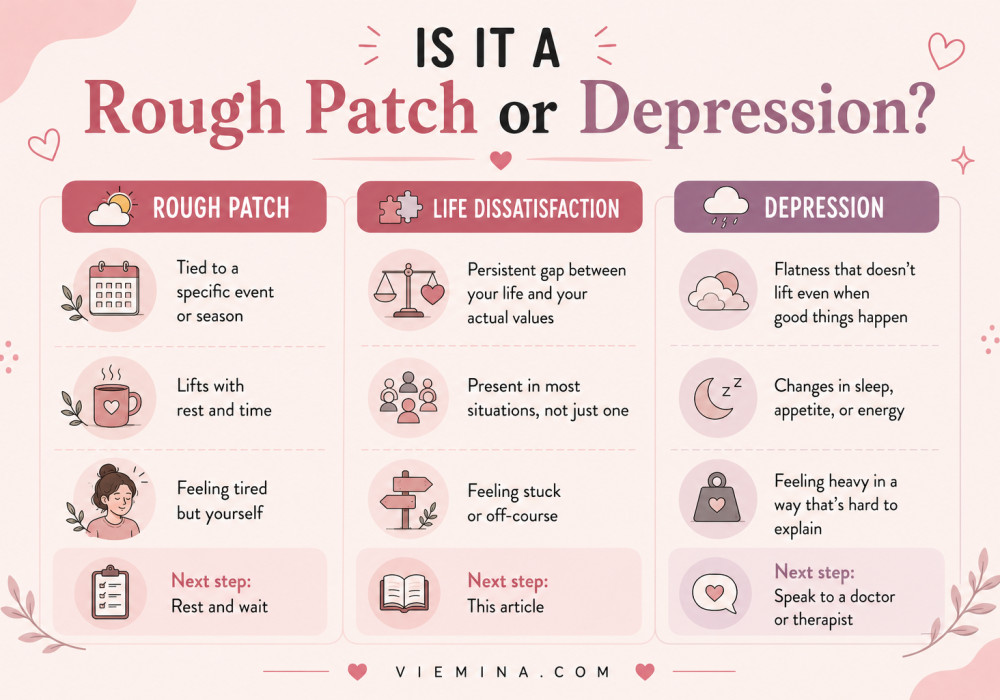
This is worth naming directly, because a lot of “signs it’s time to change your life” content skips right past it: several of the signs below- persistent low mood, loss of interest in things you used to enjoy, fatigue, feeling stuck- overlap significantly with symptoms of depression.
The distinction isn’t always obvious from the inside, and this article can’t make that call for you. A few things worth noticing: depression often comes with a flatness that doesn’t lift even when good things happen, changes in sleep or appetite, and a sense of heaviness that feels different from simple dissatisfaction with your circumstances. If that sounds more like what you’re experiencing than “I’m bored with my routine” or “this job isn’t right for me,” it’s worth talking to a doctor or therapist before assuming the answer is a life overhaul. Treating a mental health condition as a motivation problem tends to leave people more discouraged, not less.
Both things can also be true at once. It’s entirely possible to be dealing with depression and to be in a life situation that genuinely isn’t working. Getting support for one doesn’t mean ignoring the other.
If you’re unsure, the National Institute of Mental Health has a clear, accurate overview of what depression actually looks like at (What is depression), a useful reference before drawing any conclusion from this article alone.
The 11 Signs t’s Time to Change Your Life: Grouped
The following signs it’s time to change your life are grouped into four categories; not because every category applies equally, but because seeing which cluster fits your situation most helps you understand what kind of change is actually needed.
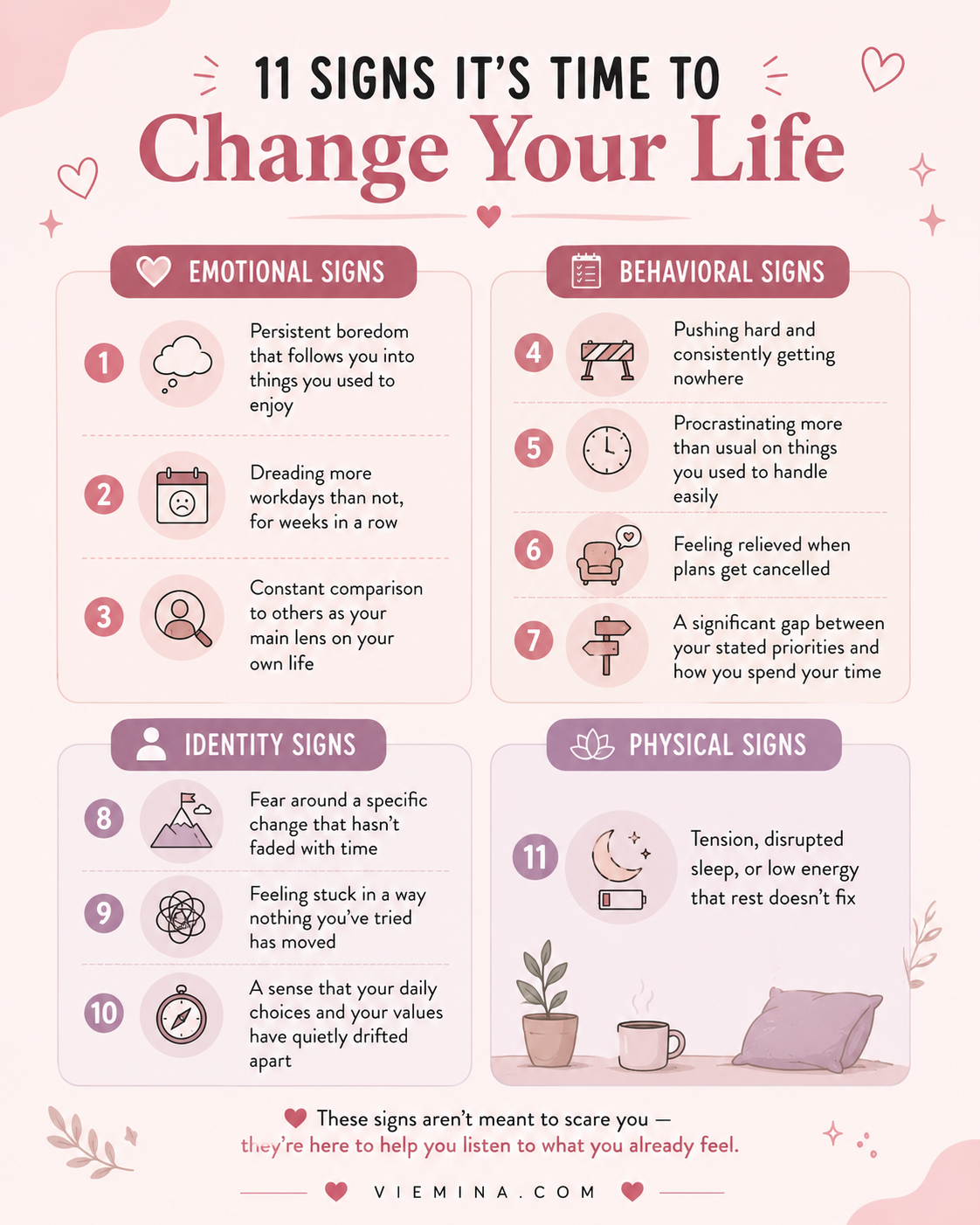
Emotional Signs:
1. Persistent boredom
Not the kind that passes with a new show or a weekend trip, but a low-grade flatness that follows you into things that used to interest you. This usually means your routine has stopped requiring enough of your attention or curiosity, not that something is wrong with you for feeling it.
2. Dreading most workdays
Occasional Sunday-night dread is close to universal. Dreading more days than not, for weeks in a row, is different. It’s worth identifying specifically what you’re dreading: the work itself, a particular person, the commute, the pace; rather than assuming it automatically means “quit.”
3. Constantly comparing your life to others’
Comparison in small doses is a normal way humans figure out where they stand. It becomes a signal when it stops being occasional and starts being the main lens you see your own life through; a sign that something about your current direction doesn’t feel like enough on its own terms.
Behavioral Signs:
4. Pushing hard and getting nowhere
Effort that consistently doesn’t translate into progress, no matter how much more of it you apply, is often your circumstances telling you something your motivation alone can’t fix. This is different from a slow season; it’s a pattern of the same wall showing up again and again.
5. Procrastinating more than usual
Occasional procrastination is close to universal, too. A sharp, sustained increase in it, especially on things you used to handle without much resistance, is often your attention quietly voting against something before the rest of you has caught up.
Related: How to Stop Procrastination (Even When You Feel Unmotivated)
6. Feeling relieved when plans get cancelled
There’s nothing wrong with enjoying an unexpected free evening. It becomes a signal when the relief you feel at a cancelled obligation is consistently stronger than the enjoyment you’d have gotten from the thing itself. That pattern, relief as the dominant response to your own commitments, is one of the subtler signs that something about your current life has stopped feeling chosen.
7. Not living according to your actual priorities
If you wrote down what matters most to you and compared it honestly to how you spend your time, would the two lists resemble each other? A significant, sustained gap between them is one of the more reliable signals on this list, because it’s measurable rather than just a feeling.
Related: How to Set Goals and Achieve Them (Complete Guide)
Identity Signs:
8. Fear of making the change
Fear isn’t a stop sign here; it’s often information. If you’ve wanted to change something specific for a long time and the fear around it hasn’t faded, that persistence is worth paying attention to. Things that don’t matter to us rarely stay frightening for years.
Relared: Decidophobia: Signs, Causes & How to Overcome It
9. Feeling stuck or stagnant
Everyone gets stuck sometimes. The signal isn’t the stuck feeling itself, but how long it’s lasted and whether anything you’ve tried has moved it.
10. A sense that you’ve drifted from who you meant to be
A more accurate way to think about this than “I’ve become someone I don’t like”: your daily choices and your sense of your own values have quietly drifted apart, often gradually enough that you didn’t notice it happening. That’s not a character flaw; it’s what happens by default when life gets busy and no one course-corrects. Noticing it is the course-correction.
Physical Signs:
11. Your body reacting
Tension, disrupted sleep, a tight chest, low energy that rest doesn’t fix; the body often registers that something is wrong before the mind has put it into words. This isn’t mystical; chronic stress has well-documented physical effects, and prolonged misalignment between how you’re living and what you actually want tends to register as exactly that: stress.
Important: If these physical signs are severe, persistent, new, or worsening, rather than a background hum you’ve had for a while, please mention them to a doctor before filing them under “this is just stress.” Physical symptoms deserve a physical health check. They may well be stress-related, but ruling out other causes first is the responsible step, not the overcautious one.
What Kind of Change Do You Actually Need?
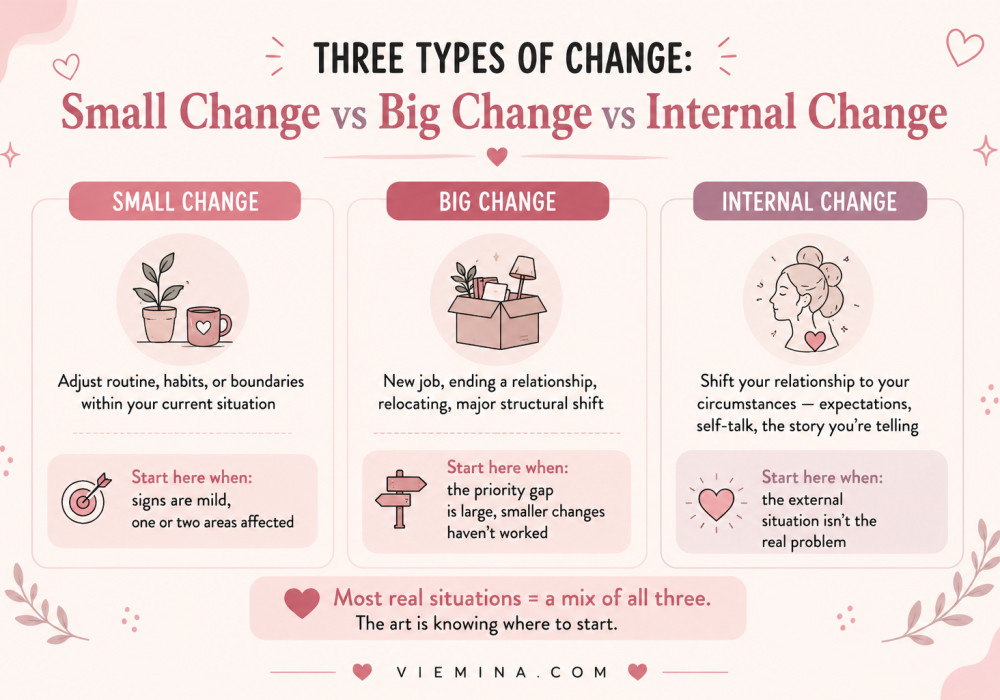
Recognizing these signs is only half the picture; the other half is realizing that “change your life” doesn’t have to mean the dramatic version most people picture first.
- Small change: Adjusting your routine, boundaries, or daily habits within your current situation. This is usually the right starting point when the signs are present but not severe, or when only one or two life areas are affected.
- Big change: A significant shift: a new job, ending a relationship, relocating, a major structural change to how you’re living. Usually appropriate when the gap between your priorities and your actual life (Sign #7) is large, when the fear (Sign #8) points clearly at one specific thing, or when smaller adjustments have genuinely been tried and haven’t moved the needle.
- Internal change: Sometimes nothing external needs to move at all, and what actually needs to shift is your relationship to your circumstances: your expectations, your self-talk, or a story you’ve been telling yourself about your options. This is easy to overlook because it doesn’t produce a visible “before and after,” but it’s often the most durable kind of change.
Most real situations are a mix of all three, not a single clean category; and it’s worth resisting the urge to decide this in one sitting.
Reflection: Where Are You in the Process?
Psychologists who study behavior change, including Prochaska and DiClemente, whose Transtheoretical Model is one of the most replicated frameworks in this area, describe change as occurring in stages, not as a single decision. Most people move back and forth between these stages more than once before something sticks.
A quick, honest check-in with yourself:
- Not yet considering it: you know something feels off, but you haven’t let yourself think about what might need to change.
- Considering it: you’re aware something needs to shift, but you haven’t decided what, or you’re still weighing whether it’s worth the disruption.
- Preparing: you’ve identified roughly what needs to change and are starting to think through how.
- Acting: you’ve started making the change, even in a small way.
There’s no “behind” in this process. If you’re only at “considering it,” that’s not a failure to act; it’s an honest, necessary stage, and rushing past it is one of the more common reasons changes don’t hold.
Common Mistakes People Make Once They Decide to Change
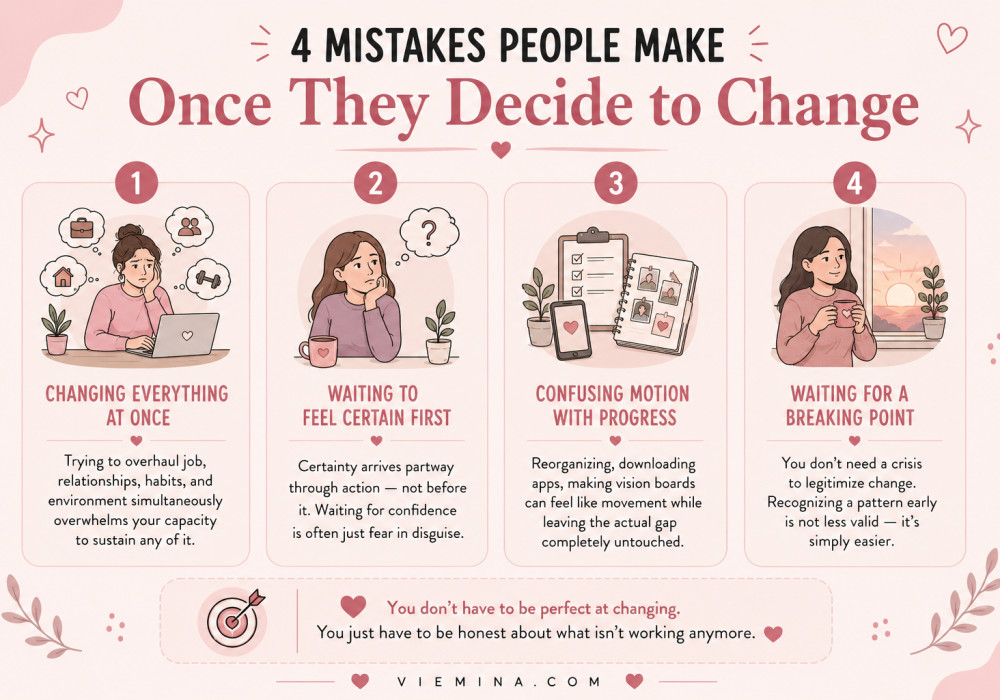
1. Changing everything at once
It’s tempting, once you’ve finally named what’s wrong, to want to fix all of it immediately. In practice, trying to overhaul your job, relationships, habits, and environment simultaneously tends to overwhelm your capacity to sustain any single change, and the whole effort collapses faster than a more targeted one would have.
2.Waiting to feel certain before starting
Certainty rarely arrives before action. For most people, it arrives partway through it, once the change has proven itself a little. Waiting for total confidence before beginning is often just fear wearing a more reasonable-sounding disguise. The evidence that you made the right call tends to show up after you start, not before.
Related: Fear of Rejection Why It Hurts and How to Work Through It
Related: How to Stop Overthinking: 12 Ways That Actually Work
3. Confusing motion with progress
Reorganizing your environment, downloading a new productivity app, or making a vision board can feel like movement while leaving the actual gap between your priorities and your life (Sign #7) completely untouched. These aren’t bad on their own; they’re just not a substitute for addressing the specific thing the signs are pointing at.
Related: What Is Toxic Productivity? 13 Signs You’ve Crossed the Line
Related: How to Plan Your Day Effectively: Complete Guide (2026)
4. Assuming you need to hit a breaking point first
A common, unhelpful belief is that change only counts or only sticks if it’s provoked by a crisis. It doesn’t have to be. Recognizing a pattern early, before it forces your hand, is no less legitimate than recognizing it after a breakdown. It’s simply easier, and easier is better.
Conclusion
If several of these signs sound familiar, that’s not proof that something is wrong with you. It’s usually proof that some part of you has been paying closer attention than you’ve been giving it credit for; noticing the gap between how you’re living and what you actually want, long before you were ready to look at it directly.
You don’t need to have the whole plan figured out today, and you don’t need the biggest possible version of change to start. Pick the smallest true thing from this list; the one sign that landed hardest; and ask yourself what one small, real step in its direction would look like this week.
That’s enough of a beginning. The rest tends to become clearer once you’re moving, not before.
Frequently asked Question About Signs It’s Time to Change Your Life:
How many of these signs mean it’s really time to change something?
There’s no fixed number. What matters more than the count is whether the signs form a pattern that persists across weeks or months and doesn’t lift when your circumstances improve. A cluster of two or three persistent signs is often more meaningful than briefly experiencing all eleven during a hard week.
Is this the same as depression?
Not necessarily, but there’s real overlap, and it’s worth taking seriously. Depression often includes a flatness that doesn’t lift with good news, changes in sleep or appetite, and a heaviness that feels different from ordinary dissatisfaction. If that description fits better than “I’m bored with my routine,” please speak with a doctor or therapist before assuming a life change alone will resolve it.
What if I recognize all of these but I’m too scared to actually do anything?
Fear at this stage is common, not a sign you’re doing it wrong. Most people move through “considering it” more than once before they’re ready to act. The most useful thing to know: certainty rarely arrives before action; it arrives partway through it, once the change has started proving itself. Starting with the smallest possible version of the change makes the fear more manageable, because you’re not asking yourself to commit to the whole thing at once.
Does the change have to be big?
No. Some situations call for a major shift. Many call for a smaller adjustment to routine, boundaries, or expectations, or an internal change in how you’re relating to your current circumstances, rather than changing the circumstances themselves. The three-category framework in Section 4 is worth spending some time with before deciding.
What if the “you’ve drifted from who you meant to be” feeling is really strong?
That feeling usually reflects a gap between your daily choices and your own values, not something fundamentally wrong with your character. It responds better to gentle course-correction than to self-criticism. And noticing it clearly, the way you just did, is already the first part of that correction.
What if I’m not sure whether this is a rough patch or something real?
Go back to the table in Section 1 and be honest about the duration column. If what you’re feeling has been present for less than a few weeks and is clearly tied to a specific event or busy period, give it time and rest first. If it’s been several weeks or months, returns after breaks, and is spreading across more than one area of your life, that pattern is worth taking seriously rather than waiting out.