

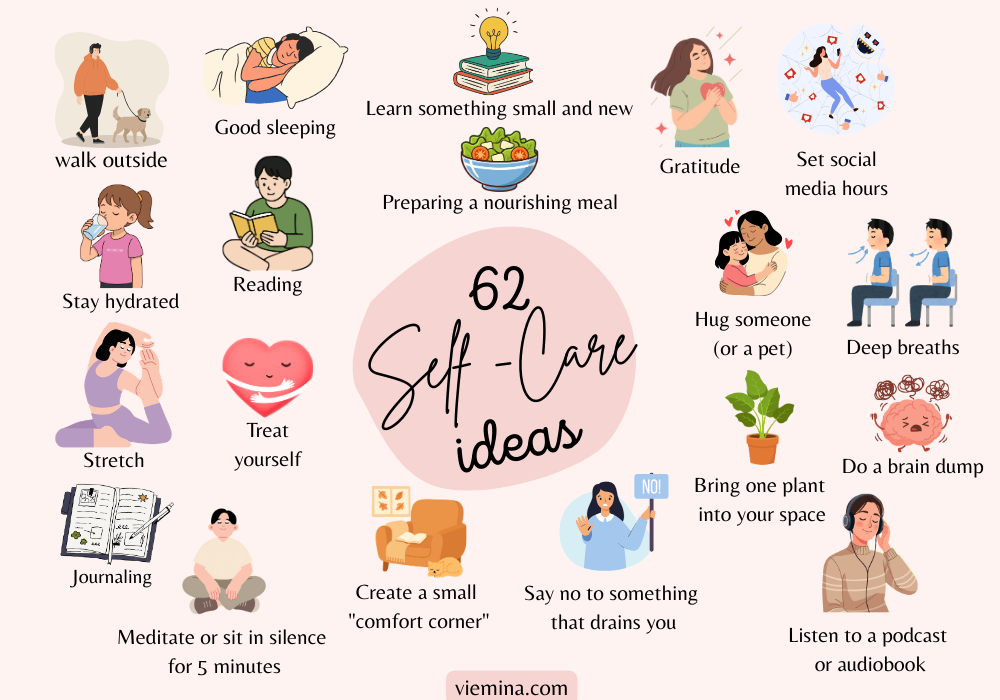
In our busy lives, self-care often feels like one more thing on the to-do list. But it doesn’t have to be complicated or time-consuming. You don’t need a spa day, a weekend retreat, or a perfectly aesthetic morning routine to take care of yourself. Sometimes, five minutes of intentional quiet is enough to change the whole tone of your day.
Here are 62 simple, actionable self-care ideas you can use today – even if you only have 5 minutes.
According to the American Psychological Association, 77% of adults in the U.S. regularly experience physical symptoms caused by stress. That’s not a personal failing – it’s a signal that most of us need to be more deliberate about how we restore ourselves. Small, consistent habits tend to do more for your well-being than occasional grand gestures.
If you’re new to this, start with our guide to the 9 Types of Self Care to understand the different dimensions of well-being. Then come back here and pick a few ideas to try.
Physical Self-Care Ideas
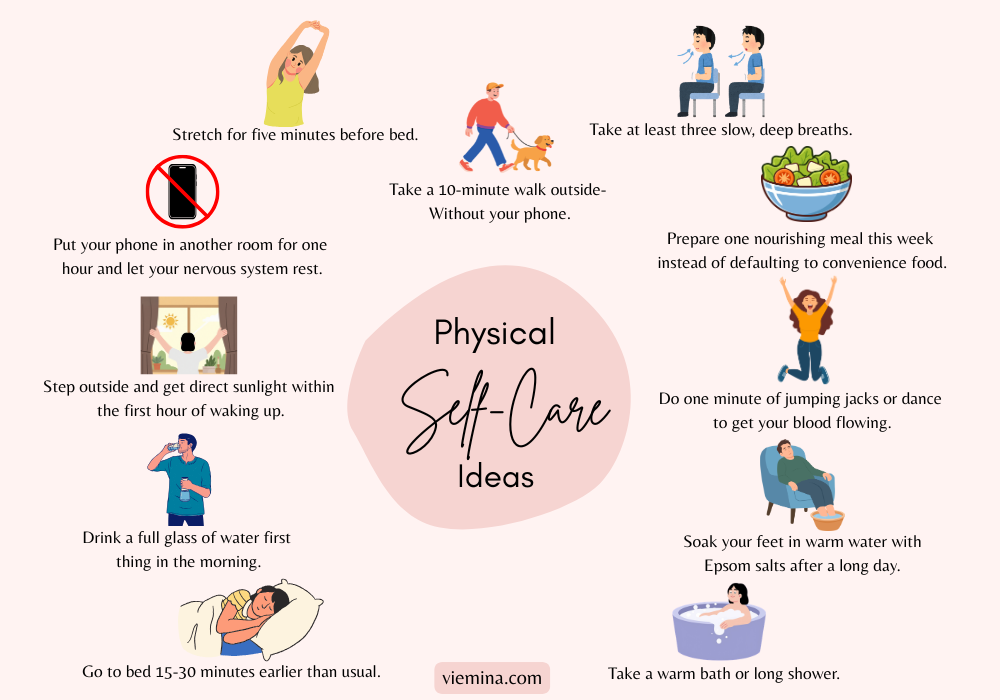
Your body is always giving you feedback. Physical self-care is about actually listening to it – rest when you’re tired, move when you’re stiff, eat when you’re hungry. These aren’t luxuries; they’re basics that are surprisingly easy to skip.
- Take a 10-minute walk outside, even if it’s just around the block – Without your phone.
- Drink a full glass of water first thing in the morning before coffee or your phone.
- Stretch for five minutes before bed to release tension you’ve accumulated all day.
- Go to bed 15-30 minutes earlier than usual – sleep debt is real and cumulative.
- Prepare one nourishing meal this week instead of defaulting to convenience food.
- Take a warm bath or long shower and treat it as intentional downtime, not a checkbox.
- Put your phone in another room for one hour and let your nervous system rest. (Try this idea, it’s give a lot of mental clarity).
- Take at least three slow, deep breaths the next time you feel your shoulders creeping up toward your ears.
- Step outside and get direct sunlight within the first hour of waking up.
- Soak your feet in warm water with Epsom salts after a long day.
- Do one minute of jumping jacks or dance to get your blood flowing.
Mental Self-Care Ideas
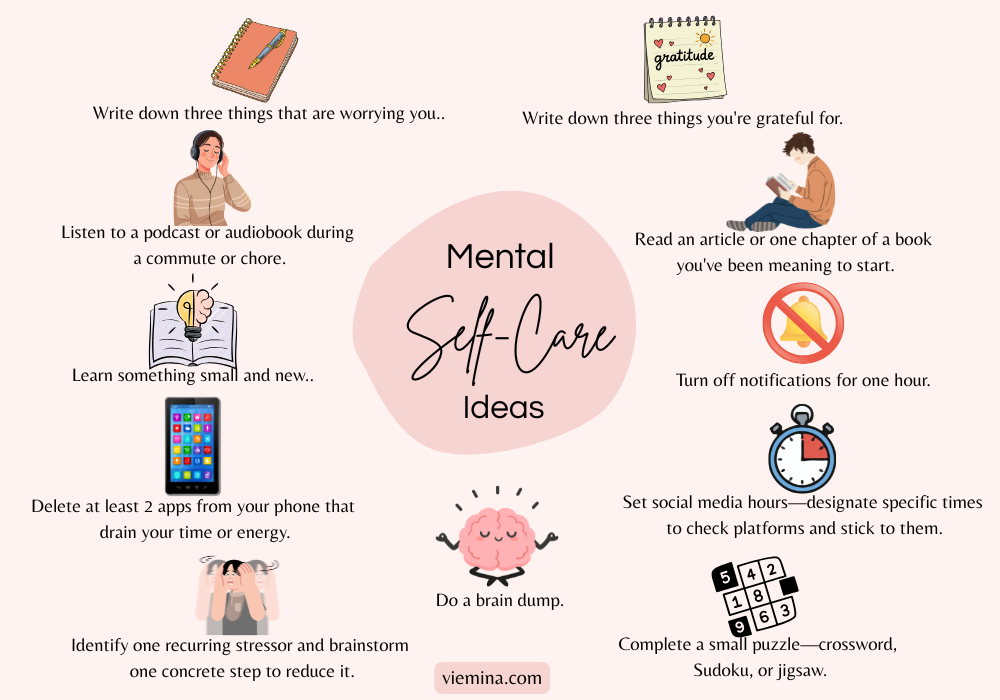
Mental self-care is less about thinking positive and more about managing the mental load you’re carrying. Burnout rarely announces itself loudly; it usually shows up as a low hum of exhaustion and irritability.
- Write down three things that are worrying you, then close the notebook – externalizing the list can quiet the mental loop.
- Read an article or one chapter of a book you’ve been meaning to start.
- Listen to a podcast or audiobook during a commute or chore instead of doom-scrolling.
- Learn something small and new – a word in another language, a historical fact, a cooking technique.
- Do a brain dump: write everything on your mind onto paper without structure or judgment.
- Identify one recurring stressor and brainstorm one concrete step to reduce it.
- Write down three things you’re grateful for—gratitude journaling promotes positive self-talk and reduces stress .
- Complete a small puzzle—crossword, Sudoku, or jigsaw.
- Turn off notifications for one hour.
- Delete at least 2 apps from your phone that drain your time or energy.
- Set social media hours—designate specific times to check platforms and stick to them.
Related: How To Improve Mental Clarity ? 16 Ways to Achieve It
Emotional Self-Care Ideas
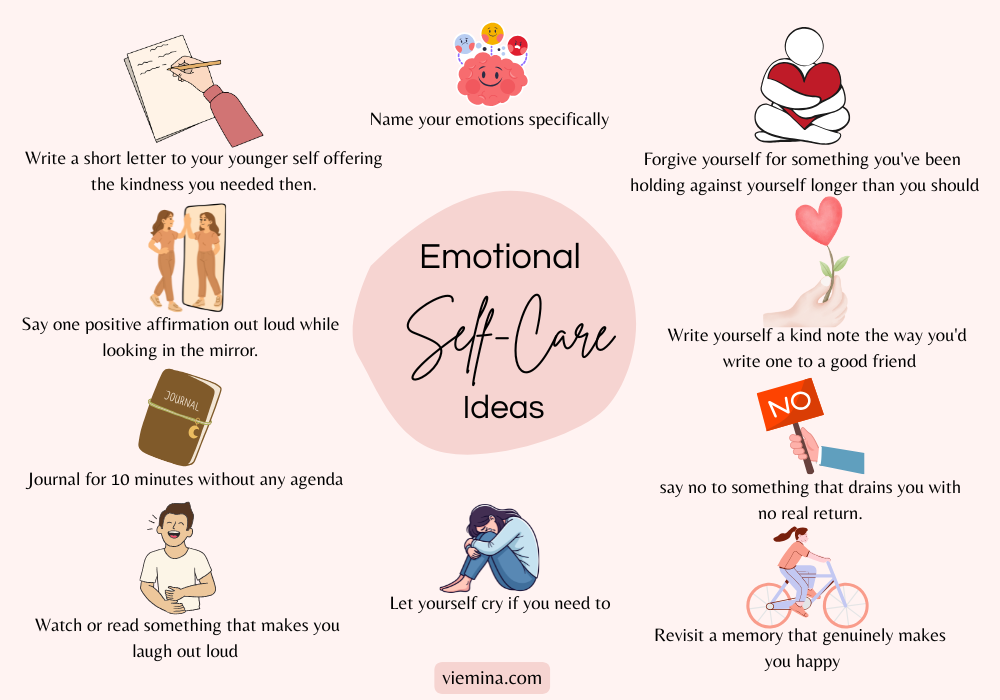
Emotional self-care is about making space for how you actually feel – not just how you think you should feel. It’s the area most people skip because it can feel uncomfortable or indulgent. It’s neither.
- Write a short letter to your younger self offering the kindness you needed then.
- Say one positive affirmation out loud while looking in the mirror.
- Journal for 10 minutes without any agenda – just write what’s true right now.
- Watch or read something that makes you laugh out loud (genuinely – not a courtesy chuckle).
- Let yourself cry if you need to; suppressing emotion costs more energy than releasing it.
- Name your emotions specifically – “frustrated” and “disappointed” are different feelings with different needs.
- Write yourself a kind note the way you’d write one to a good friend going through a hard time.
- Set one small boundary this week – say no to something that drains you with no real return.
- Revisit a memory that genuinely makes you happy – a photo, a playlist, a place.
- Forgive yourself for something you’ve been holding against yourself longer than you should. Remember, forgiveness is an act of self-love.
Related: 20 Fun Things To Do Alone At Home
Social Self-Care Ideas
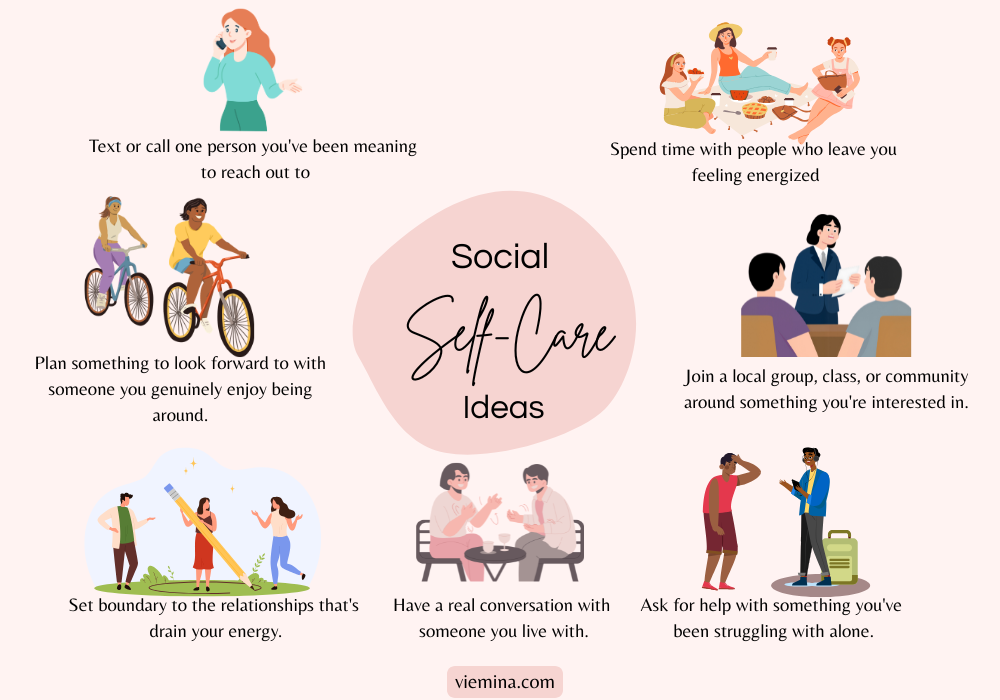
Humans are wired for connection, but life has a way of letting relationships slide into the background. Social self-care isn’t about being more social – it’s about being intentional with the connections that actually fill you up.
- Text or call one person you’ve been meaning to reach out to – just a quick check-in counts.
- Plan something to look forward to with someone you genuinely enjoy being around.
- Have a real conversation with someone you live with ( If it’s possible).
- Join a local group, class, or community around something you’re interested in.
- Spend time with people who leave you feeling energized rather than depleted – notice the difference.
- Ask for help with something you’ve been struggling with alone.
- “Prune” one relationship that drains your energy by setting a gentle boundary.
Spiritual Self-Care Ideas
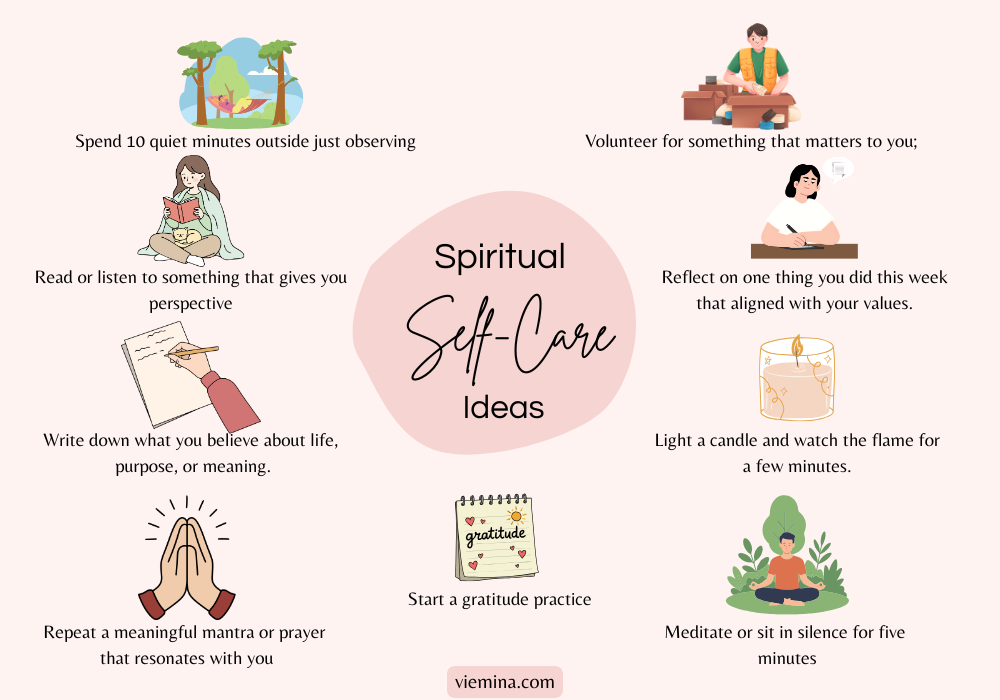
Spiritual self-care doesn’t require any particular belief system. It’s about connecting to something larger than your daily to-do list – meaning, purpose, wonder, stillness.
- Spend 10 quiet minutes outside just observing – clouds, trees, birds – without your phone.
- Start a gratitude practice: write down two or three specific things you’re genuinely grateful for each day.
- Meditate or sit in silence for five minutes; if your mind wanders, that’s fine – just keep returning.
- Read or listen to something that gives you perspective – philosophy, poetry, spiritual texts, whatever resonates.
- Volunteer for something that matters to you; contributing to others is a well-documented mood booster.
- Reflect on one thing you did this week that aligned with your values.
- Light a candle and watch the flame for a few minutes.
- Repeat a meaningful mantra or prayer that resonates with you.
- Write down what you believe about life, purpose, or meaning.
Professional Self-Care Ideas
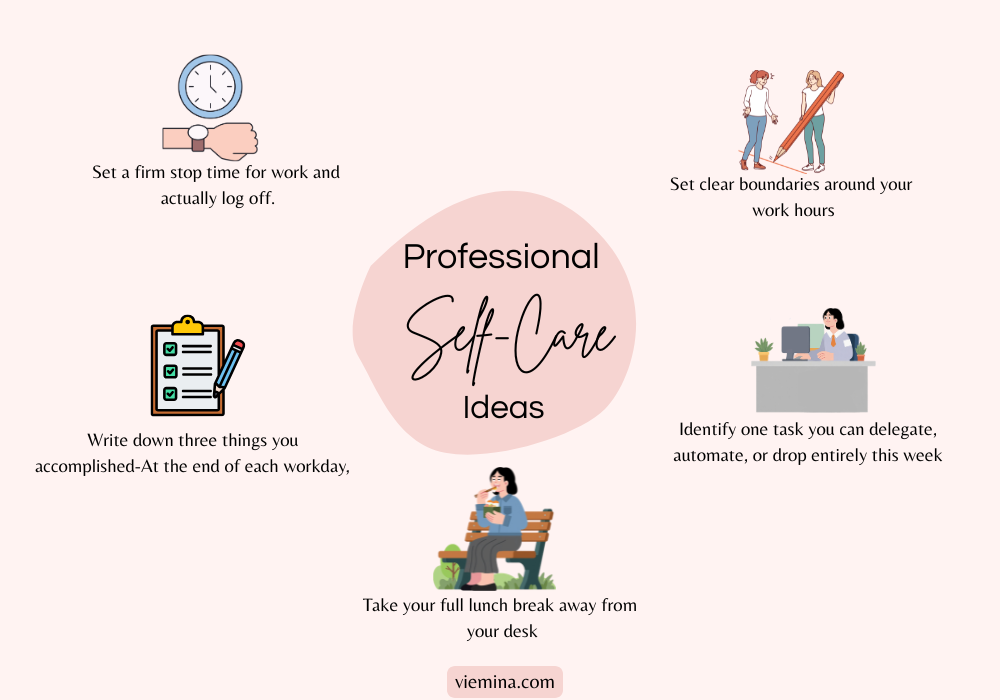
Work stress is one of the biggest contributors to burnout, and professional self-care is about protecting your energy at the source – not just recovering from the damage afterward.
- Set a firm stop time for work and actually log off.
- Take your full lunch break away from your desk, even if it’s just 20 minutes.
- At the end of each workday, write down three things you accomplished – it reframes the day positively.
- Identify one task you can delegate, automate, or drop entirely this week.
- Set clear boundaries around your work hours and communicate them if needed.
Environmental Self-Care Ideas
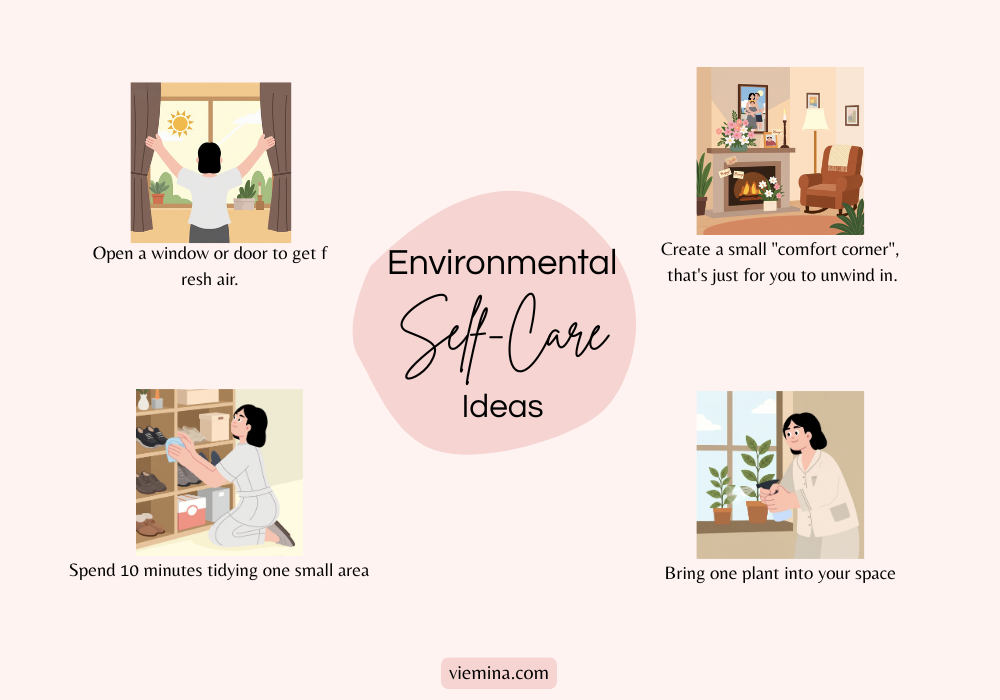
Your surroundings affect your mental state more than you probably realize. A cluttered, chaotic environment quietly adds to your cognitive load all day long.
- Spend 10 minutes tidying one small area – a desk, a drawer, a countertop – and see how it changes your mood.
- Bring one plant into your space; research consistently links greenery to lower stress levels.
- Open a window or door to get fresh air circulating in your home or workspace.
- Create a small “comfort corner” – a chair, a candle, a soft blanket – that’s just for you to unwind in.
Financial Self-Care Ideas
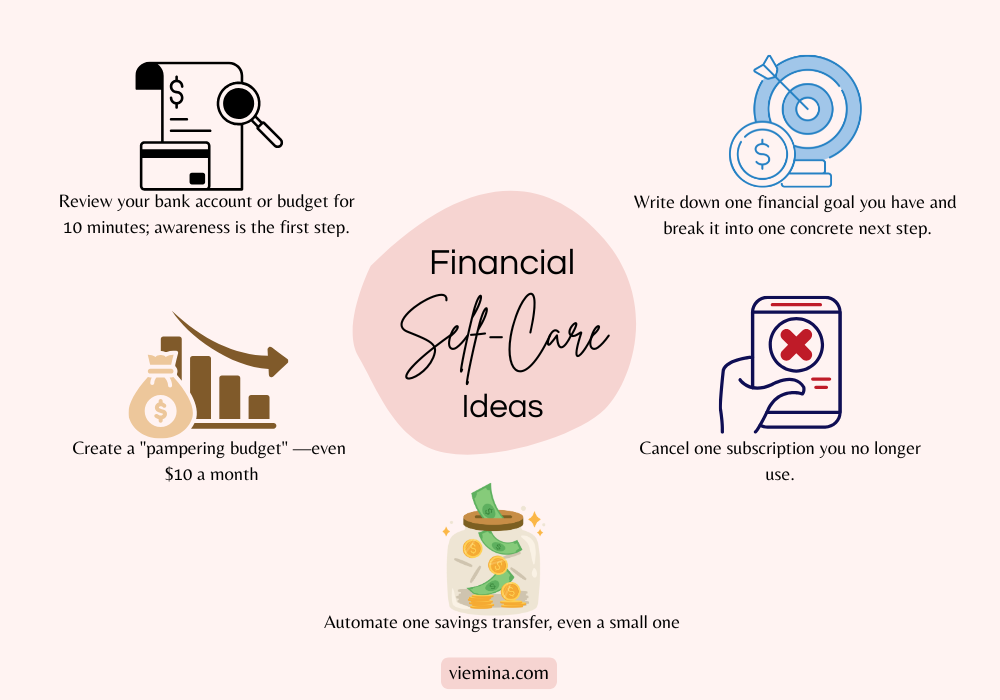
Financial stress is among the most persistent sources of anxiety adults face. You don’t need to solve everything at once, but facing it directly – even in small ways – reduces the anxiety that avoidance creates.
- Review your bank account or budget for 10 minutes; awareness is the first step.
- Automate one savings transfer, even a small one – building the habit matters more than the amount.
- Cancel one subscription you no longer use.
- Create a “pampering budget” —even $10 a month set aside just for treating yourself.
- Write down one financial goal you have and break it into one concrete next step.
Bonus: 5-Minute Self-Care Ideas for Busy Days
When you’re genuinely pressed for time, these quick self care ideas take five minutes or less and still make a difference.
- Step outside and take 10 slow, deep breaths – it resets your nervous system faster than you’d think.
- Splash cold water on your face and take 60 seconds to just stand still before continuing your day.
- Hug someone (or a pet) for 20 seconds.
- Write down one thing you’re looking forward to – it shifts your brain toward positive anticipation.
- Stretch your neck and shoulders for two minutes – tension lives there and most of us ignore it until it becomes a headache.
- Drink a full glass of water before you do anything else in the morning.
- Step outside and look at the sky for two minutes (not your phone).
- Unsubscribe from one email list that you always skip.
- Text someone you’ve been meaning to reach out to.
- Put your phone in a different room for 30 minutes.
- Take three slow, deliberate breaths — longer exhale than inhale.
- Say no to one thing today that you’d usually say yes to out of obligation.
How to Build a Daily Self-Care Routine That Actually Sticks
Most people try to build a self-care routine by doing too much too fast. They overhaul their mornings, download three wellness apps, and burn out by Thursday. Here’s a better approach.
- Pick one habit that feels easy – attach it to something you already do (morning coffee, lunch break, bedtime). This is habit stacking, and it works.
- Cover two dimensions – choose one physical habit and one mental or emotional one. Two things done daily beat ten done once.
- Anchor your morning and evening – five minutes at the start and end of your day protects the hours in between.
- Track it simply – use a self-care planner,checklist or app to check off each day. Seeing your streak builds momentum faster than motivation ever will.
If you want a structure to build from, your daily routine is the best place to anchor self care habits — morning and evening especially. A good morning sets the tone before the day has a chance to derail you, and a good evening routine is how you actually decompress instead of just collapsing. If you’re starting from scratch, these are worth reading:
Productive Morning Routine: 13 Habits That Actually Work
How To Create a Productive Evening Routine: 12 Easy Steps
How to Create an Effective Daily Routine: 13 Tips That Stick
Also worth knowing: your self care needs will change. What helps when you're stressed is different from what helps when you're grieving, which is different from what helps when you're just a little burnt out. You're not looking for the permanent answer. You're looking for what you need right now
Conclusion
Self-care isn’t selfish – it’s necessary. You can’t pour from an empty cup, and you’re not much help to the people around you when you’re running on fumes. Pick one or two ideas from this list and try them today. That’s it. You don’t need to overhaul your whole routine to start feeling better.
Remember, self-care is personal. What restores one person might drain another. Explore our guide to the 9 Types of Self Care to find the dimensions that resonate most with you and build from there.
Which of these ideas will you try today? Let me know in the comments below!
Frequently Asked Questions About Self-Care
What are some simple self-care ideas I can do at home?
Some of the easiest self-care ideas at home include journaling for 10 minutes, taking a warm bath, stretching before bed, decluttering one small area, and stepping outside for fresh air. None of these require equipment or a lot of time.
What is a good daily self-care routine for busy people?
A realistic daily self-care routine for busy people focuses on two anchor habits: one in the morning (like hydrating and stretching for five minutes) and one in the evening (like a short journal entry or screen-free wind-down). Consistency matters more than duration.
What are the 7 pillars of self-care?
The 7 pillars of self-care are: physical, mental, emotional, social, spiritual, professional, and environmental well-being. Some frameworks also include financial self-care as an eighth. Each pillar affects the others – neglecting one tends to create strain across the rest.
How do I start self-care when I feel overwhelmed?
Start with the smallest possible action. Drink a glass of water. Step outside for two minutes. Write one sentence in a journal. Deep & slow breath. When you’re overwhelmed, the goal isn’t transformation – it’s just interrupting the spiral.
What are quick self-care ideas for women with no time?
Quick self-care ideas for women on tight schedules include: deep breathing for 60 seconds, taking a walk around the block, journaling for 2-5minutes, or sitting quietly with a cup of tea without your phone. None of these take more than five minutes, and all of them work.
What’s the difference between self-care and self-indulgence?
Self-care restores your capacity to function, show up, and engage with your life. Self-indulgence tends to be avoidance-based – it might feel good short-term but doesn’t address the underlying need. The distinction usually comes down to intention: are you replenishing, or escaping?