

There’s a specific kind of confusion that comes from loving someone who makes you feel both chosen and disposable — sometimes within the same week.
You remember the beginning clearly. The intensity. The feeling that this person saw you in a way nobody else ever had. They were attentive, warm, almost magnetic — and being the focus of that attention felt like standing in a spotlight after years of being invisible.
Then something shifted. Slowly at first, then all at once. The warmth became unpredictable. The criticism started. You found yourself working harder and harder to get back to how things felt in the beginning — and never quite making it.
If that sounds familiar, you may have been caught inside what psychologists call the narcissistic relationship cycle. Understanding it — really understanding it, not just intellectually but emotionally — is one of the most important things you can do for your own healing.
What Is the Narcissistic Relationship Cycle?
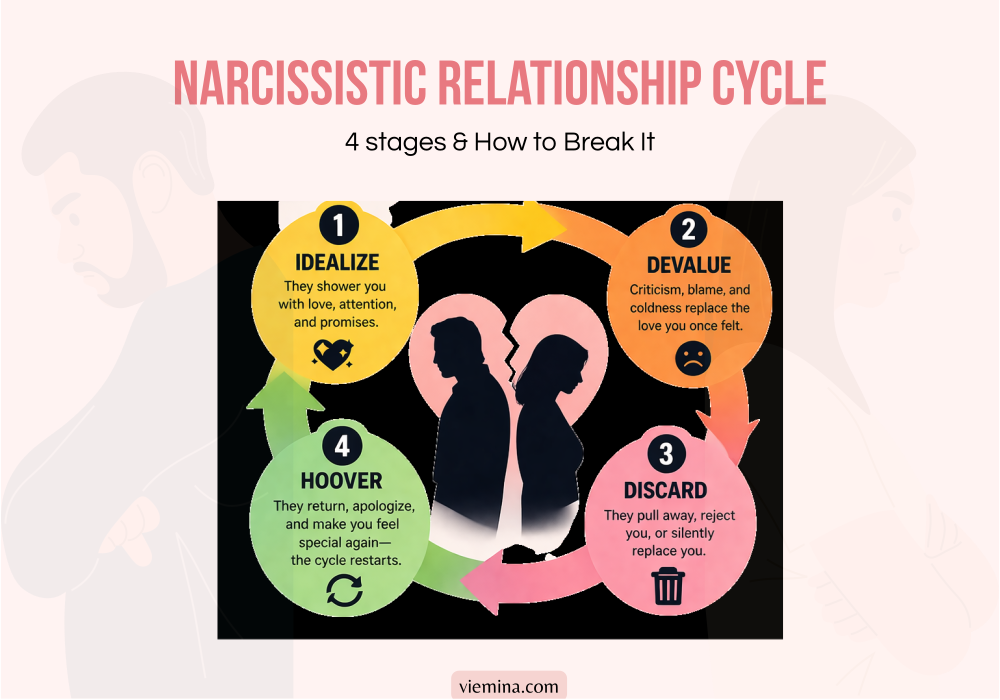
The narcissistic relationship cycle is a predictable pattern of behavior that tends to repeat in relationships involving a person with narcissistic traits or Narcissistic Personality Disorder (NPD).
It typically moves through four stages: idealization, devaluation, discard, and hoovering. These stages don’t always follow a neat linear sequence — they can overlap, repeat, and occur in mini-cycles within the larger relationship before a final ending.
What makes this cycle so psychologically damaging is not any single stage but the pattern itself. The contrast between how good it feels during idealization and how painful it feels during devaluation creates a powerful emotional bond that is genuinely difficult to break — even when you can see what’s happening.
The 4 Stages of the Narcissistic Abuse Cycle
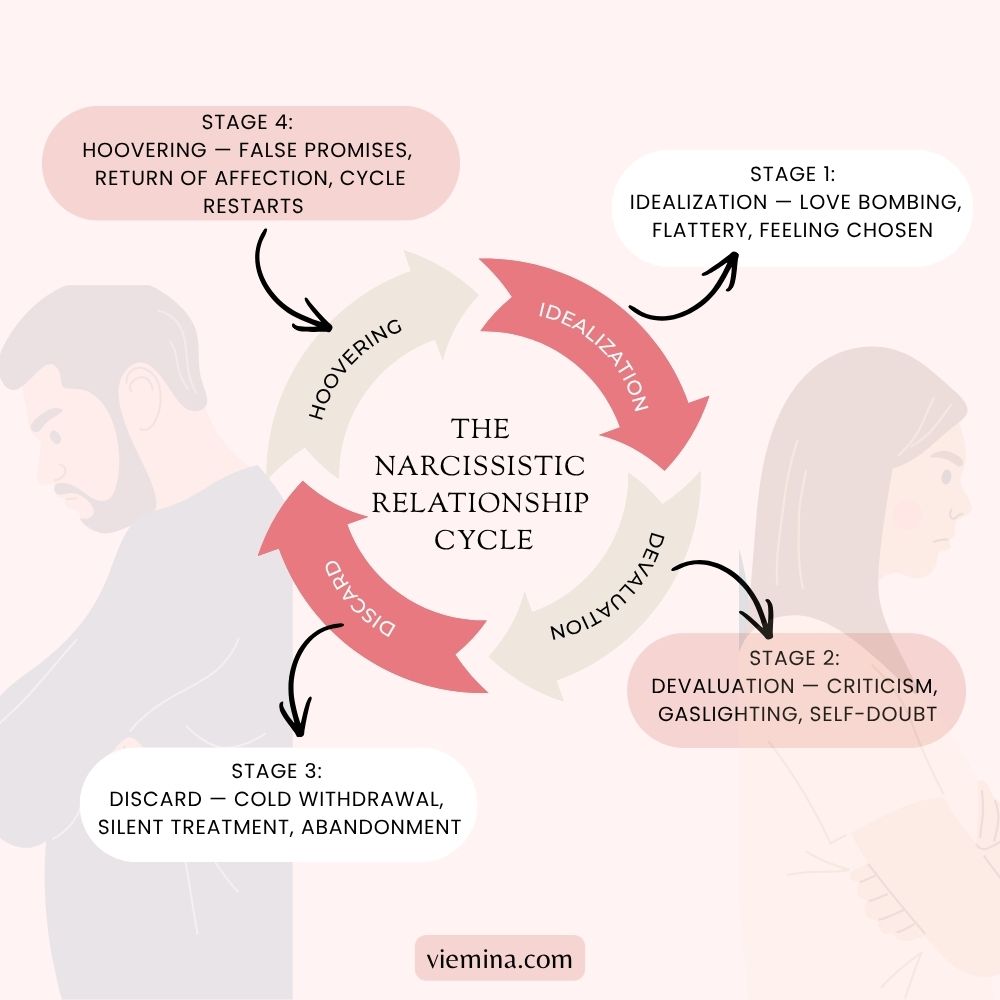
Stage 1 — Love Bombing and Idealization
The cycle almost always begins with what feels like the best relationship of your life.
The narcissistic partner is intensely attentive. They want to spend all their time with you. They tell you things like “I’ve never met anyone like you” and “you’re different from everyone else.” They mirror your values, your dreams, and your sense of humor with uncanny precision. The connection feels almost supernatural — like you’ve found your person.
This stage is called love bombing, and it’s not accidental. The narcissist is learning you during this phase — your insecurities, your needs, your values, what makes you feel seen. They are building an emotional bond as quickly as possible, partly because new relationships genuinely do provide them with what psychologists call narcissistic supply (attention, admiration, validation), and partly because the stronger the bond, the more leverage they have later.
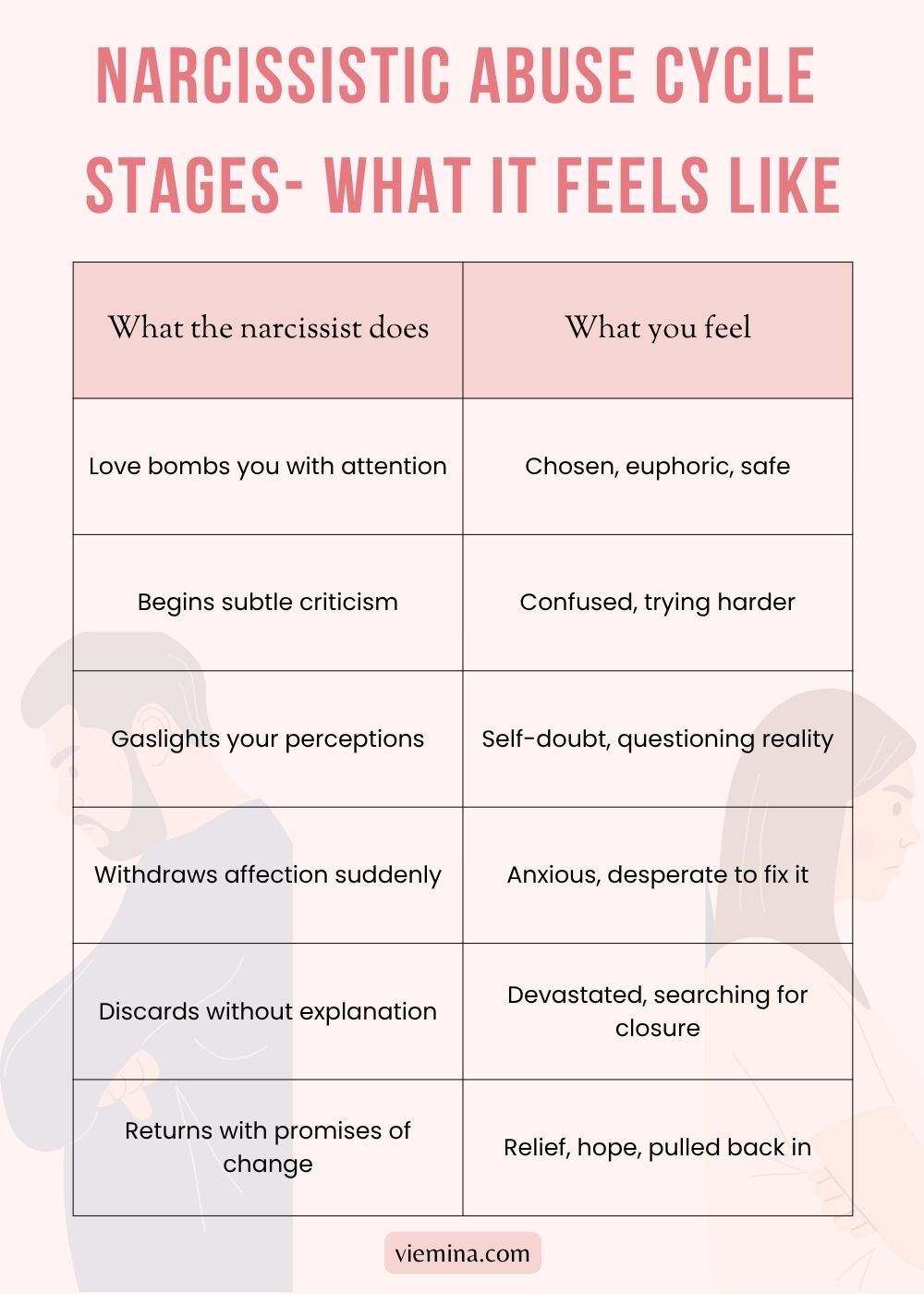
What it feels like from the inside: You feel euphoric. Chosen. Like you’ve finally found someone who truly understands you. The intensity might feel slightly overwhelming at times, but you interpret that as passion rather than a warning sign. You let your guard down completely — and you tell them things you’ve never told anyone else.
That openness becomes important in the next stage.
Related: Trauma Bond vs Love: How to Tell the Difference

Stage 2 — Devaluation
At some point — and it’s rarely possible to identify exactly when — the dynamic begins to change.
The warmth becomes less consistent. They become critical of things they previously praised. Small comments start chipping away at your confidence — the way you dress, the decisions you make, your opinions, your relationships with other people. When you bring up your concerns, the conversation somehow ends with you apologizing.
The devaluation phase is rarely sudden. It tends to build gradually, which is part of what makes it so disorienting. You keep looking for the person you fell in love with, convinced that if you could just figure out what you did wrong, you could get back to the beginning.
This is the stage where gaslighting becomes a central feature. The narcissist makes you doubt your own memory of conversations, your own perception of events, your own emotional reactions. “That never happened.” “You’re too sensitive.” “I can’t believe you’re making this into such a big deal.” Over time, you stop trusting your own instincts — and you start relying on their version of reality instead.
What it feels like from the inside: Confusing. Exhausting. You find yourself walking on eggshells, pre-editing everything you say and do to avoid their reaction. You blame yourself for the change in the relationship because they’ve told you — in a hundred direct and indirect ways — that you are the problem. The self-doubt becomes so deeply embedded that it starts to feel like just who you are, rather than something that was done to you.
Why intelligent people stay at this stage: This is the question people feel most ashamed to ask. The answer is that staying has nothing to do with intelligence. The devaluation phase works because it alternates with brief returns to idealization — moments where the person you fell in love with comes back, just long enough to renew your hope that the relationship can be what it was. This intermittent reinforcement is psychologically one of the most powerful bonding mechanisms known. It’s the same mechanism that makes gambling addictive. The unpredictability itself becomes the hook.
Related: 12 Manipulative Apology Examples: How To Spot Fake Sorries
Stage 3 — Discard
The discard is when the narcissist ends the relationship — or withdraws so completely that the relationship effectively ends.
It often happens abruptly, with little warning or explanation. One day you are in a relationship; the next, they are cold, distant, or completely gone. The contrast with the idealization phase is so stark that many people describe the discard as one of the most destabilizing experiences of their lives.
The discard typically happens when the narcissist has found a new source of supply — a new person who can provide the admiration and validation they need. From their perspective, the relationship has served its purpose. You are no longer useful in the way you once were.
What it feels like from the inside: Devastating — and deeply confusing. The grief isn’t just for the relationship as it was at the end, but for the person you believed they were at the beginning. You’re also grieving the version of yourself that existed before the devaluation — the one who trusted their own judgment and felt secure in who they were.
Many people also feel an irrational need for closure — a final conversation that explains what happened. That closure rarely comes, because the narcissist has already moved on, and because a genuine accounting of what happened would require a level of self-awareness and empathy they don’t have access to.
Related: Exploring the 5 Stages of Grief Journey
Stage 4 — Hoovering
This is the most stage that keeps people trapped longest.
Hoovering is when the narcissist comes back after the discard. The name comes from the Hoover vacuum cleaner — they suck you back in. It might happen days after the discard, or months later. It might be a text saying they miss you, a sudden reappearance in your life, a declaration that they’ve changed, or simply a small gesture designed to reopen the door.
Hoovering works because it arrives at your most vulnerable moment — when you’re still grieving, still looking for closure, still holding onto hope that the person from the idealization phase was real. The return feels like confirmation that the relationship was real, that they did love you, that maybe things can be different this time.
They rarely are. What typically follows hoovering is a return to the idealization phase — a brief, intense period of warmth and attention — before the cycle begins again.
What it feels like from the inside: Relief. Hope. The feeling of coming home. This is what makes hoovering so dangerous. It feels like what you’ve been waiting for — and it temporarily silences all the doubts you’d been building up the courage to act on.
Related: 7 Stages of Trauma Bonding: How to Break the Cycle & Heal
Related: What Is A Soul Tie? 7 Signs & How To Break The Bond
The Mini-Cycles: Why It Repeats Before the Final Discard
One thing that often gets missed in explanations of the narcissistic cycle is that the full cycle — idealization, devaluation, discard, hoovering — doesn’t just happen once across the entire relationship. It happens repeatedly, in smaller versions, throughout the relationship itself.
A fight leads to coldness (mini-discard), followed by a sudden return to warmth and affection (mini-idealization). A period of criticism is followed by a week of tenderness. These mini-cycles keep you emotionally off-balance and constantly recalibrating — never able to settle into a stable sense of where you stand.
This is precisely the environment in which trauma bonding develops. The cycle of pain and relief, repeated enough times, creates a bond that feels indistinguishable from love — and is extraordinarily difficult to break even when you understand what it is.
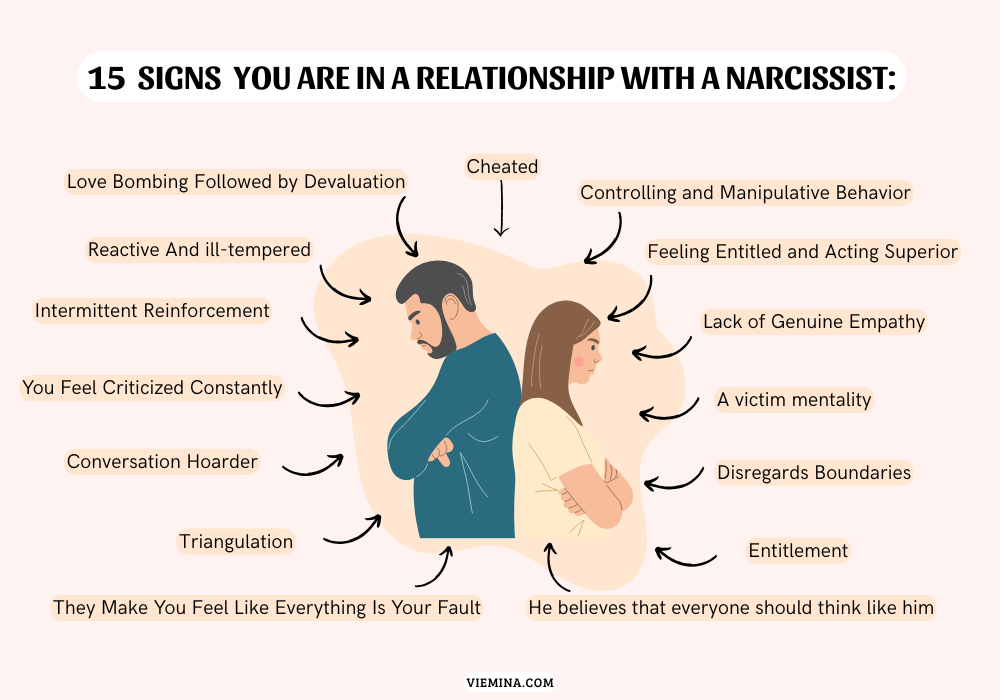
“Not sure if what you’re experiencing is narcissism or just a difficult relationship? Read: 15 Signs You’re in a Relationship With a Narcissist — Not Love — the specific behaviors that tell the difference.”
Why It’s So Hard to Leave
Leaving a narcissistic relationship is harder than most people on the outside understand. It’s not about intelligence, or strength, or self-respect. It’s about the specific psychological conditions the cycle creates.
By the time you’re considering leaving, you’ve likely experienced months or years of having your self-perception shaped by someone who needed you to doubt yourself. Your confidence in your own judgment has been systematically eroded. The good moments — and there were good moments — make it genuinely hard to reconcile the person you loved with the person who hurt you. And the fear of the grief that comes after, combined with the hope that things could return to how they were, makes staying feel more manageable than leaving.
Understanding this isn’t making excuses. It’s accurate. And naming it clearly is part of what makes it possible to move through it.
Related: 20 Signs of a Controlling Relationship — And How to Leave
Related: 15 Signs of a Controlling Friend — And When to Walk Away
How to Break Free From Narcissistic Abuse Cycle
1-Name what’s happening
The first step is always recognition. The narcissistic relationship cycle has a name, a pattern, and a psychological explanation. You are not crazy. You are not too sensitive. What you experienced is real and well-documented.
2-Go no contact if possible
The most effective way to break the cycle — particularly to resist hoovering — is to remove the opportunity for contact entirely. Block them on all platforms if you need to. This isn’t cruelty. It’s protection.
Related: Power of Silence After Break up: 11 Tips for How to Use It
Related: How Long Does It Take to Get Over a Breakup
3-Understand that closure won’t come from them
The conversation you’re waiting for — the one where they acknowledge what happened and express genuine remorse — is unlikely to come. Closure has to be built from within, not received from the person who caused the harm.
Related: How to Get Over a Breakup: 15 Steps to Heal and Move On
Related: 8 hidden Stages Of A Breakup And How To Heal
4-Rebuild your self-trust
This takes time and deliberate effort. Start small — make a decision and trust it. Notice when your instincts are right. Gradually, the internal compass that was disrupted begins to recalibrate.
5-Get support
Trauma bonding is real and recovery from narcissistic abuse often benefits significantly from professional support. A therapist who understands coercive control and narcissistic dynamics can help you process what happened in a way that is much harder to do alone.
For those seeking structured guidance on this path, a specialized program like the Neuro-Thriving Resilience Program can provide essential tools and support from certified coaches.
Conclusion
The narcissistic relationship cycle is not a reflection of your worth or your intelligence. It is a predictable psychological pattern that preys on the very qualities that make someone a good partner — empathy, loyalty, the desire to understand and be understood.
If you’ve been through this cycle, the most important thing to know is that what happened to you was not your fault — and that the confusion, the self-doubt, and the difficulty leaving are not signs of weakness. They are signs of how effectively the cycle works.
Recovery is real. It takes time, and it isn’t linear. But understanding the pattern is always the first step toward being free of it.
Frequently Asked Questions About the Narcissistic Relationship Cycle
What are the stages of the narcissistic relationship cycle?
The narcissistic relationship cycle typically involves four stages: idealization (also called love bombing), devaluation, discard, and hoovering. During idealization the narcissist is intensely attentive and affectionate. During devaluation they become critical and withholding. The discard is when they end or effectively abandon the relationship. Hoovering is when they return to pull you back in — often restarting the cycle from the beginning.
Why do narcissists idealize and then devalue?
Narcissists require constant external validation — known as narcissistic supply — to maintain their sense of self. During idealization a new relationship provides this supply in abundance. As the relationship becomes more familiar and the partner begins to have needs of their own, the narcissist starts to feel that their supply is diminishing. Devaluation is how they respond — by reasserting control and dominance, and by seeking supply elsewhere. It is not a response to anything the partner did or failed to do.
Can a narcissist change and break the cycle?
Change is possible in theory but rare in practice — and only when the narcissist genuinely recognizes the problem and commits to sustained therapeutic work. Most people with narcissistic personality disorder do not seek help because the disorder itself interferes with the capacity for self-reflection required to recognize the need for it. If change is happening it will be visible over a long period of consistent behavior — not just during the hoovering phase when they want you back.
What is hoovering in a narcissistic relationship?
Hoovering is when a narcissist returns after a discard — sometimes days later, sometimes months — with the goal of reestablishing contact and restarting the cycle. It often involves expressions of love, promises of change, or simply small gestures designed to reopen the emotional door. It is named after the Hoover vacuum cleaner because the narcissist is essentially trying to suck you back in. Recognizing hoovering for what it is — rather than interpreting it as genuine change — is one of the most important protective steps in recovery.
Why do I still love someone who treated me this way?
Because the person who treated you badly and the person you fell in love with appeared to be the same person. The love you developed during the idealization phase was real — your emotions were genuine even if their behavior was manipulative. What’s hard to reconcile is that you’re grieving someone who may never have fully existed as you experienced them. That grief is legitimate and it deserves to be taken seriously, not dismissed.
How long does it take to recover from a narcissistic relationship?
Recovery timelines vary significantly depending on the length of the relationship, the severity of the abuse, the support available, and the individual’s history. What most people describe is a non-linear process — some days feeling significantly better, others feeling like you’re back at the beginning. A general frame that helps many people is to expect the process to take at least as long as the relationship itself, sometimes longer. Professional support can meaningfully accelerate the process and help you understand what happened in a way that protects you from repeating it.