

❤ My story — why I wrote this guide
I tried 75 Hard in January 2024. I quit on day 19 — not because it was too hard, but because I missed one workout, and the rule said I had to start over. That single reset didn’t motivate me; it emptied me. I walked away from the whole thing and didn’t touch a self-improvement challenge for months. When I came across “The 75 Soft Challenge” later that year, I finished all 75 days without once hating myself for being human. That difference — punishment versus sustainability — is why I wrote this guide.You’ve seen the posts. The brutal 75-day gauntlet: two workouts a day, a gallon of water, a strict diet, a daily body photo, zero alcohol. It spread across TikTok, LinkedIn and every gym’s bio in 2019 and never really left.
But here’s what almost nobody tells you: for every person who finished 75 Hard, dozens started over twice, three times, and quietly quit. It wasn’t laziness. It was a design flaw.
Enter 75 Soft — the gentler cousin that’s quietly exploding. According to Google Trends data (October 2026), search interest in “75 Soft challenge” has risen over 80% in six months. This isn’t the “easy way out.” It’s the smarter way. And if you’ve ever struggled to stick with a self-improvement habit, this one was built for people like you.
What Is 75 Hard and Why It Breaks People
75 Hard was created in 2019 by entrepreneur and podcaster Andy Frisella, inspired by Ironman competitions. He doesn’t call it a fitness program — he calls it a “transformative mental toughness program.” Its daily non-negotiable tasks are famously strict:
- Two 45-minute workouts a day, one of them outdoors
- A strict diet with zero cheats and zero alcohol
- A gallon of water every day (3.8 liters)
- Read 10 pages of a nonfiction book
- Take a daily progress photo
Miss a single task, and you restart from day one. All of it, gone.
That’s the fatal flaw. Perfectionism is the enemy of consistency. Psychologists call the aftermath the “what-the-hell effect” (coined by researchers Polivy and Herman): the moment you break one rule, you tell yourself the whole day is ruined, so you might as well abandon the plan entirely. One missed photo, one slice of birthday cake — and back to square one, deflated.
A 2010 study by Dr. Phillippa Lally at University College London found that missing a single day of a new habit has no measurable effect on long-term automaticity. Yet 75 Hard’s design treats that single miss as a total reset. The science and the rules are in direct contradiction.
Enter 75 Soft
75 Soft is the beginner-friendly, human rewrite. Same 75 days, same spirit of building discipline — but designed so you can actually finish.
Experienced medical voices prefer it: Cleveland Clinic’s Dr. Sacco calls it safer and more sustainable than the rigid version, and HSS sports-medicine physician Dr. Metzl says it’s “both doable and realistic for most people.”
Here are the seven rules that make it work.
Rule 1 — Eat well, don’t ban
Instead of eliminating entire food groups, add nutritious foods to your diet. There is no forbidden list. Alcohol is allowed on special occasions. It’s about nourishing more, not policing yourself.
Why it works: Restrictive diets trigger the scarcity mindset. Adding rather than subtracting keeps you in an abundance frame — you’re building a better plate, not mourning what’s gone.
Rule 2 — Drink 3 liters of water
About 100 ounces, spread across the day. Hydration is the foundation of energy, focus and mood — and it’s far more achievable than a gallon (3.8 L) for most people.
Practical tip: Carry a marked 1-liter bottle. Three refills = done. Don’t trust memory; trust the bottle.
Rule 3 — Move 45 minutes a day, with one recovery day
Any movement counts: a walk, yoga, the gym, a bike ride, dancing in your kitchen. And one day each week is active recovery — a light stretch or stroll, not a workout. The goal is consistency, not punishment.
❤ My experience
I chose walking — not running, not the gym, just a 45-minute walk through my neighbourhood every morning. I picked it because I knew that if I made it intimidating, I’d quit again. The first week was unremarkable: my legs ached slightly, I was bored by day three, and I almost talked myself out of it on day five because “just walking” felt too easy to count. But by the end of week two, the morning walk had become the part of my day I protected most. It wasn’t exercise anymore — it was the 45 minutes where my head went quiet.Rule 4 — Read 10 pages of any book
Fiction or nonfiction, it doesn’t matter. The habit is the point — a daily slice of quiet that’s yours alone. No performance, no genre police.
Rule 5 — Skip the daily progress photo
The mirror-and-camera ritual of 75 Hard is exactly the kind of daily self-judgment that drains people. 75 Soft drops it entirely. You don’t need to catalogue your body every morning to build character.
Birthdays, weddings, Friday nights with friends — you can genuinely enjoy them. No guilt, no restarting the clock. This is what makes the challenge compatible with real life, which is precisely why people can sustain it.
Rule 7 — Miss a day? Just pick it back up
No “start over.” If you slip, you forgive yourself and continue the next day. This single shift is the heart of the gentler philosophy: you are rebuilding an identity, not passing a test.
The unofficial corollary that experienced 75 Soft participants add: never miss twice. One missed day is life. Two in a row is a pattern. This tiny guardrail keeps the streak alive without the crushing perfectionism of day-one resets.
75 Hard vs 75 Soft, Side by Side
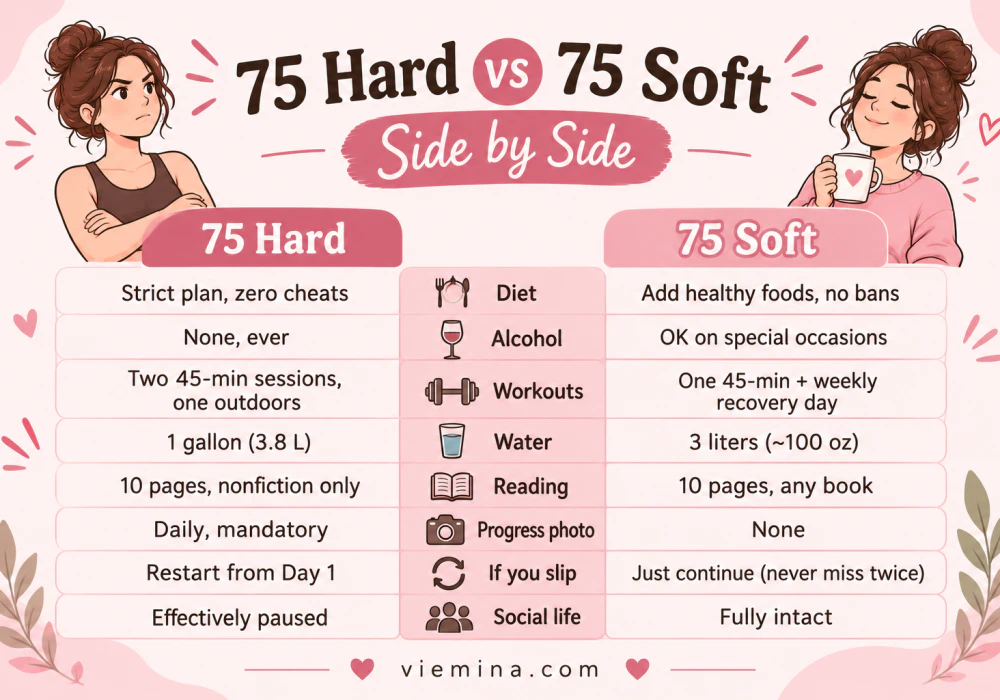
| Rule | 75 Hard | 75 Soft |
|---|---|---|
| Diet | Strict plan, zero cheats | Add healthy foods, no bans |
| Alcohol | None, ever | OK on special occasions |
| Workouts | Two 45-min sessions, one outdoors | One 45-min + weekly recovery day |
| Water | 1 gallon (3.8 L) | 3 liters (~100 oz) |
| Reading | 10 pages, nonfiction only | 10 pages, any book |
| Progress photo | Daily, mandatory | None |
| If you slip | Restart from Day 1 | Just continue (never miss twice) |
| Social life | Effectively paused | Fully intact |
Why the Gentle Version Wins (The Science)
The habit science is clear: consistency beats intensity. A program you can sustain for 75 days changes your neural wiring; one you abandon after 11 changes nothing but your self-esteem.
Dr. Lally’s UCL research (2010) showed that habits take an average of 66 days to reach automaticity — right inside the 75-day window. The key finding: a single missed day did not reduce the habit’s eventual strength. What mattered was returning, not perfection.
There’s another, quieter danger with 75 Hard. Its relentless “no excuses” framing can turn into a way of masking burnout or low mood — pushing harder when what you actually need is rest or help. A gentler structure leaves room to listen to your body instead of overriding it, which is the more mature, more sustainable form of self-discipline.
❤ My experience — Day 23
Day 23. I’d had a terrible night’s sleep, it was raining, and every reason I’d built for walking felt fake. I stood in my hallway with my shoes on for five full minutes, having the argument with myself. What kept me going wasn’t motivation — I had none. It was something simpler: I’d told myself the rule was “never miss twice,” and I’d already missed the day before. Walking in the rain for 45 minutes wasn’t discipline or willpower. It was stubbornness — the kind that’s less impressive than grit but more reliable. I finished that walk, and it was the ugliest, least Instagram-worthy session of the entire 75 days. It’s also the one I’m most proud of.The Two Weeks Where Most People Quit (Days 8–21)
Every challenge has a graveyard. For 75 Soft, it’s the second and third week. The novelty dopamine is gone, visible results haven’t arrived yet, and life keeps interrupting.
Here’s the survival protocol:
Days 8–10: The Blank Wall. You feel nothing. That’s normal. Rule: you don’t need motivation to read 10 pages or walk 45 minutes. Shrink the action until it’s impossible to refuse.
Day 14: The Identity Test. Ask yourself: “What would the person I’m becoming do today?” — then do that. This identity-based approach (popularized by James Clear in Atomic Habits) removes the daily negotiation. You’re not deciding whether to exercise; you’re being the person who exercises.
Days 18–21: The Almost-Visible Window. Sleep improves first, then energy, then someone comments. Most people quit right before the window opens. If you can see days 1–21 through, your probability of finishing jumps dramatically.
How to Start the 75 Soft Challenge This Week
You don’t need a Monday. You don’t need January 1st. You need a start date and three anchors.
- Pick a start date — ideally a Monday, but any day works. Write it down.
- Write your three daily anchors: hydrate, move, read. Post them somewhere visible (fridge, mirror, phone wallpaper).
- Calendar-block 45 minutes for movement, same time every day. Treat it like a meeting you can’t cancel.
- Set up a simple tracker — a paper grid, a notes app, a habit app. Check off each day. The visual streak is its own reward.
- Don’t announce it publicly if that adds pressure. This is for you, not for likes.
- Remove one friction: gym clothes laid out the night before, water bottle filled, book on your pillow.
Related: How to Plan Your Day Effectively: Complete Guide (2026)
“We are what we repeatedly do. Excellence, then, is not an act, but a habit.”
— Will Durant, summarizing Aristotle
Frequently Asked Questions About The 75 Soft Challenge
Is 75 Soft the same as 75 Hard but easier?
Not exactly. It’s a different philosophy. 75 Hard tests mental toughness through rigidity. 75 Soft builds identity through consistency. The goal isn’t to suffer — it’s to still be doing it on day 76.
Can I do 75 Soft without a gym?
Yes. Rule 3 counts walking, yoga, home workouts, cycling, swimming, dancing. Equipment is optional; consistency isn’t.
What if I miss a day?
Continue the next day. The “never miss twice” guideline keeps you honest without the crushing restart. One lapse has no measurable effect on habit formation (Lally et al., 2010).
Can I drink coffee on 75 Soft?
Yes. There are no caffeine rules. Just hit your 3 liters of water.
Is 75 Soft safe for everyone?
For most healthy adults, yes. But if you have a medical condition, are pregnant, or are recovering from an eating disorder, adapt the rules with your doctor. The challenge should add energy to your life, not subtract it.
When is the best time to start?
Any time. That said, many people pair it with seasonal anchors — the “Winter Arc” (December 1 → February 14) is the most popular window on Pinterest and TikTok right now.
Related ⬇️

This article is for information, not medical advice. If you’ve been struggling with low mood, anxiety, or your relationship with food, the right step is a conversation with a clinician — not a stricter set of daily rules. Start gently, and listen to your body.
Sources
Cleveland Clinic — 75 Soft Challenge · Hospital for Special Surgery (Dr. Jordan Metzl) · WebMD — 75 Hard vs 75 Soft · Penn State Health News · The Independent · The Week · Lally, P. et al. — How are habits formed?, European Journal of Social Psychology (2010) · Polivy, J. & Herman, C.P., American Psychologist (1985) · Atomic Habits, James Clear · Search-trend data: Google Trends, October 2026.