

Most people start the day with good intentions and end it wondering where the time went.
The meetings ran long. The emails never stopped. The one thing that actually mattered got pushed to tomorrow, again. And the to-do list that was supposed to bring order to the day became just another source of anxiety.
The problem is almost never a lack of effort. It’s a lack of structure.
When your day isn’t planned, your brain spends enormous energy deciding what to do next at every turn. Those decisions accumulate. Your mental capacity depletes. By early afternoon, you’re running on cognitive fumes, and the most important work still hasn’t happened.
Learning how to plan your day properly isn’t about squeezing more into fewer hours. It’s about making deliberate choices about where your time and attention go before the day begins, so the day doesn’t make those decisions for you.
This guide covers the neuroscience behind why planning works, how to build a daily plan that matches your energy rather than fighting it, five proven productivity frameworks to choose from, and the most common mistakes that turn good intentions into wasted days.
But before, let’s take a quick answer first:
How do you plan your day effectively?
Plan the night before or first thing in the morning, before reactive tasks like email take over. Identify your one to three most important tasks for the day. Schedule them during your peak energy window, not wherever they fit. Use time blocking to assign specific hours to specific work rather than working from an open list. Build in buffer time between tasks. End the day with a two-minute review of what happened and what carries forward. The goal isn’t a perfect plan; it’s a plan that makes your priorities non-negotiable.
Why Planning Your Day Actually Works: The Neuroscience
Before the how, the why, because understanding the mechanism makes you far more likely to use it consistently.
Research on uncertainty and the stress response consistently shows that unresolved open loops activate the amygdala and sustain cortisol elevation. Planning closes those loops and measurably reduces the threat response. That’s not a motivational statistic; it’s a measurable physiological change. Planning doesn’t just make you more productive. It literally calms your nervous system.
Think of your brain’s prefrontal cortex as your personal CEO. When you plan your day, you’re giving your inner CEO a clear roadmap instead of forcing it to make hundreds of small decisions on the fly.
Here’s the critical limitation most people don’t know about: according to cognitive psychology studies, our brains have a limited amount of processing power for conscious decision-making, about two to three hours of high-performance decision-making per day.
That’s it. Two to three hours.
Every “what should I do next?” moment burns through that limited supply. By the time you’ve navigated a reactive morning of emails and interruptions, most of your best thinking is already gone, and the work that actually matters hasn’t started.
When you plan ahead, you’re essentially pre-deciding, which dramatically reduces the number of decisions you need to make in the moment. You’re outsourcing those decisions to your past self, freeing up cognitive resources for actual work.
A plan isn’t a constraint on your day. It’s what protects your most valuable mental hours from being consumed by low-priority decisions.
Related: Decidophobia: Signs, Causes & How to Overcome It
Plan Around Energy, Not Just Time
The biggest mistake in daily planning isn’t failing to make a plan. It’s making a plan that ignores how your brain actually works throughout the day.
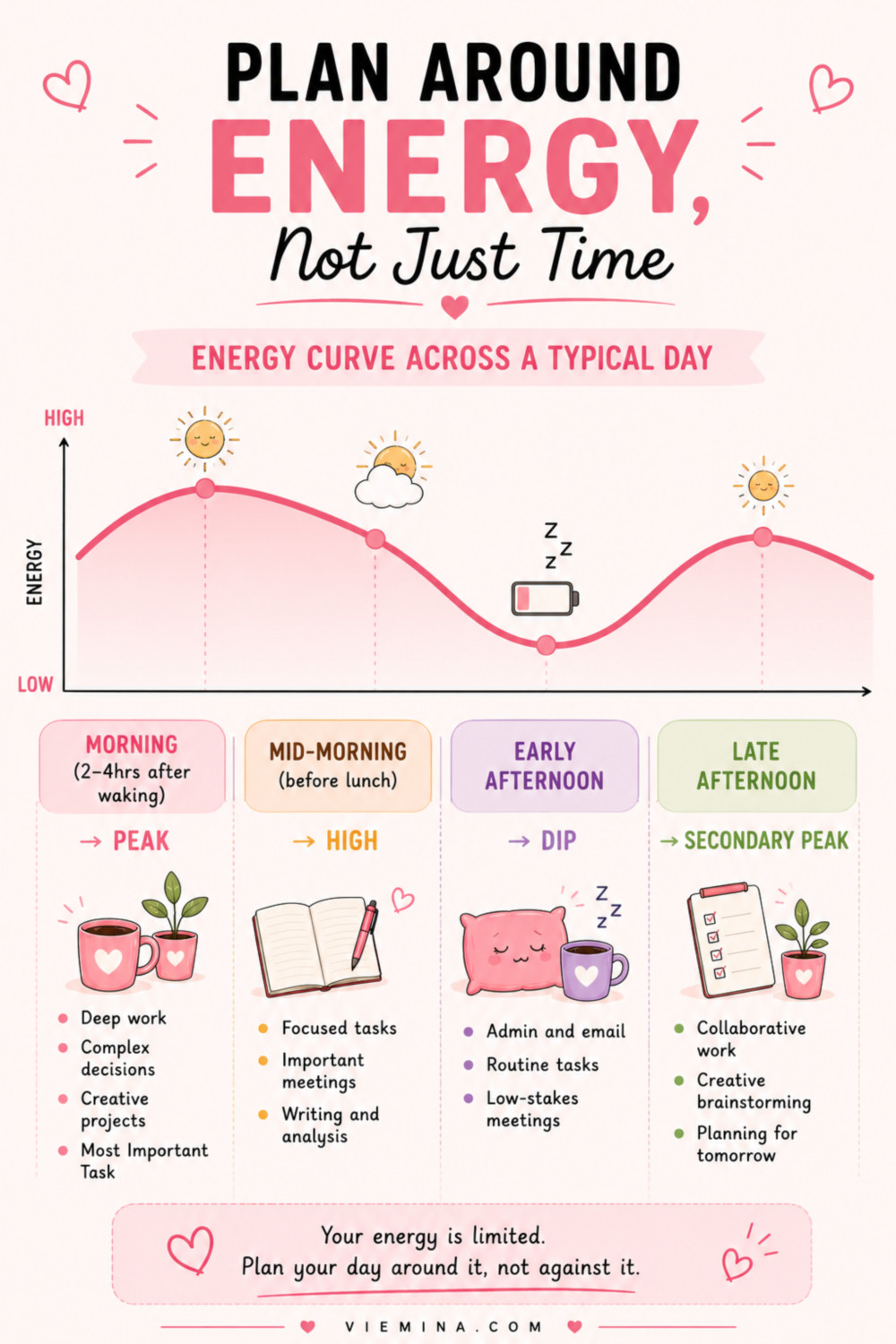
For many people, maximizing productivity depends on their own internal clocks, known as circadian rhythms, that regulate when the body feels most alert and energetic.
Most people have a cognitive peak window in the late morning, roughly two to four hours after waking. This is when focus is sharpest, decision-making is clearest, and creative thinking is most accessible. This is also, for many people, when they’re answering emails.
The principle is simple once you see it: match your highest-value work to your highest-energy window.
Deep work, writing, analysis, complex problem-solving, and creative projects belong in your peak window. Administrative tasks, emails, routine meetings, and low-cognitive-load work belong in the afternoon when energy naturally dips.
Before you build your daily plan, answer two questions honestly:
- What time of day do I feel mentally sharpest?
- What time of day do I feel most depleted?
Build your plan around those answers. A plan that works with your biology is far more sustainable than one that fights it.
Night Before vs Morning: When Should You Plan?
Both work. The research leans slightly toward planning the night before, and here’s why.
When you plan the night before, your brain has a chance to process the plan during sleep. You wake up with clarity and direction rather than spending your first cognitive resources figuring out what the day should look like. The morning brain is often at its clearest and most focused, and planning consumes that resource unnecessarily if it can be done the evening before.
Planning in the morning works well for people whose evenings are too unpredictable or who find that overnight things change enough to require a fresh plan.
The honest answer: the best time to plan is whenever you’ll actually do it consistently. A five-minute planning session the night before, done every day, outperforms an elaborate morning planning ritual that happens three days a week.
What matters most is that the plan happens before reactive tasks, before email, before social media, before anyone else’s urgency colonizes your attention.
Related: Productive Morning Routine: 13 Habits That Actually Work
Related: How To Create a Productive Evening Routine: 12 Easy Steps
How to Plan Your Day: Step by Step
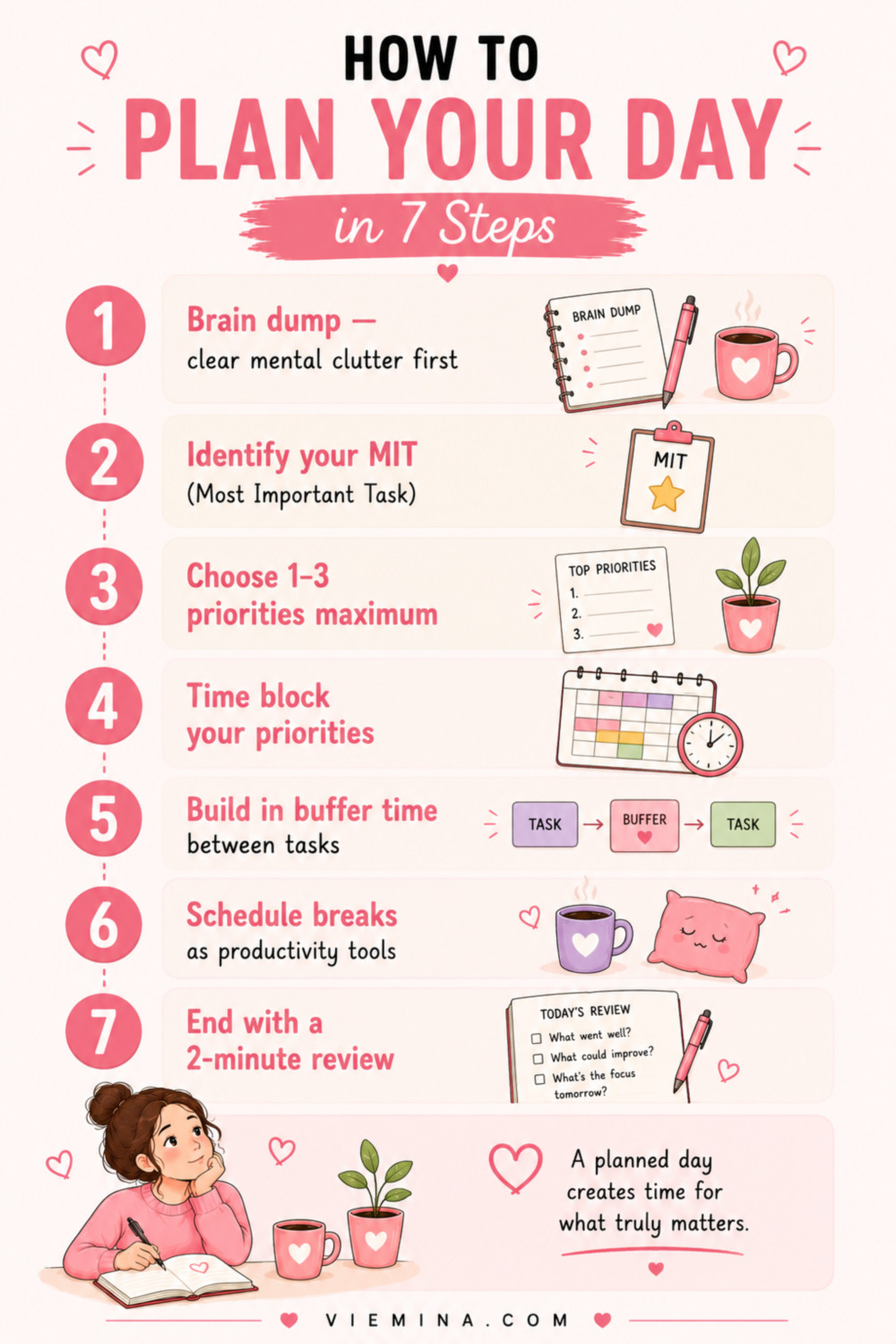
Step 1: Start With a Brain Dump
Before organizing anything, clear your head. Spend two to five minutes writing down everything on your mind, tasks, worries, things you’re tracking, and things you haven’t done. Get it all out of your head and onto paper.
This matters because mental clutter creates low-level cognitive noise that makes prioritization harder. Once it’s on paper, your brain stops holding it, and you can think more clearly about what actually needs to happen today.
–The best technique to do Brain dump is Journaling habit ( in this the article on How to Start Journaling and Make It a Habit (Complete Guide) covers exactly the real science behind why journaling works,and all what you need to know about it and how to build this habit and stick to it.
Step 2: Identify Your MIT (Most Important Task)
Before anything else, ask: what is the one thing that, if I accomplish it today, would make everything else feel secondary?
This is your Most Important Task. It goes at the top of the plan. It gets your best energy window. And it doesn’t get bumped.
Most people work from lists that treat every item as roughly equal. They don’t. One or two things on your list actually move the needle. The rest is maintenance. Identifying the MIT forces you to be honest about what actually matters rather than staying busy with what feels urgent.
Step 3: Choose One to Three Priorities (Maximum)
Beyond the most important task, identify one or two more meaningful tasks. That’s the core of your day, three things maximum that represent real progress.
Everything else, emails, admin, errands, routine tasks, fills the gaps around these priorities. When the three core tasks are done, the day is productive regardless of what else happened.
A to-do list with twenty items isn’t a plan. It’s a wish list that guarantees you’ll end the day feeling behind.
Step 4: Time Block Your Priorities
Don’t just list your tasks. Assign them to specific time slots.
“Write the proposal” is a task. “Write the proposal from 9am to 10:30am” is a commitment.
Time blocking works because it transforms vague intentions into concrete appointments with yourself. It also makes your available time visible. When you see your day laid out in blocks, you can immediately see whether your plan is realistic or aspirational.
Assign your Most important task (MIT) and priorities to your peak energy window. Keep that window distraction-free and non-negotiable.
Related: What Is Toxic Productivity? 13 Signs You’ve Crossed the Line
Step 5: Build In Buffer Time
Most daily plans fail because they’re too tight. One task runs long, one interruption arrives, and the whole plan collapses.
Build in 15-20 minute buffer blocks between major tasks. These absorb overruns, give your brain a genuine transition between different kinds of work, and prevent the cascading stress of running perpetually behind.
Buffer time feels like wasted space on a calendar. In practice, it’s the difference between a plan that survives contact with real life and one that falls apart by 10am.
Step 6: Schedule Your Energy Management
Breaks aren’t a reward for finishing work. They’re a productivity mechanism.
Research has shown that the eight-hour workday isn’t the most effective or efficient way to maintain productivity. Breaking up the workday can drastically change a person’s energy levels and lead to more sustainable outputs in the long run.
Schedule specific break times rather than waiting until you’re too depleted to work. A 10-minute break every 90 minutes restores focus more effectively than pushing through and grinding out increasingly diminished work.
Step 7: End With a Two-Minute Review
At the end of each day, spend two minutes answering three questions:
- What did I actually accomplish today?
- What didn’t happen and why?
- What carries forward to tomorrow?
This closes the day cleanly, surfaces patterns over time, and feeds directly into tomorrow’s planning session. It takes two minutes. Most people skip it. The people who don’t tend to have dramatically better week-to-week momentum.
5 Productivity Methods for Daily Planning
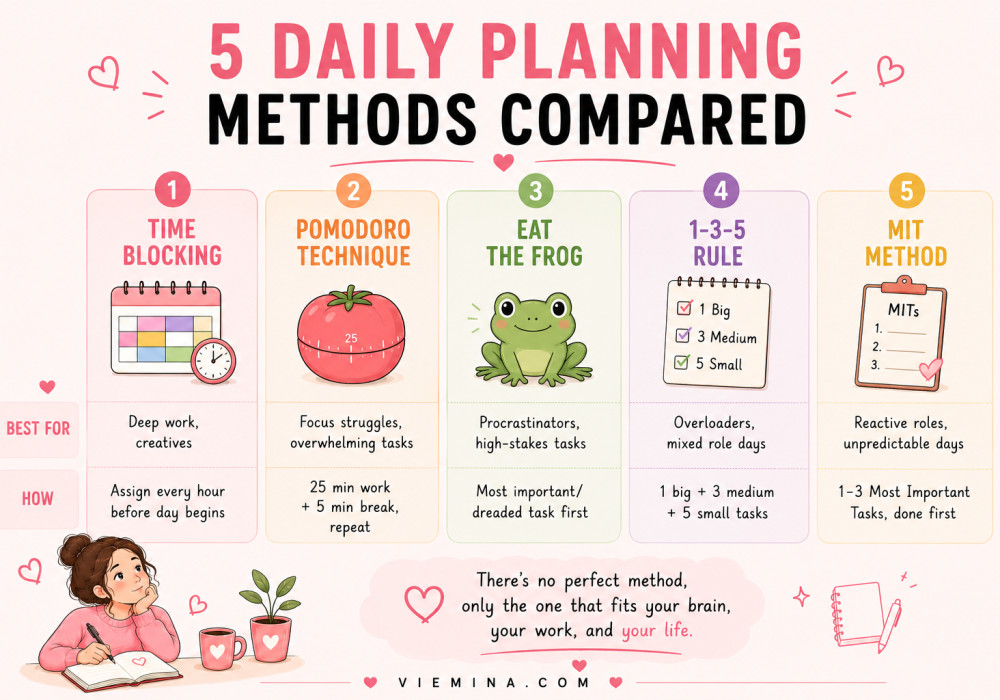
Different approaches work for different people and different kinds of work. Here are the five most effective frameworks. Pick the one that fits how your brain works.
1. Time Blocking
Assign every hour of your workday to a specific task or category of tasks before the day begins. No open-ended “work time”, everything has a designated slot.
Best for: Deep work, creative projects, and anyone who struggles with distraction or task-switching.
Cal Newport, author of Deep Work, is the most well-known advocate. His approach assigns specific blocks to specific outputs and treats the daily plan as a commitment rather than a suggestion.
2. The Pomodoro Technique
Work in focused 25-minute intervals (called Pomodoros) separated by 5-minute breaks. After four Pomodoros, take a longer break of 15-30 minutes. (The most technique that helped me personally to be more focused especially in the overwhelmed tasks).
The Pomodoro Technique was created in the 1980s by Francesco Cirillo as a time management strategy designed for sustaining energy and attention. It works by creating a simple timetable for completing work so that you can set achievable goals with small increments of time.
Best for: Tasks that feel overwhelming, people who struggle with sustained focus, or work that benefits from frequent short breaks.
3. Eat the Frog
The method involves starting the day by tackling the most difficult or least appealing task on your agenda. In doing so, all other projects you work on afterward will feel easy in comparison.
The name comes from a Mark Twain quote: if the first thing you do each morning is eat a live frog, nothing worse will happen for the rest of the day.
Best for: Chronic procrastinators, people who tend to delay their most important work until they “feel ready,” and anyone who ends the day feeling like nothing important got done.
4. The 1-3-5 Rule
The 1-3-5 rule is a daily planning method that limits your task list to nine items: one big task, three medium tasks, and five small tasks. It is designed to enforce prioritization before execution and prevent the overcommitment that turns task lists into anxiety triggers.
The strength of the 1-3-5 rule is not the cap on tasks; it’s the reduction of cognitive overhead and the structural pressure to prioritize before the day begins.
Best for: People who tend to overload their to-do lists, roles requiring both deep work and ongoing maintenance tasks.
5. The MIT Method (Most Important Task)
Identify one to three Most Important Tasks at the start of each day. Do these before anything else. Everything else is secondary.
Simpler than the 1-3-5 rule and more flexible than strict time blocking. The MIT method works well as a daily minimum, even on chaotic days. Getting one MIT done means the day wasn’t wasted.
Best for: People in reactive roles, parents with unpredictable schedules, and anyone for whom rigid time blocking feels unsustainable.
The Biggest Daily Planning Mistakes
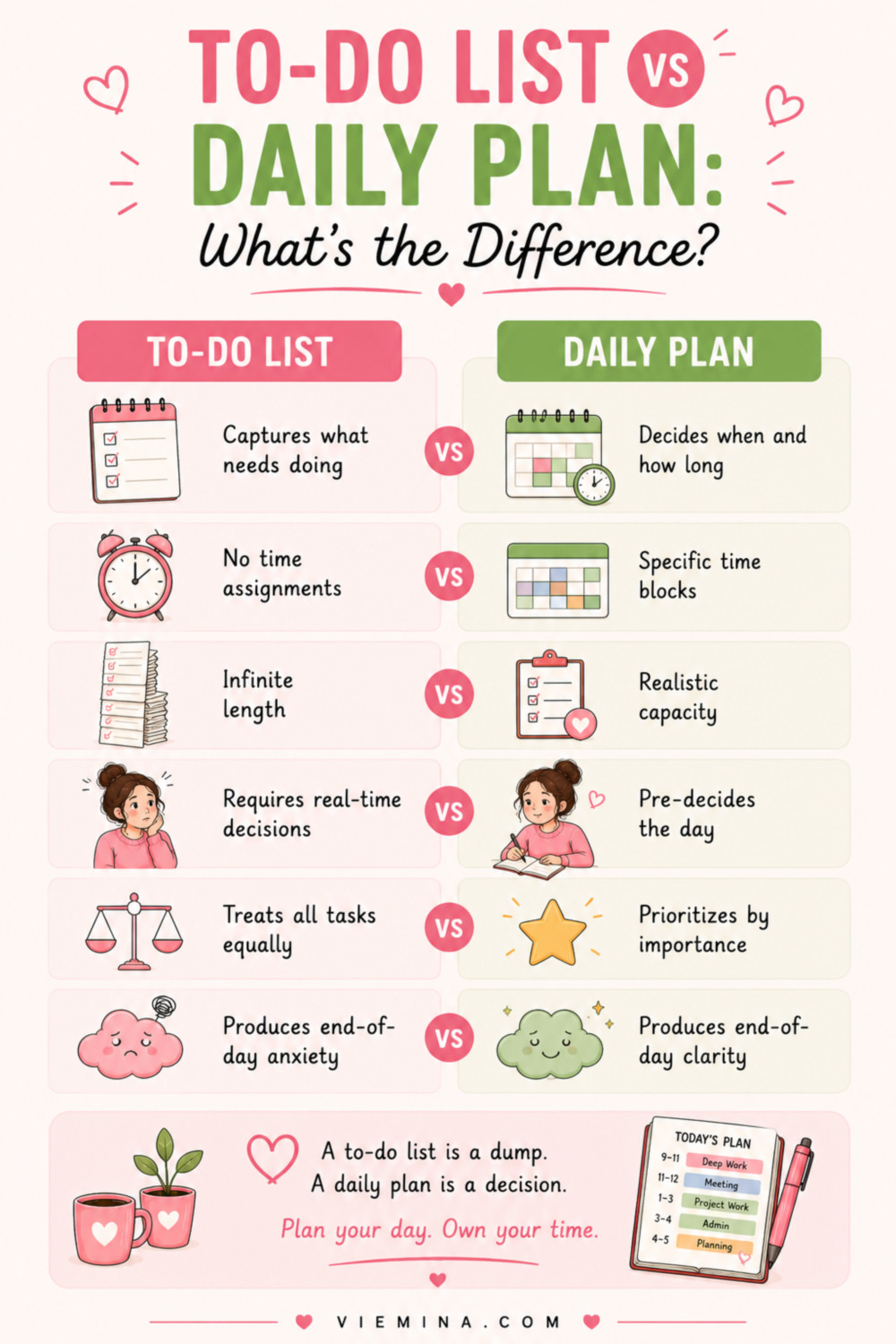
1-Treating Your To-Do List as Your Plan
A to-do list captures what needs to happen. A plan decides when, in what order, and with how much time. Without converting a list into a schedule, you’re still making real-time decisions all day about what to do next, which defeats the purpose.
2-Planning Too Much
The most common planning mistake is optimism about how much can fit in a day. A plan with twelve items isn’t a plan; it’s a guarantee of feeling behind.
Plan for 60-70% of your available time. The rest gets absorbed by interruptions, transitions, and the inevitable reality that tasks take longer than expected.
3-Ignoring Your Energy Levels
Scheduling a cognitively demanding task for 3pm when you’re reliably depleted by 2pm is a plan that sets you up to fail. Match work to energy. The plan should reflect how you actually function, not how you wish you did.
4-Never Reviewing
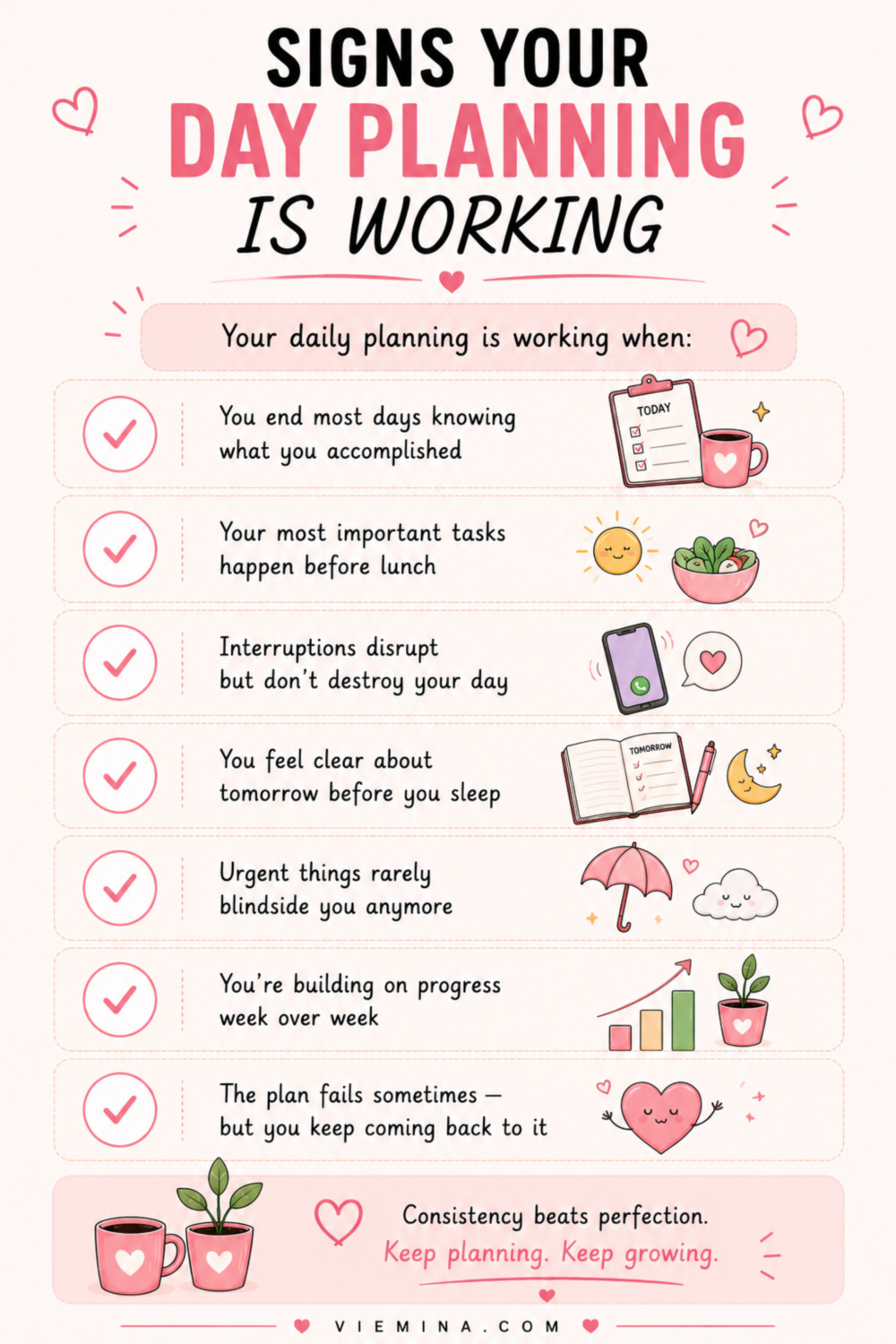
A plan you never evaluate never improves. The two-minute end-of-day review and a weekly reflection session are what close the loop, turning daily planning from a task into a system that compounds over time.
If you’re avoiding planning altogether because tasks feel overwhelming before you start, the article on how to stop procrastination covers exactly why that happens and what to do about it.
How to Plan When Life Keeps Interrupting
Rigid plans break under real conditions. The goal isn’t a plan that never changes; it’s a plan that has enough structure to survive interruption without collapsing entirely.
A few principles that help:
- Protect your MIT above everything else. Meetings can be rescheduled. Emails can wait. The one thing that genuinely matters today should be almost impossible to displace.
- Use “if-then” planning for common interruptions. If an urgent request comes in before lunch, I’ll handle it during my afternoon buffer block rather than stopping the current task. Pre-deciding your response to common disruptions removes the real-time decision.
- Accept imperfect days without abandoning the system. A day where only the MIT gets done is still a productive day. One missed day doesn’t make the planning system worthless; it just means tomorrow is another chance to use it.
The Weekly Review: What Completes the System
Daily planning works well in isolation. It works far better when it’s part of a weekly system.
A weekly review, fifteen to twenty minutes on Sunday evening or Friday afternoon, does three things:
It closes open loops from the week. Tasks that got bumped, commitments that weren’t kept, things that need to carry forward.
It reveals patterns. Maybe you consistently underestimate how long meetings drain you. Maybe Monday morning is your best creative window, but you’ve been filling it with administrative work. The weekly review is where those patterns become visible.
It sets the direction for the coming week. Rather than arriving Monday morning and figuring out the week from scratch, you arrive with a clear sense of what matters and roughly how the week should be shaped.
A simple weekly review format:
- What did I accomplish this week that I’m genuinely satisfied with?
- What didn’t happen that should have, and why?
- What are my two to three most important outcomes for next week?
- What’s on my mind that I need to capture or deal with?
For a broader framework on setting the goals your weekly review tracks against, the guide on how to set goals and achieve them covers the full system.
Conclusion:
The difference between a productive day and a scattered one almost never comes down to how hard you worked.
It comes down to whether you decided, before the day began, what actually mattered.
That decision is the whole point of daily planning. Not to control every hour. Not to optimize every minute. Just to make sure the most important things get protected from the inevitable noise of everything else competing for your time and attention.
Start with five minutes tonight. Write your MIT for tomorrow. Block ninety minutes for it in your morning peak window. Everything else can be figured out from there.
That’s the plan. It’s enough to begin.
FAQs About Daily Planning
What is the best way to plan your day?
The most reliable method combines three things: a clear MIT (Most Important Task) identified before the day begins, time blocking to assign specific hours to priority work, and a brief end-of-day review to close the loop. Beyond the method itself, the most important factor is doing your planning before reactive tasks, email, messages, and requests consume your first mental energy of the day.
Should I plan my day the night before or in the morning?
Both work. Planning the night before has a slight edge because it lets your brain process the plan overnight and means you wake up with direction rather than spending morning cognitive resources on planning itself. Morning planning works well if your evenings are unpredictable. What matters most is consistency; a simple plan done daily outperforms an elaborate system used occasionally.
How many tasks should I plan for each day?
Research and practical experience point to the same answer: fewer than you think. Three meaningful tasks are a realistic daily target for most people. If you can identify your one Most Important Task and complete it, the day was productive. Planning for more than five to seven items total, including small tasks, tends to produce anxiety without producing more output.
What do I do when my plan falls apart mid-day?
Identify your MIT and protect it first. Then apply “if-then” planning, decide in advance how you’ll respond to common interruptions rather than making real-time decisions under pressure. Accept that imperfect execution of a good plan beats no plan. At the end of the day, note what derailed the plan and adjust tomorrow’s structure accordingly.
How is time blocking different from a to-do list?
A to-do list captures what needs to happen. Time blocking assigns specific hours to specific tasks and treats those assignments as appointments. The difference in practice is significant: a to-do list still requires you to decide in the moment what to work on and for how long. Time blocking makes those decisions in advance, which reduces decision fatigue and makes it far harder to avoid the most important work.
How do I plan my day when I have no motivation?
Start with the smallest possible version of the plan. Write down one task. Assign it a time. That’s enough of a plan to begin. Motivation follows action; it rarely precedes it. A plan doesn’t need to be made when you feel motivated. It needs to be made before you start, while the intention is clear. For a deeper look at the motivation-action relationship, the article on why you procrastinate even when you want to work covers the psychology in detail.