
There’s a specific kind of exhaustion that comes from a friendship where you’re always the one giving.
You cancel your plans to be available for theirs. You hold back your real opinions to keep the peace. You say yes when every part of you wants to say no — and then spend the next day resenting yourself for it.
Setting boundaries with friends is one of the things most people know they should do and almost nobody actually does well. Not because the concept is complicated. Because the emotional obstacles — the guilt, the fear of rejection, the worry about damaging the friendship — can feel completely overwhelming.
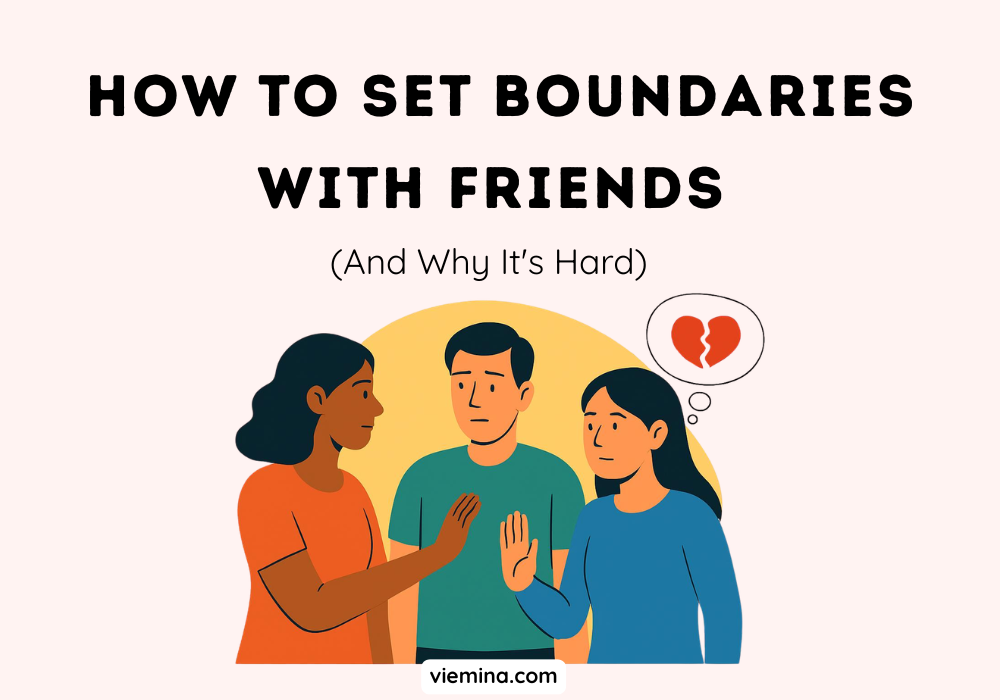
In this guide we’ll break down exactly how to set boundaries with friends — including why it feels so hard and what to actually say
What Are Boundaries in a Friendship?
Friendship boundaries are the limits you set around your time, emotional energy, personal space, and values — the things that define how you want to be treated and what you’re not willing to accept.
They’re not walls. They’re not rejection. They’re not a sign that you care less about the friendship. They’re the parameters within which a friendship can actually work for both people — where neither person consistently ends up drained, resentful, or feeling like they’re giving more than they’re getting.
Boundaries in friendship can cover:
- Time — how often you’re available and what you’re willing to reschedule your life for.
- Emotional energy — how much of someone else’s emotional processing you can hold without losing touch with your own.
- Personal space — what level of access someone has to your home, your phone, your private life.
- Communication — when and how you’re reachable, and what kinds of communication feel respectful.
- Values — things you’re not willing to do, hear, or participate in regardless of the friendship.
A friendship without any of these boundaries isn’t necessarily more intimate. It’s usually just more one-sided.
Why Setting Boundaries With Friends Feels So Hard
Most articles about friendship boundaries jump straight to the “how.” But the reason most people don’t follow through isn’t that they don’t know what to do — it’s that they run into emotional obstacles that make the doing feel impossible.
1-The fear of rejection
Setting a boundary feels like an invitation for the friendship to end. The worry is that saying “I can’t do that” or “that doesn’t work for me” will result in the other person pulling away. This fear is especially strong for people who’ve experienced friendships where any pushback was met with punishment — coldness, guilt, or the withdrawal of warmth.
Related: How To Overcome Fear of Rejection ? 12 Effective Steps
2-Guilt
Many people were raised with an implicit message that prioritizing your own needs over someone else’s is selfish. When that belief is operating, every boundary feels like a betrayal. The guilt isn’t evidence that you’re wrong. It’s evidence of a belief that needs examining.
Related: 15 Signs You’re in a Relationship with a Narcissist,Not Love
3-People-pleasing habits
People-pleasing isn’t a personality trait. It’s usually a learned response — a way of keeping relationships stable by making yourself easy. It often develops in environments where love or acceptance was conditional on behavior. The habit of self-erasure that kept you safe in one context can make it genuinely hard to show up authentically in another.
Related: How to Stop Being a People Pleaser: 10 Signs & Solutions
4-History of controlling friendships
If you’ve been in friendships where your boundaries weren’t respected — where saying no led to guilt-tripping, where having separate plans triggered hurt or anger, where your needs were consistently less important than theirs — you may have learned that setting limits is more trouble than it’s worth. You may not even be fully aware that what you experienced was controlling behavior, because it was dressed up as caring or closeness.
This is one of the least-discussed reasons why setting friendship boundaries is hard. The habits we develop in one-sided or controlling friendships — self-monitoring, preemptive apology, chronic availability — don’t automatically reset in the next friendship.
Related: 15 Signs of a Controlling Friend — And When to Walk Away
Related: 20 Signs of a Controlling Relationship — And How to Leave
Signs You Need to Set Boundaries in a Friendship
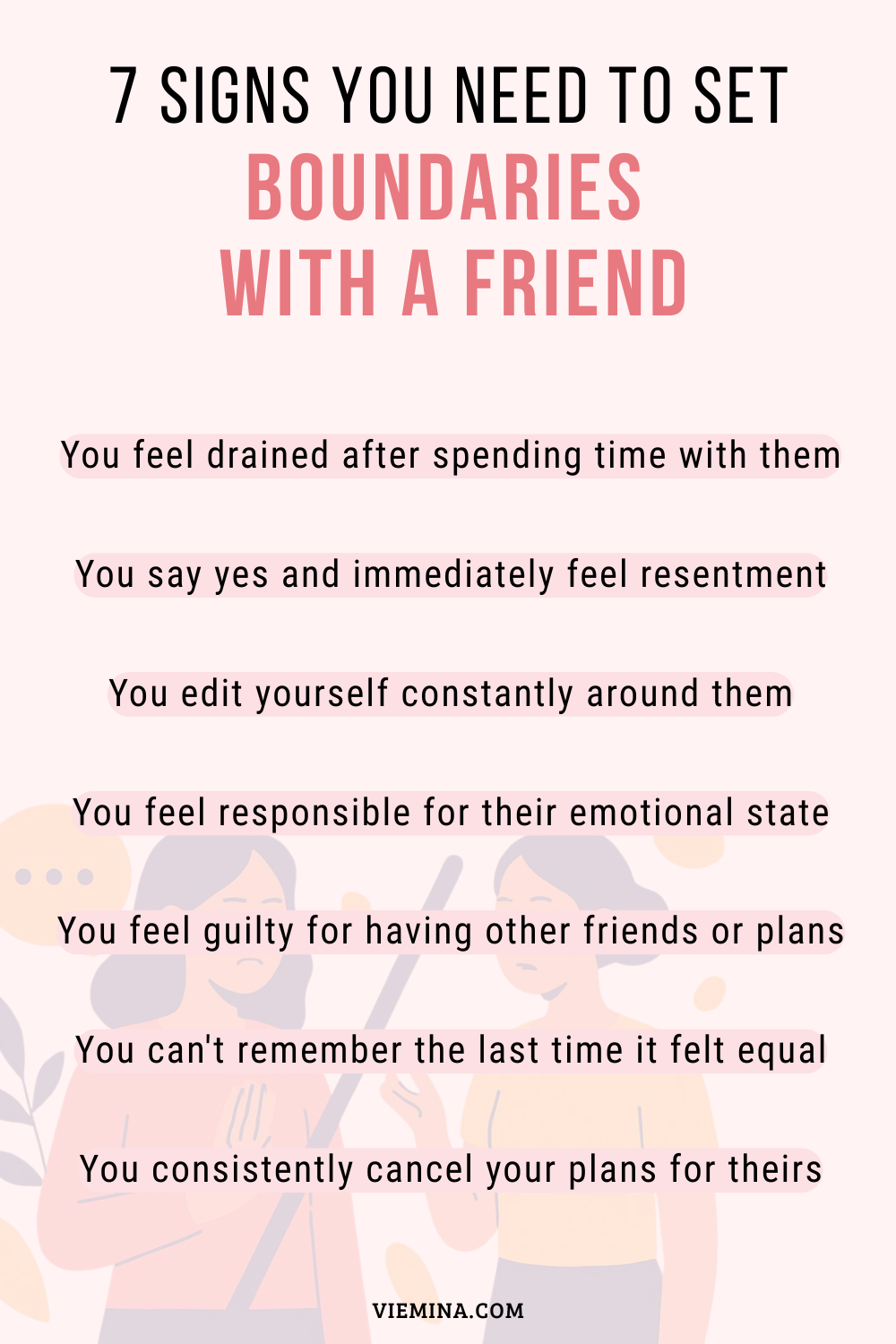
It’s not always obvious when a friendship has crossed from close into consuming. Here are the clearest signals:
1-You feel drained after spending time with them
A healthy friendship should generally leave you feeling connected, energized, or at ease. If you consistently feel exhausted, tense, or relieved when time with a particular friend is over, that’s information worth paying attention to.
2-You say yes and immediately feel resentment
Resentment is almost always a sign that a boundary has been crossed — either by them or by you agreeing to something you didn’t actually want. If you notice resentment building around a specific friendship, it’s usually pointing to a boundary you haven’t yet named or communicated.
3-You edit yourself constantly around them
If you pre-screen your opinions, avoid certain topics, or adjust what you say and do based on how you expect them to react, you’re not fully present in the friendship. You’re managing it.
Related: 20 Hidden Signs Of a Manipulative Friend You Never Knew
4-You feel responsible for their emotional state
There’s a difference between caring about how a friend is doing and feeling like their emotional wellbeing is your responsibility to maintain. If you find yourself constantly adjusting your behavior to prevent them from being upset, that’s a significant imbalance.
5-You feel guilty for having other friends or plans
Healthy friendships don’t require exclusivity or constant availability. If a friend consistently makes you feel guilty for spending time with other people, having separate interests, or simply being unavailable, that’s a pattern worth addressing.
6-You can’t remember the last time the friendship felt equal
Friendship doesn’t require keeping a ledger, but it does require a general sense of mutuality. If one person is consistently doing more of the emotional work, making more of the effort, or adjusting their life more often, something is out of balance.
How to Set Boundaries With Friends — Step by Step
1. Get clear on what you actually need before the conversation
You can’t communicate a limit you haven’t yet identified. Before you talk to your friend, spend time understanding exactly what’s not working for you. Not what you think you should need. Not what sounds reasonable. What you actually feel depleted or resentful about.
Useful questions:
- When do I feel most drained or frustrated in this friendship?
- What do I keep agreeing to that I don’t want to do?
- What would need to change for this friendship to feel sustainable?
Being specific is essential. “I need more space” is hard to act on. “I need you to stop calling me every evening — I need that time for myself” is something both of you can work with.
2. Choose the right moment
Setting a limit in the middle of a conflict, or immediately after something has gone wrong, tends to go badly. The conversation lands better when neither of you is already activated.
Pick a calm, private moment. Don’t ambush them in a group setting or via text if the conversation is significant. Give the conversation the conditions it needs to go well.
3. Lead with the relationship, not the complaint
Starting with how much you value the friendship isn’t just diplomatic. It’s true, and it matters. People hear limits very differently when they don’t feel like they’re being criticized or rejected.
Something like: “I really value our friendship, and there’s something I want to talk about because I think it’ll help us.” This frames the conversation as being in service of the friendship, not against it.
4. Be direct and specific using “I” statements
The most effective boundary conversations are clear, specific, and framed in terms of your own experience rather than the other person’s behavior.
Instead of: “You always cancel last minute and it’s really inconsiderate.” Try: “When plans get canceled at the last minute, I end up feeling frustrated and like my time isn’t being respected. I need more notice when plans need to change.”
The difference is that the second version is harder to argue with. It’s your experience, not an accusation. It states what you need without requiring the other person to accept they’re a bad friend.
Related: How To Avoid Fake Friends? 11 Warning Signs
5. Be prepared for their reaction — and hold the limit anyway
When you set a boundary with someone who isn’t used to you having one, their initial reaction may be surprise, hurt, or even pushback. This is uncomfortable but normal.
A friend who respects you will — after any initial reaction — come to understand and honor the limit. A friend who consistently responds to your needs with guilt-tripping, withdrawal, or pressure to change your mind is showing you something important about the friendship.
Setting a limit and maintaining it even when it’s uncomfortable is what transforms it from a stated preference into an actual boundary. The follow-through matters as much as the conversation.
Related: Top 10 Signs of a Toxic Friend (and How to End It Right)
6. Know when a conversation isn’t enough
Some limits don’t need a formal conversation. Consistently being less available, not engaging with certain topics, or declining certain requests are all ways of setting limits through behavior rather than declaration.
Other situations — persistent patterns that are significantly affecting your wellbeing — do need direct conversation. And some friendships, after honest attempts to address an imbalance, may need to be significantly scaled back or ended.
Recognizing that a friendship has served its purpose and no longer fits your life is not a failure. It’s self-awareness. Not all friendships are meant to last forever, and holding onto ones that consistently cost more than they give is not loyalty. It’s habit.
Related: Trauma Bond vs Love: How to Tell the Difference
Related: 7 Stages of Trauma Bonding: How to Break the Cycle & Heal
What Healthy Friendship Boundaries Look Like in Practice
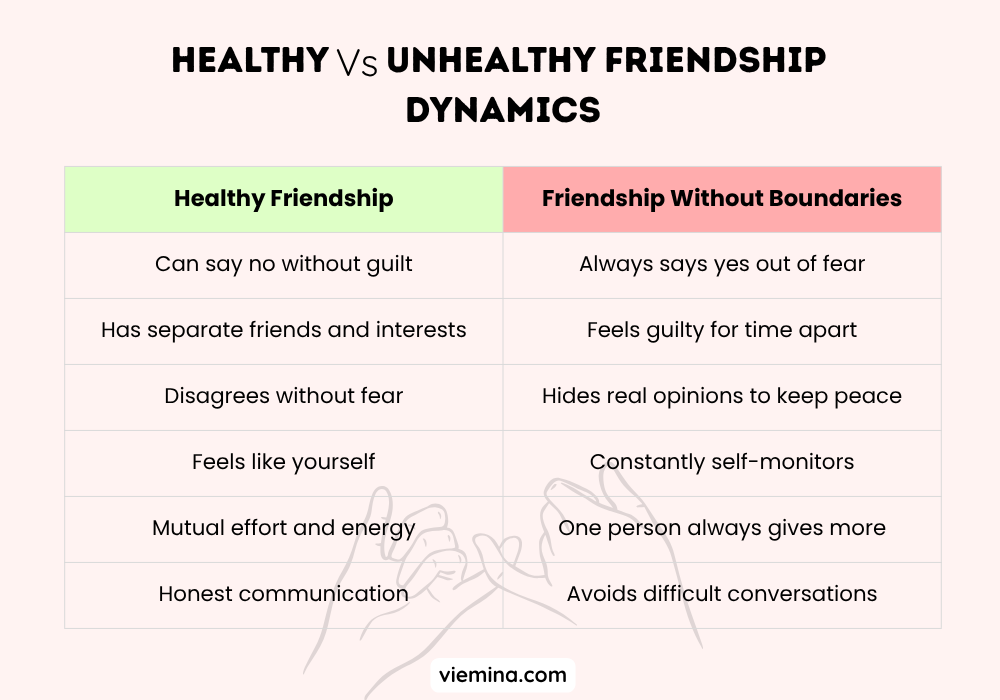
A friendship with healthy boundaries doesn’t feel transactional or cold. It actually feels more relaxed than one without them — because both people know where they stand.
It looks like:
- Being able to say “I can’t this weekend” without extensive explanation or guilt
- Knowing that disagreeing won’t threaten the relationship
- Having separate friendships and interests without it being a source of tension
- Being able to ask for what you need and trust that the response will be honest
- Feeling like yourself — not a managed version of yourself — in the friendship
The goal of setting limits isn’t to protect yourself from connection. It’s to make genuine connection possible — to show up as a real person rather than a performance, and to have friendships that sustain you rather than drain you.
Once you know how to set boundaries with friends, the relationship actually relaxes — because both people know where they stand.
A Note on Friendships That Resist Limits
If you’ve tried to set a limit with a friend and they’ve responded with consistent guilt-tripping, hurt, or pressure to abandon it — that tells you something important about the friendship’s dynamics.
Controlling behavior in friendships often doesn’t look dramatic. It looks like a friend who gets hurt whenever you’re unavailable. Who responds to your “no” with a silence that makes you apologize. Who makes you feel responsible for their emotional state and subtly punishes you when you don’t meet that responsibility.
If this sounds familiar, the problem isn’t that you haven’t communicated clearly enough. The problem is a pattern. And understanding that pattern — what it looks like, why it’s hard to leave, what it does to your sense of self over time — is the most important thing you can do, both for this friendship and for any future ones.
Related: 12 Manipulative Apology Examples: How To Spot Fake Sorries
Conclusion
Learning how to set boundaries with friends is one of the most important investments you can make in your own wellbeing and in the quality of your relationships.
Setting limits with friends is not about caring less. It’s about creating the conditions for caring more honestly — for showing up in friendships without constantly managing your own needs into invisibility.
The difficulty isn’t weakness. It’s usually evidence of habits that developed for good reasons in less safe contexts. Those habits can change. It starts with recognizing that your needs matter in a friendship — not just the needs of the person in front of you.
A friendship that can only exist without limits isn’t really a friendship. It’s a performance. And you deserve something more than that.
Frequently Asked Questions
Why is it so hard to set boundaries with friends?
Setting limits with friends is hard for several reasons including fear of rejection, deeply embedded people-pleasing habits, guilt about prioritizing your own needs, and in many cases a history of friendships where limits were met with punishment or guilt-tripping. The emotional obstacles are often more challenging than the practical steps. Many people who struggle with this developed the habit of self-erasure in earlier relationships — whether in childhood, family, or previous friendships — where making yourself easy was the way to keep connection stable.
What are examples of healthy friendship boundaries?
Healthy friendship limits include being available only during certain hours, not being expected to cancel your own plans regularly for another person’s needs, being able to decline requests without lengthy explanation, having separate friendships and interests without it causing tension, keeping certain topics or parts of your life private, and expecting honesty and follow-through from a friend. The specific limits will vary between people and friendships — what matters is that both people generally respect them.
How do you set limits without losing the friendship?
Lead with the relationship rather than the complaint. Be specific about what you need rather than making general criticisms. Use “I” statements that describe your experience rather than accusing your friend of poor behavior. Choose a calm, private moment for the conversation rather than during conflict. And be prepared for the possibility that some initial discomfort is part of the process — healthy friendships can handle the adjustment period. The friendships that genuinely can’t survive you having any limits at all were likely not as strong as they appeared.
Is it normal to feel guilty after setting a friendship boundary?
Yes, guilt after setting a limit with a friend is very common — particularly for people who were raised to prioritize others’ needs or who have a history of relationships where self-advocacy led to conflict. The guilt is usually the result of a belief — that your needs matter less, or that asserting yourself is a form of rejection — rather than evidence that you’ve actually done something wrong. It tends to fade with practice and with the experience that the friendship can survive, and often strengthen, when limits are in place.
When should you end a friendship instead of setting a boundary?
Consider ending or significantly scaling back a friendship when your limits are consistently ignored after being clearly communicated, when the friendship regularly requires more than it returns, when being around this person consistently leaves you feeling worse about yourself, or when the pattern of the friendship resembles controlling behavior — guilt-tripping, emotional withdrawal as punishment, demands for constant availability, or making you feel responsible for their emotional state. Not every friendship can or should be maintained indefinitely. Some friendships have a natural end, and recognizing that is not failure.