

Most people know how to set goals. Write it down, make it specific, give it a deadline. That part isn’t hard.
What’s hard is the part nobody talks about as much: why goals fail even when you set them correctly. Why does the gym membership from January sit unused by March? Why the business idea stays in the notes app for two years. Why does the goal that felt so urgent on Sunday feel irrelevant by Wednesday?
Setting a goal is easy. Building the kind of life where that goal actually happens is the harder skill.
This guide isn’t just another list of tips. It covers the real mechanics of goal achievement; the psychology behind why goals stick or don’t, how to build them properly from the ground up, and what to do when (not if) things fall apart along the way.
Whether you’re setting personal goals, career goals, or trying to rebuild after a string of failed attempts, this is the place to start.
How to Set Goals and Achieve Them?
Start by choosing goals that genuinely matter to you, not goals you think you should want. Write them down in specific, measurable terms with a clear deadline. Break each goal into the smallest possible actions. Build systems and routines around those actions so they don’t rely on daily motivation. Track your progress, expect setbacks, and adjust without quitting. The people who achieve their goals consistently aren’t more disciplined than you; they’ve built environments and habits that make showing up easier than not showing up.
Why Most Goals Fail (And It’s Not a Willpower Problem)
Before getting into how to set goals, it helps to understand why they usually don’t work.
The most common reason is this: people set outcome goals without building the system to support them. They decide they want to lose 10 pounds, write a book, or save money without changing any of the daily habits and environments that produce the current result.
James Clear put it well in Atomic Habits: you don’t rise to the level of your goals, you fall to the level of your systems. The goal is the destination. The system is the vehicle. Without the vehicle, you’re just wishing.
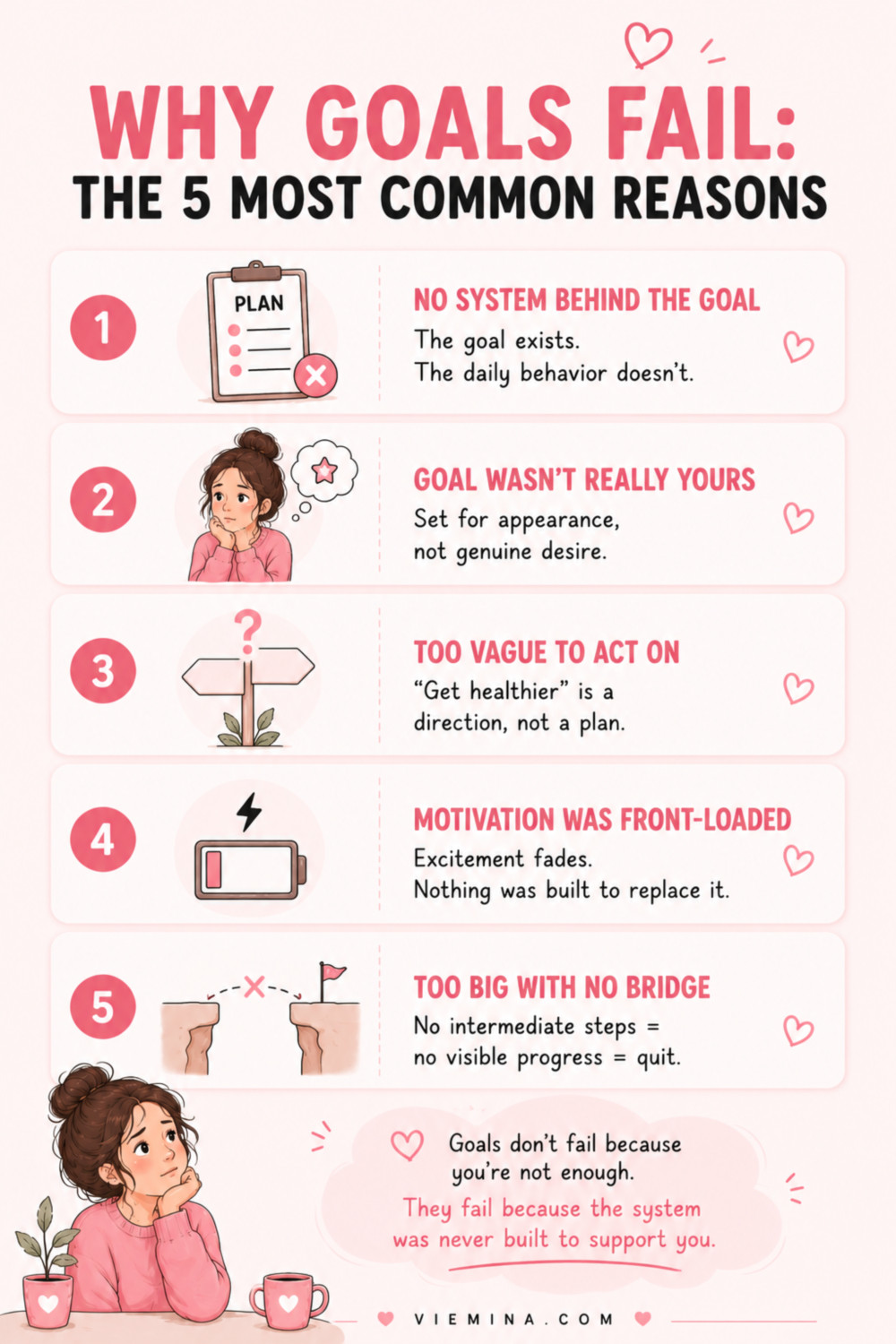
A few other reasons goals fail:
- The goal wasn’t really yours. You set it because it seemed impressive, because someone else expected it, or because it felt like the thing a better version of you would want. Goals that aren’t deeply personal rarely survive the friction of real life.
- It was too vague. “Get healthier” is not a goal. It’s a direction. Without specifics on what healthier looks like, how you’ll measure it, and what you’ll do on Tuesday at 7am, there’s nothing to act on.
- The motivation was front-loaded. Excitement at the start is easy. The goal-setting session feels productive. Then real life resumes, the initial energy fades, and there’s no system to fall back on.
- It was too big with no bridge. A goal that’s dramatically far from your current reality can become demoralizing rather than motivating if there are no intermediate steps creating visible progress.
Understanding these failure patterns before you set your goals will save you from building the same trap again.
What Kinds of Goals Are Worth Setting?
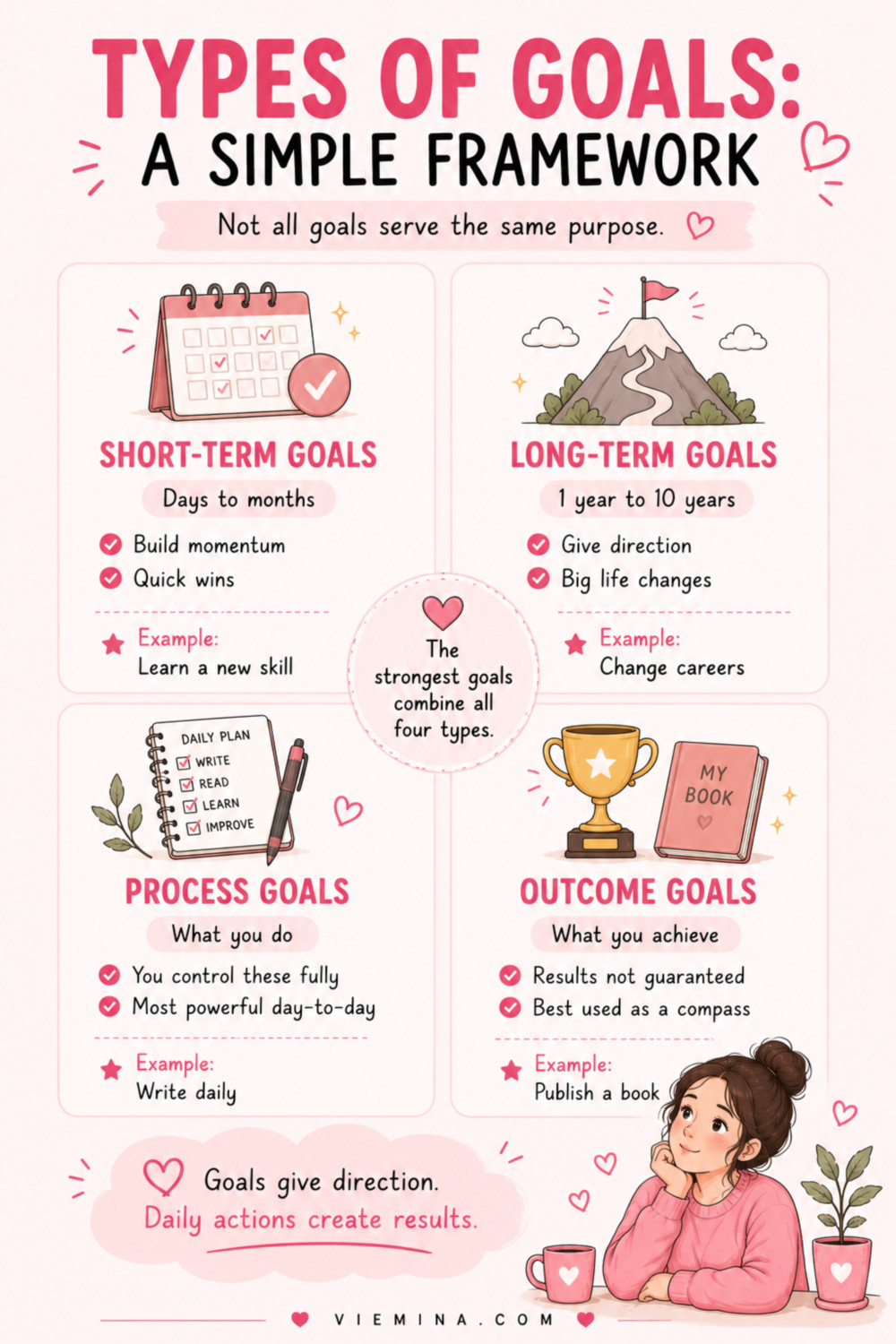
Not all goals are created equal. Before you write anything down, it’s worth knowing what you’re working with.
1-Short-Term vs Long-Term Goals
Short-term goals typically span a few days to a few months. They’re useful for building momentum, creating quick wins, and keeping you moving. Learning a new skill, finishing a project, and establishing a habit fit here.
Long-term goals are bigger and further out, a year, three years, a decade. They give direction to your short-term goals and help you make decisions about where to focus your energy. Career changes, financial goals, and major life transitions sit here.
The most effective goal-setters work at both levels. Long-term goals answer the question “where am I going?” Short-term goals answer the question, “What am I doing this week to get there?”
2-Personal vs Professional Goals
Personal goals cover your health, relationships, learning, mental well-being, and how you want to live day to day. Professional goals cover your career, skills, income, and work impact.
Both matter, and the healthiest goal-setting includes both. Focusing exclusively on professional goals at the expense of personal ones is a well-documented path to burnout. Focusing only on personal goals without professional ambition can create financial or career stagnation that eventually affects everything else.
3-Process Goals vs Outcome Goals
An outcome goal is the result: run a marathon, get promoted, write a book.
A process goal is the behavior that produces the result: run four times a week, complete one leadership project per month, write 500 words every morning.
Process goals are often more powerful day-to-day because you have full control over them. You can’t always guarantee an outcome, but you can almost always control whether you did the work. Building your daily focus around process goals while keeping the outcome goal as your compass tends to produce better results than obsessing over outcomes alone.
How to Set Goals That Actually Work
Step 1: Start With Why, Not What
Before defining the goal itself, get honest about why you want it.
Not the impressive version of the why; the real one. “I want to get fit because I’m scared of getting sick” is more actionable than “I want to be healthier.” “I want to earn more because I feel financially anxious all the time” is more honest than “I want to be successful.”
When the real reason is clear, it becomes a source of fuel when the initial motivation fades. It also helps you design a goal that addresses the actual problem rather than a surface-level version of it.
A useful question: If no one would ever know I achieved this goal, would I still want it? If the answer is no, it might be more about appearance or external validation than genuine desire. Goals driven primarily by external validation tend to have short lifespans.
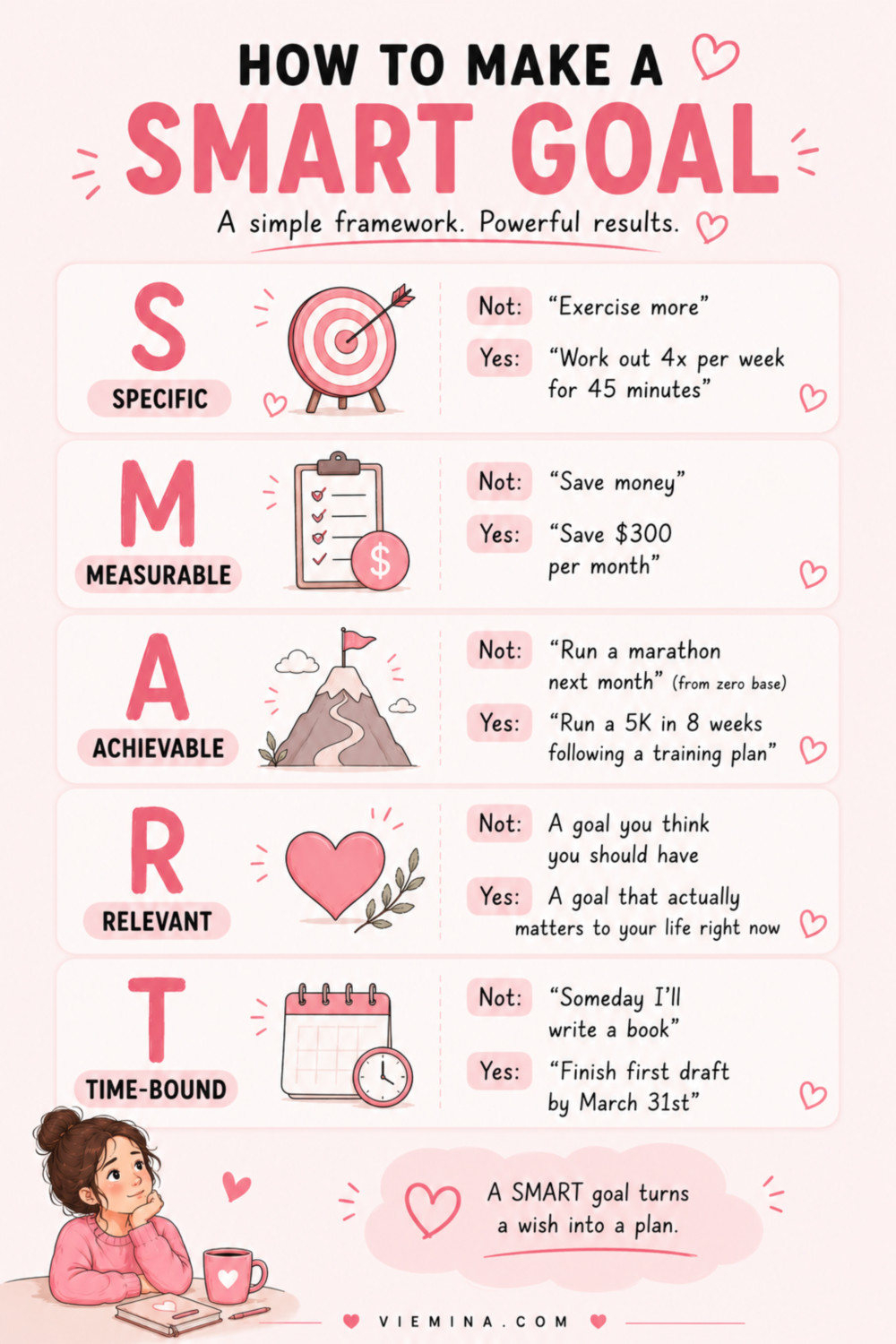
Step 2: Make It SMART
The SMART framework is everywhere, and it’s everywhere because it works. A goal that passes the SMART test is dramatically more likely to happen than one that doesn’t.
Specific: clearly defined, with no ambiguity about what “done” looks like. Not “exercise more” but “work out four times a week for 45 minutes.”
Measurable: you can track progress and know when you’ve succeeded. Numbers help here: weight, pages, dollars, kilometers, hours.
Achievable: genuinely possible given your current resources, time, and constraints. Ambitious is fine. Disconnected from reality is not.
Relevant: aligned with what actually matters to you right now, not two years ago or what someone else thinks you should want.
Time-bound: has a deadline. Open-ended goals tend to stay open. “By December 31st” creates urgency and a natural review point.
A goal that passes all five tests gives you something concrete to act on rather than aspire to.
Step 3: Write It Down Properly
This step has actual research behind it. A study by psychologist Dr. Gail Matthews at Dominican University found that people who write down their goals are significantly more likely to achieve them than those who don’t.
But how you write it matters. “I want to write a book” is passive. “I will finish a first draft of my book by March 31st by writing 500 words every morning, Monday through Friday,” is a commitment with a built-in plan.
Write the goal in present-tense language as if it’s already underway: “I am working toward…” rather than “I hope to someday…” The language you use shapes how your brain relates to the goal.
Keep it somewhere you’ll see it. A goal written once and filed away is just a journal entry.
Step 4: Build the System Around the Goal
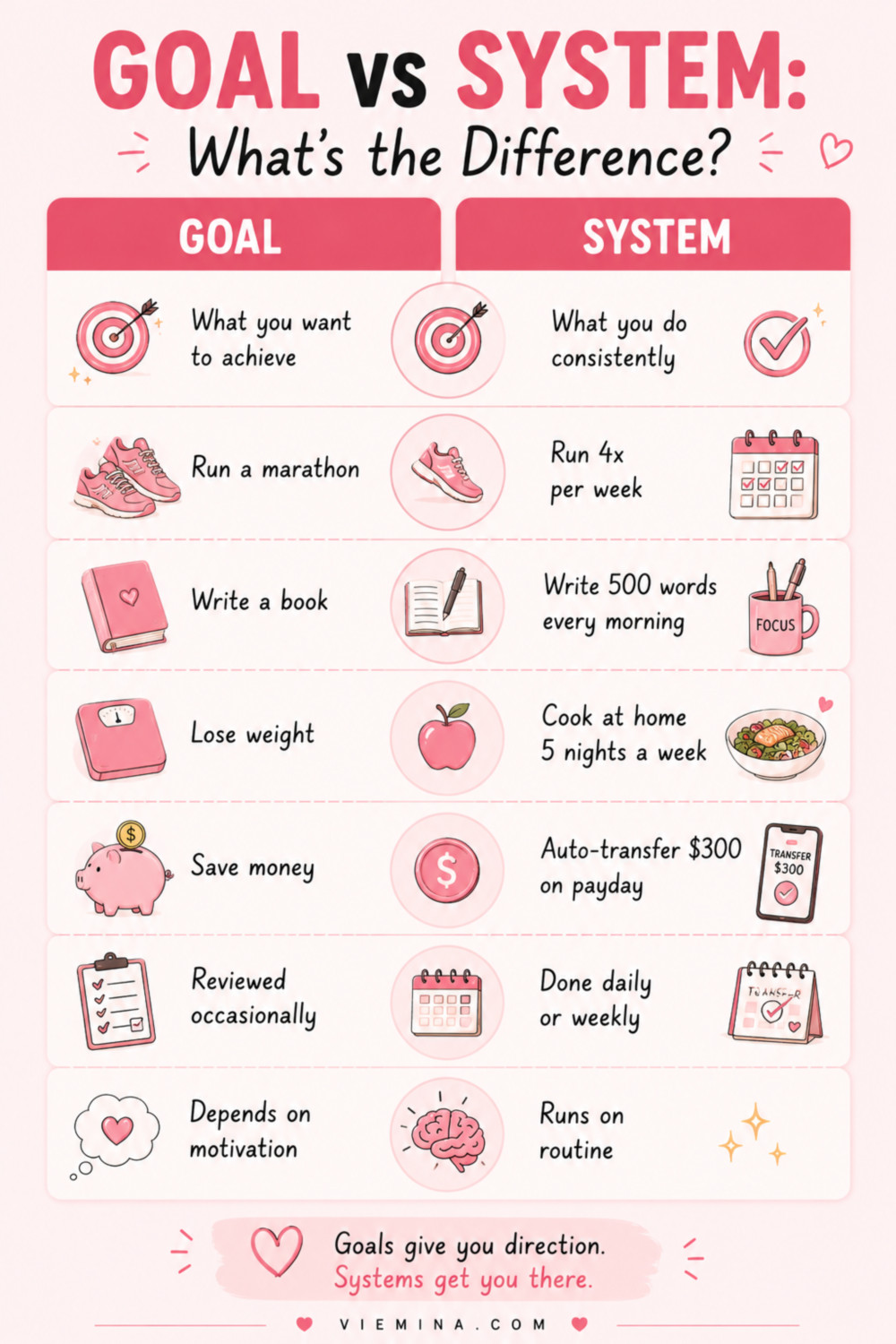
This is the step most people skip, and the reason most goals fail.
For every goal, ask: what daily or weekly behavior makes this inevitable over time? Then build that behavior into your existing routine rather than relying on yourself to choose it each day.
If the goal is to read more, the system might be: 20 minutes of reading every morning before checking your phone. That’s a decision made once, not re-made every morning.
If the goal is to save money, the system might be: an automatic transfer to savings on payday before you can spend it. The behavior becomes frictionless.
James Clear calls this “habit stacking“, attaching a new behavior to an existing one so it runs automatically rather than depending on willpower. The existing habit becomes the trigger for the new one.
A goal without a system is a wish. A system without a goal has no direction. You need both.
Related: Productive Morning Routine: 13 Habits That Actually Work
Related: How To Create a Productive Evening Routine: 12 Easy Steps
Step 5: Break It Into the Smallest Possible Steps
Big goals feel abstract. Abstract things are easy to avoid. The solution is making the next action so specific and small that it requires no decision-making; you just do it.
Not “work on my business” but “spend 30 minutes this Tuesday writing the first paragraph of the website homepage.”
Not “get in shape” but “put on workout clothes at 7am and walk to the gym.”
The goal of a micro-step isn’t to accomplish everything at once. It’s to remove the gap between intention and action. That gap is where most goals die.
When a goal starts to feel overwhelming, it usually means the next step is still too large. Break it down further until it feels almost embarrassingly manageable. Then do it.
Step 6: Build In Accountability
People achieve goals faster and more consistently when someone else knows about them.
This doesn’t have to be a formal accountability partner. It can be telling a friend your goal, joining a community of people working toward similar things, or even writing weekly check-ins in a journal where you report to yourself honestly.
The research on accountability is consistent: external commitment raises follow-through. The mechanism is partly social pressure and partly the act of articulating progress, which makes vague goals more concrete and measurable over time.
The Identity Shift Nobody Talks About
Here’s an insight that most goal-setting advice skips entirely.
The most durable behavior change doesn’t come from deciding to achieve a goal. It comes from deciding to become a certain kind of person.
The person who says “I’m trying to go to the gym” has a different relationship to the behavior than the person who says “I’m someone who works out regularly.” One is a task. The other is identity.
Every time you take an action aligned with the identity you want, you cast a vote for that identity. Miss a workout? One vote against. Show up anyway when it’s hard? One vote for. The identity builds or erodes through accumulated small actions over time.
Before setting your goal, ask: who is the kind of person who achieves this naturally? What do they believe about themselves? How do they make decisions?
Then start acting from that identity, before you’ve fully earned it. The actions build the belief. The belief sustains the actions.
This is particularly relevant if you’ve failed at the same goal multiple times. Trying harder with the same identity usually produces the same result. Shifting the identity first changes the behavior from effort to expression.
For more on why behavior change is harder than it looks and why wanting to change isn’t always enough to make it happen, the article on why you procrastinate even when you want to work covers the psychological patterns that undermine follow-through.
When You Fall Off Track (Because You Will)
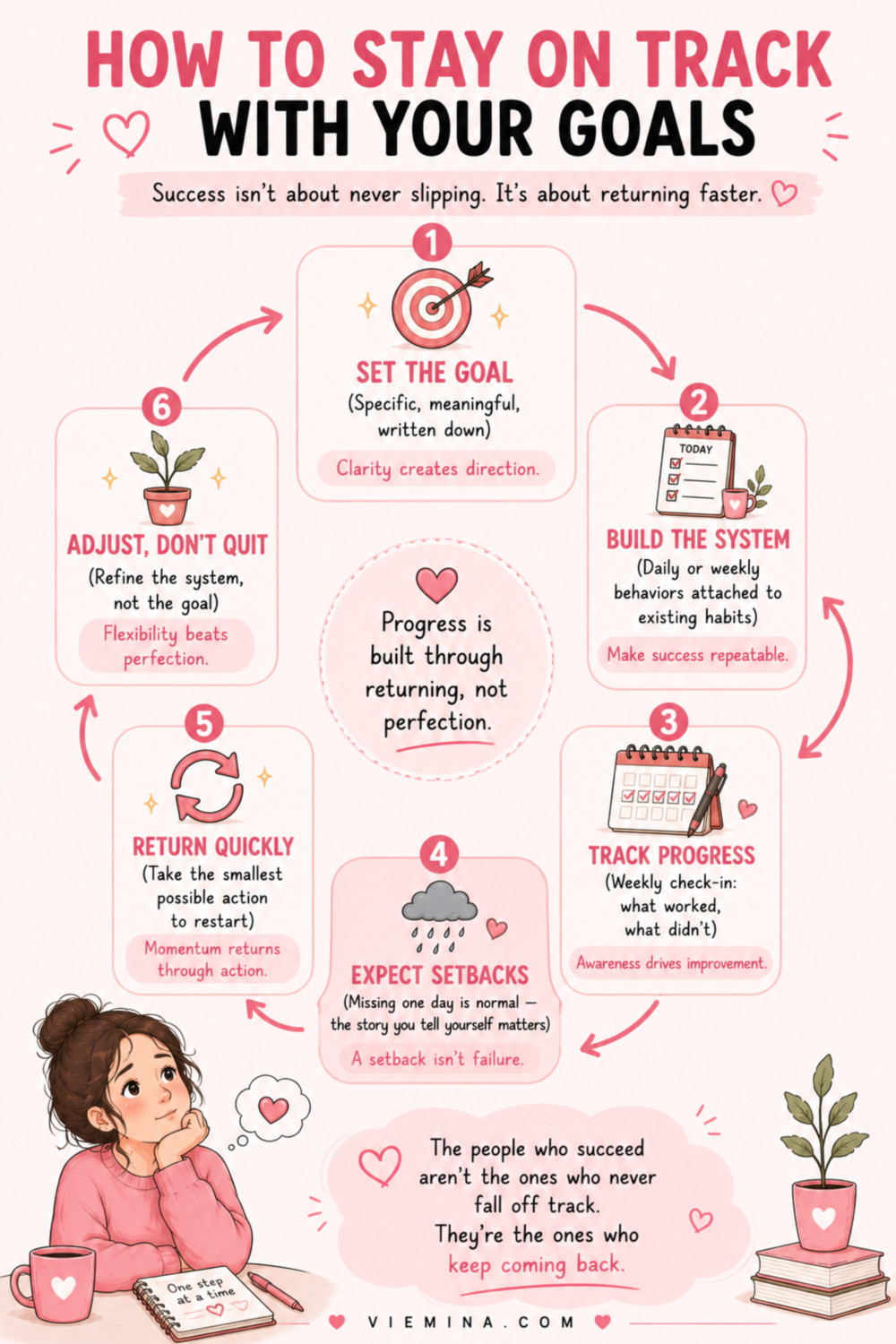
Missing a day doesn’t mean the goal is over. Missing a week doesn’t mean the goal is over.
The research on habit formation suggests that occasional lapses don’t significantly impact long-term outcomes; what matters is how quickly you return after the lapse, not the lapse itself.
The dangerous pattern is not the missed day. It’s the story that follows the missed day: “I can’t do this, I always fail, I’ve ruined it.” That story is what turns a minor interruption into an abandoned goal.
When you fall off track, the only useful question is: what’s the smallest action I can take right now to get back on track?
Not a perfect recommitment. Not a revised plan. Just the next small step. Show up imperfectly. The momentum rebuilds from there.
It also helps to do a quick review when things fall apart. Was the goal too vague? Was the system missing? Was the goal actually wrong for where you are right now? Sometimes falling off track is feedback, not failure.
Related: How to Overcome Perfectionism: What It Is and How to Stop It
Related: Perfectionism and Procrastination: The Hidden Link
How Many Goals Should You Set?
Most people set too many goals at once and accomplish none of them.
The research and the practical experience point in the same direction: focus on one to three meaningful goals at a time. Beyond that, attention gets divided, progress slows on everything, and the discomfort of juggling too many priorities often leads to abandoning all of them.
If you have more than three goals you want to pursue, prioritize. Ask which goals, if achieved, would make the others easier or less important. Start there.
You can always return to the others once the primary goals are established or completed.
Tracking Progress Without Becoming Obsessed
Tracking matters because what gets measured tends to improve, and because visible progress is one of the most reliable sources of ongoing motivation.
But tracking can also become counterproductive when it creates anxiety, becomes more important than the work itself, or turns into a performance for others rather than a tool for self-awareness.
A simple weekly check-in is usually enough: what did you do this week toward the goal, what got in the way, and what’s the one thing to focus on next week?
Keep it lightweight. The goal is insight, not administration.
Related: What Is Toxic Productivity? 13 Signs You’ve Crossed the Line
FAQs About Goal Setting
-
Why do I keep failing at my goals?
Usually, one of a few reasons: the goal wasn’t specific enough to act on, the motivation was external rather than genuine, there was no system built around the goal, or the goal was too large without intermediate steps creating visible progress. Start by identifying which of these applies, then redesign the goal or the approach, not your self-assessment.
-
How do I stay consistent with my goals when motivation fades?
Build systems that don’t depend on motivation. Schedule your goal-related activities in advance, like appointments. Make the behavior as automatic as possible by attaching it to existing habits. Reduce friction so starting is easy. Motivation is unreliable; consistency comes from design, not willpower.
-
How many goals should I set at once?
One to three. More than that divides your attention enough that meaningful progress on any single goal becomes unlikely. If you have a long list of goals, prioritize: which one would make the biggest difference, or make other goals easier? Start there.
-
What is the difference between a goal and a system?
A goal is the outcome you want to achieve. A system is the repeated behavior that produces that outcome over time. You need both; the goal gives direction, and the system makes progress consistent. Most people focus too much on the goal and not enough on building the daily or weekly behaviors that generate results.
-
How long does it take to achieve a goal?
It depends entirely on the goal, but the more useful question is: how consistent are the daily behaviors toward it? A goal with a clear system and daily action will progress faster and more predictably than one reviewed occasionally when motivation returns. Focus on the behavior frequency, not just the timeline.
-
What do I do when a goal stops feeling meaningful?
First, check whether the goal was genuinely yours to begin with or whether it was driven by external pressure or expectation. If it was yours and still matters, look at whether you’ve lost sight of why it matters; reconnecting with the original motivation often restores energy. If it genuinely no longer aligns with what you want, it’s okay to release it. Goals should serve your life, not the other way around.
Conclusion:
The gap between setting a goal and achieving it isn’t filled by wanting it more. It’s filled by building a life where the behaviors that produce the result are the default, not the exception.
That means choosing goals that are genuinely yours. Writing them in specific, measurable terms. Building systems that make action easier than inaction. Expecting setbacks and planning for them. And showing up consistently, even imperfectly, over time.
None of this requires being a different kind of person. It requires building a different kind of environment, one where the person you want to become can actually emerge.
Start with one goal. Make it specific. Take one action today. That’s enough to begin.
If procrastination is what keeps getting between you and your goals, the complete guide on how to stop procrastination goes deep into every layer of that pattern and how to break it.