

Does this sound familiar? You go to bed determined to finally master your routine, but when the alarm rings, the plan falls apart. You’re not failing at routines; you’re likely using an outdated approach. Modern psychology shows that routines—the automatic behaviors that shape nearly 40% of our day—should be a flexible framework to reduce decision fatigue, not a rigid prison for every minute.
This guide strips away the complexity and gives you a science-backed, sustainable blueprint for a daily routine that actually works, freeing your energy for what truly matters.
What is a Daily Routine?
A routine is an action that happens again and again, regularly. You often do it, like brushing your teeth, taking a shower, or making your bed. Most of us have routines, even if we don’t realize them. Routines can help us get things done more quickly because we don’t have to decide what to do next—we just do what we always do.
A great daily routine isn’t a strict, minute-by-minute prison. It’s a flexible framework that handles life’s mundane details on autopilot. It’s the structure that makes spontaneity possible, the groundwork that allows creativity to flourish, and the kindest thing you can do for your future self.
Having a routine can help us feel more in control of our lives and can give us a sense of accomplishment. A daily routine can be very helpful in getting out of a funk. It can provide a sense of structure and normalcy in your life, which can be very comforting during difficult times. Plus, it can help you get things done more efficiently because you don’t have to waste time making decisions about what to do next.
The Science-Backed Benefits of Having a Daily Routine:
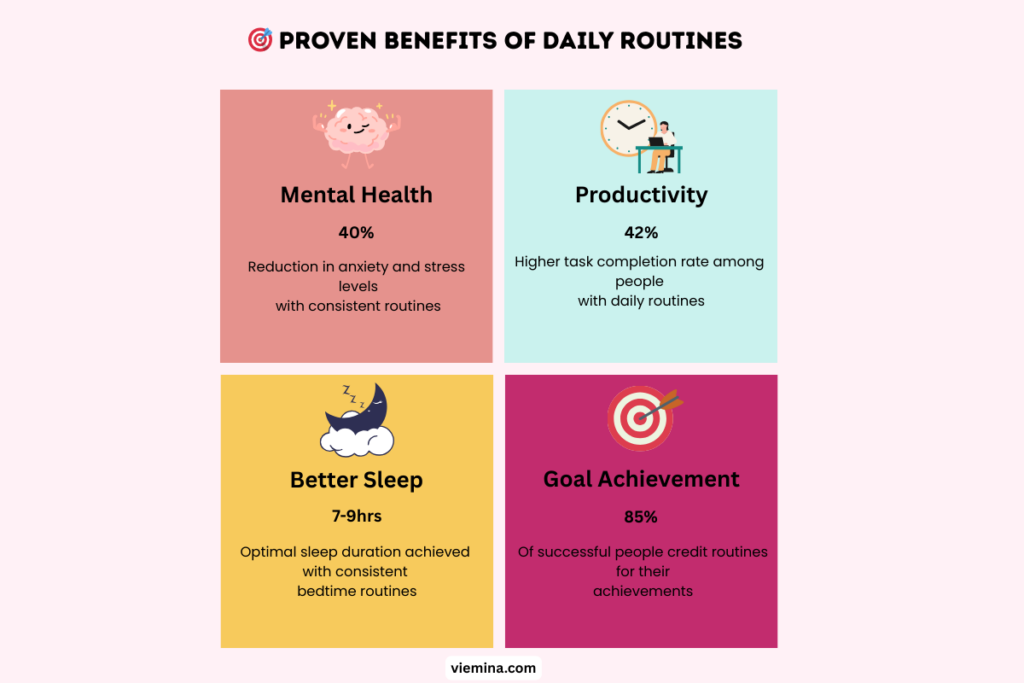
Before we build, let’s understand the powerful “why.” A daily routine is much more than a schedule; it’s a scientifically-supported tool that acts like a keystone habit, positively influencing your mental health, physical energy, and focus. Research confirms that consistent routines provide a sense of control and predictability, which directly reduces anxiety and builds resilience, especially during uncertain times.
1. It’s a Peace-of-Mind Machine (Mental & Emotional Benefits)
A predictable routine sends a powerful signal to a deep, ancient part of your brain: “Everything is okay. You are safe.” This is why studies, have found that repetitive, predictable patterns are incredibly calming and can significantly reduce anxiety.
- It Lowers Stress: When your day has a basic structure, you’re not constantly wondering what’s coming next. This reduces the low-grade stress of uncertainty. It acts like a guardrail, so when chaos hits (and it always does), you don’t go completely off the road.
- It Builds Emotional Resilience: A 2021 article in Psychology Today highlighted that daily routines are strongly linked to better mental health. The consistency provides a stable foundation, making it easier to handle tough emotions and bounce back from setbacks. You’re not building a cage; you’re building a foundation.
2. It Programs Your Body for Energy (Physical Health Benefits)
Your body loves rhythm. It thrives on consistency. A routine is how you hack your biology to feel more energized and healthy.
- You Will Sleep Better: This is the biggest one. Going to bed and waking up at roughly the same time every day—yes, even on weekends—trains your internal clock (your circadian rhythm). This leads to deeper, more restorative sleep, and you’ll wake up feeling genuinely refreshed instead of groggy. Adults need 7-9 hours, and a routine is the ticket to getting it.
Related: Sleep Deprivation: Symptoms, Causes, & 10 Effects
- You’ll Eat Healthier (Without the Struggle): When you have a routine, “grabbing fast food” becomes a conscious choice, not a default. You make time to grocery shop and prep simple meals. This isn’t about a strict diet; it’s about creating space for nutritious food to easily become part of your day.
Related: 10 Ways to Stop Emotional Eating And Be Mindful Of Your Diet
- Exercise Becomes a “Given,” Not a “Maybe”: The hardest part of working out is often the decision to start. When exercise is a non-negotiable block in your schedule (e.g., “I walk every Monday, Wednesday, and Friday at 7 AM”), you stop debating it. You just do it. The consistent momentum does the work for you.
3. It Unlocks Your Brain’s Full Potential (Focus & Productivity Benefits)
This is where the secret weapon really shines. A routine systematically removes the barriers to doing your best work.
- It Defeats “Decision Fatigue”: This is a real psychological phenomenon. As mentioned earlier, every choice taxes your willpower. High achievers like Steve Jobs and Barack Obama famously wore similar outfits daily to eliminate one trivial decision. Your routine does that for dozens of decisions, preserving your mental energy for important problems.
- It Crushes Procrastination: We often stall because starting feels overwhelming. A routine eliminates that. If your routine says “from 9 AM to 10 AM, I write,” you don’t waste 30 minutes staring at a blank screen. You start writing at 9 AM. The routine provides the starting pistol.
- It Creates Unstoppable Momentum: Small, consistent actions create massive results over time. Writing for 30 minutes a day finishes a novel. Saving a small amount each month builds wealth. A routine is the engine of this compound effect, turning lofty goals into daily, manageable steps.
A great daily routine isn't a strict, minute-by-minute prison. It's a flexible framework that handles life's mundane details on autopilot. It's the structure that makes spontaneity possible, the groundwork that allows creativity to flourish, and the kindest thing you can do for your future self.
13 Essential Tips to Create Your Effective Daily Routine:
Forget building a perfect, minute-by-minute schedule that shatters on day two. The most effective modern routines aren’t rigid—they’re flexible frameworks that guide your energy, not micromanage your time. Think of it as building a helpful rhythm for your day, not a prison sentence.
1: Identify Your Goals and Priorities:
Before creating any routine, you need clarity on what you want to achieve. Ask yourself:
- What are my short-term and long-term goals?
- Which activities contribute most to my wellbeing?
- What matters most to me personally and professionally?
- What areas of my life require more attention?
While goal-setting can include tangible achievements, you should also think about your emotional goals—what feelings you hope to have more of by following this routine.
2:Plan the Night Before (Your Secret Weapon Against Morning Chaos):
Planning the night before is like giving your future self a gift. When you spend just 10-15 minutes before bed mapping out tomorrow, you eliminate the morning scramble and decision fatigue that drains your willpower before the day even starts.
How to do it:
- Write down your top 3 priorities (focus on your “Big Rock”—the one task that matters most)
- Lay out clothes, prep your bag, and set up your workspace
- Use sticky notes, a planner, or your phone to capture everything
- Review your calendar so nothing catches you by surprise
Why it works: Your subconscious mind works on problems while you sleep. When you plan ahead, you wake up with clarity instead of chaos, and often with solutions you didn't have the night before. You're not just organizing tasks—you're programming your brain for success.
3:Master Your Sleep Schedule (The Non-Negotiable Foundation):
Your body has an internal clock called the circadian rhythm, and it thrives on consistency. Going to bed and waking up at the same time every day—yes, even weekends—is one of the most powerful things you can do for your energy, mood, and health.
Adults need 7-9 hours of quality sleep. When you keep a consistent schedule, you regulate the hormones that control alertness and sleepiness. You’ll fall asleep faster, sleep deeper, and wake up feeling actually refreshed instead of groggy.
Related: Insomnia :Symptoms ,Causes & 10 Types
4:Create a Daily To-Do List:
Having a daily to-do list can be helpful in adhering to a set routine. This list acts as a reminder of the daily tasks you set for yourself and offers a sense of satisfaction as you cross completed items off.
Effective to-do list strategies:
- Prioritize using the 1-3-5 rule: Choose 1 big task, 3 medium tasks, and 5 small tasks daily
- Time block your tasks: Assign specific time slots to each activity
- Separate “must do” from “would like to do” to manage expectations
- Review and update your list morning and evening
- Use digital tools like Todoist, Notion, or physical planners to track progress
Research shows that writing down goals and tasks increases the likelihood of completion by 42%. The act of crossing items off your list triggers dopamine release, creating positive reinforcement that motivates continued productivity.
Digital or paper? Use whatever you’ll actually use. Todoist, Notion, a bullet journal, or simple sticky notes—it doesn’t matter. What matters is capturing your commitments so your mind can rest.
👉 Get Your Free Digital & Printable Daily Planner Here
What you get: Instant access to A4, A5, and LETTER-sized PDFs. Print only what you need, whenever you need it, and begin structuring your ideal day today.
5:Take a Shower and Get Dressed (The Transformation Ritual):
Even if you’re working from home, shower, and dress like you’re going somewhere important. This simple act is a powerful psychological trigger that shifts your brain from “rest mode” to “game on mode.”
The psychology: Getting ready signals completion. You’re telling your subconscious that sleep time is over, and it’s time to show up for your life. The physical transformation creates a mental one.
6:Set Your Mealtimes (Fuel Your Body, Focus Your Mind):
Having regular mealtimes is important for your physical and mental well-being. It will help you avoid snacking and make sure you are getting the nutrients you need.
Optimal meal timing structure:
- Breakfast: Within 1–2 hours of waking to fuel morning activities
- Lunch: Midday (12-1 PM) to sustain afternoon energy
- Dinner: 3–4 hours before bedtime for better digestion and sleep
Eating meals at regular intervals supports a healthier metabolism and helps maintain stable energy levels throughout the day. When you don’t have scheduled meals, you’re more likely to make impulsive, unhealthy food choices or skip meals entirely, which disrupts blood sugar levels and cognitive function.
Meal planning tip: Dedicate time weekly to plan your meals and grocery shopping. This creates opportunities to incorporate nutritious whole foods into your everyday life while reducing the decision fatigue around “what’s for dinner?”
7:Set Aside a Regular Time (Work With Your Energy, Not Against It):
Your energy isn’t constant throughout the day—it rises and falls in 90-120 minute cycles called ultradian rhythms. When you schedule tasks based on your natural energy patterns, work feels easier and you accomplish more.
The 3-Block Framework:
1: Morning Block (6 AM — 12 PM):
Your brain is sharpest here. Do deep work—writing, strategy, problem-solving, important decisions.
Related: Productive Morning Routine: 13 Tips to Start Your Day Right
2: Afternoon Block (12 PM — 6 PM):
Energy dips slightly. Perfect for meetings, collaborative work, emails, moderate-difficulty tasks.
3: Evening Block (6 PM — 10 PM):
Wind-down time. Personal activities, relationships, hobbies, light tasks, preparation for tomorrow.
🔸Pro Tip: If something takes 40 minutes, schedule 60. This cushion prevents stress and keeps your day from derailing when life happens (and it always does).
Related: How To Create a Productive Evening Routine: 12 Easy Steps
The secret: When you honor your natural rhythms instead of fighting them, productivity becomes effortless. You're not forcing—you're flowing.
8: Be Realistic (Progress Over Perfection):
Here’s the truth nobody tells you: It takes an average of 66 days to form a habit—and some habits take up to 8 months. If you expect instant transformation, you’ll quit before the magic happens.
–Start microscopic:
Want to exercise? Start with 10 minutes, not an hour. Want to meditate? Start with 2 minutes, not 20. Tiny habits compound into massive results.
–The 80% rule:
Doing something 80% of the time is infinitely better than doing it perfectly 0% of the time. Miss a day? That’s data, not failure. Learn from it and get back on track tomorrow.
Related: Why Do I Feel Like a Failure? 20 Causes That Might Shock You
The deeper wisdom: Self-compassion isn't soft—it's strategic. When you treat yourself with kindness instead of criticism, you're more likely to persist. You're playing the long game, not sprinting toward burnout.
9: Be Adaptable (Your Routine Should Grow With You):
The routine that works for you today might not work for you in six months—and that’s okay. Life changes, you change, and your routine should evolve too.
–When to adapt:
- Life circumstances shift (new job, relationship, move)
- You feel bored or uninspired
- Your energy levels change
- Your goals evolve
–How to adapt smartly:
- Do monthly reviews (what’s working? What’s not?)
- Make small tweaks, not complete overhauls
- Create a “minimum viable routine” for chaotic times (travel, illness, busy seasons)
A rigid routine becomes a prison. A flexible routine becomes a superpower. You're not failing when you adjust—you're succeeding at listening to yourself.
10: Break Tasks into Smaller Chunks (Make the Impossible Manageable):
Big goals are inspiring but paralyzing. Breaking them into micro-habits makes them doable. When you win small, you build momentum. When you build momentum, you become unstoppable.
–Example—Exercise habit:
- Week 1-2: 10-minute walks
- Week 3-4: 15-minute workouts
- Week 5-6: 20-25 minute sessions
- Week 7+: Your target duration
–Example—Morning routine:
- Week 1: Consistent wake time only
- Week 2: Add water + stretching
- Week 3: Add breakfast + planning
- Week 4: Add meditation or journaling
Every expert was once a beginner who didn't quit. Every massive transformation started with one tiny, unsexy action, repeated consistently. You're not behind—you're building.
11: Schedule Your Work Hours and Breaks (Rest Is Productive Too):
Your brain isn’t a machine. It can only maintain intense focus for 90–120 minutes before it needs rest. Pushing through fatigue doesn’t make you productive—it makes you burnt out.
–Strategic break schedule:
- Micro-breaks (2-5 min): Every 25-30 minutes—look away, stretch, breathe
- Short breaks (15-20 min): Every 90 minutes—walk, hydrate, step outside
- Lunch break (30-60 min): Away from your desk, preferably outside
- End-of-day ritual (15 min): Close laptop, tidy space, review tomorrow
–Work boundaries matter:
- Set a hard stop time each evening
- Turn off work notifications after hours
- Create a shutdown routine that signals “work is done”
The research: Employees who take regular breaks report 21% better concentration and 22% better time management. Rest isn’t lazy—it’s how high performers stay high performers.
You're not a robot. You're a human who requires recovery. Honor that.
12: Practice a Digital Sunset for Quality Sleep:
The blue light from screens in the evening suppresses melatonin, the hormone that makes you sleepy, disrupting your circadian rhythm. Implement a “digital sunset” at least 60 minutes before bed: power down all screens. Use this time for reading, light stretching, conversation, or planning the next day. This simple habit dramatically improves sleep quality and next-day alertness.
13: Plan Your Routine on a Longer Time Scale
The most important part of creating a routine is understanding what needs to be done and when. Make a list of everything you want to accomplish on a daily, weekly, biweekly, monthly, and yearly basis. Once you have this list, you can start scheduling your activities and following your routine.
Multi-Scale Planning Framework:
- Daily: Core habits that happen every day (sleep schedule, meals, exercise, hygiene, work blocks)
- Weekly: Activities that occur several times per week (grocery shopping, laundry, meal prep, social activities, hobby time)
- Monthly: Regular but less frequent tasks (bill payments, monthly reviews, haircuts, deep cleaning, professional development)
- Quarterly: Seasonal adjustments and major reviews (goal assessment, wardrobe rotation, routine evaluation)
- Yearly: Annual milestones and planning (vacation planning, annual checkups, tax preparation, major goal setting)
If needed, purchase a calendar or agenda to start managing your time more efficiently. Having a written, scheduled routine will make it simpler to add to your day-to-day or weekly obligations. You can use the all-in-one planner to plan your daily, weekly, monthly and more.
This hierarchical approach ensures nothing falls through the cracks while preventing your daily routine from becoming overwhelming with too many tasks. You're not just planning days—you're architecting a life.
Common Mistakes to Avoid When Building Your Routine:
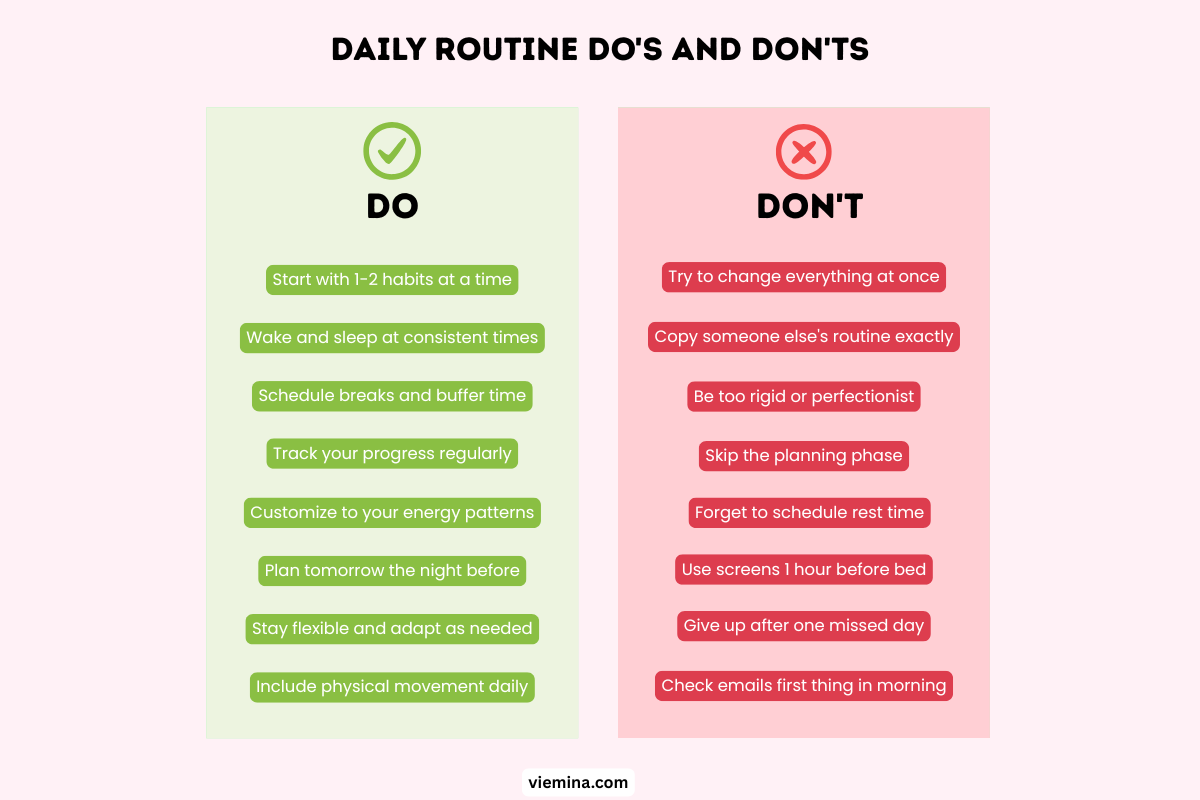
1. Being Too Rigid
A morning routine that makes you miserable is not going to help you do hard things or ultimately be more successful. Your routine should feel supportive, not restrictive.
Solution: Build in flexibility and buffer time. Allow for spontaneity while maintaining core non-negotiables.
2. Trying to Copy Someone Else’s Routine
What works for someone else may not work for you.
Solution: Use others’ routines for inspiration but customize based on your unique circumstances, energy patterns, and preferences.
3. Starting Too Big
Attempting to change everything at once leads to overwhelm and abandonment of the routine within days.
Solution: Focus on one or two keystone habits first. Master these before adding more elements.
4. Not Planning for Disruptions
Life inevitably throws curveballs—travel, illness, family emergencies, busy seasons at work.
Solution: Create a “minimum viable routine” that contains your absolute essentials (sleep, hydration, 10-minute movement) that you can maintain even during chaotic periods.
5. Skipping the Review Process
Blindly following a routine without evaluation prevents optimization and leads to stagnation.
Solution: Schedule regular check-ins to assess effectiveness and make data-driven adjustments.
6. Forgetting About Recovery
Sure, you could work for 10 hours straight and get up only to use the bathroom. But is that truly what’s best for your mind and your body?
Solution: Build in adequate rest, breaks, and recovery time. Sustainable productivity requires periods of renewal.
Conclusion:
Creating an effective daily routine is one of the most powerful investments you can make in your future. A well-structured daily routine provides a roadmap for the day to help you prioritize tasks and allocate your time efficiently, leading to improved productivity, better mental health, enhanced physical wellbeing, and greater life satisfaction.
Remember these key principles:
- Start small with 1-2 habits rather than overhauling your entire life
- Be consistent but not rigid—flexibility prevents burnout
- Track progress to maintain motivation and identify what works
- Adjust regularly as your life circumstances and goals evolve
- Focus on wellbeing rather than extreme productivity hacks
Your future self will thank you for the structure, clarity, and peace that a thoughtful daily routine provides. Success isn’t built in dramatic moments but through small, consistent actions repeated day after day.
Ready to transform your life? Start building your personalized daily routine today and experience the profound benefits of structured, intentional living.
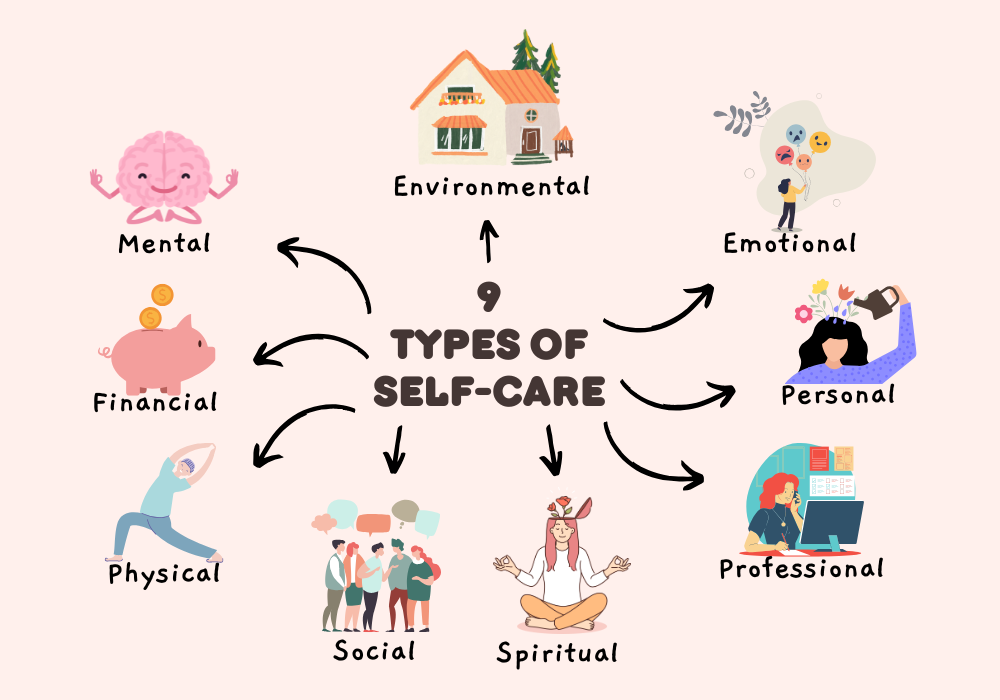
Related: 9 Types Of Self Care For Less Stress & Better Life
Frequently Asked Questions About Daily Routines
-
How long does it really take to form a habit?
A: The popular “21-day rule” is a myth. A pivotal 2009 study by Phillippa Lally at University College London found it takes an average of 66 days, with a wide range of 18 to 254 days depending on the person and habit complexity. The good news? The same research showed that missing a single day did not derail the long-term process.
-
What if my routine falls apart on a busy or bad day?
A: This is normal and why your Minimum Viable Routine (MVR) is essential. Don’t let perfectionism win. A bad day is just data, not failure. Simply return to your MVR the next day without guilt. Habit research confirms that resilience is about the trend, not perfect streaks.
-
What time should I wake up for my morning routine?
There’s no universally “best” wake time. More important than waking up at 4:30am is keeping a regular schedule and starting each day with a strong morning ritual. Choose a wake time that allows for 7-9 hours of sleep and aligns with your work schedule.
-
What if I miss a day of my routine?
Don’t let perfectionism derail your progress. Failing to follow your routine for one day doesn’t mean you’re off-track. Simply resume your routine the next day without guilt or self-criticism.
-
Should my weekend routine differ from weekdays?
While some flexibility is natural, maintaining core elements (wake time, sleep schedule, exercise) even on weekends helps preserve circadian rhythm and makes Monday transitions easier.
-
How do I deal with constant disruptions or travel?
Rely on your Minimum Viable Routine (MVR) and environment design. Your MVR is your travel-proof core. Then, “engineer” your temporary environment: book a hotel with a gym, pack healthy snacks, and use phone alarms to remind you of your consistent sleep/wake times to minimize jet lag.





Great post. I was checking constantly this blog and I’m impressed! Very useful information particularly the last part 🙂 I care for such information much. I was looking for this particular information for a long time. Thank you and best of luck.