
I had a friend like this once.
She was charming at first — the kind of person who made you feel chosen. But slowly, almost without noticing, I started changing. I second-guessed everything I said around her. When something went wrong between us, it was always my fault — or at least that’s what I ended up believing. I did what she wanted, went where she wanted, changed my plans when she needed me to. And whenever I pushed back, even gently, I’d feel this wave of guilt that made me apologize before she even asked me to.
It took me a long time to name what was happening. It didn’t look like what I thought controlling behavior looked like. There were no threats, no dramatic scenes. It was quieter than that — and somehow that made it harder to see.
Looking back now, I can see clearly what I was dealing with — and in this article I want to walk you through the most important signs of a controlling friend, how to handle it, and when it’s finally time to let go.
What Is a Controlling Friend?
A controlling friend is someone who consistently tries to influence, direct, or manage your behavior, choices, and emotions — usually in ways that serve their needs while leaving yours unmet.
The key word is consistently. Everyone has moments of being demanding or self-centered. A controlling friend does it as a pattern. Over time that pattern shapes how you see yourself, how you make decisions, and how much space you feel you have to be yourself in the friendship.
Controlling friendships rarely announce themselves. They build gradually, through small moments that seem manageable on their own but add up to something much heavier over time.
Why Do Some Friends Become Controlling?
Understanding the why doesn’t excuse the behavior — but it helps you make sense of what’s happening and why it’s so hard to spot.
Insecurity and fear of abandonment. Many controlling people are deeply afraid of being left. Controlling the people around them feels like a way to make that impossible. The tighter the grip, the safer they feel — even if it pushes you away in the end.
Anxiety. Some people manage their internal anxiety by trying to manage their external world — including other people. When things don’t go according to their plan, their anxiety spikes, and control escalates.
Learned behavior. If someone grew up in a home where manipulation and control were normal relationship dynamics, they may simply replicate those patterns without fully realizing it. It’s what relationships look like to them.
Low empathy. Some controlling friends aren’t driven by fear — they’re driven by a genuine disregard for how their behavior affects others. Their needs come first, and yours don’t register with the same weight.
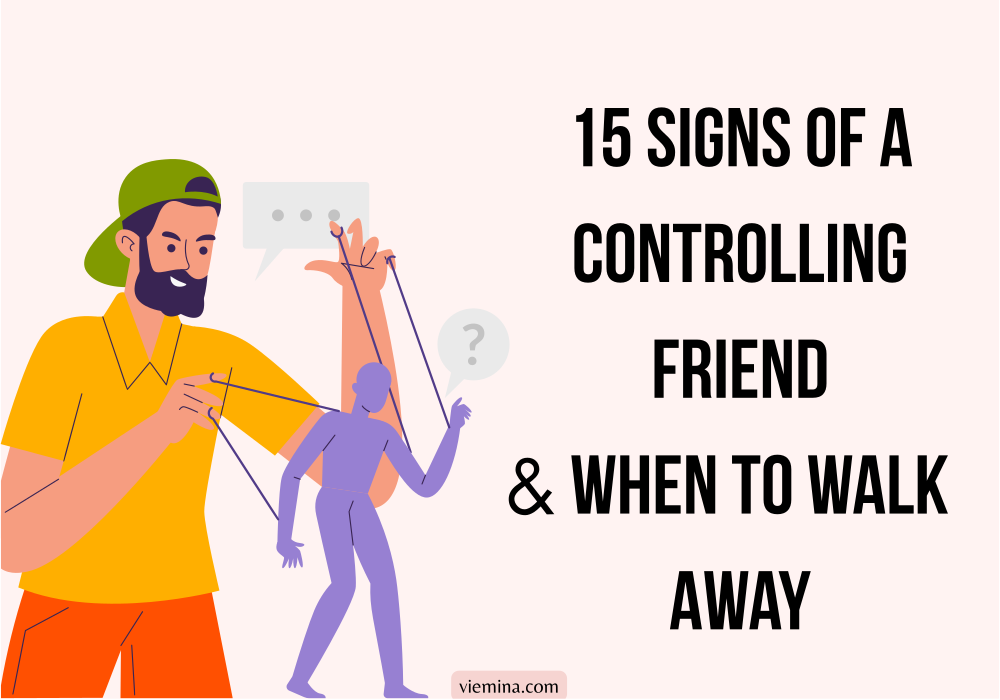
15 Signs of a Controlling Friend
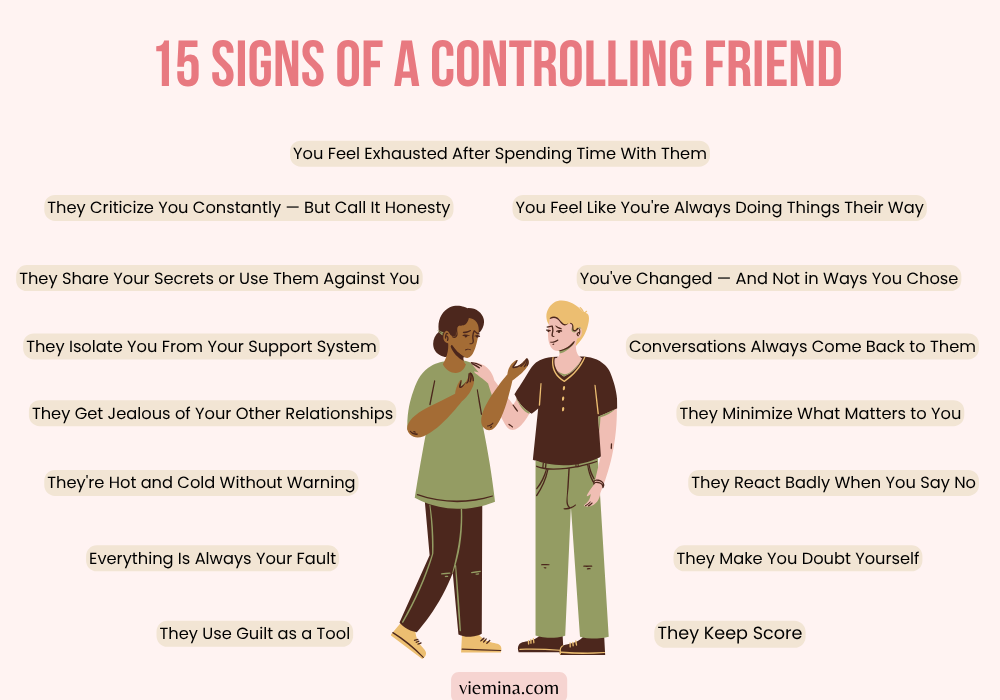
1. Everything Is Always Your Fault
One of the clearest signs of a controlling friend is that you always end up apologizing — even when you’re not sure what you did wrong. They have a way of reframing every conflict so that your actions, your tone, or your reaction is the problem. Over time you start anticipating their reaction to everything you do, constantly adjusting yourself to avoid the next round of blame.
2. They Make You Doubt Yourself
You used to trust your own judgment. Now you run decisions past them before you feel confident enough to act. They’ve subtly — or not so subtly — made you feel like your instincts are off, your opinions are naive, or your feelings are an overreaction. This self-doubt isn’t accidental. It’s one of the most effective tools of control there is.
This self-doubt is one of the most common effects of manipulative behavior in close relationships.
3. You Feel Like You’re Always Doing Things Their Way
Your plans change to fit theirs. Your preferences get overridden. You end up at the restaurant they chose, watching what they wanted to watch, spending time on what they decided mattered. When you do push for what you want, it’s met with so much friction — sulking, guilt, or just relentless persuasion — that it rarely seems worth it.
4. They Use Guilt as a Tool
Guilt-tripping is their specialty. “I thought you were my friend.” “I would have done it for you.” “After everything I’ve done.” These phrases are designed to make you feel indebted — like refusing them means you’re failing as a friend. The guilt isn’t a side effect of their hurt feelings. It’s a strategy, whether conscious or not.
Related: 12 Manipulative Apology Examples: How To Spot Fake Sorries
5. They Get Jealous of Your Other Relationships
A controlling friend often wants to be your primary relationship — and they make it clear when they feel threatened by others. They might criticize your other friends, make plans that conflict with time you’d scheduled with others, or become cold and withdrawn when you spend time with people they can’t control. The goal is isolation, even if it doesn’t look like it from the outside.
Related: How To Avoid Fake Friends? 11 Warning Signs
6. They React Badly When You Say No
In healthy friendships, “no” is a complete sentence. With a controlling friend, it’s the beginning of a negotiation — or a punishment. They might get hurt, go quiet, argue, or escalate until you cave. Over time you learn to say yes to avoid the fallout, even when everything in you wants to say no.
"Learning the basics of saying no effectively is one of the most important skills you can build in this situation."
7. They Minimize What Matters to You
Your achievements get a lukewarm response. Your problems get dismissed or redirected to their own. Your feelings are “too much” or “too sensitive.” This minimizing keeps you slightly off-balance, always seeking their validation — which they give just enough of to keep you invested, but never enough to make you feel genuinely secure.
8. They’re Hot and Cold Without Warning
One day they’re warm, generous, and attentive. The next they’re distant, cold, or easily irritated. You spend a significant amount of energy trying to read their mood and adjust accordingly. This unpredictability isn’t random — it keeps you focused on them and on managing the friendship, which is exactly where they want your attention.
9. Conversations Always Come Back to Them
You try to share something — a problem, an achievement, a feeling — and within minutes the conversation has shifted back to them. They’re not listening to understand; they’re waiting for their turn. Over time you stop bringing things to them because there’s no real space for your experience in the friendship.
10. They Keep Score
Favors, time, support — they track all of it. And you can be sure they’ll reference it when it’s useful to them. “I helped you move, and you can’t do this one thing for me?” Keeping score turns the friendship into a transaction where you’re always in debt. It’s a way of maintaining leverage.
11. They Criticize You Constantly — But Call It Honesty
There’s a difference between a friend who tells you a hard truth when it matters and a friend who consistently finds fault with your choices, your appearance, your relationships, and your decisions. Controlling friends often disguise criticism as “just being honest” or “looking out for you.” But honesty that always happens to serve their agenda and leave you feeling worse about yourself isn’t friendship — it’s control.
"This pattern of disguised criticism is remarkably similar to what many people experience with signs of manipulative parents — controlling behavior learned early often shows up in adult friendships too."
You trusted them with something vulnerable, and now it gets brought up in arguments. Or you find out they’ve shared things you told them in confidence. This isn’t carelessness — it’s leverage. When they know your weak points, they know how to get to you.
13. You Feel Exhausted After Spending Time With Them
Healthy friendships leave you feeling energized, seen, and at ease. Time with a controlling friend leaves you feeling drained, tense, or vaguely anxious — like you’ve just finished a performance you weren’t fully prepared for. That exhaustion is your nervous system telling you something important.
14. They Isolate You From Your Support System
Bit by bit, the people in your life get filtered out. They have a problem with this friend. They don’t like how that person makes you act. They need you available when others are around. You don’t notice it happening until you look up one day and realize your world has quietly shrunk to revolve around them.
Related: Top 10 Signs of a Toxic Friend (and How to End It Right)
15. You’ve Changed — And Not in Ways You Chose
This is the one that hits hardest. You’re quieter than you used to be. More hesitant. Less trusting of yourself. You hold back opinions that used to come easily. People who knew you before this friendship sometimes ask what happened to you. That change is the cumulative effect of everything on this list — and it’s the clearest sign that something in this friendship isn’t right.
How to Handle a Controlling Friend
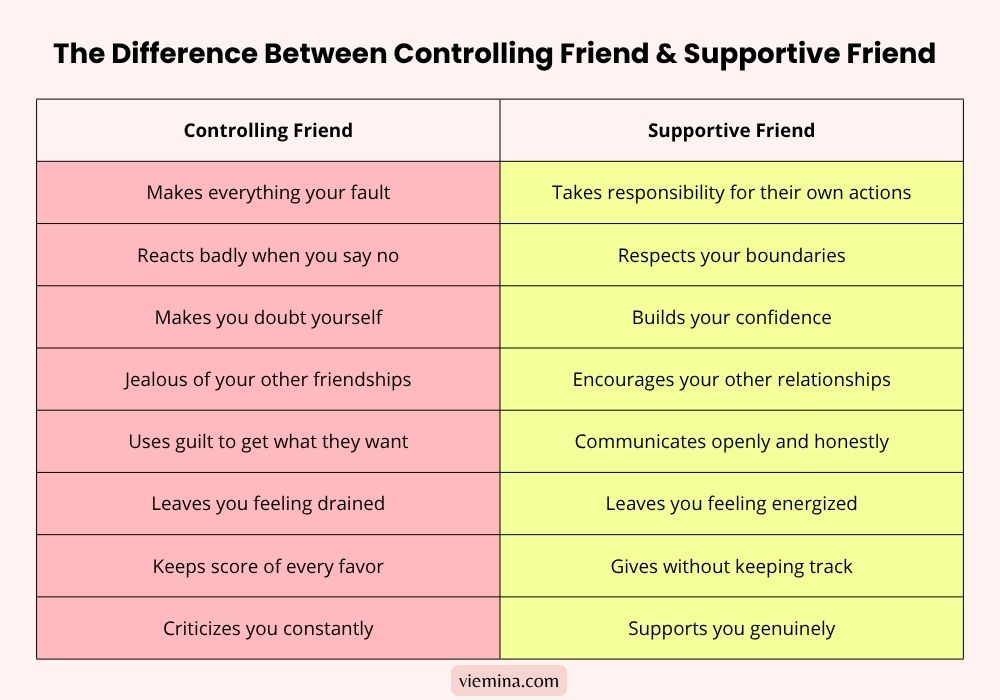
If you recognize some of these signs, here’s how to approach it before deciding whether to stay or go:
Name what’s happening — to yourself first. Before you do anything else, acknowledge what you’ve been experiencing. You’re not overreacting. You’re not too sensitive. What you’ve been feeling is real.
Set a clear boundary and watch what happens. Choose one specific behavior that you’re no longer willing to accept and hold that line. The response you get will tell you everything you need to know. A friend who genuinely cares will hear you. A friend whose control depends on you having no limits will push back hard.
Have a direct conversation. If you believe the friendship is worth trying to save, tell them specifically how their behavior affects you — not as an accusation but as an honest statement. “When you do X, I feel Y.” Stay calm, stay specific, and stay focused on their behavior rather than their character.
Stop explaining and justifying yourself. Controlling friends thrive on negotiation. Every time you explain your decisions in detail, you’re inviting them to argue with your reasoning. You’re allowed to make choices without a full defense. “I’ve made my decision” is a complete sentence.
Rebuild what got eroded. Spend time with the other people in your life. Reconnect with what you enjoy. The controlling friend narrowed your world — widen it again deliberately.
When to Walk Away
This is the question most asked. Here’s the honest answer.
- Walk away when the pattern doesn’t change after you’ve named it clearly.
- Walk away when every attempt to hold a boundary results in punishment — guilt, coldness, escalation, or retaliation.
- Walk away when you feel more like yourself in their absence than in their presence.
- Walk away when the friendship costs you more than it gives you — consistently, not just occasionally.
- Walk away when you realize you’ve been managing their emotions at the expense of your own for longer than you can remember.
You don’t owe anyone a friendship that diminishes you. Real friendship is supposed to feel like a place where you can relax and be yourself — not a performance you have to maintain to avoid someone’s reaction.
Ending a controlling friendship is hard, especially if it’s been long. You might feel guilt, grief, and relief all at once. That mix of feelings is normal. The relief, when it comes, is usually the most honest signal that you made the right call.
"If you notice these same patterns extending into your romantic life, read about the signs of a controlling relationship — the overlap is more common than most people realize."
“If a controlling friendship has crossed into emotional abuse, the National Domestic Violence Hotline offers support for all types of controlling relationships, not just romantic ones.”
Conclusion
Controlling friendships are difficult to spot because they often look like closeness at first. The intensity, the attention, the sense of being needed — it can all feel like loyalty until you realize how much of yourself you’ve given up to maintain it.
If you recognized yourself in this list, trust that recognition. You’re not imagining it, you’re not being unfair, and you’re not a bad friend for wanting something different.
You deserve friendships where you feel free, respected, and genuinely like yourself. That’s not too much to ask for — it’s the bare minimum of what friendship should be.
Frequently Asked Questions About Controlling Friends
What are the signs of a controlling friend?
The most common signs include constant guilt-tripping, making you doubt yourself, reacting badly when you say no, jealousy of your other relationships, keeping score of favors, and leaving you feeling drained rather than energized after time together. The defining pattern is that the friendship consistently serves their needs while yours take a back seat.
Why do some people become controlling in friendships?
Controlling behavior in friendships usually comes from insecurity, fear of abandonment, anxiety, or learned patterns from childhood. Some people control others to manage their own emotional discomfort — keeping friends close and dependent feels safer to them than trusting that the friendship can survive without constant management.
How do you deal with a controlling friend?
Start by setting a specific, clear boundary and observing the response. Have a direct conversation about how their behavior affects you, using specific examples rather than general accusations. Stop over-explaining your decisions, which gives them material to argue with. If the behavior continues after you’ve been direct, it may be time to create distance or end the friendship entirely.
Is it normal to feel guilty for leaving a controlling friend?
Completely normal. Controlling friends are often skilled at making you feel responsible for their emotions, so leaving triggers genuine guilt even when you know it’s the right thing to do. That guilt is the conditioning talking — not an accurate reflection of whether you’re doing something wrong. The relief that follows is usually a more honest signal.
How do I know when to end a controlling friendship?
When the pattern doesn’t change after you’ve named it clearly. When holding a boundary consistently results in punishment. When you feel more like yourself in their absence than in their presence. When the friendship costs more than it gives — not occasionally, but as its baseline. You don’t need a dramatic reason to leave a friendship that consistently makes you feel small.
Can a controlling friend change?
Some can, but only if they genuinely recognize the problem and commit to changing it — usually with outside help like therapy. Change doesn’t happen because you adjust your behavior to accommodate them, and it doesn’t happen through promises alone. If a friend responds to honest feedback with denial, blame, or escalation, the likelihood of real change without professional intervention is very low.