

You know that feeling after spending time with someone who’s supposed to be your friend — where instead of feeling good, you feel somehow worse?
More drained. More self-conscious. Like you gave a lot and received very little, like something was slightly off, but you can’t quite put your finger on what.
That feeling is often your instincts trying to tell you something. Fake friends rarely announce themselves. They tend to show up looking like the real thing — warm, fun, present — and the signs only become visible over time, usually through patterns rather than single incidents.
This article covers 15 of the clearest signs of fake friends, why it can be so hard to see them clearly, and how to actually handle the situation when you recognize it.
What Is a Fake Friend?
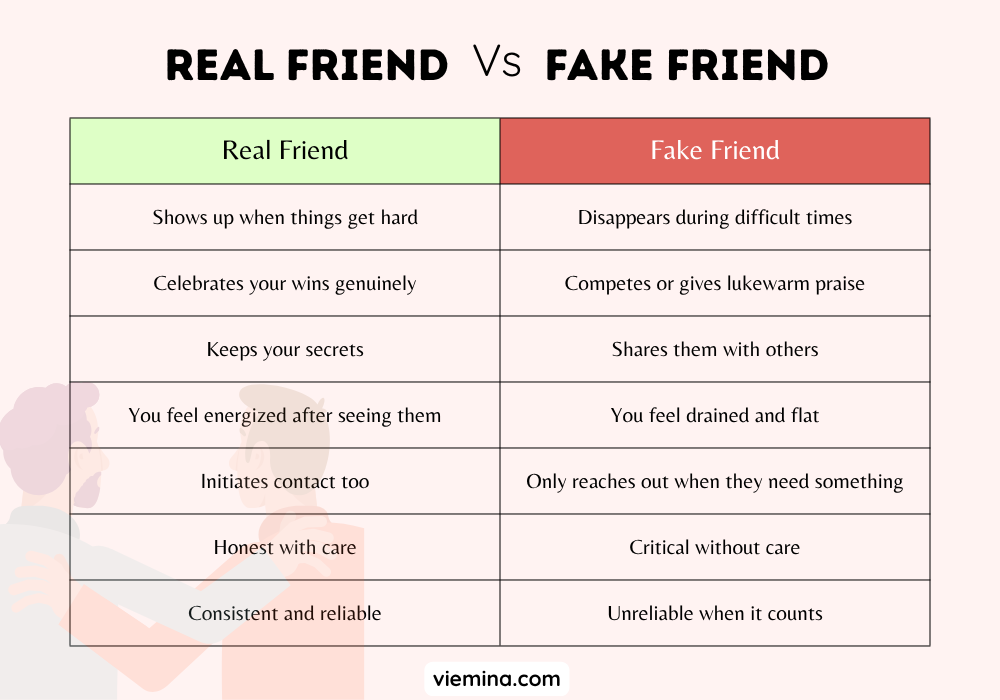
A fake friend is someone who maintains the appearance of friendship without the substance of it. They may be enjoyable company in certain contexts, but the connection lacks genuine care, mutuality, or reliability when it actually matters.
The word “fake” can feel harsh — and it’s worth noting that not every imperfect friend is a fake one. Real friendships involve conflict, inconsistency, and periods of distance. What distinguishes a fake friendship is the pattern: a consistent imbalance where you give more than you receive, where the friendship costs more than it returns, and where you consistently feel worse rather than better for having this person in your life.
15 Signs of Fake Friends
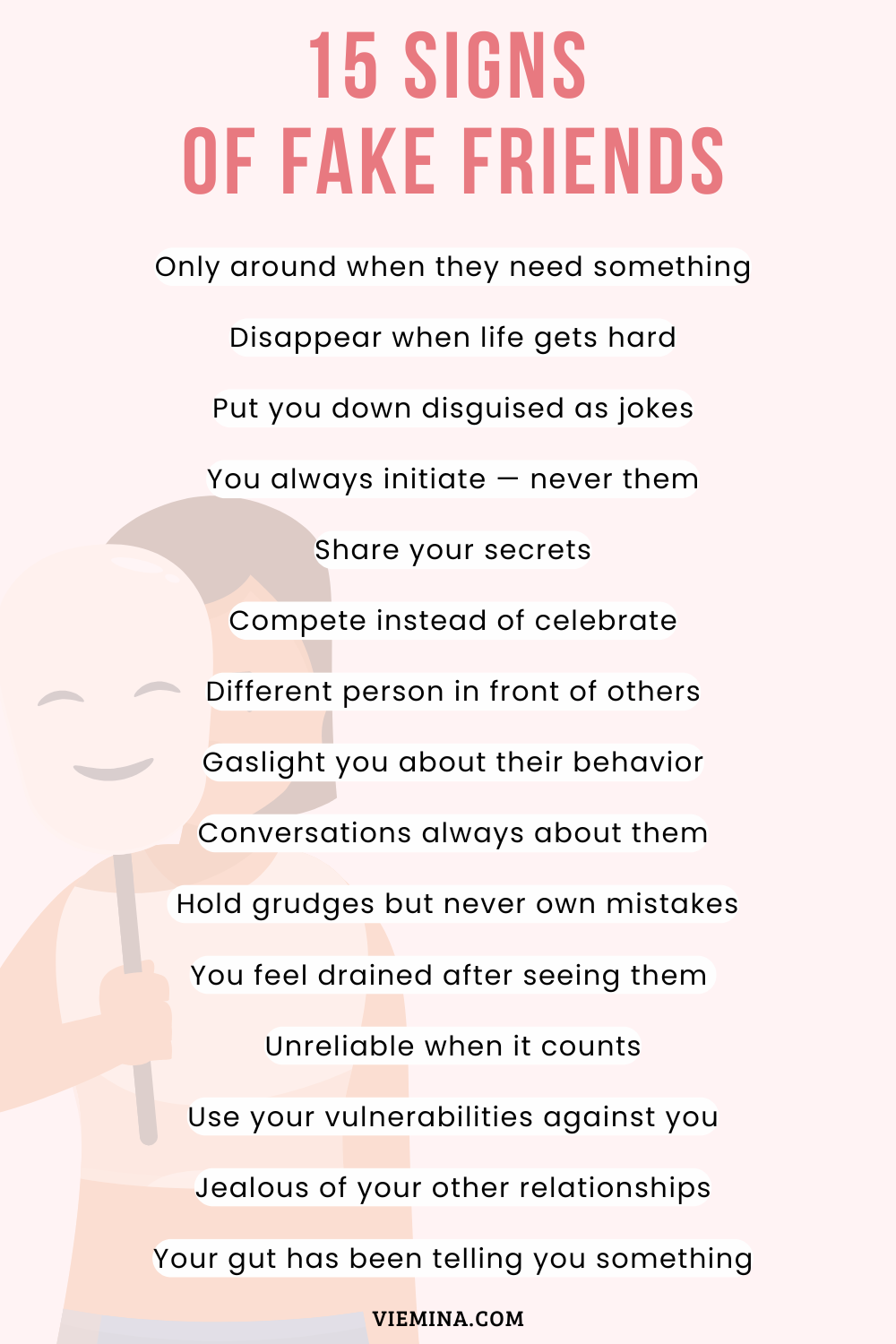
1. They’re only around when they need something
The clearest sign of a fake friend is also the simplest: they appear when they want something and disappear when you need them.
You hear from them when they need a favor, a ride, advice, or company for an event they don’t want to attend alone. When you’re going through something difficult — when you need support, presence, or just someone to check in — the silence is deafening.
Real friendship is mutual. It doesn’t feel like a transaction where you’re always on the losing end.
Related: 15 Signs of a Controlling Friend — And When to Walk Away
2. They disappear when life gets hard
Anyone can be a good friend when things are easy. The test of genuine friendship is what happens during difficult times — a job loss, a breakup, a family crisis, a period of struggle.
Fake friends tend to pull away precisely when you need people most. They become suddenly busy, hard to reach, or offer only a brief and hollow acknowledgment before changing the subject back to themselves. If someone has never shown up for you during a hard time, pay attention to what that pattern is telling you.
3. You always initiate — they never do
Think about the last ten times you connected with this person. How many of those did you initiate? If the answer is most or all of them, that’s a significant pattern.
In a genuine friendship, both people reach out. Both people think of the other and make an effort. When one person is carrying the entire weight of maintaining the connection — always texting first, always suggesting plans, always following up — the friendship is one-sided, regardless of how warm it feels when you’re actually together.
Stop initiating for a few weeks and observe what happens. The answer will be clarifying.
4. They put you down — even as a “joke.”
A fake friend has a habit of subtle put-downs dressed as humor. They make comments about your appearance, your choices, your relationships, or your achievements — and when you react, they retreat with “I was just joking” or “you’re so sensitive.”
This pattern is worth taking seriously. Genuine friends don’t consistently make you feel bad about yourself, even in jest. Backhanded compliments, sarcastic commentary, and jokes that always seem to land at your expense are not just careless humor. They’re a consistent message about how this person sees you — and what they’re comfortable doing to you.
Related: 20 Hidden Signs Of a Manipulative Friend You Never Knew
5. They compete with you instead of celebrating you
When something good happens in your life — a promotion, a relationship, an achievement — a real friend is genuinely happy for you. A fake friend struggles to hide their discomfort.
Their response to your good news is muted or quickly redirected. They one-up your achievements with something of their own. They minimize what you’ve done with a “that’s great, but…” You leave conversations about your own wins feeling somehow smaller than when you entered them.
Research on friendship quality consistently shows that how someone responds to your good news is actually a better predictor of friendship quality than how they respond to your bad news.
You told them something in confidence. You trusted them with information that was personal, vulnerable, or sensitive.
Later, you find out they shared it — with mutual friends, with people you barely know, or with someone you specifically asked them not to tell. When you address it, the response is defensive, minimizes it, or somehow turns into a discussion about their feelings rather than yours.
Trust, once broken in this way, rarely fully recovers. And a pattern of confidences being shared clearly indicates that this person doesn’t treat what you give them with the care it deserves.
7. Conversations are mostly about them
Pay attention to the balance of your conversations. Who does most of the talking? Whose problems, life updates, and experiences dominate the time?
A fake friend tends to use conversations as a platform for their own processing, venting, and storytelling — with minimal genuine interest in yours. When you do share something, the subject shifts back to them within minutes. Your experiences are briefly acknowledged rather than explored. You function as an audience, not a participant.
If you consistently leave conversations without having been genuinely heard, that’s a pattern worth naming.
Related: Top 10 Signs of a Toxic Friend (and How to End It Right)
8. They gaslight you about their behavior
When you raise a concern about something they’ve done — a comment that hurt, a pattern you’ve noticed, a commitment they didn’t keep — a fake friend doesn’t engage honestly with it.
Instead, they reframe it. “That’s not what happened.” “You’re being too sensitive.” “I can’t believe you’d think that about me.” The conversation ends with you apologizing for raising the issue, and the original concern is still unaddressed.
This pattern — where your perception of events is consistently questioned and redirected — is a form of gaslighting. Over time, it can cause you to stop trusting your own reading of situations, which is exactly the effect it has.
Related: 15 Signs You’re in a Relationship with a Narcissist,Not Love
Related: 12 Manipulative Apology Examples: How To Spot Fake Sorries
9. They hold grudges but never own their mistakes
A fake friend has an asymmetrical relationship with accountability. Your mistakes are remembered, brought up, and held against you long after the fact. Their mistakes are minimized, justified, or denied entirely.
If you find yourself in a friendship where every conflict ends with you taking responsibility — even when you’re not sure what you actually did wrong — and where your friend’s behavior is never genuinely acknowledged, that imbalance is worth paying attention to.
10. They treat you differently in front of others
How someone behaves with you one-on-one versus in a group setting can be revealing.
A fake friend might be warm and attentive in private but dismissive, inattentive, or even slightly unkind in public — particularly in front of people they want to impress. They may ignore you in group settings, fail to include you in conversations, or make comments at your expense in front of others that they’d never say when it was just the two of you.
The version of them that shows up when no one important is watching is often the more accurate one.
11. You feel drained after spending time with them
This is one of the most honest indicators available to you: how do you feel after being around this person?
Not whether the conversation was entertaining or the time was filled. How do you actually feel? If your consistent experience is exhaustion, a vague unease, or a slight lowering of your mood, if you feel less good about yourself after spending time with them than before, that’s your nervous system giving you feedback.
Genuine friendship is not always easy or conflict-free, but it should generally leave you feeling more connected and more yourself, not less.
Related: 20 Signs of a Controlling Relationship — And How to Leave
12. They’re unreliable when it counts
Plans canceled at the last minute. Commitments forgotten. Promises made and quietly abandoned. Consistent lateness with minimal acknowledgment of the impact.
Some unreliability is human and understandable — everyone has periods of overwhelm or poor follow-through. What distinguishes a fake friend is the pattern: the unreliability is consistent, the apologies are brief and habitual, and there’s no visible effort to improve. Your time and expectations are not treated as worth protecting.
13. They use your vulnerabilities against you
This is one of the more insidious signs, and one of the hardest to name in the moment.
You shared something vulnerable — an insecurity, a fear, an experience — in a moment of trust. Later, in a conflict or a difficult conversation, that information surfaces. Used as a point of leverage, as evidence of your irrationality, or simply brought up in a way that makes you feel exposed.
A genuine friend holds what you share with care. A fake friend files it.
14. They’re jealous of your other relationships
A fake friend may express subtle discomfort or outright hostility toward your other friendships, your relationship, or your family connections.
They make comments about how much time you spend with others. They react with coldness when you have plans that don’t involve them. They’re critical of the people you’re close to in ways that feel less like honest concern and more like competition.
Genuine friends are secure enough to be happy that you have other people in your life. Someone who consistently makes you feel guilty for having connections beyond them is showing you something important.
15. Your gut has been telling you something for a while
This may be the most important sign on the list.
Most people who are in fake friendships have known something was off for longer than they’ve been willing to acknowledge it. There’s a quiet, persistent discomfort that gets explained away — they’re going through something, I’m being too sensitive, it’s not that bad.
Your instincts about people are generally more reliable than you give them credit for. If something has felt wrong for a long time, that feeling deserves to be taken seriously rather than managed into silence.
Why Fake Friendships Are Hard to Leave
Understanding why it’s hard to walk away from a friendship that isn’t good for you matters, because “just cut them off” is rarely as simple as it sounds.
- Shared history. Long friendships accumulate shared experiences, memories, and context that feel significant to lose, even when the present reality is painful.
- Sunk cost. The more time and emotional energy you’ve invested in a friendship, the harder it is to acknowledge that the investment hasn’t been returned. Walking away can feel like admitting the time was wasted.
- Social overlap. When fake friends are also mutual friends, colleagues, or part of a shared social circle, distancing yourself has real practical complications.
- Self-doubt. If someone has consistently questioned your perceptions or made you feel like the problem in the friendship, you may genuinely doubt whether your reading of the situation is accurate. This is particularly common after gaslighting.
- Familiarity. For people whose early experiences involved inconsistent relationships — where love or care was conditional or unpredictable — the emotional texture of a one-sided friendship can feel uncomfortably familiar. Not in a good way, but in a way that feels known.
Related: 7 Stages of Trauma Bonding: How to Break the Cycle & Heal
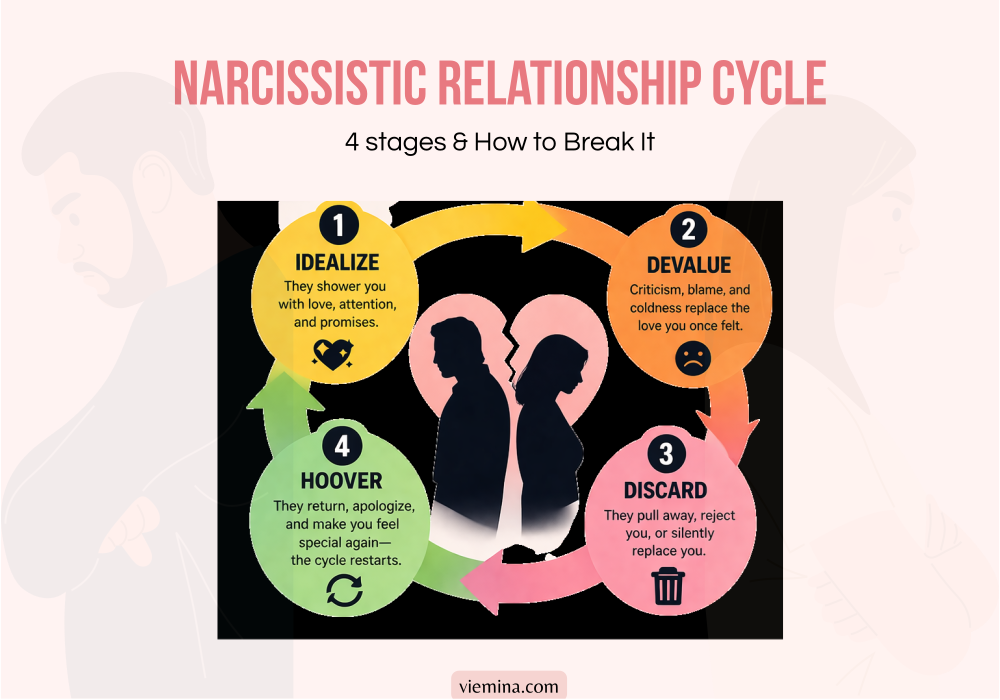
Related: Narcissistic Relationship Cycle: 4 stages & How to Break It
How to Deal With Fake Friends
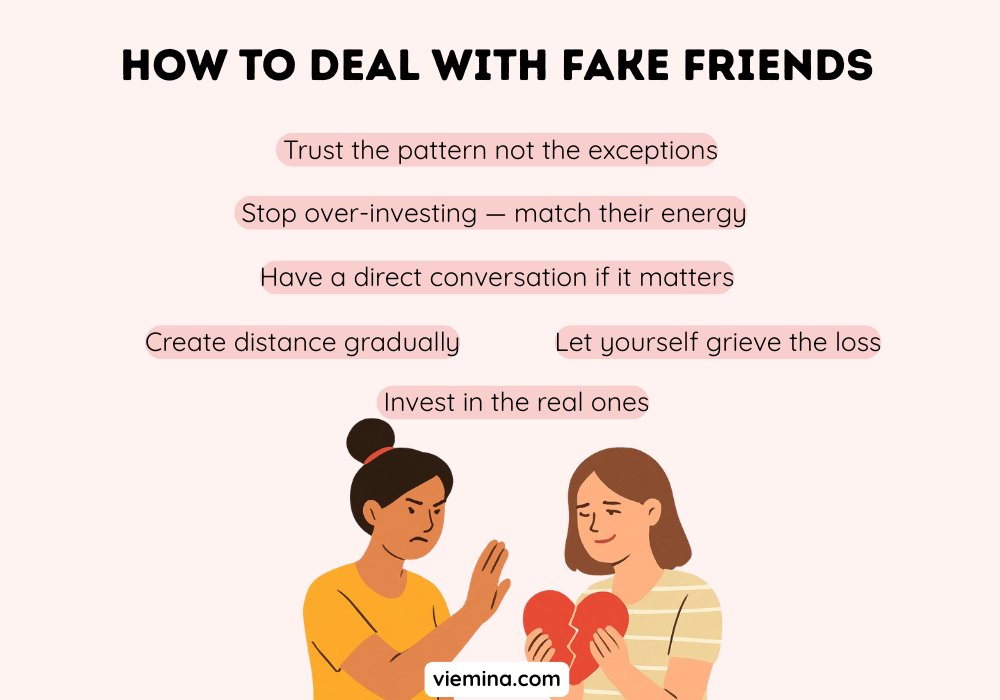
1. Trust the pattern, not the exceptions
Every fake friendship has good moments. Moments of warmth, connection, fun. These exceptions can make it easy to dismiss the pattern. The pattern is more reliable than any individual moment.
2. Stop over-investing
Before doing anything dramatic, simply match their energy. Invest in the friendship at the level they invest in you. Stop initiating. Stop being more available than they are. Observe what happens. Often, the friendship quietly fades without conflict.
3. Have a direct conversation if it matters
If this is a longstanding friendship that matters to you, it’s worth addressing the pattern directly before walking away from it. Be specific about what you’ve experienced, frame it in terms of your own feelings, and give them a genuine opportunity to respond. Their response, whether they engage honestly, deflect, or turn it back on you, will tell you what you need to know.
4. Create distance gradually
You don’t always need a dramatic ending. Reducing availability, declining plans, and gradually shifting your energy elsewhere is a legitimate option — particularly when a full confrontation feels unsafe or impractical.
5. Let yourself grieve
Losing a friendship, even a fake one, involves genuine loss. The grief isn’t for what the friendship was — it’s for what you hoped it might be. That grief is real and deserves to be acknowledged rather than dismissed.
Related: How to Get Over a Breakup: 15 Steps to Heal and Move On
Related: 8 hidden Stages Of A Breakup And How To Heal
6. Invest in the real ones
The most productive response to fake friends is not just to remove them from your life but to deepen the genuine connections you have. Real friendship exists. It’s quieter, less dramatic, and less immediately intense than the fake kind — but it doesn’t leave you feeling worse for having it.
Related: How to Set Boundaries With Friends (And Why It’s Hard)
Conclusion
Fake friends rarely feel fake in the beginning. The signs usually accumulate slowly — small moments of inconsistency, subtle put-downs, patterns of one-sidedness that each feels explainable on its own.
What changes is your ability to see the pattern as a whole rather than explaining away each incident.
You deserve friendships that don’t require you to make yourself smaller, ignore your instincts, or consistently give more than you receive. Recognizing what a fake friendship looks like is the first step toward something genuinely better.
Frequently Asked Questions
What are the signs of a fake friend?
The clearest signs of fake friends include only being around when they need something, disappearing when you need support, never initiating contact, putting you down through “jokes,” competing with you instead of celebrating your success, breaking your trust by sharing secrets, making conversations entirely about themselves, gaslighting you when you raise concerns, and consistently leaving you feeling drained rather than energized. The most reliable indicator is a persistent pattern across multiple areas of the friendship — not a single incident.
How do you deal with fake friends?
Dealing with fake friends depends on the situation. If the friendship is casual, the simplest approach is to gradually reduce your investment — stop initiating, match their energy, and let it quietly fade. If it’s a closer friendship, a direct conversation about specific patterns may be worth having first. In both cases, the goal is to stop putting more into a friendship than it’s giving back, and to redirect that energy toward genuine connections.
Why is it hard to recognize fake friends?
Fake friendships are hard to recognize because they usually contain genuinely good moments mixed in with the problematic ones. The inconsistency itself — warmth followed by withdrawal, support followed by disappearance — makes it easy to hold onto the good moments and explain away the pattern. It’s also hard because recognizing a fake friend means confronting a loss, which most people naturally resist.
Can a fake friend become a real friend?
It’s possible but uncommon. Change in friendship dynamics requires the other person to recognize the problem and genuinely commit to behaving differently — not just temporarily adjusting after a confrontation. If someone has a pattern of one-sided behavior, self-absorption, or boundary violations, meaningful change is possible only if they’re actively working on it, not just responding to pressure. Pay attention to behavior over time, not promises in the moment.
What’s the difference between a fake friend and a bad friend?
A bad friend can be genuine but has poor friendship skills — inconsistency, poor communication, and self-absorption during their own difficult periods. A fake friend lacks genuine care for you as a person. The distinction isn’t always clean, but the clearest test is whether they ever show up for you when it costs them something. A bad friend may be selfish, but still come through when it really matters. A fake friend tends not to.
How do fake friendships affect your mental health?
Research on relationship quality consistently shows that low-quality, ambivalent relationships — where support is inconsistent, and trust is uncertain — are more psychologically damaging than clearly negative relationships. Fake friendships create chronic low-level stress through uncertainty, erode self-trust through gaslighting and inconsistency, and can contribute to anxiety, lowered self-esteem, and difficulty trusting others in future relationships. Distancing yourself from fake friendships is not antisocial — it’s a legitimate act of self-care.





I have a scenario. I have a friend who wanted to introduce me to their friend to potentially match. In short, it wasn’t fruitful as the friend wasn’t very engaging. When I shared this with my friend and noted that I didn’t think it was a good fit, they noted that they talked with the friend. The firmed noted that they were very busy and that they may talk to me. To note, I did also note prior that I assumed that they were just very busy. My friend also went on to say that I was being too sensitive and that I should essentially wait for them to make time. My thing is that my time is just as important as theirs. I don’t think it’s fair for me to put my life on hold for a maybe situation and then be shamed under the guise of being too sensitive. Last time I checked I have a life too. I’m just found it a bit distasteful and disrespectful as if I’m beneath this friend and am expected to cater to them at my expense. My friend also went on to say that I should try harder.
All that noted, I’m starting to question their intentions toward me. I don’t think that’s how people should be treated. What’s your thoughts on this? Thanks.